

Statutory accounts are the legally required annual financial statements every UK limited company must prepare and file with Companies House and HMRC, usually 9 months after the end of the financial year. If you've just closed your first year, that's the compliance job sitting on your desk right now, whether you like it or not.
You don't need mystery or ceremony here. You need a clean handover, the right documents, and a clear understanding of what your accountant has to produce so you can stay out of trouble and keep the company compliant.
Table of Contents
- Understanding Statutory Accounts and Why They Matter
- The Required Components of Statutory Accounts
- Filing Obligations by Company Size and Type
- Deadlines Penalties and What Happens When You Miss Them
- How to Prepare Your Statutory Accounts Step by Step
- Why Outsourcing to a Professional Accountant Makes Sense
- Your Annual Compliance Calendar and Key Takeaways
Understanding Statutory Accounts and Why They Matter
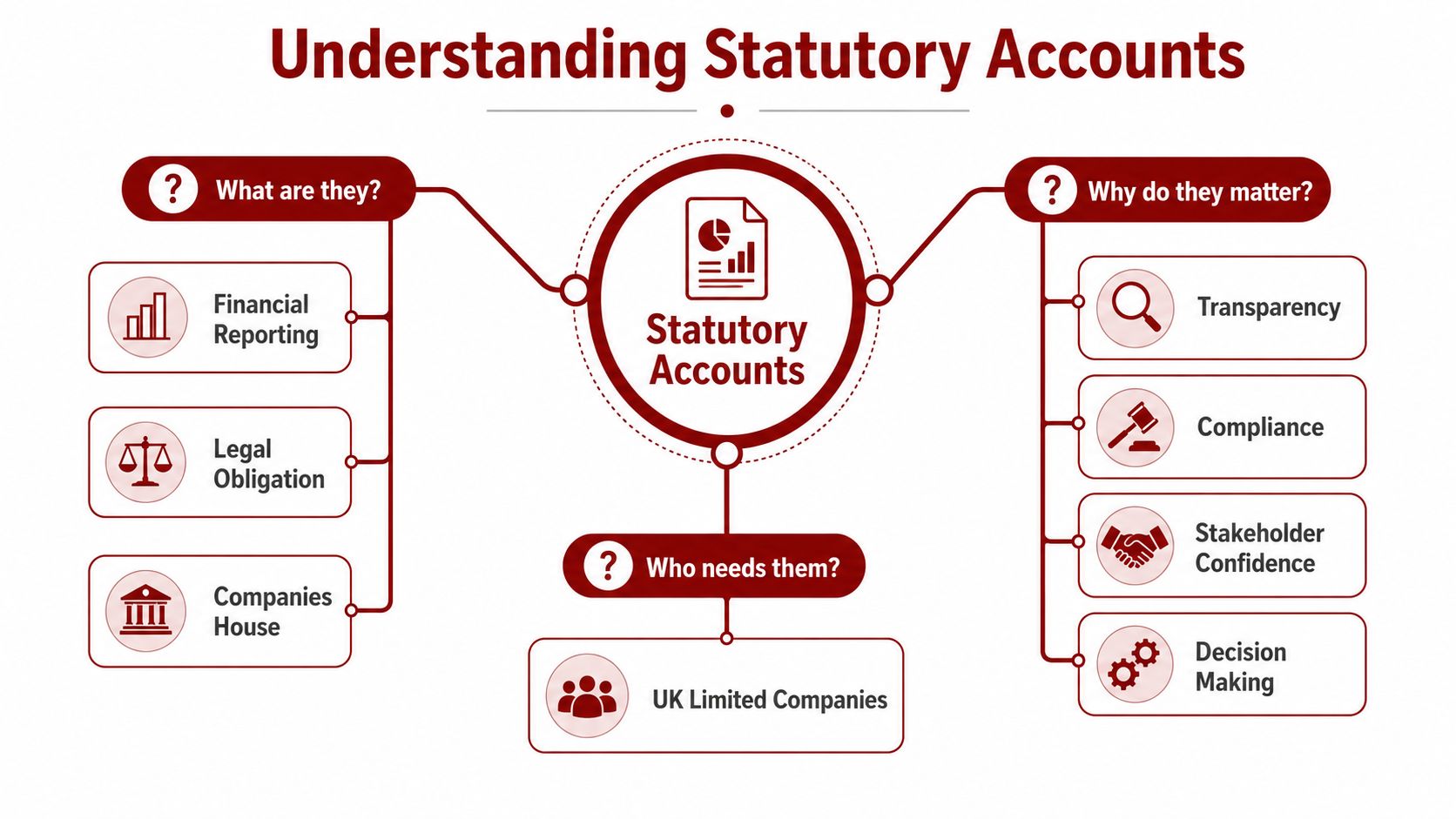
You have traded for a year, the bank feed is a mess, and somebody has told you it is time for “year-end accounts”. That phrase gets used loosely. Statutory accounts are the legal version, the ones your company must prepare under UK company law and file with Companies House and HMRC for corporation tax purposes, not a management pack you throw together for your own dashboard. They must contain at least a balance sheet, profit and loss account, and notes.
That fixed reporting cycle is the point. The law wants a standard year-end snapshot, not whatever format happens to suit the director that month. For UK founders, statutory accounts are a predictable annual compliance milestone, not a mysterious accounting ritual. They also sit alongside the company's wider filing duties, so get the process into your calendar early and treat it as routine, not optional.
Statutory accounts are not management accounts
Management accounts are for you. Statutory accounts are for the company, the tax authority, and the public record. They follow prescribed disclosures and deadlines, and they are filed in a way that creates a consistent evidence base for people who need to assess solvency, profitability, and compliance.
Practical rule: if you would not be comfortable seeing it on the Companies House register, do not assume it belongs in the statutory filing without review.
That distinction matters because founders often confuse “accounts” with “records”. Your bookkeeping can be messy during the year and still be rescued at year-end, but the statutory filing has to be right. If your structure or filing status is unusual, check the current UK audit exemption threshold guidance before you assume you qualify for simpler reporting.
The legal obligation applies to every UK limited company regardless of size or whether it is trading. That is why this is one of the first compliance deadlines I tell founders to put on a calendar the day they incorporate. If you are outsourcing the job, hand your accountant the full bank feed, sales invoices, purchase invoices, payroll records, loan statements, director loan account details, and anything else that affects the year-end numbers. That gives them what they need to prepare the filing properly, instead of chasing you for missing pieces later.
The Required Components of Statutory Accounts
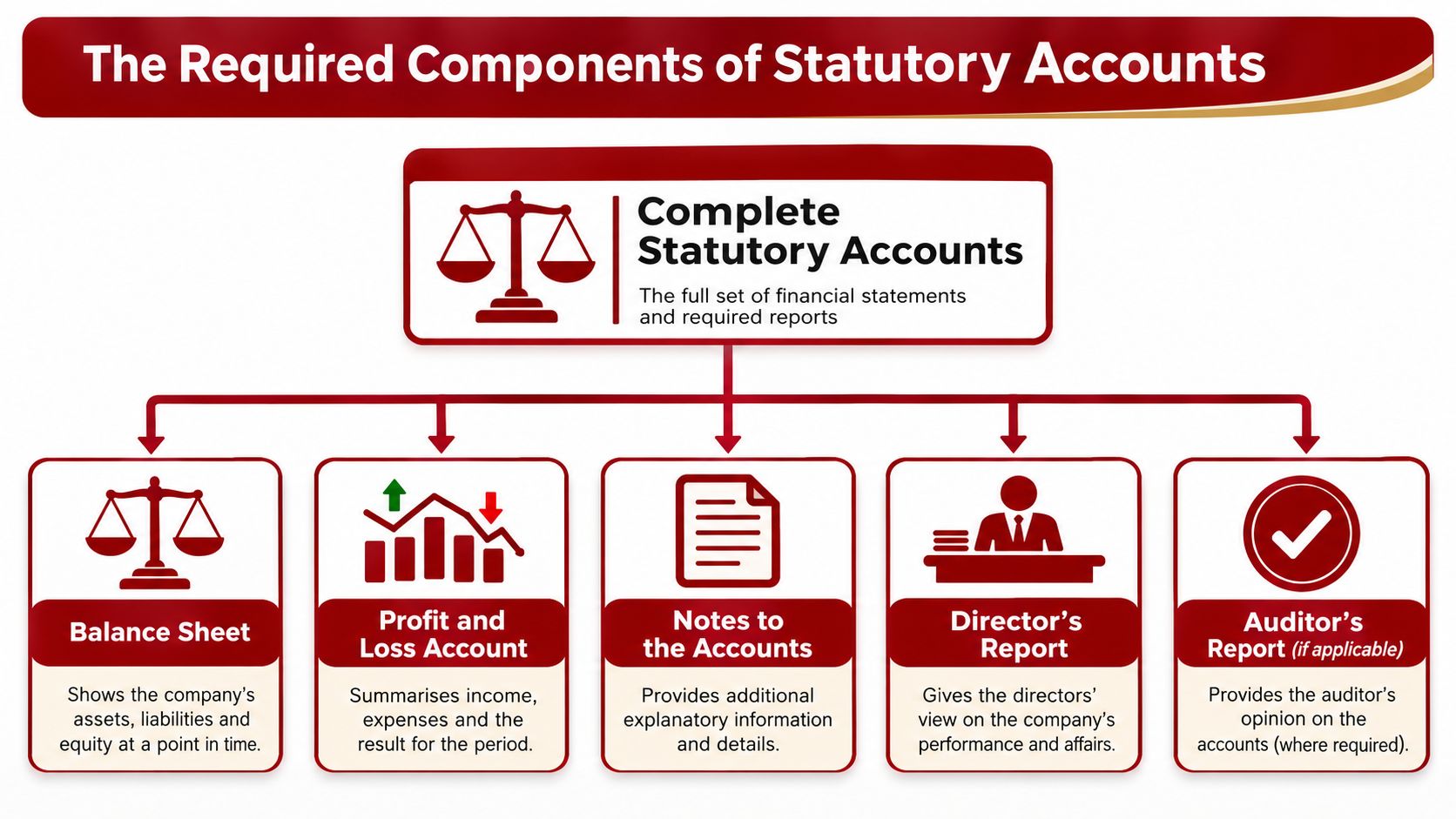
Statutory accounts are built from a small set of documents, and each one answers a different question. Think of the balance sheet as the financial photograph at year-end, the profit and loss account as the film of trading over the year, and the notes as the explanation underneath the numbers. Saint Financial Group's summary of statutory accounts sets out the core structure clearly: balance sheet, profit and loss account, and notes, with a directors' report generally required unless the company is a micro-entity.
What each part tells readers
The balance sheet shows what the company owns, what it owes, and what's left for shareholders at the year-end. The profit and loss account shows income and expenses across the financial year, so it tells the story of performance rather than position. The notes to the accounts give the detail behind key figures, which is where a lender, investor, or accountant checks the assumptions rather than just the headline numbers.
The directors' report gives context about the business and its activities. For a founder, that means the filing is more than a spreadsheet export. It is the official story of the company's year, written in a way that meets the legal format.
A useful outside reference for the difference between the balance sheet and profit and loss account is the Business Loan Warrior lender guide. It's a practical reminder that lenders read those two statements differently, and they're looking for different signals in each.
Read your own accounts like a third party would. If the balance sheet looks technically correct but the notes are thin or the categorisation is sloppy, that weakness still shows.
If your company reports under different standards or needs a transition review, the accounting treatment can shift in ways that matter. For that reason, check the FRS 102 changes guidance before you let last year's format roll forward unchanged.
Don't treat every component as optional
Some founders ask their accountant to “just file the numbers”. That's the wrong mindset. If a component is required for your company type, it has to be there, and if a disclosure is missing, the filing can be defective even when the headline profit looks fine.
The safest approach is simple, give your accountant a complete year-end pack and let them decide what belongs in the statutory format. If you're unsure who handles filings, internal approvals, and secretarial paperwork, it's worth understanding company secretarial support before year-end closes.
Filing Obligations by Company Size and Type
A founder usually gets caught out here because the filing rules do not ask for the same level of detail from every company. The technical core stays the same, though. Your year-end accounts still have to be prepared properly, and the filing format depends on how your company is classified. Smaller companies may file abridged or filleted accounts, which reduces what the public can see on Companies House, while larger companies have to put more on the record.
For a limited company director, the question is simple: what category does the company legally fit into? Get that wrong and you can over-disclose, under-file, or hand your accountant the wrong starting point. The system is built around standardised reporting because stakeholders need a comparable annual record, not a custom version based on convenience.
Use the table as a quick reference, but do not treat it as a substitute for current filing guidance. The law changes, and the detailed tests sit in the rules that apply at the time of filing.
| Category | Turnover Threshold | Balance Sheet Total | Employees | Directors' Report Required | Filing Options |
|---|---|---|---|---|---|
| Micro-entity | Smallest company category under the filing rules | Smallest balance sheet total band | Lowest employee band | Usually not required | Very limited disclosure, micro-entity format |
| Small company | Above micro-entity but below medium thresholds | Below medium thresholds | Below medium thresholds | Generally required unless exempt under the rules | Abbreviated or filleted accounts may be available |
| Medium or large company | Above small company thresholds | Above small company thresholds | Above small company thresholds | Required | Fuller filing with more disclosure |
What founders should watch for
A small company can keep some information off the public register, but that does not reduce the work. Your accountant still needs the underlying records, and the figures still need to be clean, complete, and internally consistent. The change is visibility, not the standard of discipline.
The filing option should follow the legal category, not the amount of effort you want to spend.
If you want a wider compliance checklist for directors, the company director guidance from Grow My Acorn is a practical companion read. Accounts are only one part of the job. Annual filings, record-keeping, and director duties sit together, so treat them as one compliance cycle.
If your company is becoming more complicated, especially with share issues, officer changes, or filings outside the usual cycle, do not leave that to memory. A proper company secretarial setup keeps the statutory side in order before the accounts are finalised.
Deadlines Penalties and What Happens When You Miss Them
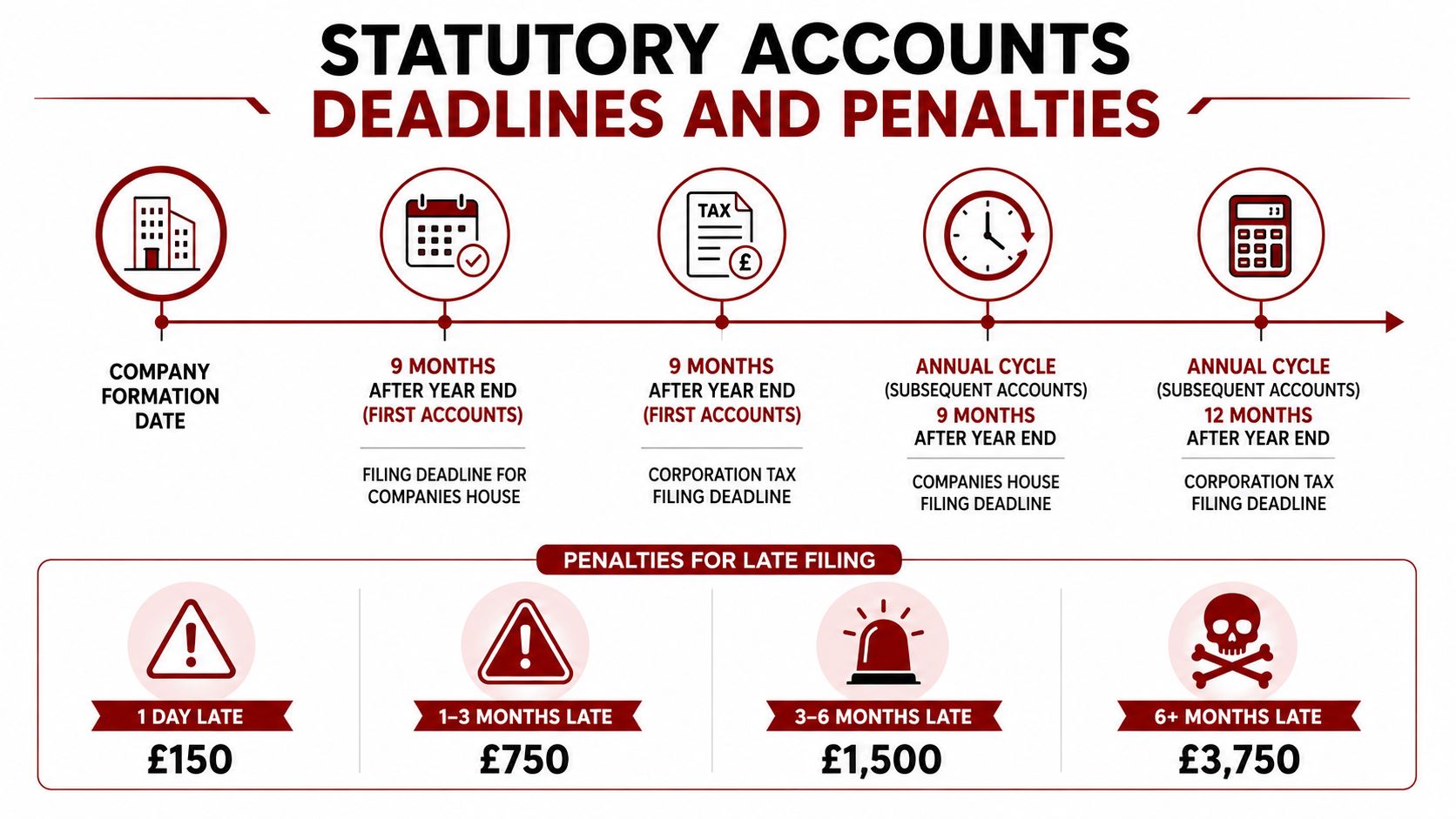
A missed filing date is not a small admin slip. It is a compliance failure, and the company pays for it. Companies House expects most private companies to file statutory accounts within the required post-year-end deadline, and HMRC still needs the accounts for the Company Tax Return process. A newly formed company normally works to the standard reporting cycle set out in Xero's year-end guide, so the deadline is predictable from day one.
That predictability is the point. Late filing usually comes from poor planning, not bad luck. If the accounts are still sitting in draft a week before the deadline, the issue is not the accountant's speed, it is that the records were not handed over early enough.
Late filing gets expensive fast
The penalty structure is unforgiving. The longer the delay, the higher the cost. An infographic detailing statutory account filing deadlines and late penalty fees for UK limited companies. sets out how quickly the charges increase, and Perrys Accountants' explanation makes the point clearly, statutory accounts are required by law, and missing the filing obligation can lead to penalties or enforcement action.
What happens when you are late
Companies House can charge penalties that rise as the delay continues. HMRC can also apply separate penalties if the Company Tax Return is late, so one missed deadline can trigger two separate problems. That is why treating accounts filing as a minor admin task is a mistake.
If you think a late filing can be sorted out later, you are already behind. Put the deadline in front of the records, then work backwards and hand everything to your accountant early.
Extensions are rare and should never be assumed. If the filing date is tight, the right move is to prepare early, give your accountant a complete pack, and remove the pressure before the deadline arrives.
How to Prepare Your Statutory Accounts Step by Step
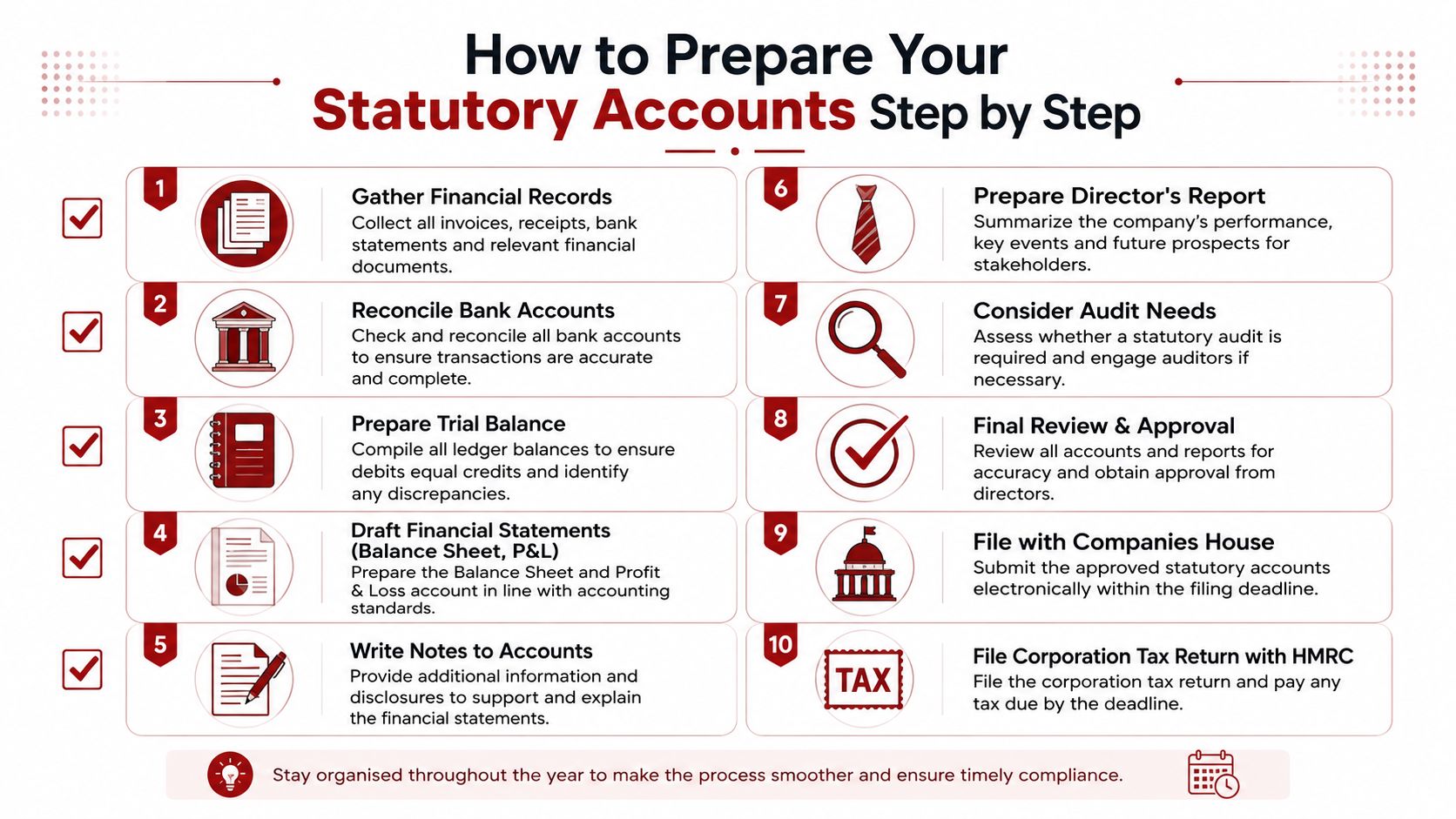
Good statutory accounts start with bookkeeping discipline, not year-end panic. If your records are clean, the accountant can move quickly. If they're scattered across inboxes, personal cards, and three cloud apps, expect delays and more questions.
The best source of friction-free preparation is a year-end pack built during the year, not after it. A clear checklist also stops founders from sending random PDFs and hoping the accountant can reverse-engineer the rest. For practical startup-focused preparation, the financial statements for startups guide from HireAccountants is a helpful reference point.
What to hand over to your accountant
Give your accountant the records that prove the year's activity and the balances at the year-end. Don't assume they can chase everything for you.
- Bank statements and reconciliations. These show the actual cash trail and help match book figures to reality.
- Sales invoices and purchase invoices. The accountant needs the source documents behind revenue and costs.
- Payroll records. If you pay staff or directors, those records need to tie back to the figures in the accounts.
- Expense receipts. Cards, travel, software, subscriptions, and reimbursed costs should all be backed up.
- Loan agreements and director's loan details. These often create balance sheet items that founders forget to mention.
- Stock information, if relevant. If you hold inventory, the year-end position matters.
- VAT returns and any tax correspondence. These help reconcile reported figures and tax filings.
- Details of new shares, dividends, or company changes. Anything corporate that affects the accounts should be included.
If you want a cleaner handover, use this year-end accounts checklist before sending files. It's easier to fix a missing document now than after the draft accounts have already been prepared.
Follow a simple preparation sequence
Start with bank reconciliation, then move to unpaid invoices, unpaid bills, loans, and stock. After that, the accountant can prepare the trial balance, draft the statements, and finalise the notes and reports. That order matters because the balance sheet depends on everything tying together.
If you're unsure whether your own records are enough, don't guess. Ask for a pre-year-end review and let the accountant tell you what's missing before the filing deadline gets close.
Why Outsourcing to a Professional Accountant Makes Sense
Most first-time founders try to save money by doing statutory accounts themselves. That instinct is understandable, but it's usually false economy. A decent accountant doesn't just file forms, they make sure the format is right, the disclosures are complete, and the tax numbers line up with HMRC's expectations.
That matters even more if your company has awkward items such as director's loans, stock, a mix of personal and business spending, or sector-specific obligations. Action Accountants Limited, for example, handles statutory accounts, company secretarial support, bookkeeping, payroll, VAT, and tax compliance for growing businesses, which is the sort of joined-up support most founders need when the company stops being a side project.
What you actually buy from a professional
You buy fewer errors, a faster year-end process, and someone who spots issues before they become penalties. You also buy judgment. A professional accountant can tell the difference between a clean filing and a technically acceptable filing that still creates problems later.
You should also expect them to manage the submission process with Companies House and HMRC, not leave you to chase two separate deadlines yourself. That alone removes a surprising amount of risk.
For contractors and landlords, specialist knowledge matters even more because the accounting can get tangled fast. CIS records, property income, loan structures, and director-related transactions all raise the chance of avoidable mistakes if the person preparing the accounts only files generic small-company returns.
Pay for competence once. Paying for corrections, penalties, and rework later is the expensive version.
If you're comparing accountants, ask a blunt question. Who checks the filing classification, who reconciles the tax treatment, and who owns the deadline? If the answer is vague, keep looking.
Your Annual Compliance Calendar and Key Takeaways
Put the dates on a calendar now, not when the year-end arrives. The sequence is simple, year-end, accounts preparation, Companies House filing, Company Tax Return, and confirmation statement. If you treat statutory accounts as a fixed annual milestone, they stop being a crisis.
A basic founder calendar looks like this. Start gathering records two to three months before year-end, chase missing invoices immediately after year-end, and send the full pack to your accountant well before the filing deadline. That gives everyone room to review, query, and sign off without panic.
Key takeaways
- Statutory accounts are mandatory. They're legal annual financial statements, not optional reporting.
- The format is fixed. Balance sheet, profit and loss account, notes, and usually a directors' report.
- Company size affects disclosure. It doesn't remove the filing obligation.
- Deadlines are predictable. Miss them and penalties follow.
- A clean handover saves money. Good records beat end-of-year firefighting every time.
If you want the year-end process handled properly, Action Accountants Limited can take the records, prepare the accounts, and file the compliance work in the right order. Visit Action Accountants Limited and ask for help before the deadline turns into a penalty.