


You've just incorporated, the Companies House email has landed, and now someone in the business is asking whether the confirmation statement is “basically the tax return”. It isn't. If you run a UK company, company secretarial services are the work that keeps your legal records, board decisions, share changes, and filings aligned, so you can move without tripping over your own paperwork.
For a London startup, this stops being a nice-to-have very quickly. The Companies Act 2006 is still the core statute for directors' duties, company records, filings, and shareholder administration, and the UK had millions of registered companies active in the 2020s, which is exactly why this work keeps showing up on the desk rather than disappearing after incorporation. The regime is also getting tighter. Companies House identity-verification and transparency reforms under the Economic Crime and Corporate Transparency Act 2023 are pushing the job away from loose admin and toward evidence quality, auditability, and accurate records.
If you want the blunt version, this is not about form-filling. It's about keeping your company in a state where a bank, investor, accountant, or regulator can trust what they see.
Table of Contents
- What Company Secretarial Services Actually Cover
- Core Duties Every UK Company Has to Handle
- Statutory Deadlines and the Real Cost of Missing Them
- Outsourcing Versus an In-House Company Secretary
- Service Packages and Typical UK Pricing
- A Practical 30-Day Start-Up Checklist
- How to Choose the Right Provider in London
What Company Secretarial Services Actually Cover
A founder in West London often discovers the difference the hard way. They incorporate, get their certificate, then open the first Companies House email and see a confirmation statement due. They assume it's the same thing as a tax return, or that the accountant will “sort it”. That's how small mistakes start, because company secretarial services sit in a different lane from tax compliance and they carry their own rhythm, deadlines, and legal records.
The legal frame comes from the Companies Act 2006, which consolidated and modernised UK company law. In practice, the service covers incorporation, maintenance of statutory registers, drafting board and shareholder minutes, filing confirmation statements, tracking PSC and RLE records, and keeping the registered office and official correspondence tidy. A solid overview of the role is set out in this guide to what a company secretary does, and the key point is simple, the company secretary function is the administrative backbone of corporate life, not an optional extra.
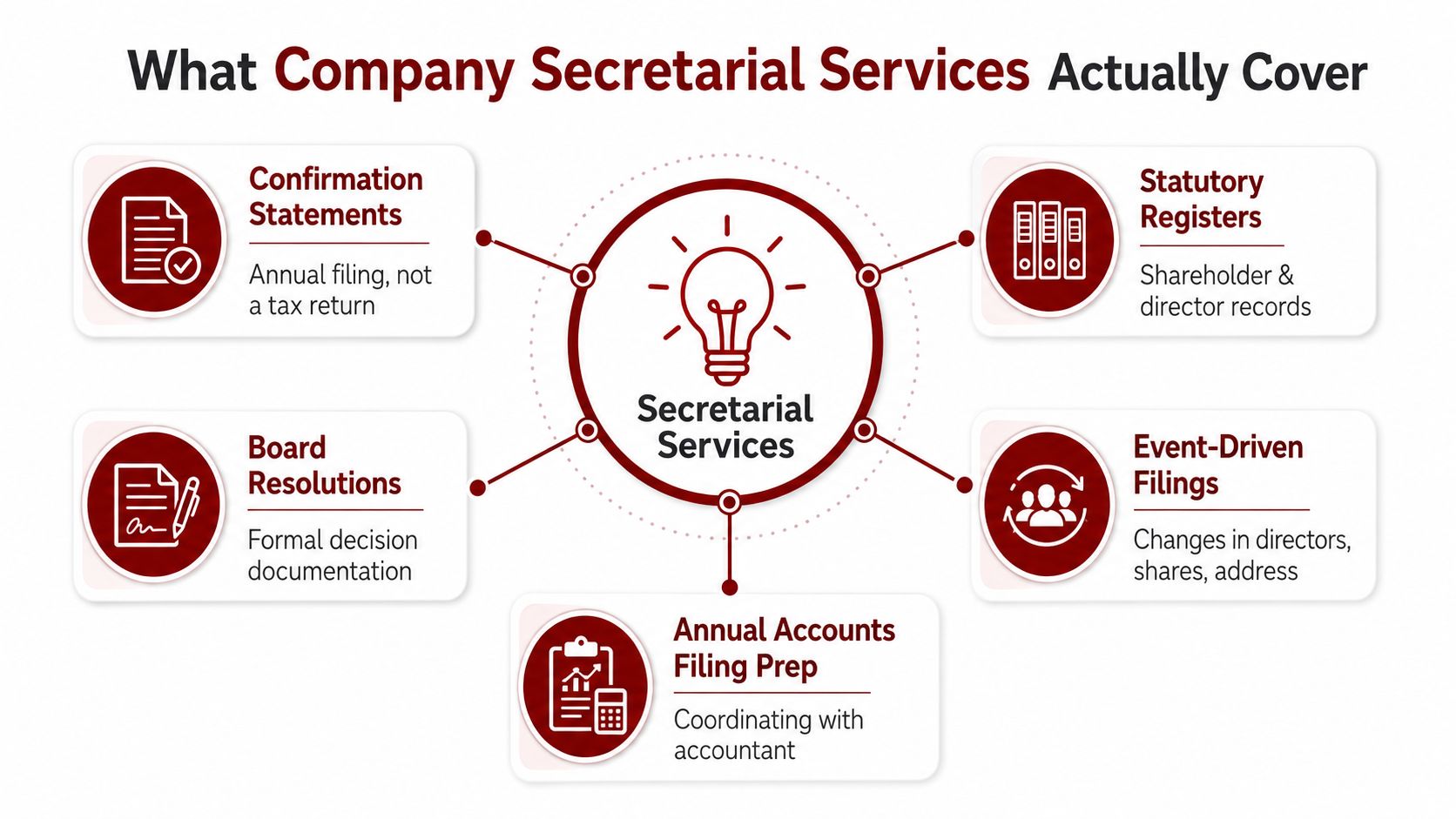
The practical scope, not the brochure version
A proper provider does more than file one annual form. They keep the company's internal books aligned with what's on the public register, so share allotments, director changes, and address updates don't drift into inconsistency. That matters more now because the verification direction at Companies House means officer, PSC, and register data has to be clean before it goes in.
Practical rule: if a document changes how ownership, control, or management looks on paper, it belongs in the company secretarial file the same day, not weeks later.
That's why founders pay for this work. The function makes corporate housekeeping repeatable, evidenced, and defensible. If you're also looking at document workflows, a guide to compliance document automation is useful background because the problem is usually not effort, it's version control and traceability.
Core Duties Every UK Company Has to Handle
The job looks messy until you split it into five separate chores. That's how I'd explain it to a first-time director, because once you see the moving parts, you can tell immediately whether your provider knows what they're doing or is just shuffling templates.
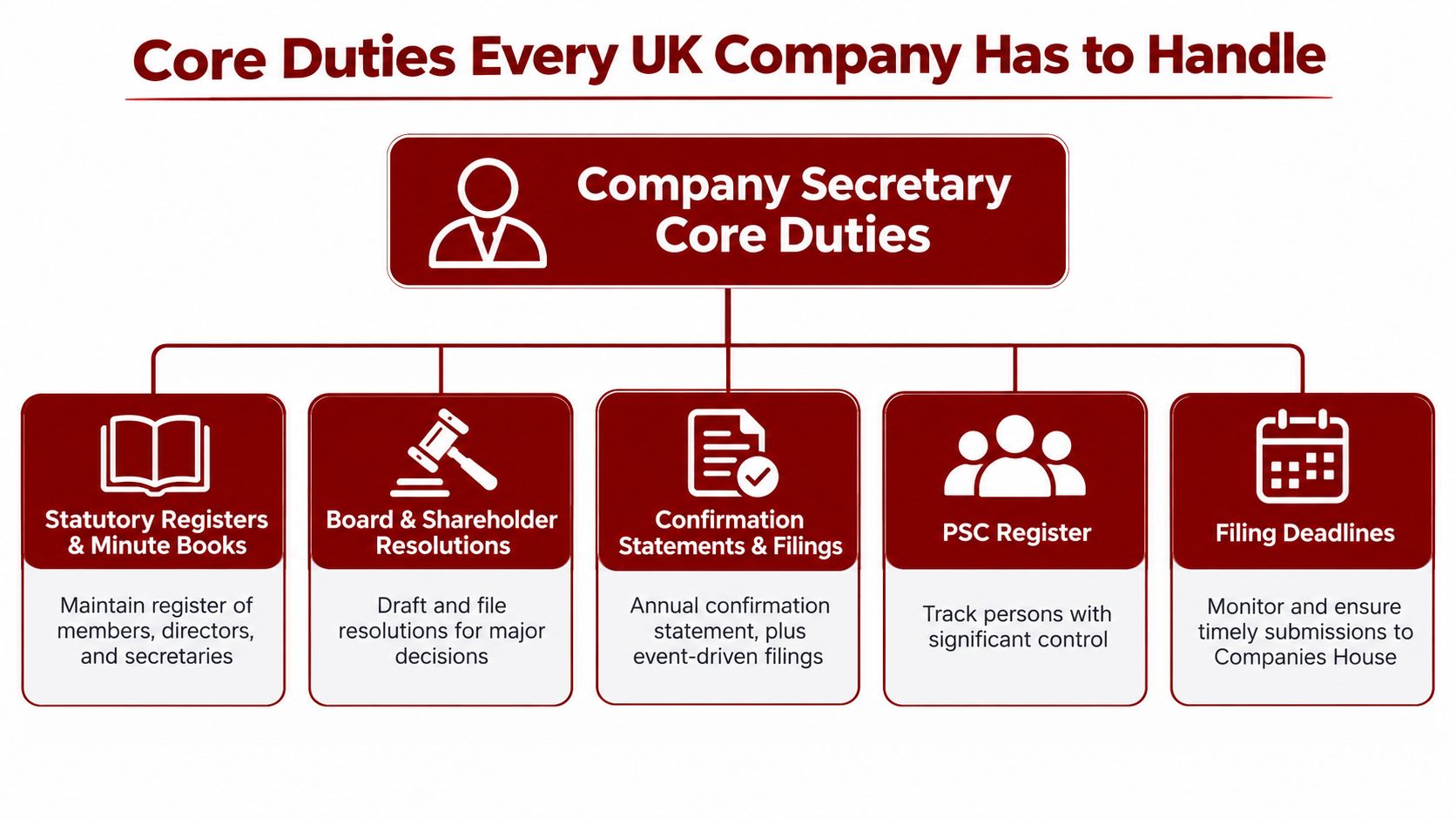
The five jobs that keep the company clean
Statutory registers and minute books.
These are the company's internal records of members, directors, secretaries, and key decisions. They're updated by the company, usually through the secretary or adviser, and they change when someone is appointed, resigns, or shares move hands. If these books lag behind reality, every later transaction becomes slower and more annoying.Board and shareholder resolutions.
A new share issue, a change of address, a director appointment, or a restructuring should be documented formally. The evidence sits here. A crisp minute today saves arguments later when an accountant, investor, or solicitor wants to see authority for the action.Confirmation statements and event-driven filings.
The confirmation statement is the annual check that public information is correct, while event-driven filings handle changes as they happen. A good operator doesn't batch everything until year-end. They file when the trigger occurs, because delay creates filing mismatches.PSC and RLE registers.
The persons with significant control record, and any relevant legal entity tracking, are not cosmetic. They are core governance records. If ownership changes, or control shifts through a new shareholding structure, these records need updating promptly.Registered office and Companies House correspondence.
Mail still matters. Missing a notice because the address is wrong is a silly way to create stress. The routine inbox at Companies House is part of the control system, not junk mail.
For a separate primer on ownership records, this PSC register explainer is worth reading once.
If registers are updated contemporaneously, share allotments, name changes, capital reorganisations, and dissolutions usually move faster. If they're not, you pay twice, once in admin time and again in rework.
The other practical point is document discipline. A lawyer using Legitt AI to manage contracts is solving a similar problem, keeping approvals, edits, and records traceable. In company secretarial work, that same discipline keeps your internal books and Companies House filings consistent.
Statutory Deadlines and the Real Cost of Missing Them
The mistake most founders make is treating deadlines as housekeeping. They're not housekeeping. They're the timetable that decides whether your company looks orderly or sloppy when someone checks it, and sloppy records create real friction with banks, investors, accountants, and the registrar.
The calendar that matters
The confirmation statement cycle is the easiest place to start. It is not optional, and it exists to keep the public record current. If your company changes directors, shares, or control arrangements during the year, the filing discipline matters long before the annual review comes round. That's why a clear reminder system beats memory every time, and this confirmation statement guide is a sensible reference point if you're building your own calendar.
Accounts filing sits alongside secretarial work because the two processes touch the same corporate record set. If the internal books are wrong, year-end becomes slower and messier. The same goes for share allotments, director changes, and PSC updates, which should be reflected when the event happens, not when someone notices the paperwork months later.
| Filing | Deadline Trigger | Penalty if Late |
|---|---|---|
| Confirmation statement | Due on the company's review cycle | Public record becomes stale, and follow-up compliance work gets harder |
| Annual accounts | Due after the accounting period ends | Late-filing penalties apply and escalate with delay |
| Director change filing | Triggered by appointment, resignation, or detail change | Filing inconsistency can lead to rejected or outdated records |
| PSC update | Triggered by ownership or control change | Inaccurate PSC data becomes a regulatory red flag |
| Share allotment record | Triggered when new shares are issued | Fundraising and cap table review can slow down badly |
Why delay costs more than the filing itself
The hidden cost is not just a late notice. A missed confirmation statement can complicate a bank review because the public record no longer matches the conversation you're having with the bank. A delayed share allotment record can derail investor diligence because no one wants to debate whether the cap table is current. If PSC data is wrong, the company looks weak on control and ownership, which is exactly the wrong signal under the newer verification-heavy regime.
Practical rule: if the event changes who owns, controls, or manages the company, document it first and file it immediately after.
That is the standard I'd use for any North West London startup. Short, clean, and boring is good. Late, uncertain, and inconsistent is expensive.
Outsourcing Versus an In-House Company Secretary
A small UK company usually reaches this decision the hard way, after the first rushed filing, the first board dispute, or the first time someone realises the records do not match what was agreed. The question is whether governance needs to sit inside the business every day, or whether it needs disciplined external delivery with clear ownership and deadlines.
In-house gives context, outsourcing gives resilience
An in-house or fractional company secretary knows the board personalities, the commercial pressure points, and the history behind each decision. That matters when you are preparing for investors, dealing with a restructure, or handling a difficult shareholder issue. The trade-off is plain. You carry a fixed cost, you need cover when that person is absent, and one departure can leave the business exposed if the knowledge lives in one head.
Outsourcing suits many startups because it brings broader experience of awkward filings, ownership changes, and record-keeping problems without forcing a hire. It also makes budgeting more predictable, which matters for London SMEs that need to protect cash. The wider market points in the same direction. One GIIR research market report estimates the global company secretarial services market at $6.85 billion in 2025 and $7.35 billion in 2026 at a 7.3% CAGR, which shows businesses are buying structured compliance support, not casual admin.
The simple decision rule
If you are pre-Series A, or you run a small SME with limited moving parts, outsourcing usually wins. It keeps the governance record tidy without locking you into a salary, and it gives you access to someone who has already seen the common mistakes. If the board is getting more complex, diligence is slowing down, or governance quality is starting to affect valuation, then an in-house or fractional hire starts to make sense.
A guide to choosing an accountant applies for the same reason. You want the person or firm that understands how the business works, not someone who only knows how to submit forms.
My view: if the company still fits on one sensible service pack and one monthly review call, outsource it. If the company needs constant board support, investor packs, and transaction coordination, hire for it.
That is the clean line. Most founders are nowhere near the second camp on day one.
Service Packages and Typical UK Pricing
Providers don't all sell the same thing, even when the sales copy sounds identical. Some only file the annual paperwork. Others act like a lightweight governance team. You need to know which tier you're buying, because early-stage companies often pay too much for features they won't use.
Three sensible package levels
The cheapest package is compliance-only. That usually means a registered office, confirmation statement filing, and basic register maintenance. For a very simple company, that's enough. It's also where you should start if all you need is clean administration and you're still proving the business model.
The middle tier is the standard SME package. This adds PSC updates, director changes, share changes, minutes, and resolutions. For most London startups, this is the sweet spot because it covers the events that happen in year one.
The top tier is governance-plus. That's where you pay for board packs, cap table administration, investor-ready records, and restructuring support. It's sensible for businesses with active fundraising, group structures, or more demanding stakeholders, but most early-stage companies don't need a board portal just because it sounds serious.
A rough market shape is visible in the wider service market reporting, where company law compliance remains a major service segment and broader secretarial services continue to expand as regulatory demands rise (Dataintelo market report). The exact package you choose matters more than the label on the invoice.
What to pay for, and what to skip
- Pay for disciplined PSC records. If the ownership trail is messy, fix that first.
- Pay for event-driven filing support. That's where small companies usually slip.
- Skip heavy board software at the start. If you're a five-person startup, a polished portal is usually overkill.
- Consider bundled support. A practice that already handles bookkeeping, payroll, VAT, and formation can often keep secretarial work joined up with the rest of compliance. Action Accountants Limited offers that kind of combined formation and company secretarial support, which can be more practical than buying the service in pieces.
Don't buy features to look grown-up. Buy the controls that stop records drifting.
If you're pricing this sensibly in London, the package should feel boring, repeatable, and easy to hand over when the founder is busy. That's what you're paying for.
A Practical 30-Day Start-Up Checklist
The first month after incorporation is when the company either starts clean or starts messy. Keep it simple and do the obvious things in order. That way, when the first real transaction lands, you're not rebuilding the basics from scratch.
The first month, in order
Confirm the incorporation details. Check the registered office, director details, and share structure straight away. Don't assume the filing agent has mirrored everything correctly.
Open the statutory registers. Set up the register of members, directors, secretaries if relevant, PSC register, and minute book. If those books don't exist, every later update becomes clumsy.
Write the first board minute. Record the initial decisions, including the founder's share allotment if that happened at incorporation or immediately after. Do this within two weeks, while the facts are still fresh.
Verify the registered office and correspondence route. Make sure statutory mail won't vanish into a receptionist's tray or a shared inbox nobody checks.
Set the deadline diary. Put the first confirmation statement date into the calendar, then add reminder points well before it.
Check the cap table against the registers. If the ownership structure is simple, keep it simple, but keep it accurate.
Align with tax registrations. The Companies House record should match the accounting and tax setup, so the company doesn't split into competing versions of itself.
A clean first month saves a year of arguments.
If you're handing the work to a provider, this list should be enough to test whether they know the job. If they can't talk through the order, the records, and the filing triggers, they're not ready for a live company.
This checklist assumes a standard UK private limited company. Charities, LLPs, and PLCs need additional steps and more careful governance handling.
How to Choose the Right Provider in London
A cheap company secretarial service looks fine until Companies House bounces a filing, a register falls out of date, or a director change is handled badly. At that point, you are paying twice, once for the original service and again to fix the mess. Choose a provider that treats evidence quality and governance as part of the job, because that is what keeps a small UK company tidy under the current reforms.
What to test before you sign
- Credentials and supervision. Ask who reviews the work, which professional body they belong to, and how they keep pace with UK company law and filing practice.
- Workflow quality. Ask whether they use a proper Companies House process or rely on manual re-keying. Manual work usually means more errors, slower corrections, and weaker audit trails.
- Sector understanding. Construction, property, and regulated trades need tighter records than a casual consultancy, especially where contracts, ownership, or compliance checks can be challenged later.
- Fee clarity. You want a clear scope, clear extras, and no surprise charges when a director changes, a share issue lands, or a confirmation statement needs correcting.
- Scale. The same provider should handle a simple confirmation statement now and a more complicated restructure later without forcing you to start again.
A guide to choosing an accountant helps here because the right firm should sound organised, specific, and calm under pressure. The same standard applies to company secretarial work. If they cannot explain deadlines, record-keeping, and filing triggers in plain English, they are not a serious option for a live company.
Use the first call to check how they work under pressure. Ask them to talk through a recent confirmation statement, what records they checked first, and how they would fix a discrepancy between the registers and Companies House. If they answer with process and evidence, that is a good sign. If they answer with vague admin talk, keep looking.
For a London SME, price matters, but only after competence. A sensible outsourced package should be enough to keep the registers current, the filings on time, and the evidence trail clean without tying up your founder time in avoidable corrections. That is the standard worth paying for.