
What Is a Company Secretary: Role, Duties & UK Needs 2026
Action Accountants •3 June 2026
A company secretary is the company's chief governance professional, responsible for ensuring the business complies with UK company law and maintains proper corporate records. In the UK, public companies are required to have one, while private companies aren't under the Companies Act 2006.
If you're a founder, you're probably already doing parts of the job without calling it that. You're approving contracts, updating Companies House, trying to remember when accounts are due, keeping track of who owns what, and wondering whether board minutes matter if it's only you and one other director.
That's where the role gets misunderstood. A company secretary isn't just the person who takes notes in meetings. Done properly, it's the function that keeps the company legally tidy, decision-ready, and easier to grow. It reduces avoidable risk. It also gives directors a cleaner operating system for making decisions, documenting them properly, and showing later that the business was run with care.
For founders, that matters more than is generally understood. Businesses rarely get into trouble because one dramatic thing goes wrong. More often, the problems start with small omissions. A register isn't updated. A resolution isn't recorded. A filing is made late. Ownership terms are agreed casually and never formalised. If numbers and compliance language don't come naturally, this guide on staying financially steady as a business owner is also worth reading alongside this topic.
Table of Contents
- The Unseen Director on Your Board
- The Company Secretary's Official Role in the UK
- Your Company Secretary's Core Duties
- Outsourcing Versus an In-House Appointment
- Who Is Qualified to Be a Company Secretary
- Founder's FAQ and Action Checklist
The Unseen Director on Your Board
Founders usually meet the need for company secretarial work at the point where growth starts creating paperwork faster than memory can handle it. One investor wants formal resolutions. A bank asks for proof of authority. A director changes address. Shareholders need clear communication. Suddenly, “we'll sort that later” stops being good enough.
That's why I think of the company secretary as the unseen director on your board. Not a director in law, but often the person who keeps directors out of preventable governance trouble. They are the company's internal conscience for process, records, and compliance discipline.

Why founders misread the role
Many new business owners hear “secretary” and assume clerical support. In practice, the work is much closer to governance control. The role sits between directors, shareholders, statutory records, and filing obligations. It turns business decisions into a proper legal trail.
That's also why this role often gets compared with administrative support roles in other jurisdictions, even though the responsibilities differ. If you operate internationally, this explanation of the UAE PRO role explained is a useful contrast. It helps clarify why UK company secretarial work is tied so closely to governance rather than general administration.
Practical rule: If a decision would matter to a bank, investor, regulator, or buyer, it usually needs to be recorded properly.
What founders actually gain
A good company secretary gives you more than compliance. You get structure. Meetings happen with the right papers. Resolutions are drafted clearly. Company records stay current. Directors know what needs approving and when.
For a small company, that can feel like overkill until the first due diligence request lands. Then the value becomes obvious. Clean corporate records don't just help you avoid mistakes. They make funding, restructuring, ownership changes, and exits far less painful.
The Company Secretary's Official Role in the UK
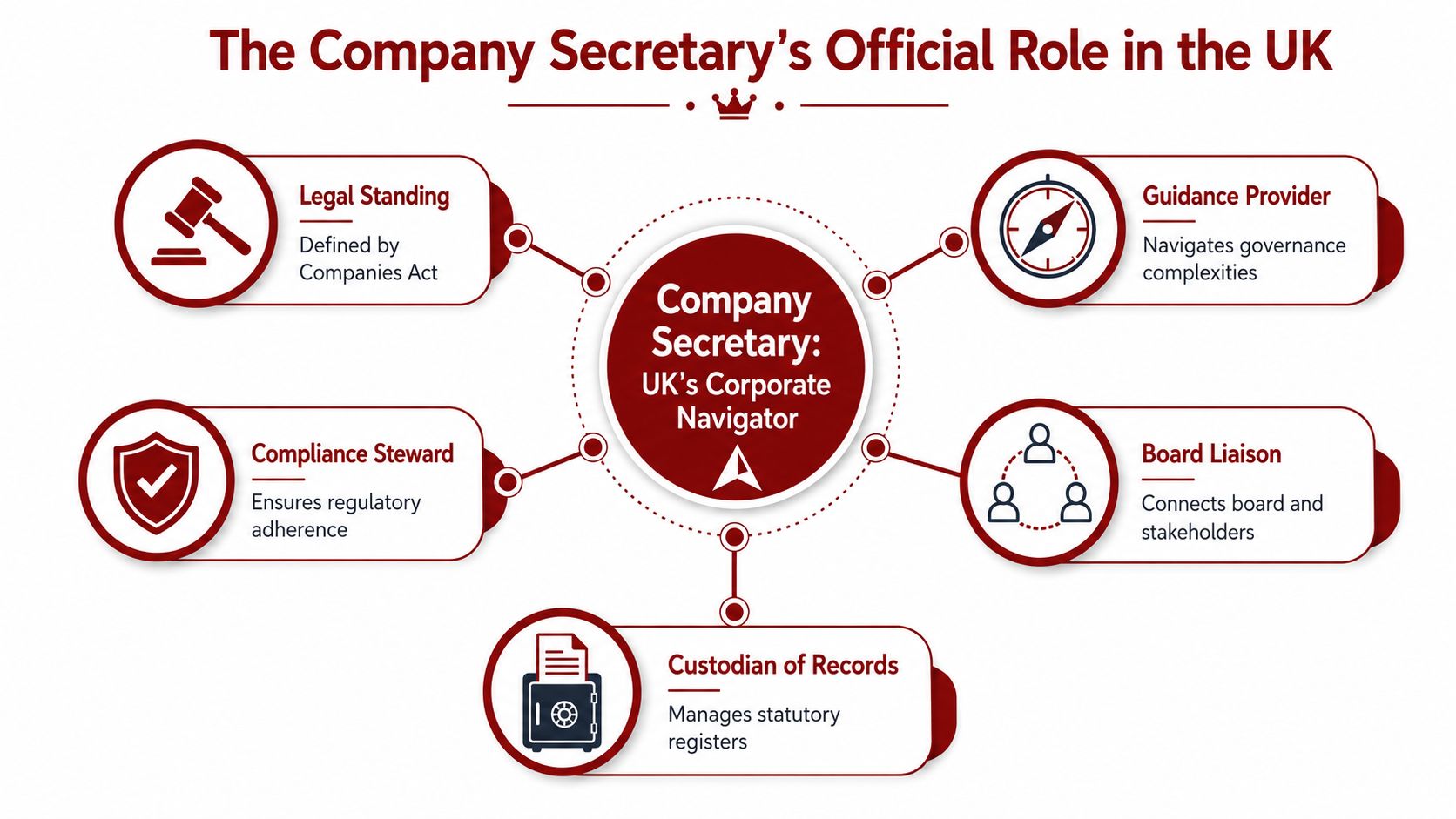
In the UK, the cleanest way to understand the role is to think of a company secretary as the ship's navigator. Directors decide where the company is going. The company secretary helps make sure the route is lawful, documented, and workable.
The legal position matters. According to Ocorians overview of what a company secretary does, private companies are not required to appoint one under the Companies Act 2006, but public companies are required to have one. The same source describes the role as a governance function rather than a clerical one, with responsibility for maintaining statutory registers, filing updates with Companies House, and advising directors on legal duties.
Public companies and private companies
If you run a PLC, the role isn't optional. It is part of the legal architecture of the company.
If you run a private limited company, you can choose not to appoint a secretary. Many founders do exactly that at the start. The mistake is assuming “not legally required” means “not practically useful”. Those are different questions.
Here's the trade-off:
- No formal secretary works when the company is simple, owner-managed, and changes rarely.
- A proper company secretarial function becomes more useful once you have multiple shareholders, outside finance, regular board decisions, or frequent changes to officers and registered details.
Why the role is strategic
A secretary who only files forms is doing half the job. The stronger version of the role helps directors stay inside the rules while keeping governance efficient.
That means things like:
- Maintaining statutory registers so ownership and officer records are accurate
- Filing changes promptly with Companies House
- Keeping decision records so approvals can be evidenced later
- Advising directors when process matters, especially around authority and duties
The role earns its value when the company is moving quickly. Fast-growing businesses make more decisions, and more decisions need clean records.
The founder's instinct is often to focus on tax, sales, and cash flow first. Fair enough. But governance is what keeps those commercial decisions supportable when someone later asks, “Who approved this, and where is it recorded?”
Your Company Secretary's Core Duties
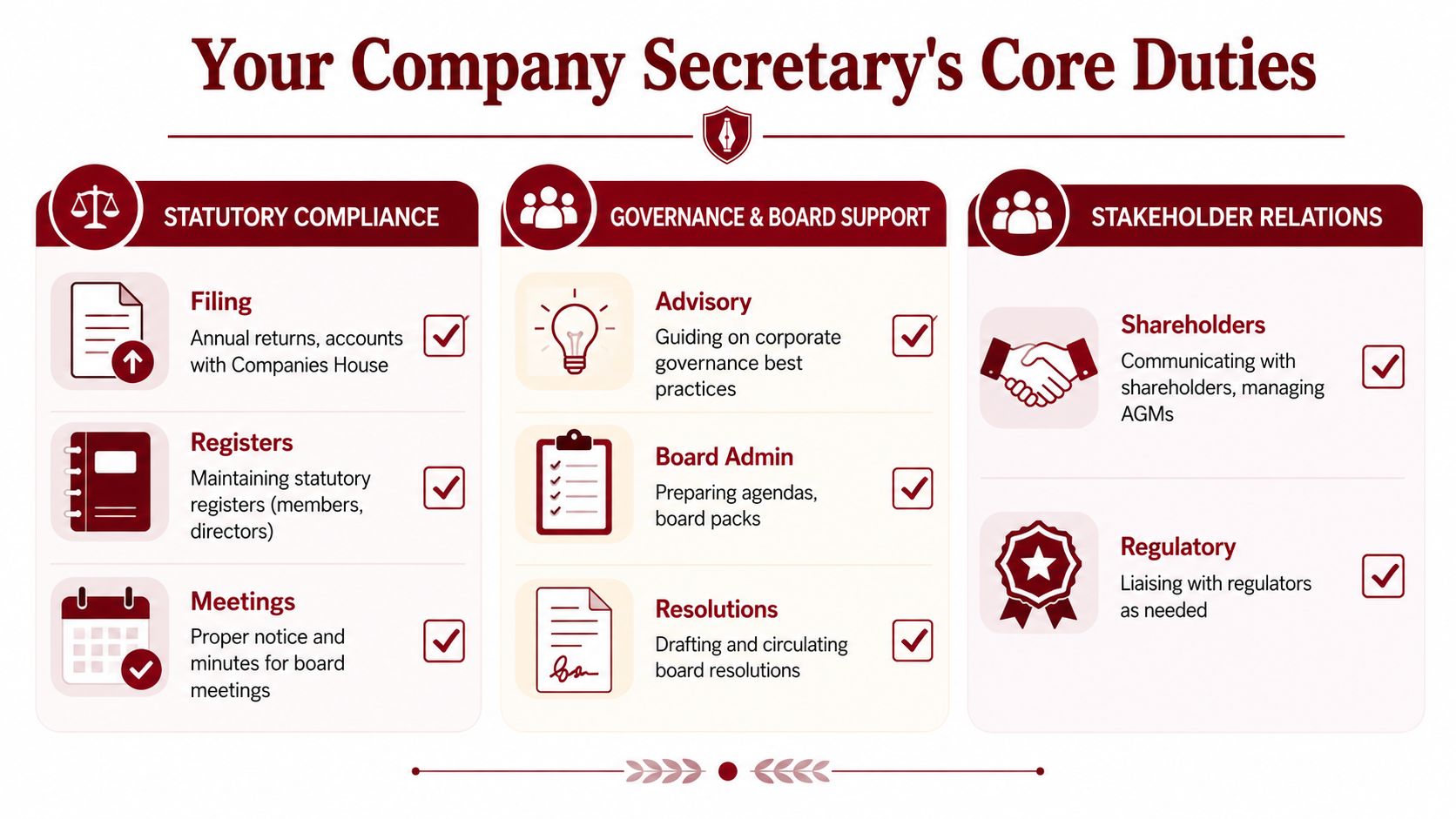
A useful way to look at the job is through three buckets. Research summarised in Wikipedia's overview of company secretary practice groups company-secretary tasks into reporting, governance, and board process, with larger organisations prioritising board process and smaller organisations focusing more on reporting and compliance.
For founder-led companies, that split is practical. Early on, the pressure usually comes from filings and records. As the business matures, board process becomes more important because more people are involved, more decisions need documenting, and more stakeholders want clarity.
Statutory compliance
This is the part founders usually notice first, because it's attached to deadlines and public records.
A company secretary typically handles or oversees:
- Statutory registers such as members, directors, and other required books
- Companies House updates when details change
- Record maintenance for the registered office and officer information
- Compliance coordination around accounts and related administrative obligations
This isn't glamorous work, but it's the base layer. If records are wrong, everything built on top of them becomes harder. If you need better document discipline, even simple systems help. A guide on how to find a free document management system can be a useful starting point for organising resolutions, registers, signed forms, and board papers.
Board and shareholder administration
Here, the role stops looking administrative and starts looking operationally important.
A competent company secretary helps organise:
- Board meetings with the right notice, agenda, and papers
- Minutes that record decisions clearly enough to stand up later
- Written resolutions when a formal meeting isn't needed
- Shareholder communications including AGM support where relevant
Many founders cut corners here because everyone “already knows what was agreed”. That works until there's a dispute, an investor query, or a transaction. Then memory becomes a weak substitute for paperwork.
For related legal housekeeping, this guide to creating business contracts is worth keeping alongside your company records process.
A short explainer can help if you want to see the role in practice:
Governance advice
This is the part that saves directors time and embarrassment.
A strong secretary doesn't just ask, “Was the form filed?” They ask better questions:
- Was this decision approved by the right people?
- Does the minute reflect what was decided?
- Have shareholders been told what they need to know?
- Are the company's records aligned with what management believes is true?
Good governance advice often sounds boring in the moment. It sounds brilliant during due diligence, a dispute, or a regulator query.
What doesn't work is treating the role as an afterthought given to whoever has spare admin capacity. The task list looks simple until the company faces pressure. That's when judgement matters.
Outsourcing Versus an In-House Appointment
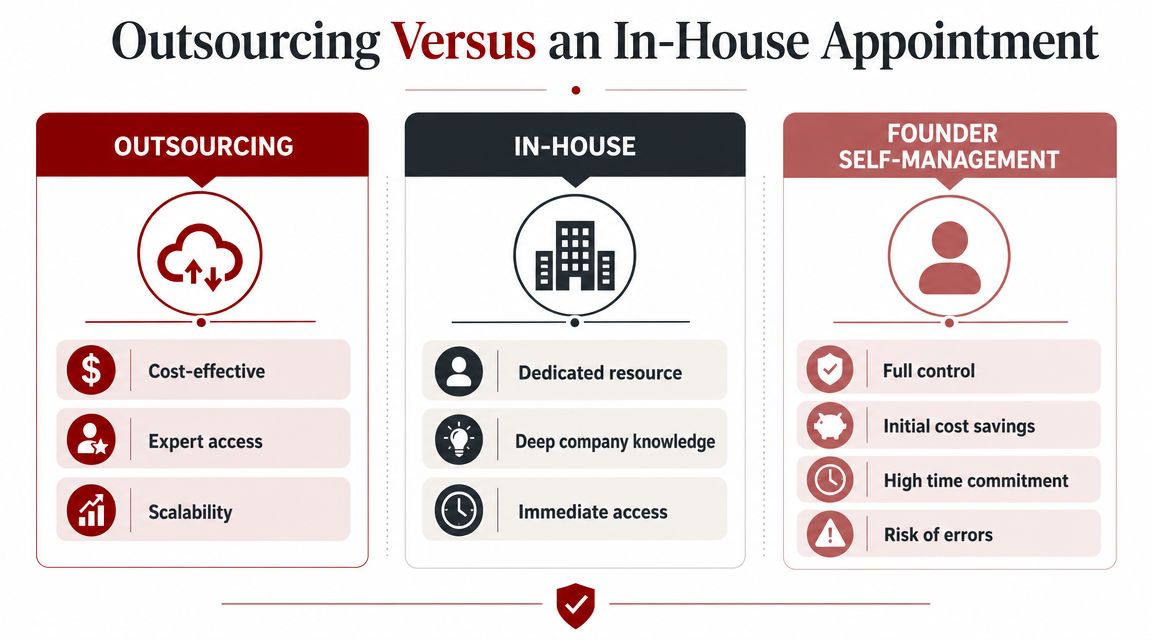
Founders usually have three choices. Do it yourself, appoint someone internally, or outsource the function. The right answer depends less on company size alone and more on complexity, pace of change, and your tolerance for risk.
The weakest option in practice is usually founder self-management for too long. It feels cheaper because there's no obvious invoice attached to it. But the cost turns up elsewhere. Missed filings, patchy records, avoidable interruptions, and directors spending time on governance admin instead of running the business.
The practical comparison
| Factor | In-House Secretary (e.g., a Director) | Outsourced Firm (e.g., Action Accountants) |
|---|---|---|
| Control | Immediate internal access | External support with agreed scope and process |
| Knowledge of business | Strong day-to-day familiarity | Needs onboarding but can be documented well |
| Governance expertise | Depends heavily on the individual | Usually broader, because the provider sees many situations |
| Continuity | Can weaken if the person leaves or changes role | Often more stable across absences and staffing changes |
| Scalability | May struggle as obligations increase | Easier to expand support as the company grows |
| Founder time saved | Moderate if the person is capable | Often high, especially where records need catching up |
| Risk of informal shortcuts | Higher in small teams | Usually lower if the provider follows a formal process |
What works and what doesn't
In-house works well when you already have someone organised, detail-focused, and comfortable with board process. It's strongest in businesses with regular governance demands and enough internal structure to support the role properly.
Outsourcing works well when the company is growing, directors want experienced oversight, and there isn't a natural internal candidate. It also suits businesses that want discipline without hiring a full-time specialist.
Founder self-management works briefly at the earliest stage. It tends to break once the business adds investors, multiple directors, share changes, or frequent decisions requiring formal approval.
If you're repeatedly asking “does this need to be filed?” or “should this have a minute?”, you've probably reached the point where dedicated support makes sense.
For many small businesses, the smart move is to buy expertise instead of trying to build it from scratch. That's especially true where the business already relies on outside advisers for tax, payroll, or financial control. This broader look at ways an accountant can help your small business fits that same logic.
Who Is Qualified to Be a Company Secretary
The legal answer depends on the type of company. The practical answer is simpler. You want someone organised, reliable, discreet, and comfortable with governance detail.
For public companies, the role carries a formal governance expectation. The Chartered Governance Institute UK & Ireland factsheet explains that for public companies the company secretary is a legal requirement under the Companies Act framework, and the role is expected to support the chair by preparing agendas, commissioning papers, and documenting decisions in minutes. That work converts board decisions into auditable corporate records.
For a private company
A private company has more flexibility. In practice, the role may be filled by:
- A director, if the business is still very small
- An employee, if someone has the discipline and capacity
- An external professional, if you want cleaner process and less risk
Flexibility shouldn't be confused with simplicity. A private company can legally operate without a formally appointed secretary, but the work still exists. Someone must keep the records straight.
Who usually makes the best fit
In my experience, the best appointments are people who combine technical accuracy with calm judgement. The role isn't only about forms. It's about knowing which decisions need a paper trail, which changes trigger filings, and which loose ends could become problems later.
That's why founders often prefer support from an experienced accountancy or governance practice rather than assigning the job casually inside the business. If you're weighing up professional support, this overview of a trusted accountancy practice in London gives a sense of the type of broader advisory relationship that often sits well with company secretarial work.
Founder's FAQ and Action Checklist
Common founder questions
Do I need a company secretary for my limited company?
Not necessarily. A private company isn't required to appoint one under the Companies Act 2006. But if your company has multiple shareholders, frequent changes, or regular formal decisions, the function becomes very useful.
Can my accountant help with this?
Often, yes. Many accountancy firms support company secretarial work alongside accounts, tax, payroll, and formation matters. The key question isn't the job title. It's whether they can keep records current, manage filings properly, and support governance decisions cleanly.
Can a director act as company secretary?
For many private companies, that can work in the early stages. The risk is that the founder-director already has too much on their plate and treats governance admin as something to do later.
What's the first sign I need proper support?
You start losing confidence in your records. You're unsure whether the registers are current, whether decisions were formally approved, or whether Companies House reflects reality.
Action checklist
Use this as a quick founder review:
- Check your current records. Make sure registers, officer details, and ownership records are accurate.
- Review your decision trail. Confirm major decisions have minutes or written resolutions.
- List upcoming filings. Don't rely on memory or inbox searches.
- Assess complexity. More shareholders, more directors, and more change usually mean more governance work.
- Choose ownership of the role. Decide whether it sits with you, an internal colleague, or an external adviser.
- Build a repeatable system. Store board papers, signed resolutions, and statutory records in one place.
A company secretary isn't there to create bureaucracy. The role exists to stop basic governance work from becoming a future problem.
If you want practical support with company formation, statutory filings, governance records, and day-to-day compliance, Action Accountants Limited can help. The firm supports founders and growing businesses with clear, hands-on advice, so your company stays organised, compliant, and easier to run.