


You've incorporated your company, checked that Companies House shows the right directors, and assumed the paperwork is finished. Then your accountant asks for the statutory registers, and you're left wondering whether everything still belongs in a company binder, whether Companies House now holds it all, and what changed in the last few months.
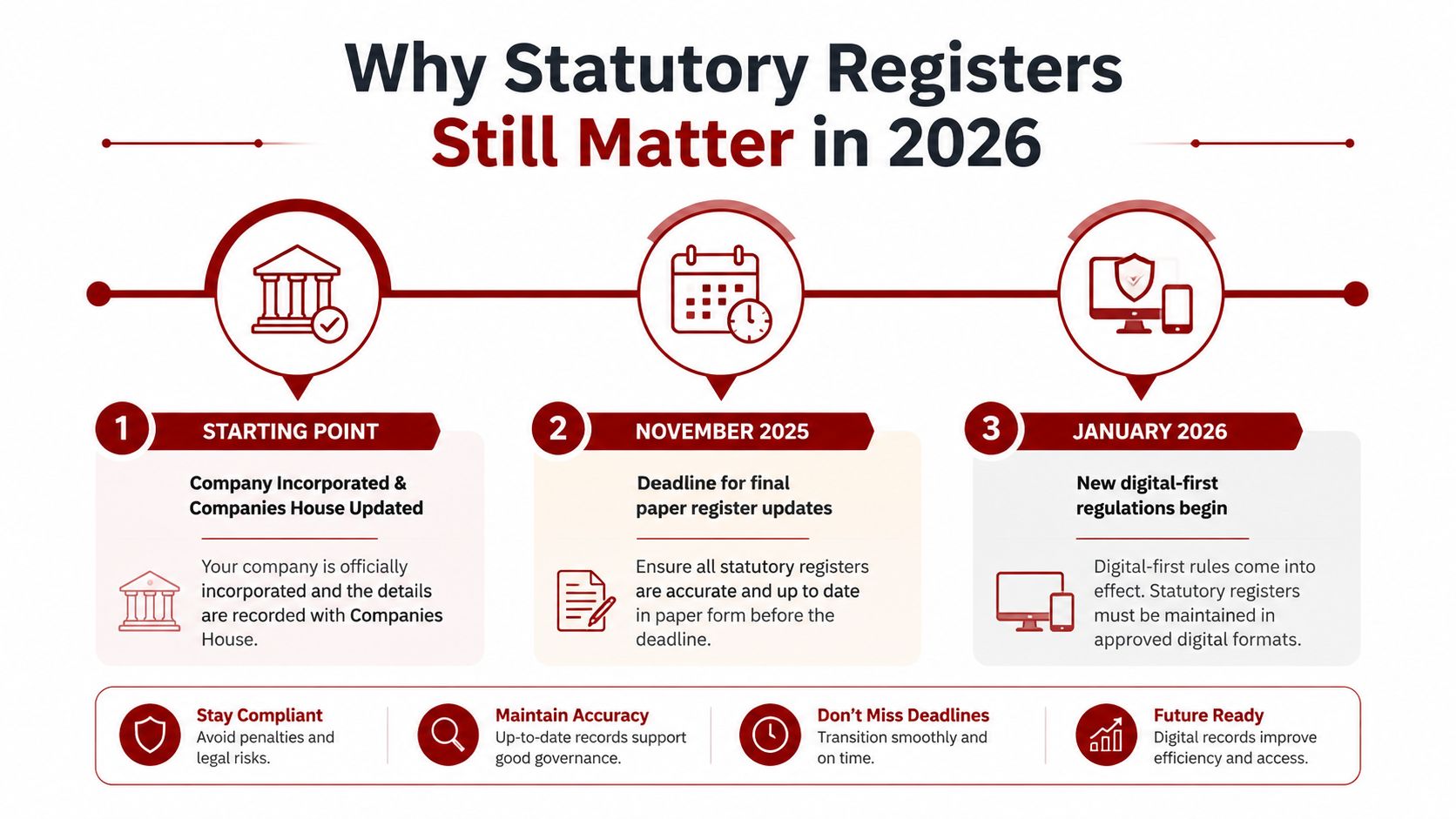
That uncertainty is understandable. The old “keep every register locally” approach no longer describes the 2026 position, but the opposite assumption is just as dangerous. From 18 November 2025, companies no longer had to maintain local registers of directors, directors' residential addresses, secretaries, or people with significant control. From 26 January 2026, the option to keep the register of members on the central register was removed, so companies once again had to maintain that register at the registered office or a Single Alternative Inspection Location, known as a SAIL address. The government's company-register guidance sets out the transition.
This guide gives you a working framework rather than a statute-listing exercise. By the end, you'll be able to confirm what your company must hold locally, audit the records already in place, and redesign your company-secretarial workflow so that digital filing and local record-keeping work together. Founders building organised internal processes may also benefit from these insights for small product teams from SpecStory, Inc., particularly when assigning ownership of recurring operational tasks.
Table of Contents
- Why Statutory Registers Still Matter in 2026
- Categories of Statutory Registers at a Glance
- Each Register Explained With Real Entries
- Central Register Versus Local Register in 2026
- How to Maintain and Update Statutory Registers
- The Biggest Compliance Trap Founders Miss
- Consequences of Getting Statutory Registers Wrong
- Quick Reference Card for Every Register
- Key Terms Founders Need to Know
- Your 30-Day Statutory Register Action Plan
Why Statutory Registers Still Matter in 2026
A shareholder transfer is completed, but the register of members is not updated. Months later, the company's filings, share certificates, and internal records tell different stories. That is the practical risk statutory registers prevent. Companies House shows what has been filed centrally. Your company records show how ownership, control, and decisions changed over time.
The register of members remains the critical local record. Under the Companies Act 2006 provisions on the register of members, every UK company must keep one. It records each member's name and address, the date they became a member, and the date they ceased to be one. Keep it available for inspection at the registered office or another approved location. The law treats it as prima facie evidence of the matters entered in it.
Practical rule: Companies House is not a substitute for understanding your own ownership records.
The November 2025 change removed several local maintenance duties, rather than removing the need for accurate information. Directors, directors' residential addresses, secretaries, and PSC information still need to be filed with Companies House and updated when circumstances change. From January 2026, the register of members again had to be maintained locally. That transition requires a redesigned workflow, not a wholesale move to central filing.
What you should do first
Separate local record-keeping from central filing:
- Confirm the local record: Check that the current register of members exists and is held at the registered office or SAIL address.
- Reconcile central information: Compare Companies House entries for directors, secretaries, PSCs, share capital, and charges with your internal documents.
- Assign ownership: Nominate one person to update records after every share transaction, board change, or control change.
- Preserve the evidence: Store signed resolutions, transfer forms, allotment paperwork, and dated minutes with the company records.
A founder who follows this process has a working compliance system, not just a folder labelled “statutory registers”. For practical ideas on assigning recurring operational tasks, see these insights for small product teams.
Categories of Statutory Registers at a Glance
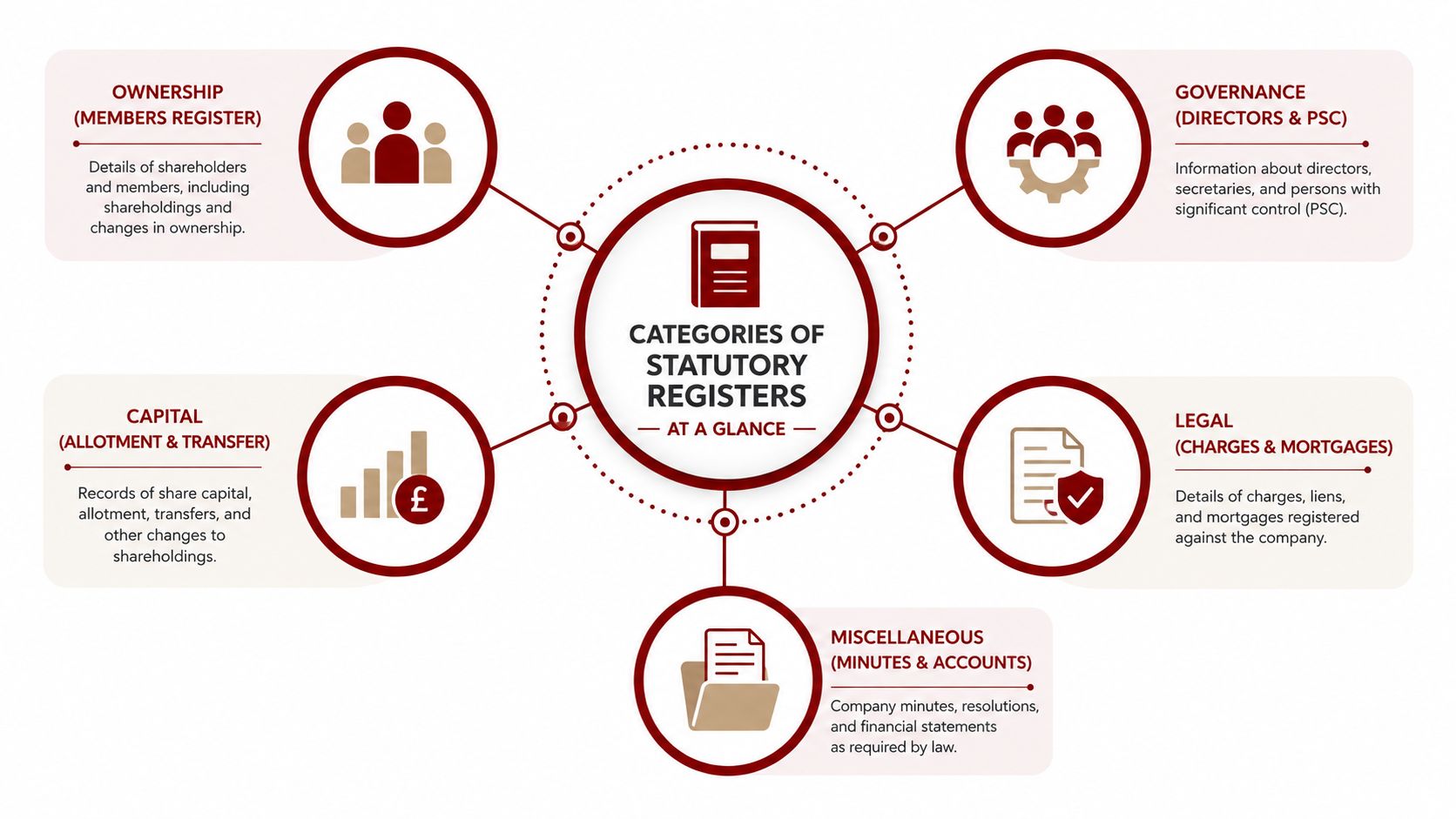
A long statutory list becomes easier to manage when you group records by the question they answer. Ask whether you're recording who owns the company, who runs it, who controls it, what secures its debts, or what supports its day-to-day legal history.
Ownership records
The register of members answers the ownership question. It records the legal members of the company and must remain available locally in 2026. Share allotments and transfers feed directly into this record, so your share certificates, transfer forms, board approvals, and member register should agree.
Governance records
Directors and company secretaries sit in the governance category. Since November 2025, companies no longer need to maintain local statutory registers for directors, directors' residential addresses, or secretaries. The information still belongs on Companies House, and your board minutes and appointment or resignation documents should support every filing.
Control records
The PSC category concerns the individuals or legal entities with significant control. The local PSC register is no longer required after the November 2025 change, but the company must still identify, verify, and update PSC information at Companies House. Treat the central filing as an active compliance record, not a one-off incorporation task.
Security records
Charges and mortgages show whether company assets secure borrowing. Lenders, investors, and buyers care about this category because an undisclosed or poorly recorded charge can complicate a transaction. Keep loan agreements, security documents, and filing evidence together.
Operational records
The final category covers records that support transactions and governance, including allotments, share transfers, debentures, beneficial interests, minutes, and accounts. Some are formal statutory registers, while others are supporting company records. You should manage both as one controlled company-secretarial file.
The following video provides a useful visual overview of how these categories fit together.
Each Register Explained With Real Entries
A founder can have a tidy Companies House filing and still keep poor company records. In 2026, North West Studio Ltd must separate two questions: which information the company must report, and which registers it must physically maintain at its registered office or SAIL address. The fictional entries below show what good records look like after the November 2025 and January 2026 changes.
Register of members
Prioritise this register. It records the company's legal members, not only the names on an informal cap table. The register of members remains a local company record, so keep it current and make sure every entry can be supported by ownership documents.
A basic entry might read:
| Field | Example |
|---|---|
| Member name | Aisha Khan |
| Member address | 14 Mill Hill Road, London, NW7 2HL |
| Date registered | 6 February 2026 |
| Shares held | 100 ordinary shares |
| Date ceased to be a member | Blank while membership continues |
Record each member's name and address, the date of registration, and the date membership ended. If Aisha transfers all her shares to Daniel Brooks, update the records to show the transfer and the date she ceased to be a member. File the signed stock transfer form and board approval with the register. Do not rely on the cap table, accounting software, or a spreadsheet as the legal record.
For the legal background, use the Companies Act 2006 register of members provisions. For control records, see this practical guide to the PSC register.
Register of directors
The local statutory register of directors is no longer required after the November 2025 change. The company must still provide accurate director information to Companies House and retain enough governance evidence to prove what happened.
A Companies House record might include:
| Field | Example |
|---|---|
| Director | Daniel Brooks |
| Service address | 8 Station Parade, Edgware, HA8 7BD |
| Nationality | British |
| Occupation | Software consultant |
| Date of birth | Recorded with Companies House as required |
| Appointment date | 6 February 2026 |
When Daniel resigns, record the resignation date in the governance file and submit the relevant Companies House update. Keep the signed resignation letter and board minutes. The removal of the local register changes where the information is maintained. It does not remove the need for an appointment history, approval trail, or accurate central filing, as noted in the Companies Act 2006 provisions cited earlier.
Register of directors' residential addresses
The local register of directors' residential addresses was also removed from the maintenance requirement. Residential addresses remain protected information and must be supplied to Companies House where required. Do not place them in ordinary public-facing company records.
For Daniel, retain the address information and filing evidence in a secure governance file. Limit access to people who need it for compliance work. If his residential address changes, update the central record through the appropriate Companies House process and retain evidence of the change.
Register of company secretaries
A private company may appoint a company secretary, but it does not have to do so. If North West Studio Ltd appoints Priya Shah, its governance records should show:
- Name: Priya Shah
- Service address: 22 High Street, Hendon, NW4 4EA
- Appointment date: 6 February 2026
- Resignation date: Blank unless she leaves
The local statutory register is no longer required after the November 2025 change. The appointment, resignation, approval, and filing records still matter. A change in secretary should trigger board documentation, a Companies House update, and a check that signing authorities and internal responsibilities remain accurate.
Register of people with significant control
The local PSC register is no longer required, but the company must still identify who controls it and keep the central filing accurate. Treat the PSC register guidance as a practical reference when reviewing control information.
For example:
| PSC | Nature of control |
|---|---|
| Aisha Khan | Holds more than half of the issued shares |
| Daniel Brooks | Holds voting rights through a separate share class |
The control statement must match the company's actual ownership and voting arrangements. If Aisha sells shares and falls below the relevant control threshold, investigate the change immediately, obtain the required confirmation, update Companies House, and retain the evidence.
Keep the PSC record separate from the member record. A person can exercise control through voting rights or another arrangement, while the register of members records legal membership. One record cannot safely replace the other.
Register of charges
Charges secure company borrowing against assets. If North West Studio Ltd grants a fixed charge over equipment to a lender, retain:
- Charge holder: North London Commercial Bank
- Secured obligation: Business loan
- Charged property: Specified production equipment
- Creation date: The date the security was granted
- Filing evidence: Companies House registration confirmation
A new charge should trigger a review of the loan documents, Companies House filing, and internal security schedule. A release or satisfaction should trigger the relevant filing and an update to the internal file. Keep the executed security document with the filing confirmation, rather than storing either item in isolation.
Register of debenture holders
If the company issues debentures, record the relevant holders and the terms establishing their rights. For North West Studio Ltd, an entry could identify:
- Holder: Priya Shah
- Address: 22 High Street, Hendon, NW4 4EA
- Instrument: Convertible debenture
- Issue date: 6 February 2026
- Amount and terms: As stated in the executed instrument
The exact record depends on the instrument and the company's structure. When a debenture is transferred, redeemed, or converted, update the record and retain the signed instrument, board approval, and any required filing evidence. Link the entry to the executed document so a reviewer can verify the terms without searching through unrelated files.
Register of beneficial interests
Beneficial interests concern rights held behind registered legal ownership. A nominee arrangement, trust, or other beneficial entitlement can create a gap between the person named in the member register and the person who benefits economically.
Suppose shares are registered in the name of “Oak Nominees Ltd” for the benefit of Aisha Khan. Retain the relevant declaration or notice, identify the legal holder, record the beneficial interest information required for the circumstances, and link the record to the ownership documents.
When the beneficial arrangement ends or changes, update the supporting record, review the member and PSC position, and consider whether a Companies House filing is required. Never use an informal spreadsheet as the only evidence of ownership. The ownership documents, approvals, notices, and filings should tell the same story.
Central Register Versus Local Register in 2026
The central register and the local register now perform different jobs. Companies House is the public filing centre for information that must be reported there. The registered office or SAIL address remains the place where the company keeps the register of members and makes it available for inspection.
The change took effect in two stages. On 18 November 2025, local registers for directors, directors' residential addresses, secretaries, and PSCs were no longer required. On 26 January 2026, companies lost the option to hold the register of members on the central register, so that ownership record returned to local maintenance. The government's explanation of company-register changes should be your starting point when checking the transition.
| Register | Local register required? | Available for public inspection | Update trigger |
|---|---|---|---|
| Members | Yes | Yes, at the registered office or SAIL address | Admission, transfer, or cessation of membership |
| Directors | No local register required | Companies House information is publicly available as applicable | Appointment, resignation, or personal-detail change |
| Directors' residential addresses | No local register required | Generally protected from ordinary public inspection | Residential-address change |
| Secretaries | No local register required | Companies House information is publicly available as applicable | Appointment, resignation, or detail change |
| PSCs | No local register required | Companies House information is publicly available as applicable | Control or verification change |
| Charges | Maintain supporting security records and check central filing | Companies House charge information is publicly available as applicable | Creation, satisfaction, or release |
A confirmation statement remains the point at which you confirm that the central company information is current. Use this practical guide to what a confirmation statement is when reviewing your filing calendar.
The right question in 2026 isn't “Where is the register?” It's “Which information must exist locally, which must be filed centrally, and what evidence supports both?”
How to Maintain and Update Statutory Registers
A founder relocates the company from its registered office to a SAIL address, then discovers that the register of members is still stored at the old premises. Fix that before the move. Record the SAIL address with Companies House, transfer the controlled register there, and make sure it can be produced for inspection at that location. A digital copy works only if it is complete, protected from unauthorised changes, and available in the required form.
The register must be available for inspection by an entitled person. Set up a process for access and copy requests, including the date received, requester's identity, response, and any permitted fee. Keep the request log with the register's supporting records.
Build a trigger-based routine
Use each transaction as the control point. Do not wait for the confirmation statement to expose an outdated record.
- Share transfer: Collect the signed transfer documents, obtain any required approval, update the register of members, issue or replace certificates where appropriate, and check whether control has changed.
- Share allotment: Approve the allotment, update ownership and capital records, issue evidence of title, and complete the required Companies House filing.
- Director resignation: Date the resignation, retain the signed notice and board minutes, update Companies House, and remove the former director from banking and signing authorities where necessary.
- PSC change: Confirm the basis of control, obtain the required information, update Companies House, and retain evidence of verification.
Former-member entries can be removed after 10 years under the Companies Act 2006 rules cited above. If a former member's entry remains within that period when the company moves from its registered office to a new SAIL address, move the historical record with the current register. Do not delete it during the relocation, and do not treat the address change as a fresh start.
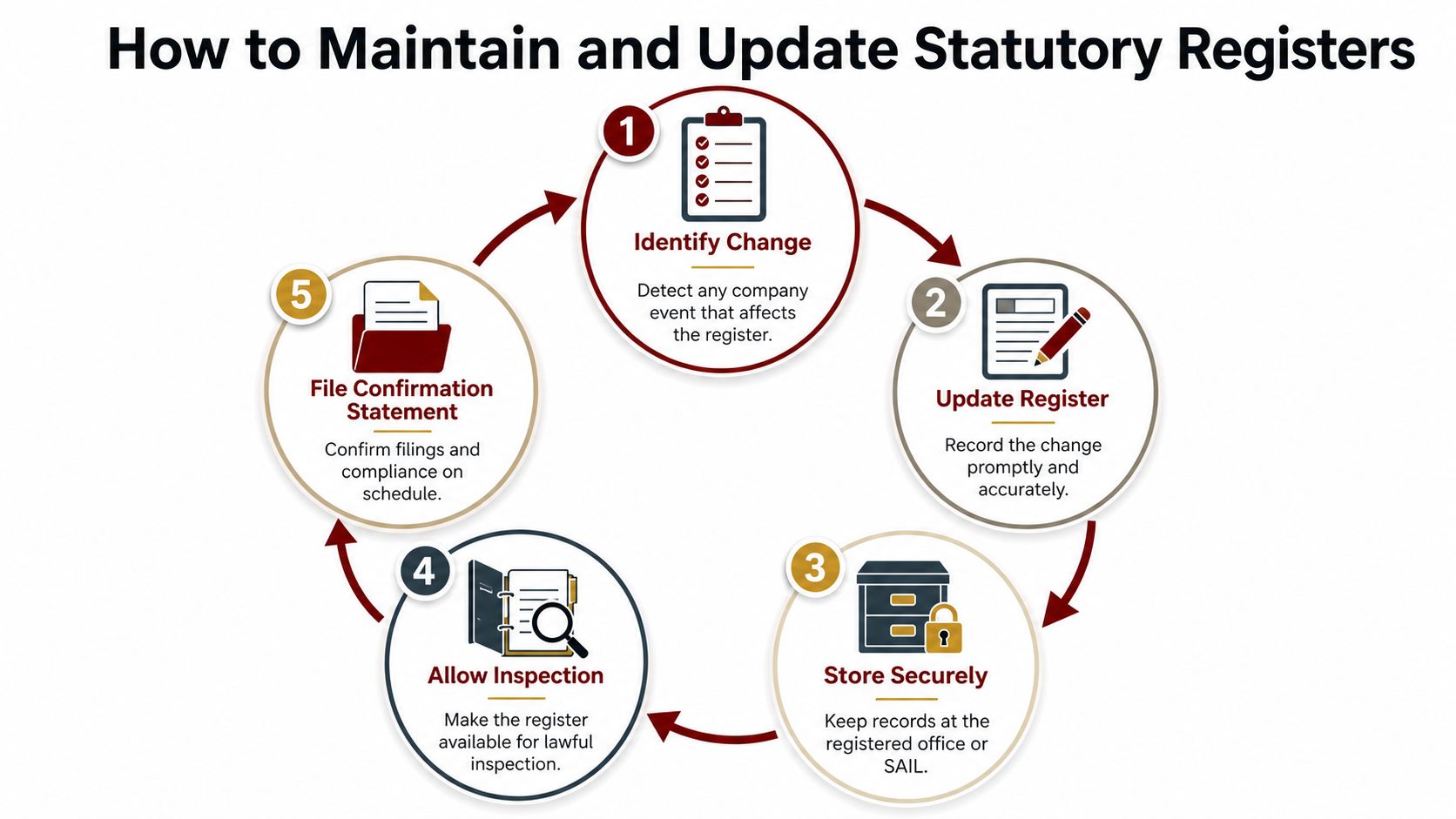
Use a shared compliance calendar, restricted-access storage, and a named reviewer. For outside support, company secretarial services can manage filings, records, and recurring governance work.
The Biggest Compliance Trap Founders Miss
The biggest mistake is treating “no local register” as “no obligation”. That conclusion is wrong. The November 2025 change removed local maintenance for several registers, but the company still has to maintain accurate underlying information and update Companies House when circumstances change.
A founder should operate four controls from the beginning:
- Reconciled share ledger: Compare the register of members, share certificates, allotment documents, transfer forms, and Companies House share-capital information.
- Signed transaction file: Keep executed transfer forms, allotment approvals, shareholder resolutions, and related correspondence together.
- Dated board minutes: Record the decision, the date, who attended, and the authority relied upon.
- Named filing owner: Assign one person to monitor Companies House updates, confirmation statements, PSC changes, and charge filings.
PSCs still need to be identified and verified. A company that fails to investigate its control structure can file incomplete information even though it no longer keeps a separate local PSC register.
For a broader operational checklist, these required document lists for firms can help you organise the supporting evidence around your formal records. If several founders are involved, document voting rights, transfers, and decision-making in a signed shareholder agreement, then update the related company records whenever the ownership position changes.
Consequences of Getting Statutory Registers Wrong
Poor record-keeping creates both legal and commercial problems. Directors and secretaries can face criminal liability where the company fails to maintain a required register or fails to provide it for inspection. The precise consequences depend on the register and the breach, so don't rely on a generic online checklist where the company has disputed ownership, complex control arrangements, or secured borrowing.
An inaccurate Companies House file can cause filings to be rejected, leave the company exposed to enforcement, and create strike-off risk where required information isn't maintained. The Companies Act includes offence provisions linked to register failures, including section 453 and section 858, depending on the register and the relevant obligation.
The commercial damage often arrives before formal enforcement. A bank may pause lending, an investor may request explanations, and a buyer's solicitor may qualify due diligence if you can't produce a clean ownership trail. Missing transfer forms, inconsistent share numbers, or unexplained PSC changes make a simple transaction look like a deeper governance problem.
A register is cheap to maintain. Reconstructing ownership history during an investment or sale is not.
Quick Reference Card for Every Register
Use this table as a working checklist, then verify unusual arrangements with a company secretary or solicitor.
| Register | Location | Inspection rights | Update trigger |
|---|---|---|---|
| Members | Registered office or SAIL | Public inspection rights apply | Membership, transfer, or cessation |
| Directors | Companies House and supporting governance file | Companies House information is publicly available as applicable | Appointment, resignation, or detail change |
| Directors' residential addresses | Secure company records and Companies House | Protected information rules apply | Residential-address change |
| Secretaries | Companies House and supporting governance file | Companies House information is publicly available as applicable | Appointment, resignation, or detail change |
| PSCs | Companies House and supporting verification file | Companies House information is publicly available as applicable | Control or verification change |
| Charges | Companies House and internal security file | Companies House charge information is publicly available as applicable | New, released, or satisfied charge |
| Debenture holders | Company records, supported by executed instruments | Rights depend on the company's documents and applicable rules | Issue, transfer, redemption, or conversion |
| Beneficial interests | Company records and supporting declarations | Access depends on the record and applicable law | Nominee, trust, or beneficial-right change |
Key Terms Founders Need to Know
Statutory register: A formal company record maintained because company law requires it.
SAIL address: A Single Alternative Inspection Location where certain company records can be kept available for inspection instead of at the registered office.
PSC: A person with significant control over the company through ownership, voting rights, or another recognised control route.
Beneficial owner: The person who ultimately benefits from shares or control, even where someone else is the registered legal holder.
Confirmation statement: A Companies House filing used to confirm that the company's central information is current.
SIC code: The classification describing the company's principal business activity.
Company secretary: An officer who may support governance and administration. A private company's appointment requirements depend on its constitution and circumstances.
Your 30-Day Statutory Register Action Plan
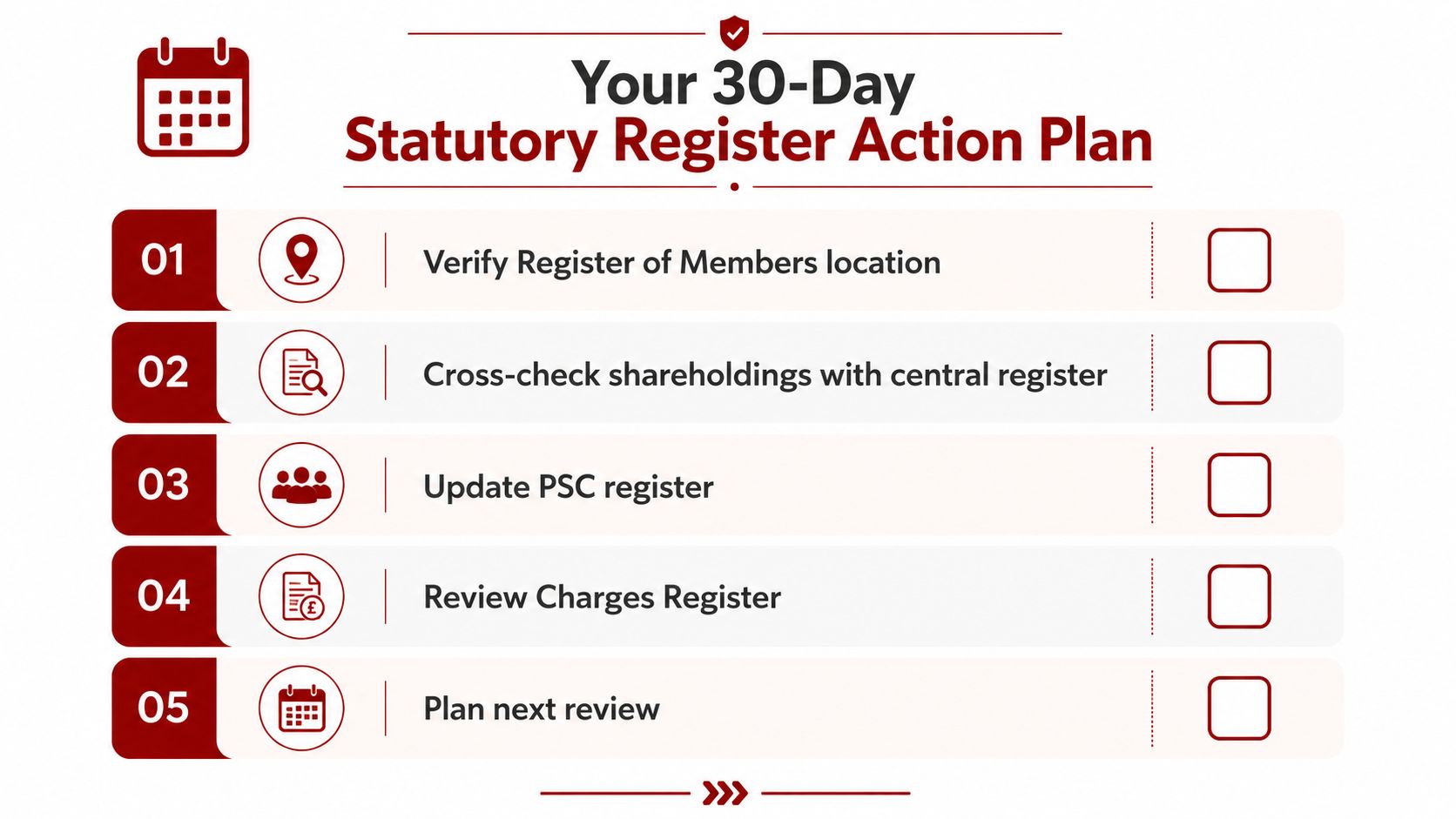
Put the following actions on your calendar and complete them in order:
- Verify the register of members: Confirm that the current register is held at the registered office or SAIL address and contains complete member histories.
- Cross-check ownership: Reconcile the local register with share certificates, allotments, transfers, and Companies House share information.
- Refresh PSC details: Review who controls the company, confirm the basis of control, and update the central filing where needed.
- Review charges: Match Companies House charge information with loan agreements, security documents, releases, and satisfaction evidence.
- Assign ongoing ownership: Nominate a responsible person, set transaction triggers, and schedule the next governance review.
Statutory registers stop being a chore when they become a controlled audit trail. That trail supports funding, exits, banking reviews, and confident decision-making because the company can show not only what it reports, but how it got there.
Action Accountants Limited offers company-secretarial support that can help you maintain the register of members, coordinate Companies House updates, and organise recurring compliance tasks around your business. Visit Action Accountants Limited to discuss a practical statutory-register routine for your company.