

Two founders can get from “we trust each other” to “who controls the company?” faster than they expect. It often happens at the first funding conversation, when one person wants flexibility, the other wants protection, and neither wants to revisit the cap table after the room has already moved on. A shareholder agreement template gives you a private contract to sort that out before the friction starts, alongside the company's articles of association, and it's where control, transfers, and disputes get put into writing in a way the company can live with.
If you want a practical reference while you work through this, the 2026 shareholder agreement guide is a useful companion for understanding the moving parts. For founders who need to think beyond the agreement itself, the company ownership context also connects closely with the PSC register, because ownership and control questions never sit in isolation for long.
Table of Contents
- Why UK Founders Need a Shareholder Agreement Template
- Shareholder Agreement versus Articles of Association
- Clause-by-Clause Template Explanation with Examples
- Real-World Exit Transfer and Deadlock Scenarios
- Tailoring Approving and Signing Your Agreement
- Company Secretarial Compliance and Legal Support
- Keeping Your Agreement Effective as You Grow
Why UK Founders Need a Shareholder Agreement Template
Two co-founders in Colindale can build a promising company, agree everything verbally, then hit a wall the moment a third party asks for certainty. One wants to sell, the other wants to wait, and neither side has a written rulebook for exits, voting, or what happens if the relationship breaks down. That is exactly where a shareholder agreement template earns its keep, because it turns the unstated parts of the relationship into enforceable private terms.
ACCA notes that a shareholders' agreement is a foundational private contract sitting alongside the company's articles of association, and that it is commonly used to regulate control, decision-making, share transfers, and dispute resolution between shareholders. The same material also shows why the paperwork matters in practice, since templates usually ask for the company's issued share capital, the shareholders' identities, and the number of shares each person holds. Those details are not administrative filler, they are the structure that the rest of the agreement depends on. See the legal context in ACCA's note on shareholder agreements.
What the template is really doing
A good template gives founders a framework for the decisions that are hardest to make under pressure. It sets the rules for who can approve major actions, how new shares are issued, what happens if someone wants out, and how disagreements are handled before they become a company-ending deadlock.
Practical rule: use the template before the first serious external conversation, not after it. Once shares have moved, the drafting choices become harder and the margin for error gets smaller.
For a startup or small company, the aim is simple. Lock in expectations while everyone is still aligned, then let the document manage the awkward moments later.
Shareholder Agreement versus Articles of Association
A founder can get the clauses right and still have the document set wrong. The usual problem is not the wording of pre-emption, drag-along, tag-along, leaver provisions, or deadlock. The problem is deciding which terms sit in the shareholder agreement and which must also appear in the articles of association, so the private bargain and the company's constitutional documents do not point in different directions.
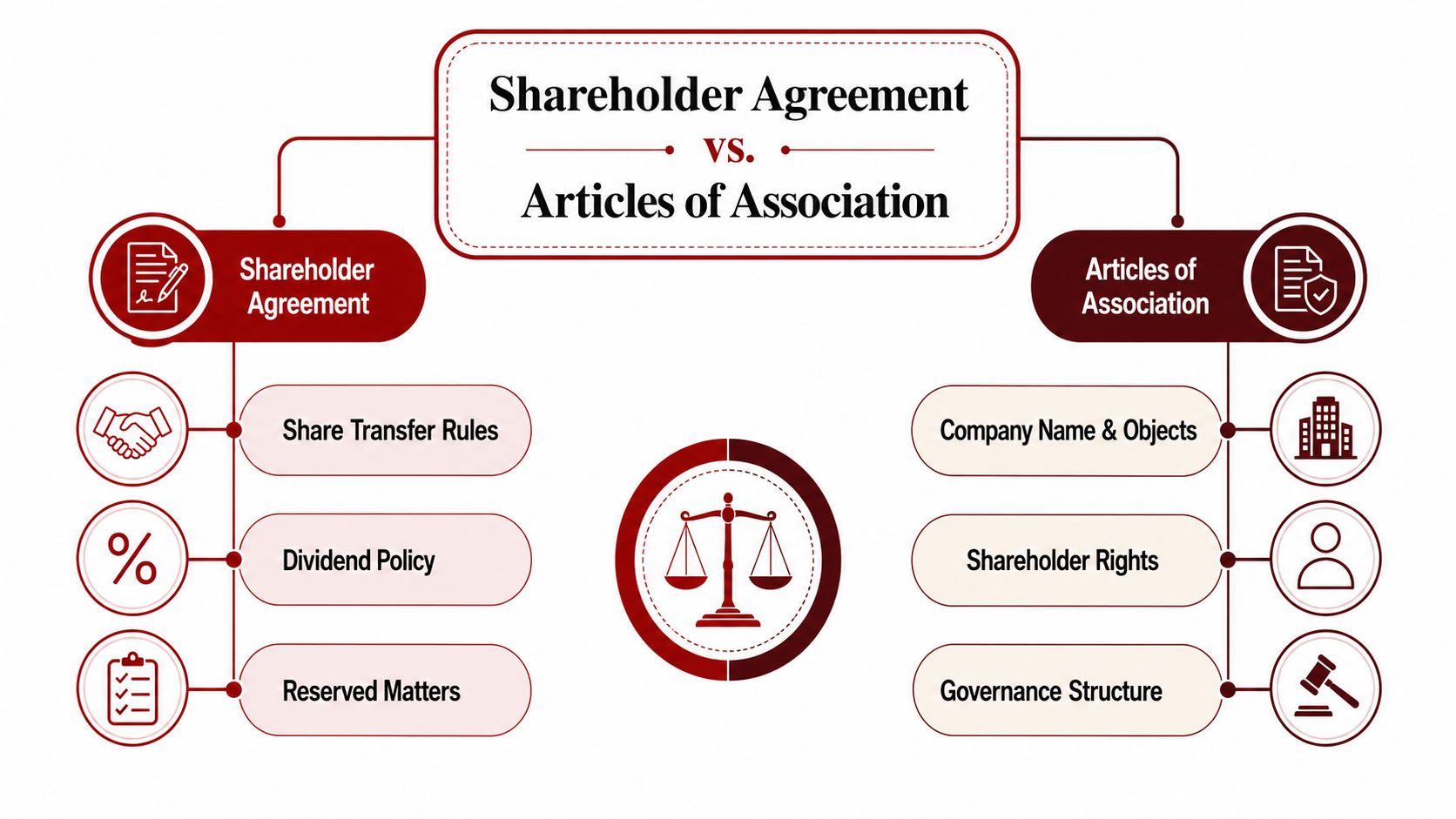
Private contract versus constitutional document
The shareholder agreement is a private contract between the parties. The articles sit inside the company's constitutional framework, so they carry the company-law effect that a private agreement cannot create on its own. That split matters at incorporation, and it matters again at funding, when new investors, new rights, or a revised cap table force the documents back into line. The Companies Act 2006 context is worth keeping in view here, especially the director duties and company governance points around section 172.
Sprintlaw's guidance on UK shareholder agreement template key clauses and common pitfalls captures the practical trap. A template can look complete, yet if the agreement and the articles diverge, the company can still end up with sensible wording that does not work cleanly in practice.
What breaks when they differ
Once the articles say one thing and the shareholder agreement says another, the result is usually internal inconsistency, uncertainty over voting rights, and arguments about whether a transfer restriction or consent right can be relied on. That risk increases when founders assume the private agreement alone governs the company, then discover the constitutional documents were never updated to match.
In real terms, the mismatch shows up at the point where a decision needs to be enforced. A consent right in the shareholder agreement may be commercially clear, but if the articles do not support the same mechanics, a third party, a new investor, or even the company's own officers can treat the position differently. This is why the document architecture matters as much as the clause list. It is also why due diligence on umbrella companies remains a useful reminder that constitutional documents and compliance checks travel together, even when founders would rather keep them separate.
Bottom line: draft the two documents together. The shareholder agreement records the commercial deal between shareholders, while the articles give the company the legal mechanics that make the deal workable.
Clause-by-Clause Template Explanation with Examples
A founder pair with a 60/40 split usually reaches for a template and then gets stuck at the blanks. That is normal. The issue is rarely the wording itself, it is knowing what each clause is meant to protect, and how much detail the company needs.
The core clause groups
The template usually starts with the basics, the company name, issued share capital, shareholder identities, and the number of shares each person holds. That information matters because the rest of the agreement is built on the exact ownership position, not a vague idea of who “mostly” owns the company.
A reserved matters clause is often where the practical balance of power sits. In a 60/40 company, founders may choose unanimous approval for certain decisions, or reserve a short list of actions that need both sides to agree. That can prevent one shareholder from forcing through a major change that the other never signed up for.
A separate share rights section is where different classes can be reflected if the company needs them. If the economic or voting arrangement is not the same for every shareholder, the template has to say so plainly, or the company can end up with an internal mismatch between the cap table and the legal rights attached to the shares.
Why leavers and vesting matter early
Vesting is not just for large venture rounds. It protects the company if a co-founder leaves early, stops contributing, or walks away before the value is really built. Without that discipline, one person can leave with a large stake and leave the remaining founders carrying the operational load.
For the drafting mindset behind these clauses, the right companion reading is everything businesses need to know about creating business contracts, because the same principle applies across all commercial documents, define the bargain clearly, then test what happens when one side stops doing its part.
The safest template is the one that forces precise answers. If a blank can't be completed in one sentence, the company probably hasn't decided the position yet.
Real-World Exit Transfer and Deadlock Scenarios
A founder decides to sell to an outside buyer. Another shareholder wants to keep the cap table tight. Pre-emption rights do real work here, because they give the existing shareholders a chance to step in before the shares go to a stranger. The clause is not decorative, it is the difference between a controlled exit and a cap table that changes without the remaining founders' consent.

Another common case is a minority shareholder being carried into an exit. Tag-along rights are the fairness mechanism here, because they help stop the majority from negotiating a sale on terms the minority never had a chance to join. That matters most when the buyer wants certainty and the smaller shareholder would otherwise be left behind.
Deadlock and valuation pressure
Deadlock often appears when the documents were not aligned in the first place. If the articles and the shareholder agreement point in different directions, the company can get stuck arguing not only about the business decision, but about which document governs the decision at all.
The valuation of a business becomes relevant when a transfer, buyout, or exit needs a price. Without a clear mechanism, valuation turns into a negotiation battle instead of a process, and that can freeze the deal.
After the commercial mechanics are agreed, disputes still need a forum. Some companies rely on arbitration clauses, others on mediation first, but the key point is that the resolution route should be drafted before a real argument begins. That is especially true when a deadlock would otherwise stop appointments, transfers, or strategic decisions from moving forward.
Tailoring Approving and Signing Your Agreement
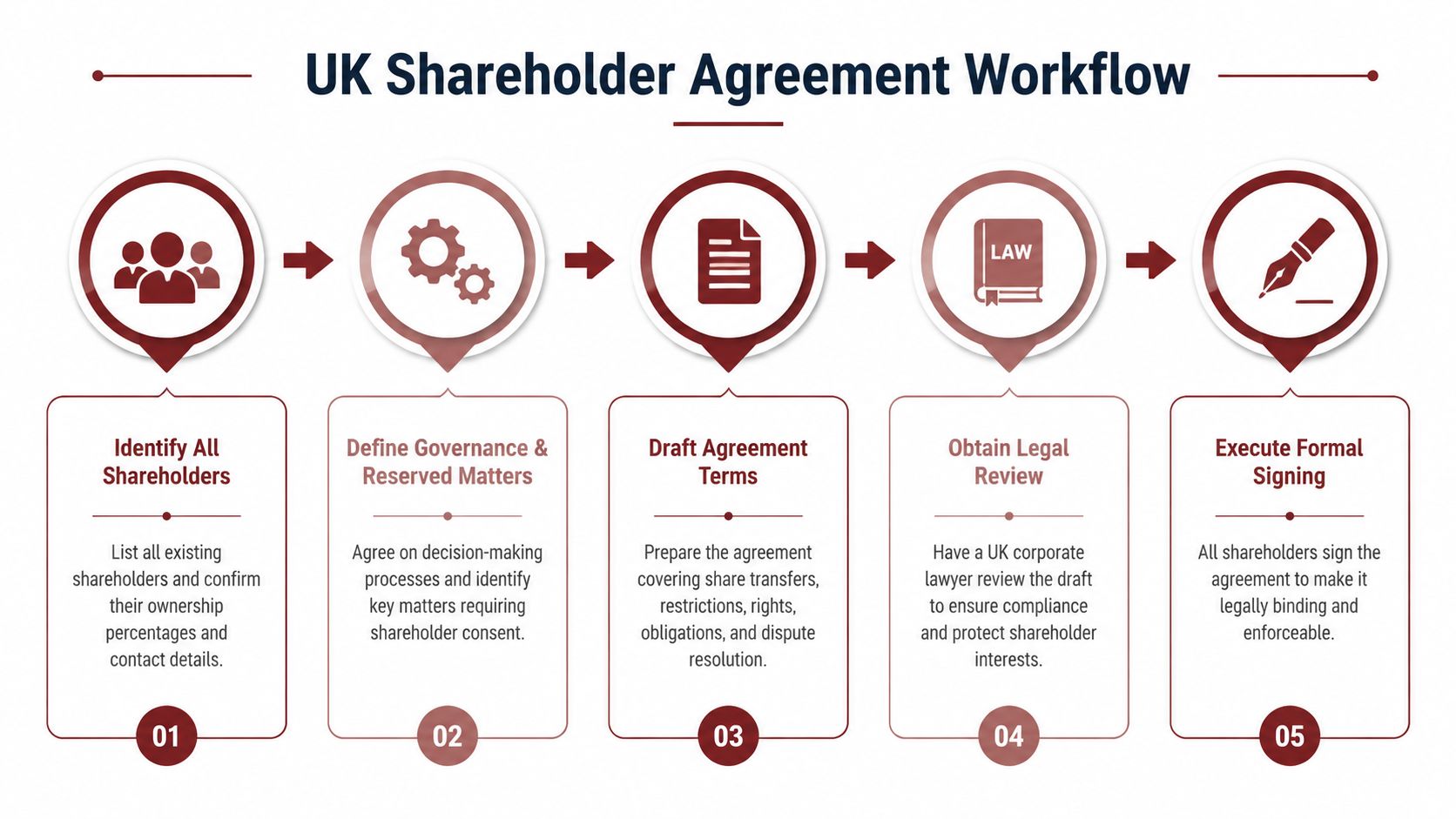
A clean workflow starts with the people, not the document. In a real UK startup, that means identifying current shareholders, deciding who is likely to join through the first round, and setting the governance questions they care about. It also means deciding which decisions are reserved, which are routine, and which need everyone in the room. Then set the transfer and exit mechanics so the company knows what happens if someone wants out, dies, gets disgruntled, or wants to sell.
Draft in the right order
A practical sequence is straightforward.
- Identify every shareholder role. Include founders, early investors, and anyone who will join through the first round.
- Set reserved matters. Decide which actions need unanimous approval and which can pass by majority.
- Build transfer mechanics. Cover pre-emption, permitted transfers, and any lock-in or right of first refusal.
- Align with the articles. Make sure the company's constitutional documents do not contradict the private bargain.
- Complete execution formalities. Sign properly, keep the final version safe, and make sure the company records match the signed deal.
The order matters because template guides often go wrong here. A shareholder agreement can deal with private rights between signatories, while the articles carry the company-law machinery that binds the company itself. If those two documents say different things at incorporation or during a funding round, the result is usually delay, argument, or a clause that looks strong on paper but fails when someone tries to rely on it. That is the point where a private bargain needs to be checked against the constitutional documents, not after the signatures are already in.
The best practices for e-signatures guide is a useful practical reference when teams are signing remotely or across multiple locations. The point is not convenience alone, it is making sure the signature process matches the company's record-keeping needs and leaves a clear execution trail.
Practical rule: if a clause depends on someone who is not a party, stop and redraft. A private agreement cannot do company-law work it was never drafted to do.
Company Secretarial Compliance and Legal Support
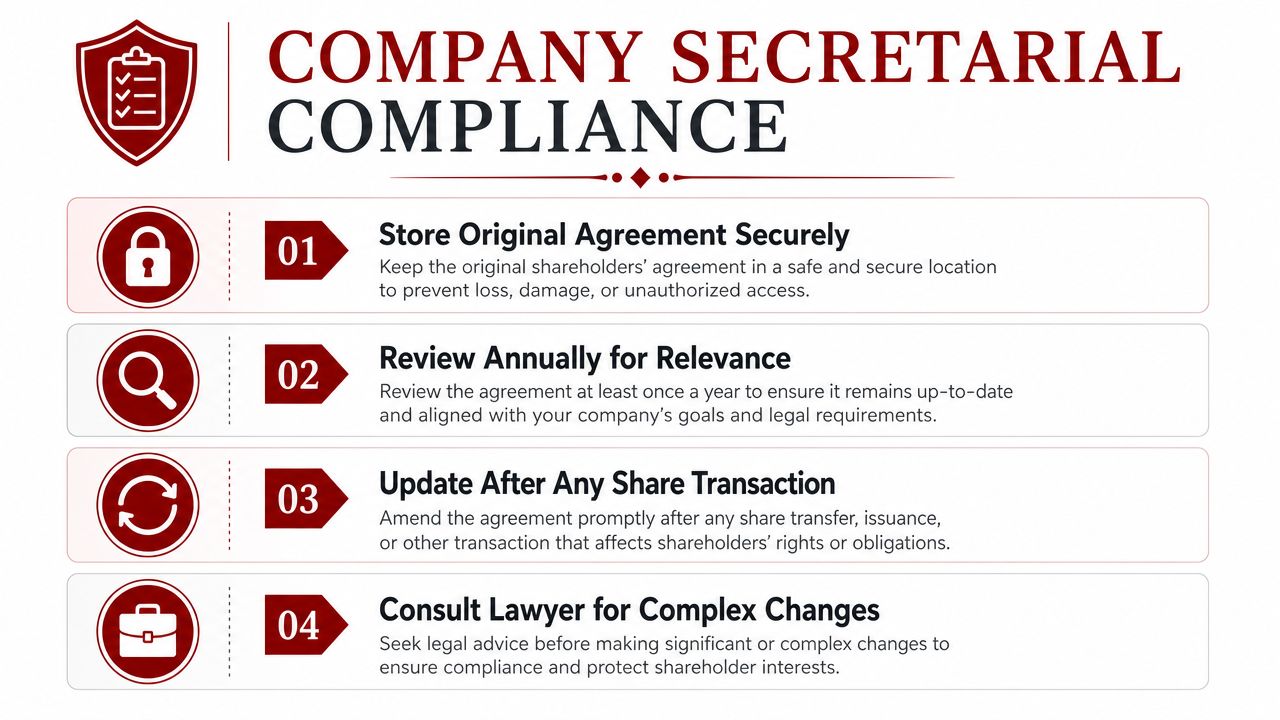
A signed agreement that nobody maintains is a weak document, not a protective one. Store the final version securely, keep the cap table consistent after any share issue or transfer, and check whether the articles need to be updated when the company changes shape. The shareholder agreement and the articles need to sit comfortably together at incorporation and at funding, because mismatches tend to surface when someone wants to rely on them.
Keep the records aligned
A sensible company secretarial routine is simple.
- Store the signed agreement securely. Keep the final version with the company records, not in someone's personal inbox.
- Update after every share transaction. Make sure the shareholder list, share numbers, and related records still match.
- Review after structural changes. A funding round, new class of shares, or revised control arrangement can make old drafting obsolete.
- Escalate complex changes early. If the documents no longer match the commercial reality, get legal and accounting support before the conflict hardens.
If signatures are being collected electronically, the best practices for e-signatures article is worth using as a process check so the execution trail stays tidy and defensible.
The practical issue is record control. Template use is fine, but template maintenance is where many companies slip. Founders can handle straightforward upkeep themselves, yet anything involving conflicting documents, funding changes, or sensitive exit terms should be reviewed by a professional who can spot the knock-on effect before it becomes a problem.
Keeping Your Agreement Effective as You Grow
Treat the shareholder agreement template as a living document, not a one-off download. The architecture rule stays the same, the clauses need to match the company's real control structure, and the records have to stay aligned whenever shares move or investors join. If those three habits hold, the agreement keeps doing the job it was built for, instead of becoming a folder item nobody trusts.
Action Accountants Limited can help you put the document architecture, company records, and signing process on the same page from day one. If you want a properly customized shareholder agreement, alongside the formation and company secretarial support that keeps it workable as you grow, visit Action Accountants Limited to start the conversation.