

Section 172 Companies Act 2006: Director’s Duty
Action Accountants •2 August 2026
Section 172 of the Companies Act 2006 is the statutory duty requiring every UK company director to act in good faith to promote the success of the company for the benefit of its members as a whole, while having regard to six specific factors. The key issue isn't whether the duty exists, it's whether directors can prove they consistently applied it when making decisions.
Most advice on section 172 Companies Act 2006 stops at the annual report. That's too shallow for busy owners, because the legal risk sits in the gap between what boards say they considered and what they can evidence when challenged. For directors who want a practical benchmark for good governance, it helps to think about how compliance sits alongside wider record-keeping and control systems, including resources like protect your company with compliance.
Table of Contents
- Why Section 172 Matters More Than You Think
- What Section 172 Companies Act 2006 Requires
- Section 172 Reporting Requirements for Large Companies
- Practical Compliance Steps for Directors
- Section 172 in Practice for Startups SMEs and Construction Contractors
- Common Pitfalls and the Creditor Protection Pivot
- Your Section 172 Compliance Checklist and Next Steps
Why Section 172 Matters More Than You Think
Directors often treat section 172 like a sentence for the annual report, something drafted late, signed off, and then forgotten. That misses the essential point. Section 172(1) is the duty that requires directors to act in good faith to promote the success of the company, while having regard to the statutory factors set out in the Act, and it sits at the centre of UK board accountability Companies Act 2006, section 172.
The gap between the statute and the boardroom
The issue goes beyond whether the duty exists. Directors need to be able to show that they applied it in decision-making. Government research findings reported that interviewees said s.172(1) had “minimal to no influence” on board decisions in most cases government research findings paper. In practice, that means the legal duty is present, but the discipline around it often depends on shareholders, scrutiny, and the board's own habits.
Practical rule: if you can't show the process, you'll struggle to show the duty was met.
That is where many directors get caught out without meaning to. A sensible conversation in the boardroom is not enough on its own. If the minutes are thin, the papers are vague, or the reasons are not recorded, the decision can look like a tidy explanation written after the event rather than genuine consideration. Governance then becomes a question of evidence, not intention.
Why business owners should care
For owners, especially in smaller companies, this duty is part of everyday management, not just legal housekeeping. It shapes how you weigh staff issues, supplier pressure, customer complaints, environmental impact, and reputational risk before a decision is made. If you want a business that can stand up to scrutiny, the board needs more than instinct, it needs a clear trail of judgment.
A practical way to view section 172 Companies Act 2006 is as part of your wider control environment. Good compliance works like a record of how directors thought through a decision before acting. It also helps protect your company with compliance when questions arise later, because weak records make weak decisions look worse, even where no one is threatening a claim.
What Section 172 Companies Act 2006 Requires
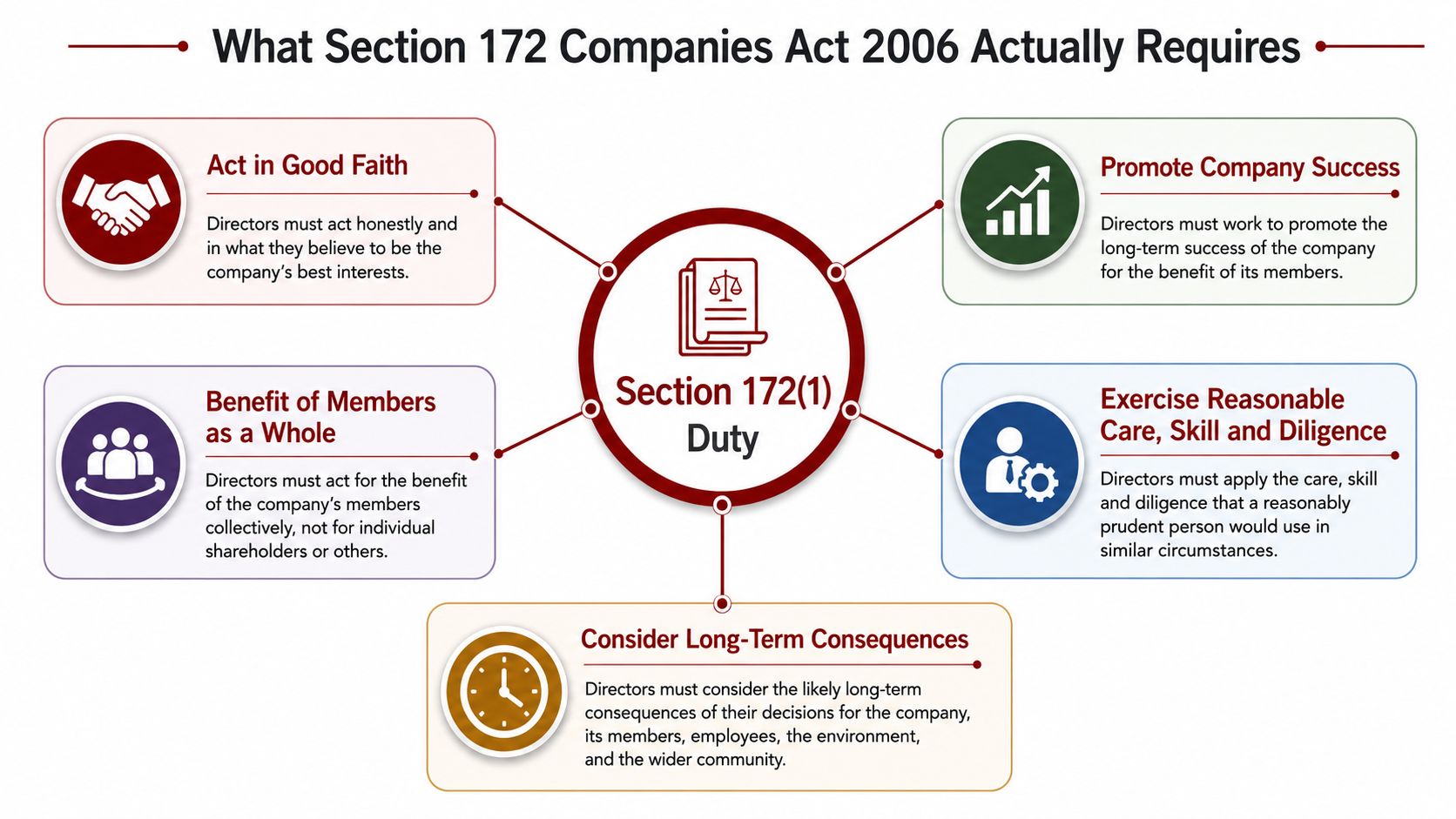
The duty in section 172 is easy to recite and easy to underplay. A director must act in good faith in the way they believe is most likely to promote the success of the company for the benefit of its members as a whole, while having regard to specific factors set out in the statute section 172 text.
The central duty in plain English
The main rule is straightforward. Directors must try to promote the company's success, and they must do so for the company, not for personal convenience or for one stakeholder group at the expense of everyone else. The phrase “good faith” matters because it points to honest judgment, not a retrospective explanation written after the meeting.
That legal wording is broader than many board minutes suggest. It asks directors to have regard to the long-term consequences of decisions, the interests of employees, the need to foster business relationships with suppliers and customers, the impact on the community and environment, the desirability of maintaining a reputation for high standards of business conduct, and the need to act fairly as between members section 172 text.
How the six factors fit together
- Long-term consequences mean directors should not chase a short-term gain that weakens the business later.
- Employees covers practical issues such as retention, morale, safety, and whether management decisions carry credibility.
- Suppliers and customers matter because a company depends on trust, continuity, and working relationships.
- Community and environment brings the business's footprint into the decision, including how its actions are seen beyond the boardroom.
- Business conduct points to reputation, ethics, and the standards the board wants the company to be known for.
- Fairness between members prevents directors from favouring one shareholder group without a proper reason.
The list is non-exhaustive. Directors also need to consider anything else relevant to the company's success, especially where the business has a particular operating context or a wider purpose. That is why UK governance writing often describes the duty as enlightened shareholder value, shareholder interests still matter, but they are not the only lens.
This is also why evidence matters so much in practice. A board can say it considered the right things, yet if the papers are thin or the minutes do not show how the judgment was reached, the company may struggle to prove that proper consideration took place. For routine filings, the same discipline helps elsewhere too, including the evidence trail behind a confirmation statement, because clean records make it easier to show the company kept its governance obligations in order.
The wording also leaves room for companies with wider purposes to frame the duty around those purposes rather than shareholder benefit alone. In practical terms, the board should be able to explain not just what it decided, but why those statutory factors were part of the judgment and how they were weighed against each other.
Section 172 Reporting Requirements for Large Companies
The reporting duty changed the feel of section 172. What used to sit in the background now has to be explained in the annual Strategic Report for periods beginning on or after 1 January 2019 QCA guidance. That shift matters because silence is no longer a safe default.
Who has to report
A company is “large” if it meets two of three thresholds, turnover of at least £36 million, a balance sheet total of at least £18 million, and more than 250 employees. That threshold test picks out a defined group of companies, rather than placing the same reporting burden on every business in the UK.
The practical point is simple. For those companies, section 172(1) statements must explain how directors had regard to the statutory factors when promoting company success. A statement that says the board “considered s.172” is too thin. The disclosure has to show how the board considered the factors and how stakeholder engagement shaped the decisions taken during the year. The government research findings paper also underlines the gap that often appears between what directors say they considered and what the paperwork shows.
Why boilerplate fails
Many annual reports miss the mark. They use polished language, but the wording does not show the decision trail. If the board met staff, spoke to suppliers, or adjusted a plan after customer feedback, that needs to appear in a way that links the engagement to the actual choice made.
The disclosure should read like a decision story, not a slogan.
For finance teams, the working file matters more than the final prose. Minutes, email trails, meeting notes, engagement summaries, and decision papers all become useful because they show process, not just outcome. If your company also needs help keeping routine filings straight, the same discipline that supports a compliance calendar for matters like a confirmation statement can help keep section 172 evidence organised too. In the same way, good financial due diligence for sellers depends on a clear record that explains what was reviewed and why the decision was reached.
Smaller companies still need to understand the duty, even if they do not carry the same reporting burden. Boards may not have to publish a formal statement, but they are still expected to make real decisions with proper consideration. The difference is transparency, not immunity.
Practical Compliance Steps for Directors
Good section 172 compliance is mostly about habits. If the board only thinks about the duty at year-end, the record will usually look patchy. If directors build the duty into their normal decision-making, the evidence trail becomes natural.
What to do in the boardroom
Start with the meeting papers. Every major paper should flag the relevant statutory factors, especially where a decision could affect people, cash flow, reputation, or supply chains. That doesn't mean turning every memo into legal prose, it means giving directors a prompt to ask the right questions.
You should also record the discussion, not just the resolution. If the board weighed delayed supplier payment against protecting staff wages, say so. If it rejected a cheaper option because it would damage customer service or a key relationship, say that too. The point is to show how the board reasoned, not to dress the decision up after the event.
A practical checklist for everyday control
- Prepare decision papers early: include the relevant stakeholder impacts before the meeting starts.
- Record the discussion clearly: note what the board considered, not just the outcome.
- Keep evidence of engagement: save supplier emails, customer calls, staff feedback, and board briefing notes.
- Link the decision to the factors: show how long-term impact, employees, suppliers, community, reputation, and fairness were weighed.
- Review the trail regularly: check whether your minutes and papers would make sense to an outsider.
The strongest compliance files are usually the simplest. They don't try to impress, they just show the chain of thought. That becomes especially important if a board decision is later questioned by investors, a creditor, or a regulator.
A company secretary or finance lead can help here by making section 172 part of the standard board pack, rather than a separate annual project. If you need a practical reference point for the role that controls board records and governance papers, see this guide on what a company secretary does.
The video below is also useful if you want a quick refresher on the discipline behind consistent compliance records.
If your board is already preparing finance information for a transaction, the same documentary discipline applies. A well-run process for matters like financial due diligence for sellers usually produces the kind of working papers that also support a solid section 172 file.
Section 172 in Practice for Startups SMEs and Construction Contractors
The duty looks the same on paper, but the pressure points change by business type. A startup founder, a North West London SME owner, and a construction contractor all face different decision patterns, so the evidence trail should match the way the business works.
Startups and founders
Early-stage founders often make fast decisions about hiring, cash burn, customer promises, and who gets paid first. That's exactly where section 172 becomes useful, because it forces the board to slow down just enough to ask whether a short-term fix will damage the business later.
A founder deciding whether to take on a new hire, for example, should be able to show why the move was right for growth, cash flow, and team stability. If the company postpones the hire because the pipeline is too uncertain, the note should reflect that trade-off. That kind of record is simple, but it proves the directors considered the business properly.
SMEs and owner-managed companies
For SMEs, the challenge is usually not complexity, it's time. Directors rarely have a full governance department, so the process needs to be light but consistent. Short board notes, action logs, and a habit of attaching stakeholder concerns to major decisions can go a long way.
Keep the record brief, but make it specific enough that someone outside the room can follow the logic.
The duty is especially useful where owners are also directors and shareholders. That overlap can make decisions feel obvious, but section 172 asks for a company view, not just a personal one. If the board is choosing between reinvesting cash or delaying supplier payments, the record should show how that choice was assessed for the company as a whole.
Construction contractors and subcontractors
Construction brings sharper supplier, cash flow, and reputation issues. Payment timing, site continuity, labour availability, and subcontractor relationships can all turn into section 172 questions very quickly. For firms in this sector, the link between financial control and governance is tighter than many owners realise.
For contractors and subcontractors, the operational question is often whether the board can show it understood the knock-on effect of a decision on suppliers, employees, and project delivery. That's why proper bookkeeping and job-level visibility matter, especially where CIS and project billing are part of the picture. A useful sector-specific reference is this guide on accounting for contractors and construction.
The image below can help anchor the compliance mindset for directors who want a quick visual reminder of what to keep on file.

Common Pitfalls and the Creditor Protection Pivot
The most common pitfall is believing that saying you considered section 172 is the same as showing that you did. It isn't. The other mistake is assuming the duty always points in the same direction, because in stressed trading the focus can shift fast from shareholders to creditors.
Why the enforcement gap still matters
The research and academic commentary are blunt about a basic weakness, section 172 often relies on shareholder pressure, and if the shareholders are indifferent, or if they're also the directors, the practical effect can be limited Abertay University publication. That doesn't make the duty meaningless, but it does mean the board can't assume the existence of the rule will police itself.
Internal discipline matters most here. If the board wants to avoid future criticism, it should treat the minutes, decision papers, and engagement records as evidence, not admin. A neat narrative after the event won't carry the same weight as contemporaneous notes made at the time of decision.
When solvency starts to matter
The creditor point is where the duty gets sharper. Recent UK commentary on Saxon Woods Investments Ltd v Costa explains that where directors fail to evidence real consideration of the company's interests, courts may apply an objective test, and in doubtful solvency directors must pay close attention to creditors, especially material creditors that are unreasonably overlooked Charles Russell Speechlys commentary.
That means directors need more than a general statement that they “kept things under review”. They should be able to show they looked at cash flow, creditor pressure, payment sequencing, and whether a decision unfairly pushed risk onto those creditors. In practice, the right record might be a board paper, a cash forecast, a note of alternatives, and the reasons one option was chosen over another.
If you want a broader risk lens, a business liability guide can also help owners think through how board decisions sit alongside wider exposure. A practical starting point is the Professional Insurance Advisors liability guide, especially if your company's decisions affect supply chains, site operations, or staff safety.
The key lesson is straightforward. In good times, section 172 is mainly about thoughtful governance. In stressed conditions, it becomes evidence of whether directors looked after the company properly while respecting creditor risk.
Your Section 172 Compliance Checklist and Next Steps
The practical way to approach section 172 Companies Act 2006 is to treat it as a living governance framework that needs steady attention, not a year-end filing exercise. Directors are expected to act in good faith, keep the statutory factors in view, and leave a paper trail that shows the board considered them.
Keep these points in front of the board
- The core duty: promote the success of the company for the benefit of members as a whole.
- The six factors: long-term consequences, employees, suppliers and customers, community and environment, business conduct, and fairness between members.
- The reporting trigger for large companies: as outlined above, the reporting thresholds determine whether the section 172 statement requirement applies.
- The disclosure standard: show how the board had regard to the factors and how stakeholder engagement affected decisions.
- The evidence trail: minutes, board packs, engagement notes, cash-flow papers, and decision summaries.
A board that handles this well does not wait for the annual report cycle before it thinks about section 172. It folds those considerations into routine decisions, so the record reflects how the business is run. For smaller companies, that approach keeps compliance practical without turning it into guesswork.
The same discipline matters for startups that are still building their controls. Clean bookkeeping, clear approvals, and a habit of recording why decisions were made make later governance much easier. If that is your current stage, the bookkeeping for startups guide is a useful companion, because tidy records support both day-to-day management and section 172 evidence.
If you are reviewing your minutes, board papers, or annual report and want to know whether they would stand up in a real challenge, get the file checked before the next major decision lands. Action Accountants Limited helps businesses build practical compliance habits, keep records organised, and support directors who want to show they have taken their duties seriously. Visit Action Accountants Limited to get the right accounting and compliance support for your company.