
Bookkeeping for Startups a UK Founder’s Playbook
Action Accountants •22 July 2026
You're in the first proper stretch of trading, and the books already feel behind. Receipts are in email, cash is moving through three different apps, the bank balance looks healthier than it is, and you're trying to answer a simple question, “Can I afford the next hire?” without trusting a spreadsheet you no longer trust yourself. That's exactly where bookkeeping for startups stops being admin and starts becoming survival.
For UK founders, this is especially true in London, where growth, VAT, payroll, and often CIS can all hit before the business feels “mature”. The market itself shows bookkeeping is a core service, not an afterthought, with the UK bookkeeping industry estimated at £6.8 billion in 2026 and 6,059 businesses operating in the sector, after growing at a 1.7% CAGR between 2020 and 2025 (IBISWorld). If you want a practical reference point for cash pressure while you tighten the basics, Credit for Startups on cash flow is worth a look.
The point isn't to turn founders into part-time accountants. It's to build a record-keeping system that protects the business, supports funding conversations, and keeps HMRC paperwork from becoming a fire drill. If you want a wider view of how an accountant can support that process, the team at Action Accountants lays out the main support areas clearly.
Table of Contents
- Stop Drowning in Receipts The Strategic Role of Bookkeeping
- Laying the Groundwork Your Startup's Financial Foundation
- Choosing Your Tech Stack and Getting It Right
- Building Your Day-to-Day Bookkeeping Rhythm
- Navigating UK Compliance VAT Payroll and CIS
- From Bookkeeping to Business Intelligence
Stop Drowning in Receipts The Strategic Role of Bookkeeping
A founder walks into the office with a paper bag full of receipts, three months of unexplained Stripe payouts, and a bank statement that doesn't match the spreadsheet. The business is still alive, but nobody can say what's really going on with cash, tax, or margin. That's the moment bookkeeping stops being background work and becomes the difference between control and guesswork.
Bookkeeping for startups works because it turns scattered activity into usable information. The UK market data backs that up, since the sector is large, established, and built around cloud accounting workflows, transaction recording, reconciliations, and financial reporting (IBISWorld). That scale matters for a founder because it means there's a normal, proven way to handle the admin rather than improvising one from scratch.
Practical rule: if you can't produce clean records quickly, you don't have a bookkeeping problem, you have a decision-making problem.
The best founders use bookkeeping as a steering wheel, not a rear-view mirror. Cash visibility shapes hiring, marketing spend, supplier negotiations, and whether a funding conversation is even realistic. If your books are late or messy, you're making those calls with partial information, which is a bad habit when investor diligence and tax deadlines don't wait.
What clean books actually buy you
Clean records don't just reduce stress, they give you options. You can see which customers pay late, which costs keep creeping up, and whether your reported growth is backed by real cash. That's why professional accounting support has a commercial value too, with Intuit's UK SMB economy research linking professional accounting services to 11.5% increase in revenue per year, rising to 12.8% per year for medium-sized firms (Intuit UK SMB economy research).
The founder's job is to build the business. The bookkeeping job is to make the business legible. When those two work together, you stop asking “What happened last month?” and start asking better questions about pricing, timing, and runway.
Laying the Groundwork Your Startup's Financial Foundation
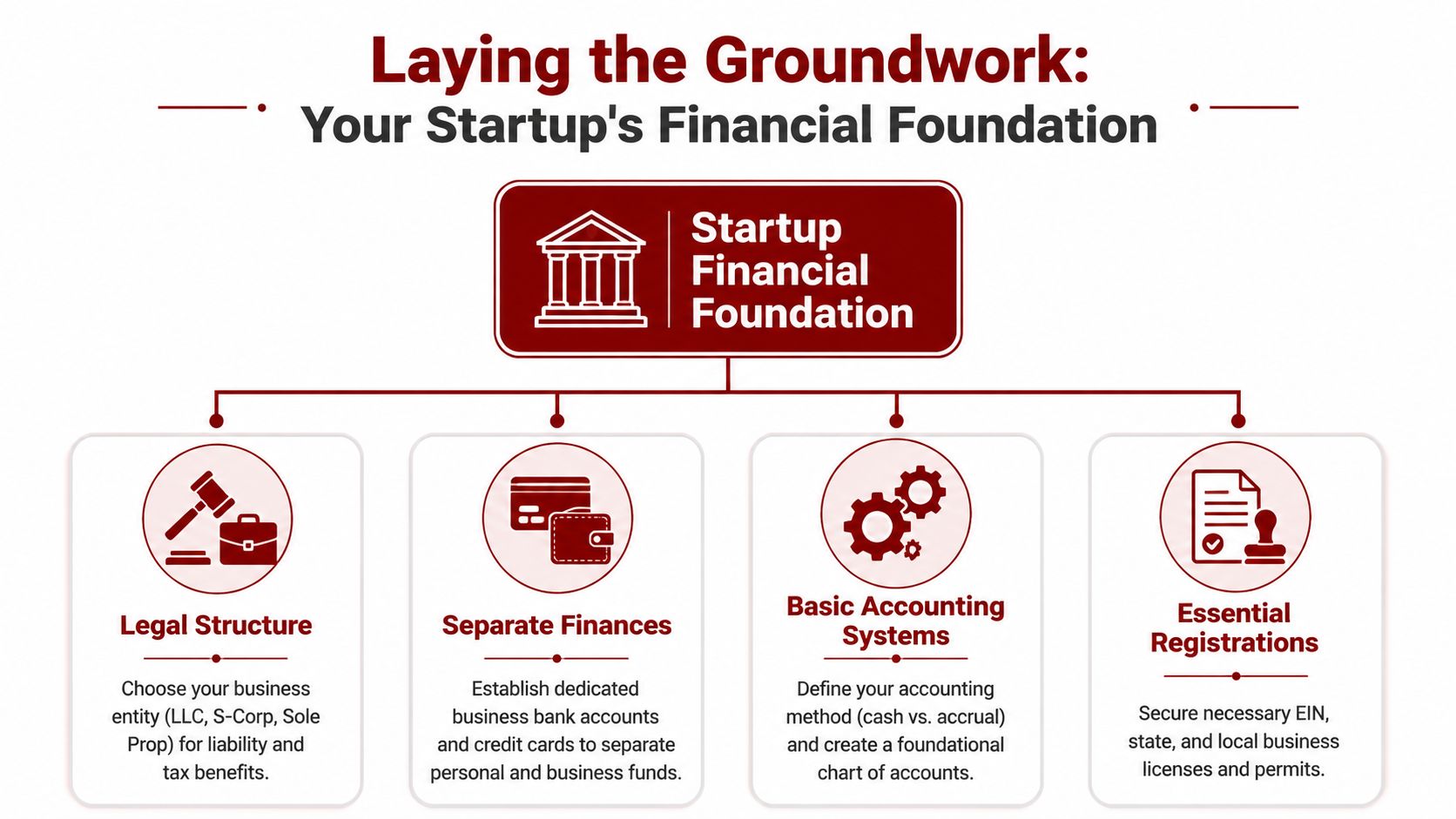
The first mistake most founders make is trying to tidy up later. Later is expensive. Once the business is already taking payments, paying suppliers, and pushing money through personal cards, the clean-up takes longer than setting things up properly from the start.
Separate the money before you separate the tasks
A dedicated business bank account is the first move. It keeps company funds away from personal spending, makes reconciliation possible, and gives you a cleaner audit trail when HMRC asks for evidence. A practical UK guide recommends linking every transaction back to its source document, keeping a clear chart of accounts, and keeping business banking separate from personal activity (Consultefc).
That structure matters because bookkeeping accuracy is tied to record-retention rules. Accounting and company records generally must be kept for six years from the end of the financial year in the UK, so the system you build now needs to be searchable later, not just readable in the moment.
Build a simple chart of accounts
A startup chart of accounts should be boring in the right way. Keep it tight enough to be useful, but not so thin that everything gets dumped into miscellaneous. Revenue, software, subcontractors, travel, marketing, and professional fees are usually enough to start with. If the business is in construction, split labour, materials, and subcontractor costs cleanly so CIS records are easier to track.
Practical rule: if a category would embarrass you in an investor deck, it is probably too vague for the chart of accounts.
Legal structure also changes how records are kept. A sole trader does not face the same corporate paperwork as a limited company, and the record trail changes with that choice. If you are deciding which route fits your plans, this limited company vs sole trader guide is a sensible starting point.
Set the rules before the first transaction
Before trading properly, lock down three things. Decide who enters transactions, who approves payments, and where receipts live. The goal is to stop founders and staff from inventing process as they go, because that is how the books drift away from reality.
Record the source document near the transaction date, not weeks later. That habit saves hours when VAT, payroll, or HMRC queries arrive. For payroll software choices, LeaveWizard's recommendations for UK payroll can help if you want to compare tools without getting buried in feature noise.
Choosing Your Tech Stack and Getting It Right
A startup's software stack is a control decision. If the bookkeeping platform does not connect bank feeds, invoices, approvals, and reporting properly, you end up correcting the same errors by hand every month. That is wasted time, and it becomes harder to manage once payments, payroll, VAT, and investor reporting begin to overlap.

Choose for fit, not for hype
QuickBooks, Xero, FreshBooks, Zoho Books, and ClearBooks all have different strengths, so the right choice depends on how your business runs. Service businesses usually care most about invoicing and client communication. Product-led startups tend to care more about integrations, bank feeds, and reporting that can grow with the finance function.
A London construction startup has another layer to think about. If CIS is part of the model, the stack needs to handle subcontractor records cleanly, because messy software makes CIS reporting harder than it needs to be. The same applies when VAT is close at hand, because the platform should support accurate coding rather than hide it behind a friendly dashboard.
If payroll is already in play, use a tool that works properly with payroll software and your accountant's workflow. For a useful comparison point on payroll tools, LeaveWizard's recommendations for UK payroll can help you think through the setup without getting lost in feature noise.
Configure the system properly on day one
Do not just sign up and hope it sorts itself out. Link the business bank account, set VAT correctly if you are registered, create invoice templates that show the right legal and payment details, and decide who has approval rights. If staff can spend, they need a policy attached to those permissions, not a verbal reminder in Slack.
The other test is whether your accountant can work inside the system without constant exports and reformatting. That is where cloud accounting wins, because it reduces the friction between day-to-day trading and month-end close. If you want outside support at this stage, our cloud accounting services are often the cleanest handoff point between founder-led admin and professional oversight.
Keep the software close to the workflow
The best systems sit in the background and do their job. Bank feeds pull transactions in, invoices go out quickly, and documents are attached to the right entries without a chase. Once a platform turns into a dumping ground for uncoded transactions, it creates more work than it saves.
A founder should be able to see whether the numbers are ready for a lender, an investor update, or a VAT return without rebuilding the file first. That matters in London startups that are trying to prove discipline while they are still hiring, spending, and chasing growth milestones. Good bookkeeping software should support that story, not complicate it.
If you are comparing tools for the wider finance stack, keep the setup practical and not flashy. A small business can get good results from a simple system if the permissions, bank feeds, VAT handling, and reporting are configured properly from the start.
Building Your Day-to-Day Bookkeeping Rhythm
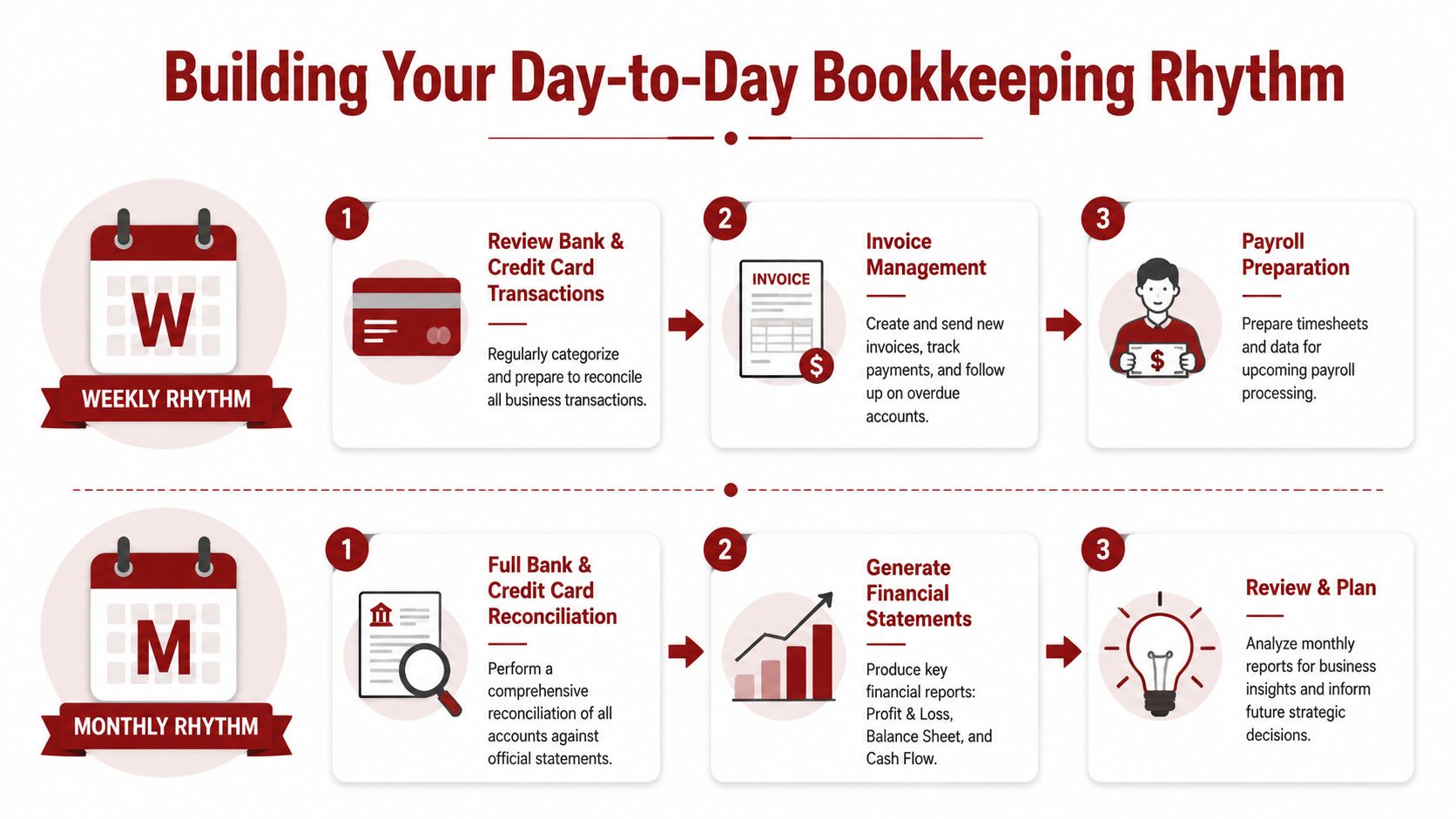
Bookkeeping falls apart when founders treat it like a rescue job. It works when it becomes a rhythm. A startup that codes transactions as they happen, reconciles regularly, and closes the month properly is far less likely to be blindsided by hidden liabilities or cash gaps.
Weekly work that keeps the month sane
Daily or weekly capture is the practical benchmark for expenses and transactions, while formal reconciliation should happen on a monthly cadence. In plain English, don't wait until the end of the quarter to ask what half your card spend was for. For a London startup, that early habit also helps when VAT treatment, contractor payments, or CIS deductions need checking before the figures are filed or shared with investors.
Use the week for transaction coding, invoice checks, and payment follow-up. If a customer is late, chase it before the debt becomes normal. If a contractor submits an expense claim without a receipt, park it until the evidence arrives. That small discipline stops the books from becoming a pile of assumptions.
Monthly close is where the truth shows up
A UK startup bookkeeping control cycle should include bank and credit card reconciliation, chasing outstanding invoices, capturing and coding expenses, updating VAT records, and producing a profit-and-loss statement. That monthly close is where aged receivables, unreconciled items, and tax liabilities surface before they distort management accounts.
Practical rule: if the bank doesn't match the books, don't move on. Fix the difference before you trust any report that comes after it.
The month-end review should also tell you whether the business is tightening or loosening its cash position. A lot of founders watch revenue and miss the timing of collections, which is how profitable companies still run short of money. Clean reconciliation keeps that from happening in silence, and it gives you a cleaner base for lender conversations, board updates, and the kind of growth milestones that matter when funding is on the table.
Invoicing and expenses need policy, not memory
Invoices should go out promptly, with a fixed naming convention and a clear due date. Expense capture should be immediate, ideally from a mobile app so receipts are attached before they vanish. Team policies matter here, because staff will follow whatever process is easiest, even when it's a bad one.
Keep one simple standard. Every business spend needs a source document, a category, and a purpose. If that sounds basic, good. The most reliable startup finance systems are built on basic things done consistently. For a fuller walkthrough of the fundamentals, see our guide on how to do small business accounting.
Navigating UK Compliance VAT Payroll and CIS
London startups usually meet compliance in stages. First VAT, then payroll, then, for founders in construction, property, or development work, CIS starts demanding more detail than a generic bookkeeping template can handle. Treat each obligation as a trigger linked to growth, not as an abstract legal risk.
The UK bookkeeping market's size is a useful clue. In 2026, the UK bookkeeping industry is estimated at £6.8 billion, which shows that outsourced bookkeeping is a standard operating expectation for many businesses, not a niche fix.
VAT and payroll become operational milestones
VAT changes how you record sales, purchases, and supporting evidence. Payroll changes how you handle employee payments, National Insurance, and pension admin. Once the first employee joins, bookkeeping stops being only a record-keeping exercise and becomes part of a wider compliance workflow.
Source documents matter because they make HMRC review easier to handle. Invoices, payroll records, and bank entries should all trace back quickly to the original evidence. The bookkeeping habit you build in the early months directly affects how much stress you feel later, and it also affects how confidently you can speak to lenders or investors when cash flow and controls are under review.
CIS needs its own discipline in London
CIS catches many construction-linked startups out. If you act as a contractor, subcontractor records need to stay tight and deductions need to be handled properly. If you work as a subcontractor, invoices, verification details, and payment records need to line up cleanly with what the contractor reports.
Local experience matters in London because CIS often sits alongside VAT and payroll in the same month-end process. A generic bookkeeper may know the software but miss the sequencing that keeps the records aligned. That is especially true when a startup sits between consultancy, fit-out, and development work, where the paperwork trail can get messy fast.
HMRC doesn't care that the records are “almost right”. It cares whether the numbers and supporting documents line up.
If you are unsure where your obligations begin, map them to actual activity, not to company size alone. Hiring, invoicing, and subcontracting each create different bookkeeping consequences, and those consequences should sit inside your monthly process from the start. That discipline also helps when you are speaking to funders about growth milestones, because clean records make it easier to show that the business can scale without compliance issues slowing it down. For founders who want a closer look at how reporting ties into investor readiness, see Gritt.io for Business Intelligence funding.
From Bookkeeping to Business Intelligence
Once the books are clean, the value shifts. You're no longer just proving that the records are correct. You're using them to decide whether to hire, raise, cut spend, or delay a launch.
Reports should answer operational questions
A profit and loss statement tells you whether the business made or lost money over a period. A balance sheet shows what the company owns and owes at a point in time. Those two reports are useful because they turn transaction noise into a view of performance and position.
For startups, cash is still the main test. A business can look busy and still run into trouble if collections lag or spending outruns receipts. The accounting data only becomes useful when it helps you see that pressure early enough to do something about it.
Outsource on triggers, not emotion
The move away from DIY bookkeeping usually happens when transaction volume, payroll, and reporting needs start to collide. A UK-focused provider's pricing signals make that pretty clear, with pre-revenue startups often sitting around £200 to £400 per month, seed-stage companies with 10 to 30 employees around £400 to £900, and post-Series A businesses at £900+ as complexity rises (AccountUp). That doesn't mean every business should outsource at the same point, but it does highlight common inflection points.
Use a simple framework when deciding between doing it in-house and outsourcing.
| Factor | DIY / In-House | Outsourced |
|---|---|---|
| Transaction volume | Manageable when low and simple | Better when entries pile up quickly |
| Payroll | Possible for very small teams | Cleaner when staff and filings expand |
| VAT and CIS | Feasible with discipline | Safer when deadlines stack up |
| Management reporting | Basic reports only | Stronger monthly insight and review |
| Founder time | Cheap in cash, expensive in hours | Frees time for sales, product, and funding |
Bookkeeping should support funding conversations
If you're raising money, the books need to do more than stay tidy. Investors want to see clean management accounts, consistent records, and a finance function that doesn't break under pressure. If you're looking for investors in business intelligence or adjacent areas, Gritt.io's UK investor search for business intelligence is a practical place to understand the kind of environment financial clarity has to support.
That's the ultimate goal. Good bookkeeping helps you survive compliance, but excellent bookkeeping helps you explain the business, defend the numbers, and grow with fewer surprises. If your records are already getting hard to manage, Action Accountants Limited can take over the bookkeeping, VAT, payroll, and reporting side so you can focus on building the company.