


You're probably at the point where the business is still yours, but it no longer feels small. The invoices are more regular, clients are asking awkward questions about VAT or a company number, and you've started wondering whether the current setup is helping you or holding you back. That's the moment most owners begin looking at the sole trader to limited company move, not because it sounds clever, but because the structure they started with has begun to creak.
The mistake many guides make is to treat incorporation like a switch. It isn't. It's a change in legal form, a change in how money moves, and a change in how the existing trade is transferred into a new entity.
Table of Contents
- Why Sole Traders Consider Switching to a Limited Company
- When Incorporation Pays Off
- Registering the Company and Telling HMRC
- Transferring the Trade, Assets, and Goodwill
- Rebuilding Payroll, VAT, and CIS From Day One
- Common Pitfalls and How to Avoid Them
- Your Pre-Switch Checklist and Next Steps
Why Sole Traders Consider Switching to a Limited Company
A sole trader usually reaches the turning point for one of four reasons. The work grows, the contracts get more formal, the risk gets more obvious, or the tax bill starts feeling too close to the profit. Once clients want a company registration, a VAT number, or a cleaner paper trail, the old “just invoice and bank it” model stops fitting neatly.
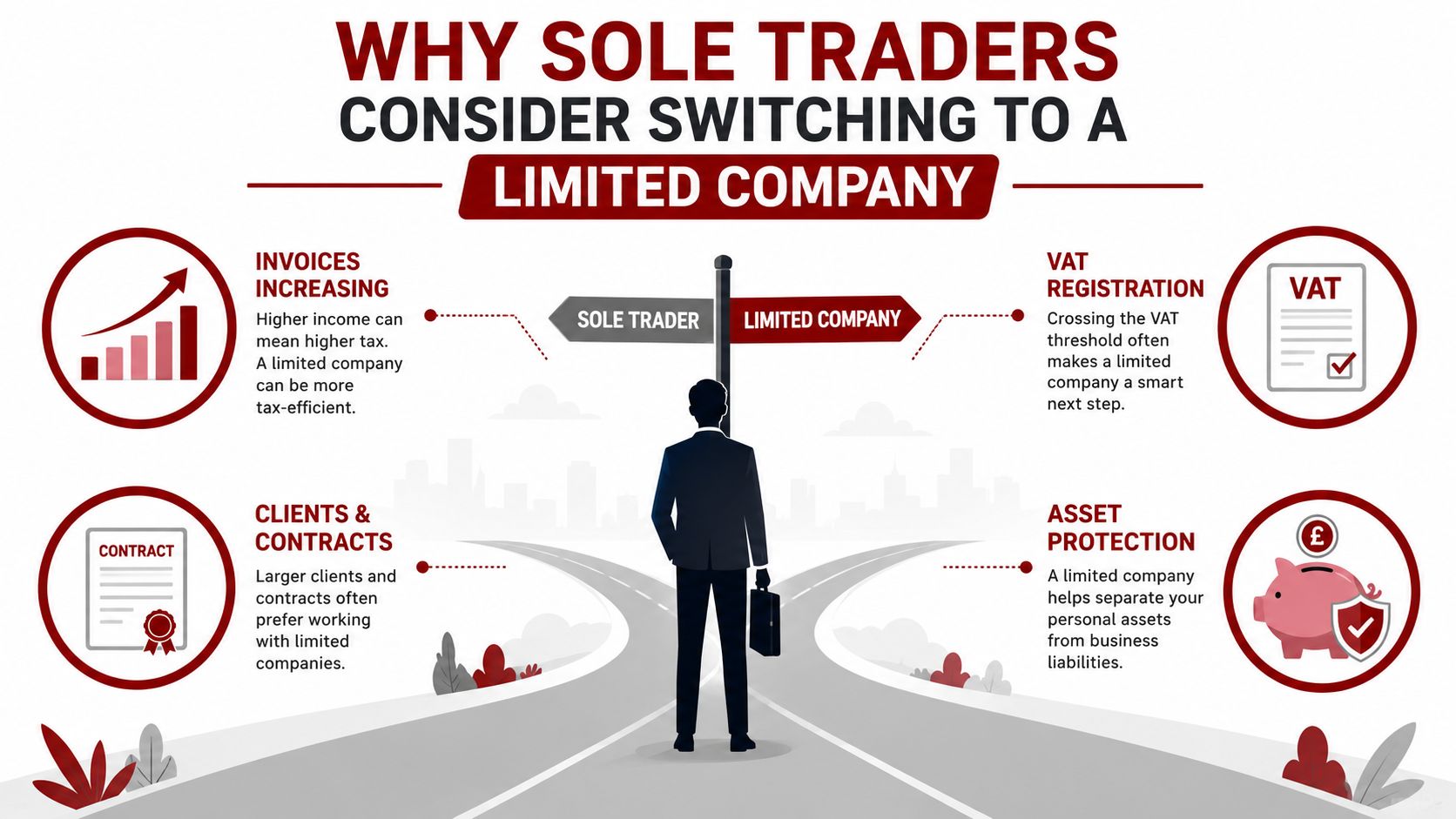
The legal difference matters more than people expect. A sole trader is the same person as the business for tax and liability purposes, while a limited company is a separate legal entity. That means contracts, assets, bank accounts, and responsibility for debts all sit differently once you incorporate, which is why the move isn't a cosmetic rename.
What usually triggers the switch
In practice, I see the same signals again and again. A contractor gets asked for a company name on the next tender. A consultant wants to separate business cash from personal spending. A landlord starts thinking about how the portfolio is held. A tradesperson gets tired of every pound landing in the same personal account and wants a structure that supports growth.
Practical rule: if the business has outgrown a notebook-and-bank-transfer approach, the structure probably needs to change too.
The UK business population data shows this isn't a fringe choice. At the start of 2025, the UK had 5.7 million private sector businesses, with 3.2 million (57%) sole proprietorships and 2.1 million (37%) actively trading limited companies, according to the government's business population estimates government business population estimates 2025. Over the longer run, companies have grown much faster than sole proprietors, which points to incorporation becoming a mainstream route for owners planning to scale.
For sole traders who still need to finalise historic tax records before changing structure, a clear guide to sole trader tax returns helps check the end of the self-employed period and make sure nothing is left hanging before the switch.
The key point is simple. Incorporation is not just about tax. It changes how the business is owned, how contracts are held, and how money can be taken out later.
When Incorporation Pays Off
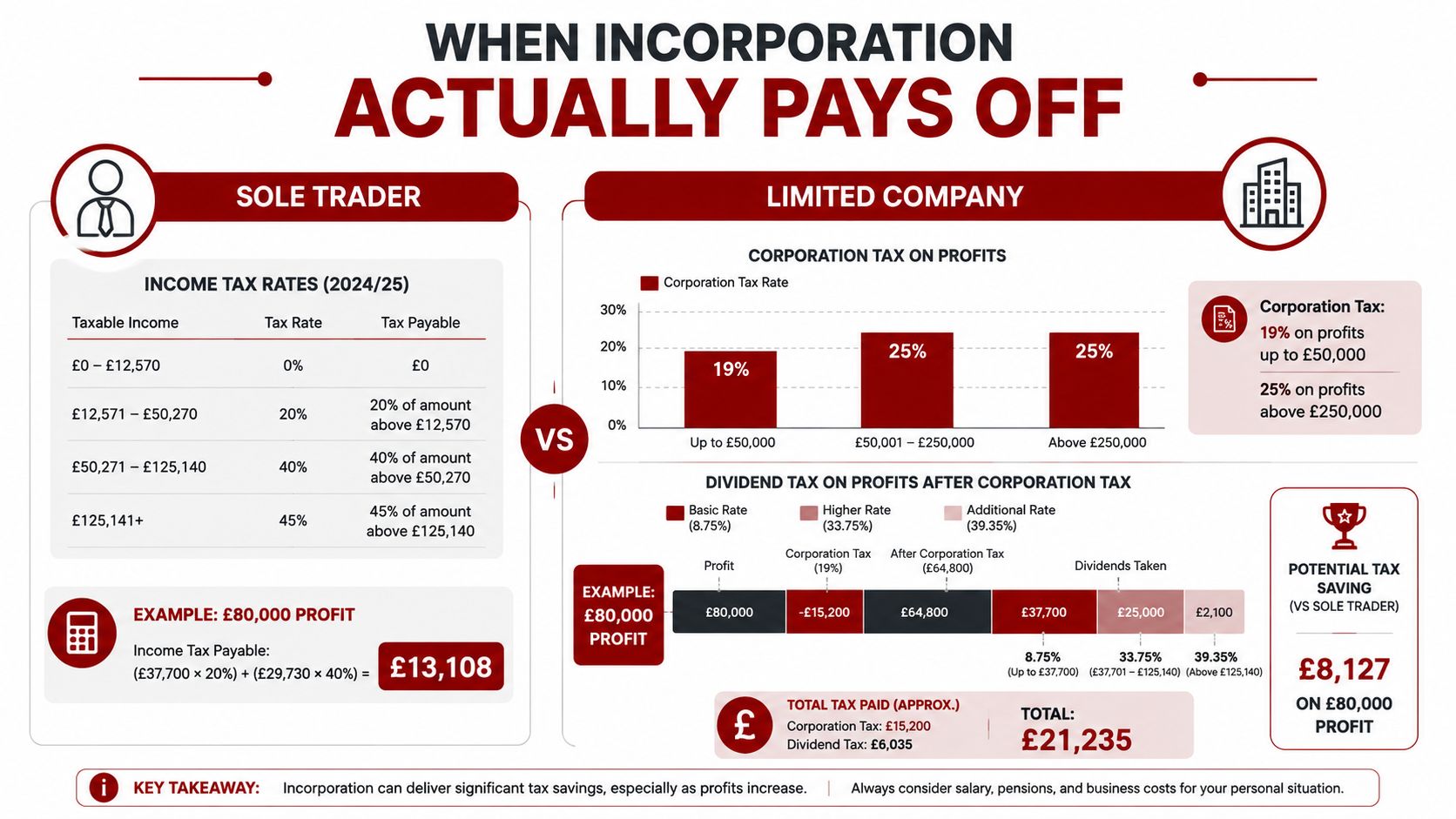
The most expensive mistake is assuming a company is always the cheaper option. It isn't. A limited company brings Corporation Tax, dividend planning, payroll, confirmation statements, separate bookkeeping, and the admin of keeping everything clean. Those costs only start to make sense once the profit level and business profile justify them.
At a headline level, the UK corporation tax framework is tiered. The small profits rate is 19% on profits up to £50,000, the main rate is 25% above £250,000, and profits in between are marginally relieved, so the benefit depends heavily on how much profit you keep in the company HSBC UK on sole trader vs limited company. That is why the old one-line answer, “go limited when you earn more”, does not hold up on its own.
The honest way to think about the numbers
A sole trader keeps all profits directly, but pays personal tax on those profits. A company pays tax on its profit first, then the owner takes money out through salary, dividends, or both. Once you add accounting fees and company admin, the company only wins if the tax structure and the level of profit outweigh the extra running costs.
The test is how the business behaves in practice. If profit is rising but still unpredictable, the company may add paperwork without delivering much savings. If the business produces steady profit and some of that money can stay inside the company, incorporation becomes easier to defend.
A rough comparison helps. At around £40,000 of annual profit, incorporation may start to look attractive, but only if the director is disciplined about drawings and the business does not create unnecessary costs. At around £90,000, the company structure often becomes easier to justify because the gap between sole trader tax and a planned company extraction method usually becomes more obvious, especially if profit is not fully withdrawn every month.
| Profit profile | Sole trader view | Limited company view |
|---|---|---|
| Lower mid-range profit | Simpler, less admin | May save less once fixed costs are counted |
| Higher profit | Personal tax pressure rises | More room for salary, dividends, and retention |
A company is only efficient when you use the structure properly. If you mix business and personal spending, the tax advantage disappears fast.
For owners comparing their options against real-world running costs, the 2026 online business tax guide is useful because it sets out the trade-offs without dressing them up.
The honest conclusion is that incorporation is a threshold decision, not a reflex. If profits are still uneven, or if the business is too small to absorb the cost of extra compliance, staying put can be the sensible move. If profits are solid and the work is becoming more formal, the company structure usually starts earning its keep.
Registering the Company and Telling HMRC
The filing itself is usually the straightforward bit. The work is making sure the company exists properly in law, then telling HMRC at the right time so the handover does not drift into a tax mess.
The clean sequence
Start with the company name, then file the incorporation at Companies House. If you do it online, the standard filing fee is £50, and you will need the formation details, including the SIC code and articles how to register a new business. Once the company exists, open a separate business bank account and use it from day one, because the company is a separate legal entity and its money should stay apart from your personal funds.
Operational rule: if the company has started trading, the personal account should stop being the default landing point immediately.
Once incorporation is complete, the company must be registered for Corporation Tax within three months of starting to trade, and that is the deadline that gets missed most often during rushed transitions Sleek UK on sole trader to limited company. VAT and PAYE can sit in the same danger zone, especially where the owner assumes the incorporation filing has already handled every tax job in one go.
I have seen DIY filings work perfectly well for simple setups, but a formation agent or accountant becomes far more useful once there are existing contracts, VAT registration, or payroll to set up. If the old sole trade keeps trading while the company starts billing too, the overlap makes it harder to show which entity earned which income, and that is where avoidable errors start.
For owners who want a practical walk-through of the new-company setup, the how to register a new business guide is a useful companion while the paperwork is being assembled. The aim is not just to form a company. It is to form the right one, then tell HMRC about it in the right order.
Transferring the Trade, Assets, and Goodwill
This is the part too many articles skate past. Incorporation is not finished when the company certificate lands. The old trade has to be transferred into the new company as a legal and tax event, which means recording what is being handed over, what it is worth, and who owns it from that point on.
What moves across
The usual items are stock, equipment, work in progress, intellectual property, trading contracts, and goodwill. If the values and terms are not written down, confusion follows later, especially where the business has material goodwill or customer relationships Tinytax on transferring a sole trade into a limited company. HMRC will care less about labels and more about whether the transfer is supported by evidence.
A simple example makes the point. Say the business transfers £25,000 of stock and equipment into the new company, along with £40,000 of goodwill. That transfer needs a defensible valuation and a written record showing what the company received and what consideration the owner got back. In practice, that consideration is often tracked through a director's loan account until shares or other agreed value settle the position.
Why the paperwork matters
A written transfer agreement does two jobs. First, it shows the trade was moved, not just restarted under a new name. Second, it creates an audit trail if HMRC asks why an asset was moved at a particular value or why goodwill was recognised at all.
Incorporation relief may apply where the whole business is transferred for shares, but it only becomes relevant if the structure is right and the transaction is documented properly Tinytax on transferring a sole trade into a limited company. That is why the transfer step needs an accountant who understands valuations, not just filing forms.
Before any asset list is finalised, business valuation guidance is worth reviewing so the figures are not based on guesswork. The practical rule is simple. If you cannot explain the transfer on paper, do not assume it will be tidy in tax terms.
Keep this clean: values, ownership, and consideration should all line up before the first company invoice goes out.
Rebuilding Payroll, VAT, and CIS From Day One
Once the trade moves, the compliance stack has to be rebuilt. That does not mean panic filing or starting blind, but it does mean the company needs its own payroll, VAT position, and sector registrations from day one.
Payroll, VAT, and the company's own records
If the director is taking a salary, a PAYE scheme should be in place and the payroll run should be linked to the company, not the old self-employed record. Mixed banking is a common cause of muddled payroll entries, which is why a separate bank account and clean bookkeeping matter so much. For VAT-registered businesses, the registration itself may continue to sit with the same trading activity, but the invoices now come from the company, so the paperwork, VAT returns, and named supplier details need to match the new entity. If the old sole trade and the new company are treated as if they are the same trader, the records quickly stop lining up.
If you are deciding whether the services you sell need a particular VAT treatment, VAT on services is a useful reference point while the company is being set up. The first month is where errors happen, because owners often assume old habits can carry over unchanged.
CIS and landlord points that need early attention
For construction contractors and subcontractors, the new company will need its own CIS setup and its own UTR. You cannot rely on the old sole trader position continuing as though nothing changed. The right payroll processing workflow matters too, and a practical overview such as payroll processing for security teams is a useful reminder that payroll systems only work when worker status, pay runs, and deductions are set up correctly from the start.
Landlords need a different kind of review. If rental income is moved into a company, the mortgage interest position changes, and stamp duty and ATED questions may come into play depending on the asset and structure. VAT can also become awkward where the company is providing services or recovering costs in a way that did not apply to the sole trade, so the treatment needs checking before invoices start going out. That is the point where tax, property, and finance advice should meet, rather than being dealt with in separate silos.
If there is one place where specialist help pays for itself, it is the week after incorporation. A clean payroll setup, the right VAT approach, and the correct CIS or property treatment stop small filing mistakes from turning into avoidable correction work later.
Common Pitfalls and How to Avoid Them
Most problems are not dramatic. They're administrative. That's why they're so common, and why they're so irritating to fix after the event.
The mistakes that keep showing up
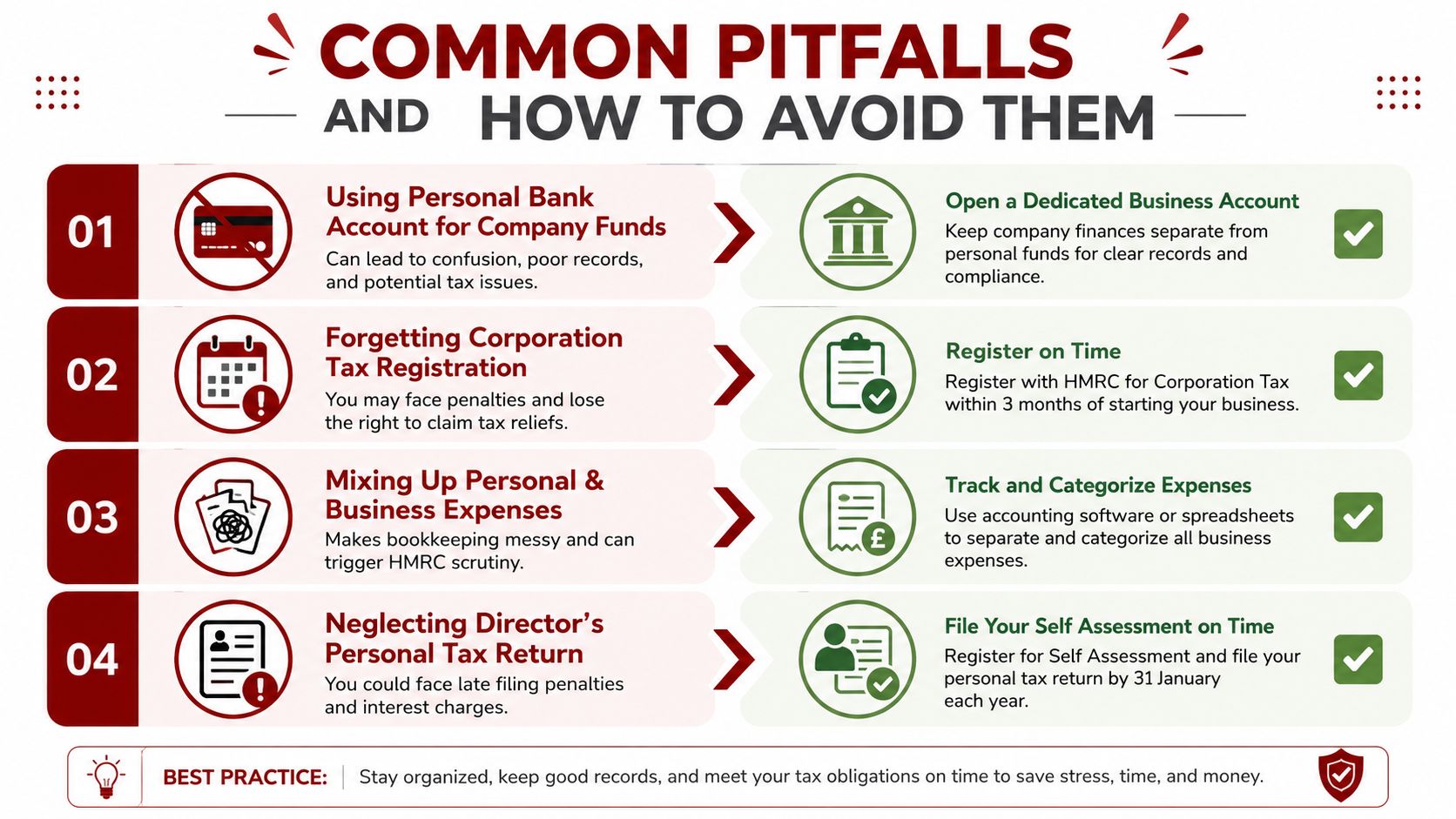
- Using the personal account for company income. This usually means the owner wanted speed, then forgot to separate money later. Open the company bank account first and route everything through it.
- Missing the Corporation Tax deadline. If the company has started trading, the three-month window matters. Put the notification on the incorporation checklist, not on a later reminder.
- Treating the company as a continuation of the sole trade. The legal entity has changed, so contracts, invoices, and bookkeeping need to reflect that from the start.
- Leaving the final Self Assessment unfinished. The sole trade doesn't disappear just because the company exists. The pre-cessation profit still has to be reported properly.
There are two sector-specific traps that deserve extra attention. For CIS contractors, unpaid deductions can sit against the wrong UTR if the switchover isn't handled cleanly. For landlords, moving rental income into a company can change the mortgage interest position and remove some reliefs that were available in the personal name.
Recognition cue: if you're still using the old bank card, old invoice template, and old HMRC references after incorporation, the transition isn't finished yet.
The fix is boring but effective. Separate the money, update the registrations, file the final sole-trader return, and make sure the company's records stand on their own. Anything less invites rework.
Your Pre-Switch Checklist and Next Steps
Before you incorporate, answer the questions that affect the decision. What level of profit are you making, how much do you draw, do your clients require a company, and does your risk profile justify separating the trade from your personal position? If you're a contractor, landlord, or family business, those questions matter more than the headline idea of “going limited”.
What to gather before the meeting
- Profit and drawings figures. Know what the business has really been making and what you've been taking out.
- Transfer paperwork. Prepare asset lists, draft valuations, and a simple cessation note for the sole trade.
- Registration list. Confirm Companies House, Corporation Tax, PAYE, VAT, and CIS where relevant.
- Banking and bookkeeping plan. Decide who opens the company account, who runs payroll, and who keeps the records tidy.
For owners who still need help thinking through the launch side after incorporation, a practical 90-day startup marketing roadmap can help align the business setup with the first period of trading.
The timing rule stays the same. Incorporate first, open the company bank account second, move the trade third, file the final sole-trader return fourth, and keep personal and company money visibly separate from day one. That sequence is what keeps the transition understandable to HMRC, your accountant, and you.
Incorporation is paperwork with consequences, not a leap in the dark. If you want a clean switch, with the valuations, registrations, and transfer documents handled properly, Action Accountants Limited can help you map the move and keep the new company compliant from the start.