


You've got the shoebox, the email receipts, the bank feed you meant to tidy up in May, and the 31 January deadline staring at you like it's personally offended. That's the normal state of affairs for a lot of sole traders, and the mistake many make is treating the return as a once-a-year scramble instead of a year-round job. The practical truth is simple, tax returns for sole traders are manageable when the records are clean, the forms are right, and the filing rhythm is locked in early.
Table of Contents
- What Sole Traders Need to Know Before Filing Season
- Keeping the Right Records All Year Round
- Allowable Expenses That Reduce Your Tax Bill
- Calculating Taxable Profit and National Insurance
- Making Tax Digital for Income Tax in 2026
- Deadlines, Payments on Account and Penalty Traps
- When to Hire an Accountant Instead of Going Solo
What Sole Traders Need to Know Before Filing Season
A first-year sole trader usually finds out too late that the return is more than a form, it is a sorting exercise. I've seen people turn up in late January with a carrier bag of receipts, a half-working spreadsheet, and no clear idea whether they needed SA103S or SA103F. That mess is avoidable if you start in the right order, register properly, and gather the right pages before HMRC becomes the loudest voice in the room.
Start with HMRC, not the spreadsheet
If you're trading on your own, you need to register for Self Assessment with HMRC and get your Unique Taxpayer Reference, or UTR. That is the key to the return. Without it, you are not filing properly, you are improvising.
The tax year runs from 6 April to 5 April. Your return covers that period, not the calendar year, so your bank statements and invoices need to follow HMRC's timetable, not your own. If you want a clean registration route, use this practical guide to registering for Self Assessment.
Practical rule: register as soon as you know you've crossed into self-employment. Waiting until filing season is how people create avoidable pressure for themselves.
There's a threshold people keep muddling. The £1,000 trading allowance matters for deciding whether small bits of income can sit outside a return, but it does not give you a free pass to ignore your obligations when HMRC expects a filing. GOV.UK's rules are clear that you must send a return if your income cannot be fully covered by the trading allowance, or if HMRC asks you to file (HMRC who must send a tax return).
Use the right return pages from day one
The structure is straightforward once you stop overcomplicating it. You complete the SA100 main return, then add SA103S for the short self-employment pages or SA103F for the full version, depending on how complex the business is. If you also have property income, employment income, or capital gains, you may need extra supplementary pages as well.
That matters because the wrong form does not just waste time, it creates corrections. A mixed-income client can file the wrong pages, then spend weeks fixing an incomplete return while the deadline keeps moving. That is why a self-employment-only assumption is dangerous. If the facts include rent, a day job, or asset disposals, the return needs to reflect all of it.
Here's the clean way to approach it:
- Register with HMRC and secure the UTR.
- Identify every income source before you touch the return.
- Choose SA103S or SA103F based on the actual business setup.
- Add supplementary pages for anything outside trading income.
- Reconcile records before 31 January, not after.
For clients with awkward mixtures of freelance work, side income, and property, I've found that a structured intake helps more than another spreadsheet ever will. If you need a digital triage tool for collecting responses and supporting documents, multilingual survey software can make that intake process less messy than email chains and scattered notes.
A simple return is rarely the problem. A return built on the wrong assumptions is. If your business is straightforward, Self Assessment is routine. If it isn't, you need the paperwork mapped before the numbers go in.
Keeping the Right Records All Year Round
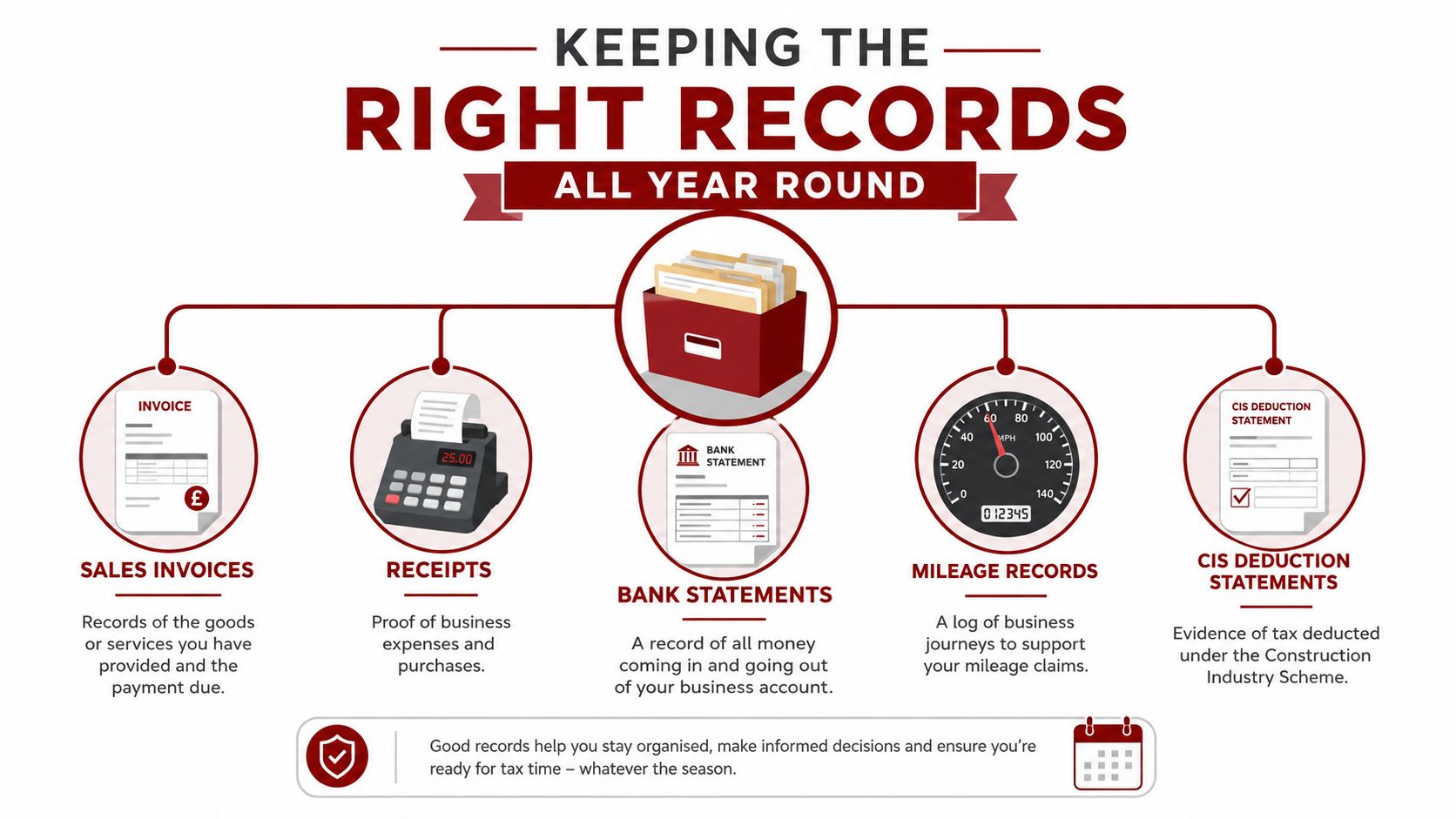
A sloppy record trail turns a tax return into guesswork. HMRC expects the figures to link back to invoices, receipts, bank statements, mileage logs, and CIS deduction statements where they apply. If you leave that trail until January, you are making a simple filing job harder than it needs to be.
Keep the evidence, not just the totals
A bank total on its own proves very little when you need to justify income or expenses. Keep the invoice, the receipt, and the matching bank line together, and you can answer questions quickly instead of rebuilding a year from memory. That is the difference between a return you can stand behind and a mess you have to tidy up later.
Paper folders still work for some sole traders, but they are clumsy and easy to lose. A cloud bookkeeping system linked to bank feeds gives you a live record trail and cuts the risk of receipts disappearing in a van, a glovebox, or under a printer. For many clients, that switch matters even more now because Making Tax Digital is turning record-keeping into a year-round workflow, not a once-a-year panic. Quarterly digital reporting will punish bad habits, but it also gives you cleaner numbers sooner and a better grip on cash flow.
That shift is already happening. HMRC-linked survey data show 65% of sole proprietors or partnerships liable for income tax self-assessment used record-keeping software in 2024, up from 61% in 2023 (sole traders tax returns and software use).
Keep one rule in your head. If you cannot prove it, do not expect to claim it.
A weekly routine solves most of the problem. Set aside fifteen minutes, upload the receipts, match the bank entries, and flag anything unclear while it is still fresh. In practice, that habit saves far more time than a year-end scramble, and it stops small omissions from turning into amended returns later.
If your filing still depends on inbox searches and a stack of crumpled receipts, get proper support. A practical bookkeeping service for sole traders is usually cheaper than the time you waste trying to piece everything together in January. For awkward intake and document collection, multilingual survey software can also keep client responses and supporting files in one place instead of buried in email threads.
What a complete record file looks like
A complete file does not need to be fancy. It needs to be usable when HMRC asks for the trail.
Keep these records together and in order:
- Invoices issued and received: show what was sold or bought, the date, and who paid whom.
- Receipts for expenses: prove the business purpose and the amount.
- Bank statements: help reconcile income and spending, especially where card records are thin.
- Mileage logs: record business journeys clearly, not just rough estimates.
- CIS deduction statements: keep these safe if you work in construction or subcontracting.
If those records are organised properly, your return stops feeling like a scavenger hunt. If they are not, you end up trying to reconstruct a trading year from scraps, and that is where avoidable errors creep in.
Allowable Expenses That Reduce Your Tax Bill
A sole trader return goes wrong in two ways. People claim private spending, or they leave legitimate costs out and hand money straight to HMRC. Neither is clever.
Start with the rule that matters: if the expense is wholly and exclusively for the trade, it belongs in the return. That is the standard, and it is the one HMRC will expect you to defend. A van's fuel for a tradesperson, software for a designer, or room hire for a tutor's workspace can all qualify if they are business costs.
The problem starts with mixed-use spending. Client meals are usually not ordinary business travel, and everyday clothing does not become deductible just because you wear it for work. If an item serves both personal and business purposes, split it fairly or leave it out. Anything less is asking for trouble.
Home working costs need the same discipline. Use a sensible method for business use of the home, or a simpler allowance route if it fits your facts. Do not dump household bills into the return and hope they pass without comment.
Evidence comes first, tax treatment second
The claim stands or falls on the records behind it. Keep the invoice for software, the receipt for materials, and the mileage log for travel. If a cost repeats every month or every quarter, keep it visible so the pattern is easy to follow.
If you want a quick sense-check before filing, use a practical guide to tax-deductible expenses for self-employed people. The rule is still the same. The expense has to be business-related, reasonable, and capable of standing up to scrutiny.
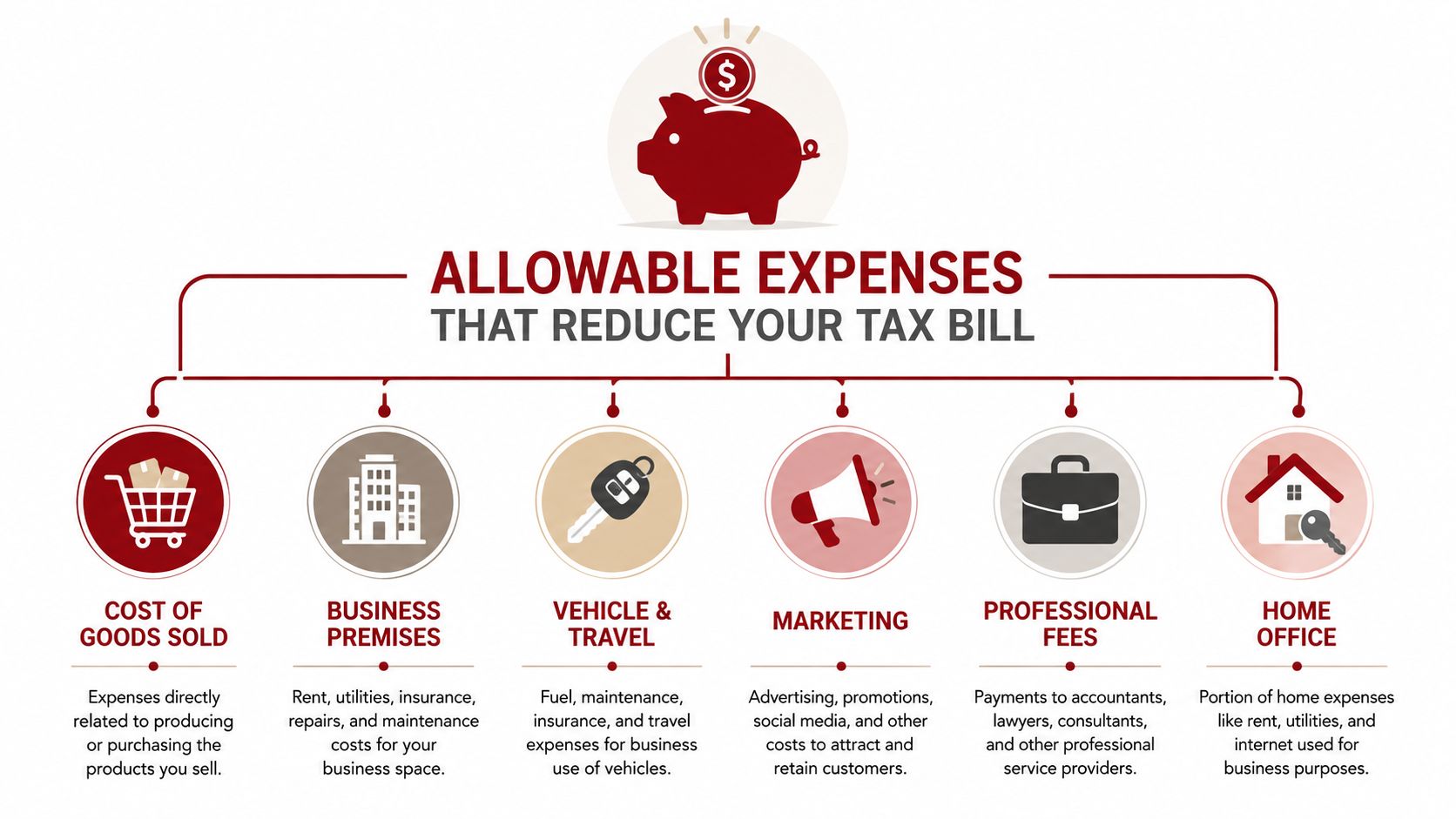
A clean way to organise the categories is this:
- Cost of goods sold: materials, stock, and direct supply costs.
- Business premises: rent for a workspace, utilities where relevant, and similar running costs.
- Vehicle and travel: business mileage, parking, and work-related travel.
- Marketing: advertising, website costs, and promotion tools.
- Professional fees: accountancy, legal, and relevant subscriptions.
- Home office: a fair share of costs tied to legitimate business use.
That approach keeps your return defensible and stops you paying tax on money you never had to begin with. Get it wrong, and January turns into a dispute over personal bills dressed up as business spending.
Calculating Taxable Profit and National Insurance
A lot of sole traders get this wrong at the start. Turnover is not profit. Your return starts with gross turnover, then subtracts allowable expenses to reach net trading profit, and that is the figure HMRC uses for the tax calculation.
Do the maths in the right order
Start with income, then take off the business costs. Do not blur the two together. HMRC expects the self-employment figures to be built from the expenses first and the taxable result second, which is why the order matters.
That profit figure then sits alongside any PAYE income from employment, if you have a job as well. Your tax is worked on the whole picture, not just the self-employed income. If you have salary income and sole trader income in the same return, both need to be entered properly or the calculation will be off.
The accounting basis matters too. Cash basis and accruals basis can give different answers, and choosing the wrong one is a common reason a return needs correcting later. Use the basis that fits the way the business runs, then stick with it.
National Insurance follows the profit figure
Once the taxable profit is known, Class 2 and Class 4 National Insurance may apply alongside Income Tax. I say this plainly because it is part of the cost of trading, and you should budget for it during the year instead of discovering it in January. Ignore it all year, and you create your own shock bill.
If you want a broader walkthrough of the process, the Making Tax Digital self-employed rules are the other piece to get straight, because the filing rhythm is changing as well as the numbers.
Here is the structure in plain terms.
| Band or Charge | Threshold or Rate | Notes |
|---|---|---|
| Trading profit | Income minus allowable expenses | Starting point for the return |
| Personal allowance | Applies before tax where available | Reduces taxable income |
| Income Tax | Based on the taxable income bands for the year | Applied after deductions |
| Class 2 National Insurance | Charged where the rules require it | Part of Self Assessment |
| Class 4 National Insurance | Charged on trading profits above the relevant threshold | Also collected through Self Assessment |
A worked example helps more than theory. If a sole trader turns over £60,000 and has £18,000 of allowable expenses, the net trading profit is £42,000. That number drives the rest of the calculation, along with any other income in the return.
Making Tax Digital for Income Tax in 2026
Making Tax Digital is not a footnote any more. For many sole traders, it is the biggest workflow change on the horizon, because it turns tax from an annual scramble into an ongoing digital process. HMRC's own guidance frames MTD for Income Tax as the new reporting route for sole traders and landlords with qualifying income (GOV.UK MTD for Income Tax collection).
The real change is the workflow, not the tax
From April 2026, sole traders with income above £50,000 come into MTD and must submit quarterly updates using compatible software (sole trader Self Assessment and MTD guide). The tax itself isn't reinvented, but the admin rhythm is. Instead of one big annual tidy-up, you're keeping digital records all year and sending updates every three months.
That shift is easier to handle if you stop thinking of bookkeeping as a back-office chore and start treating it as part of cash flow control. When you update the records quarterly, you spot profit trends earlier, which means the tax estimate stops being a shock at year-end. That's the advantage many sole traders miss.
Mixed-income sole traders need to pay even closer attention. If you've got more than one trade or rental income as well, you may need separate quarterly updates for each income source, which multiplies the admin. That's where MTD stops being an abstract policy change and becomes a practical workload issue.
A useful breakdown of the self-employed MTD rules is available in this guide to Making Tax Digital for sole traders. Read it with one question in mind, not “what is MTD?” but “how many records will I need to keep clean every quarter?”
Software choice decides whether this becomes painful
The software you choose matters because the system only works if the records are easy to capture and submit. Basic apps can suit a simple trade. More managed packages suit traders who want the bookkeeping and submissions handled together.
For a lot of clients, the win is not the software itself, it's the routine around it. If you're already late on reconciliations, a quarterly digital cycle will expose that weakness fast. If your records are clean, though, the quarterly rhythm can improve cash planning because you're looking at the numbers more often.
Quarterly reporting is not just compliance. Used properly, it gives you a better view of what you can afford to take out of the business.
[iframe width="100%" style="aspect-ratio: 16 / 9;" src="https://www.youtube.com/embed/_aPINA_tYw4" frameborder="0" allow="autoplay; encrypted-media" allowfullscreen>
Deadlines, Payments on Account and Penalty Traps
The deadline calendar is where good intentions fall apart. Too many sole traders know the January filing date and little else, then act surprised when a paper return, a balancing payment, or a second payment on account lands at the wrong time. Get the dates straight once and the process gets far easier to control.
Mark the key dates
The filing deadlines are straightforward. 31 October is the paper return deadline, 31 January is the online filing deadline and balancing payment date, and 31 July is the second payment on account if it applies (Self Assessment tax return deadlines and penalties). The filing route matters because the paper deadline arrives earlier, and relying on post when you should have filed digitally is a needless mistake.
Payments on account catch plenty of first-timers out. HMRC uses them to estimate future tax, so the system can feel like you are paying twice if you have not budgeted properly. If profits fall, you can apply to reduce them, but only if the lower figure is realistic. Do not guess low just to ease cash flow for a month.
For a clear explanation of how that cycle works in practice, use this guide to payments on account. If you owe tax through Self Assessment, the payment timing matters as much as the filing itself. For a broader overview of the rules around the return, this guide to self employed taxes keeps the basics in one place.
Know the penalty ladder before it bites
Late filing penalties are harsher than many new sole traders expect. HMRC starts with a £100 penalty straight away, then adds further charges if the return stays outstanding for longer, including daily penalties after three months and a more serious charge once the delay passes six months (Self Assessment tax return deadlines and penalties). Late payment is a separate issue, and people mix the two up all the time.
Late filing and late payment are distinct failures that HMRC treats differently. If you file on time but pay late, interest can still apply. If you pay on time but file late, you can still be penalised.
Here are the mistakes I see most often on real returns:
- Mixing personal and business spending: split dual-use items or leave them out.
- Forgetting small side income: declare it if it belongs in the return.
- Claiming the wrong share of home costs: apportion carefully, do not improvise.
- Losing CIS deduction statements: keep them, or your numbers get messy fast.
- Using the wrong accounting date: the return has to follow the correct tax-year basis.
The fix is usually boring, and boring is good. Keep one rule in mind, if a cost is business-related and you can prove it, claim it. If you cannot, leave it off and move on.
When to Hire an Accountant Instead of Going Solo
DIY filing works until it doesn't. If your turnover is climbing, your records are mixed, or you're planning to grow, the time you spend trying to stay compliant can easily wipe out the fee you thought you were saving. I'd use three tests. If two of these three apply, get help, turnover above £40,000, mixed income sources, or an active plan to expand.
The warning signs are usually obvious
The expensive mistakes are rarely glamorous. Wrong accounting basis, missed CIS deductions, late-payment interest, and a return built on incomplete records are the ones that create the most unnecessary pain. They do not usually happen because someone is careless, they happen because the business got busier and the filing system didn't keep up.
A decent accountant is not just there to press submit once a year. The value is in keeping MTD compliant, sorting CIS records if you work in construction, planning around tax before the bill arrives, and stepping in if HMRC opens an enquiry. That is a different service from “I'll do it on the 30th of January if I have time”.
If you want a practical option, Action Accountants Limited provides Self Assessment, bookkeeping, payroll, VAT, and CIS-aware support from North West London. That matters if your return is starting to look like a tangle rather than a straightforward trade.
If your tax return needs corrections every year, you do not have a filing problem. You have a systems problem.
The best time to hire help is before the return turns into a rescue job. If you're already spending evenings patching together records, the fee for proper support is usually cheaper than the cost of your own lost time and avoidable mistakes.
If you want your Self Assessment handled properly, with year-round bookkeeping, MTD setup, and no January panic, speak to Action Accountants Limited about a clean, compliant process for your sole trader business. Their team works with sole traders, contractors, and mixed-income clients who want straight answers, not guesswork, and they can help you get the next return right before the deadline starts chasing you.