
Tax Deductible Expenses for Self Employed: A UK Guide
Action Accountants •5 June 2026
You're probably doing one of two things right now. You've either got a pile of receipts on the kitchen table in Edgware, or you're scrolling through banking apps in Finchley wondering which payments HMRC will let you claim. That's normal. New sole traders and contractors across North West London hit this point every year.
The good news is that tax deductible expenses for self employed people aren't a loophole or some clever trick. They're part of basic tax hygiene. If you've spent money to run your business, you should usually get the right tax treatment for it. If you don't, you end up paying tax on profit you never really kept.
That matters to a lot of people. HMRC reported around 12.2 million Self Assessment taxpayers for the 2023 to 2024 tax year via Experian's summary of self-employed tax deductions. So if your return feels stressful, you're not the odd one out.
It also matters beyond tax. If you're trying to sort a mortgage after a couple of years trading, your figures need to be clean, consistent, and believable. A useful place to start is this EHF Mortgages self-employed guide, because borrowing and tax records often overlap more than people expect. The same goes for day-to-day business discipline. If you want better habits around money generally, this practical read on spending smart and growing fast is worth your time.
Table of Contents
- Your Guide to Lowering Your UK Tax Bill
- Understanding HMRCs Wholly and Exclusively Rule
- What Can You Actually Claim A Guide to Expense Categories
- Simplified Expenses or Actual Costs Which Method Is Best
- Capital Allowances CIS and Contractor-Specific Deductions
- Flawless Record Keeping and Claiming on Your Self Assessment
- Avoiding Common Mistakes and Optimising Your Claims
Your Guide to Lowering Your UK Tax Bill
A builder in Kingsbury buys screws, blades, gloves, fuel, and phone data every week. A consultant in Colindale pays for software, train fares into client meetings, and part of the broadband at home. A designer in Hendon works from the spare room and forgets half the subscriptions they use for work. Same problem, different trade. They all risk missing claims they're entitled to.
My view is simple. If you're self-employed, you should stop thinking about expenses only in January. Treat them as part of pricing, cash flow, and survival. North West London isn't cheap. Rent is high, travel adds up, and subcontractors often have awkward payment patterns. If you ignore allowable expenses, you're making business harder than it needs to be.
What this really means in practice
You're trying to answer three questions:
- What counts as allowable: Not everything you buy can go through the business.
- What needs splitting: Some costs are part business and part personal.
- What needs stronger records: If HMRC ever asks, you need to show your workings.
Good expense claims aren't aggressive. They're organised.
For new sole traders, that's the shift. Stop guessing. Start classifying. Once you do that, your tax bill usually becomes more manageable and far less mysterious.
Understanding HMRCs Wholly and Exclusively Rule
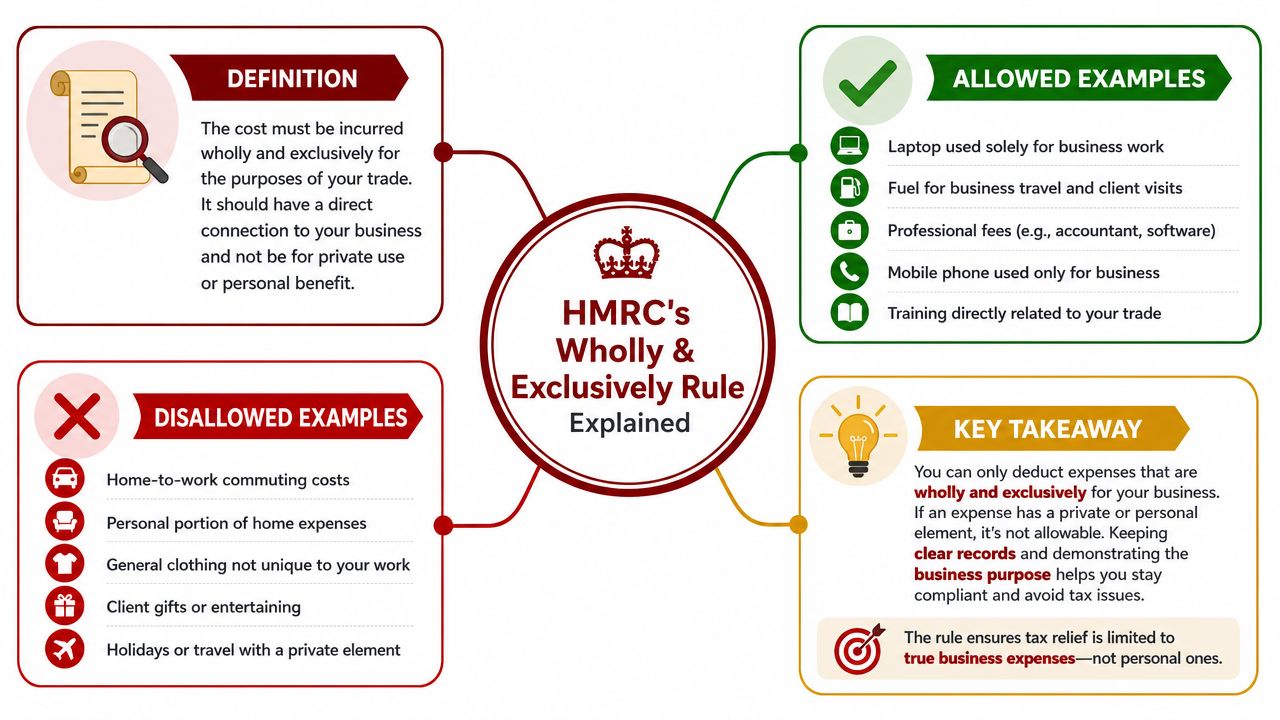
If you remember one rule, remember this one. HMRC's core test for sole traders is whether an expense is incurred wholly and exclusively for the trade, as explained in Deel's summary of common deductions and HMRC treatment.
That sounds legalistic, but it's not complicated once you strip the jargon out. I tell clients to think of each expense as needing to wear a work uniform. If the cost is clearly dressed for business, it usually belongs in your accounts. If it's plainly personal, it doesn't. If it's wearing half a uniform and half weekend clothes, you can usually only claim the business part.
Pure business, pure private, and mixed use
Here's the clean version.
- Pure business costs: Items you buy only for work. Think trade insurance, accounting fees, job-specific software, or stationery for the business.
- Pure private costs: Personal shopping, family groceries, your own non-business subscriptions, everyday private spending.
- Mixed-use costs: Broadband, mobile phones, vehicle running costs, and household utilities when you work from home.
Mixed-use costs are where people go wrong. They either claim too much and create risk, or claim nothing and overpay tax. The right move is apportionment, which just means splitting the bill fairly and keeping a sensible record of how you arrived at that split.
How to apportion without making it messy
You do not need a dramatic spreadsheet worthy of a forensic investigator. You do need a method you can explain calmly.
For example:
- Phone use: If your mobile is used for client calls and personal chats, claim the business share, not the whole bill.
- Broadband: If you use it to send invoices, attend Zoom meetings, or upload files, there may be a business proportion. But don't pretend the entire household internet bill is a business expense if the family also streams films on it every evening.
- Home utilities: If you work from home, part of heat, light, and similar costs may be claimable, but only on a justifiable basis.
Practical rule: If you can't explain the split in one clear sentence, the claim probably needs tightening up.
Running costs versus bigger purchases
There's another distinction people miss. Day-to-day costs are one thing. Larger equipment purchases are another. HMRC treats some bigger items as capital items, which may need capital allowance treatment instead of being treated like ordinary running costs.
That matters because the tax treatment changes. A laptop for your business isn't analysed in quite the same way as printer paper or software subscriptions. If you're a contractor in Harrow buying tools, a van accessory, or a computer, don't shove everything into one generic “expenses” bucket and hope for the best.
What Can You Actually Claim A Guide to Expense Categories
Most self-employed people don't underclaim because they're lazy. They underclaim because they don't have a clear list in their head. So here's the practical version.
Office and admin costs
These are the ordinary costs of keeping the business running.
- Stationery and consumables: Paper, ink, postage, packaging, and small office bits.
- Software and subscriptions: Design tools, bookkeeping software, job management platforms, cloud storage, and invoicing systems used for the business.
- Office costs: Rent for business premises, office supplies, printing, and other admin spend tied to the trade.
- Use of home: If you work from home, part of the relevant costs may be claimable, subject to the method you use and the business element.
If you're newly trading, review your bank statement line by line. People forget recurring payments because they're small. Those little costs are often the easiest wins.
Financial and professional costs
This category is boring, but it saves tax.
- Accountancy fees: Preparing accounts, tax returns, and bookkeeping support.
- Business bank charges: Transaction fees and account charges on your business banking.
- Insurance: Cover connected to the business, such as public liability or professional indemnity where relevant.
- Professional fees: Trade body memberships or specialist support directly related to the business.
A lot of sole traders also ask about VAT-related costs and admin. If you're registered or close to the threshold, this guide on how to claim VAT back helps you understand where VAT recovery fits into the wider picture.
Marketing and business development
If you're trying to win work, these costs are often part of the trade.
- Website costs: Hosting, domains, maintenance, and basic web tools used for the business.
- Advertising: Paid listings, local ads, sponsored campaigns, flyers, and similar promotion.
- Branding materials: Business cards, signs, brochures, and client-facing collateral.
If you want another practical rundown of common categories, this guide on how self-employed people save on tax through allowable expenses is a useful companion read.
Travel and transport
London-based self-employed people often err on this point. HMRC distinguishes between business travel and ordinary commuting, and TurboTax's summary of the rule captures the key line: travel from home to a regular workplace is usually not deductible, while travel between temporary workplaces can be.
For North West London traders, that means:
- Allowable business travel might include: Driving from Colindale to a temporary site in Brent, then on to a supplier in Harrow. Or taking the Tube from Finchley to a one-off client meeting in Central London.
- Usually not allowable: Your normal trip from home to your regular place of work.
If you go to the same place regularly and treat it like your normal base, don't assume the journey is deductible just because you're self-employed.
Subcontractors and people costs
If you pay others to help deliver the work, those costs are often part of running the business.
- Subcontractor payments: Common for trades, especially in construction.
- Staff costs: Wages or other business-related staffing costs where applicable.
- Outsourced support: Admin help, freelancers, or specialist services used for the trade.
For CIS subcontractors, there's one extra trap. The deduction shown on your CIS statement is not the same thing as a business expense. I'll deal with that properly in a moment, because plenty of contractors in North West London muddle this and distort their tax position.
Simplified Expenses or Actual Costs Which Method Is Best
For some costs, HMRC gives you a choice. You can keep it simple and use flat rates, or you can work out the actual business proportion. Neither method is automatically “better”. One is easier. The other can be more accurate.
The flat-rate option
HMRC's simplified expenses regime was introduced in 2013, and Insureon's overview of self-employed deductions summarises the key figures. For home-working, the simplified flat rate can be £6 per week. For business mileage, the fixed rates are 45p per mile for the first 10,000 business miles in a tax year and 25p per mile thereafter.
That method suits people who want tidy administration and don't want to apportion every last bill. If you're a sole trader who works from the dining table a few times a week and drives to varied jobs, the flat-rate route can keep things manageable.
The actual-cost option
Actual costs mean you calculate the business share of what you spent. That can work well if your business use is high and your records are solid.
Examples include:
- Home costs: You work from a dedicated room regularly and can justify a business proportion of utilities and similar overheads.
- Vehicle costs: You keep detailed records and your actual running costs produce a better result than mileage.
- Mixed bills: Phone, broadband, and utilities where your business use is material and you can evidence the split.
This route can be more tax-efficient for some traders, but only if the paperwork is there. If your records are patchy, simplified expenses are often the safer choice.
Keep your ego out of it. The best method is the one you can support cleanly and consistently.
Simplified Expenses vs. Actual Costs
| Expense Type | Simplified Method | Actual Costs Method | Best For |
|---|---|---|---|
| Home-working | £6 per week where eligible | Claim a business proportion of relevant actual home costs | Sole traders who want simplicity versus those with higher, supportable business home use |
| Vehicle use | 45p per mile for the first 10,000 business miles in a tax year and 25p per mile thereafter | Claim the business proportion of actual running costs | Drivers with straightforward mileage logs versus those with high business usage and strong records |
| Mixed-use bills | Not generally a flat-rate shortcut across every mixed bill | Apportion the business element and keep evidence | Traders with clear, defensible apportionment |
My recommendation
Use simplified expenses if your records are basic, your business use is moderate, or you want less admin.
Use actual costs if you are organised, your business use is clearly higher, and the difference is worth the effort.
Don't switch into the more complicated method just because it sounds more serious. Plenty of sole traders create admin pain for almost no extra tax benefit.
Capital Allowances CIS and Contractor-Specific Deductions
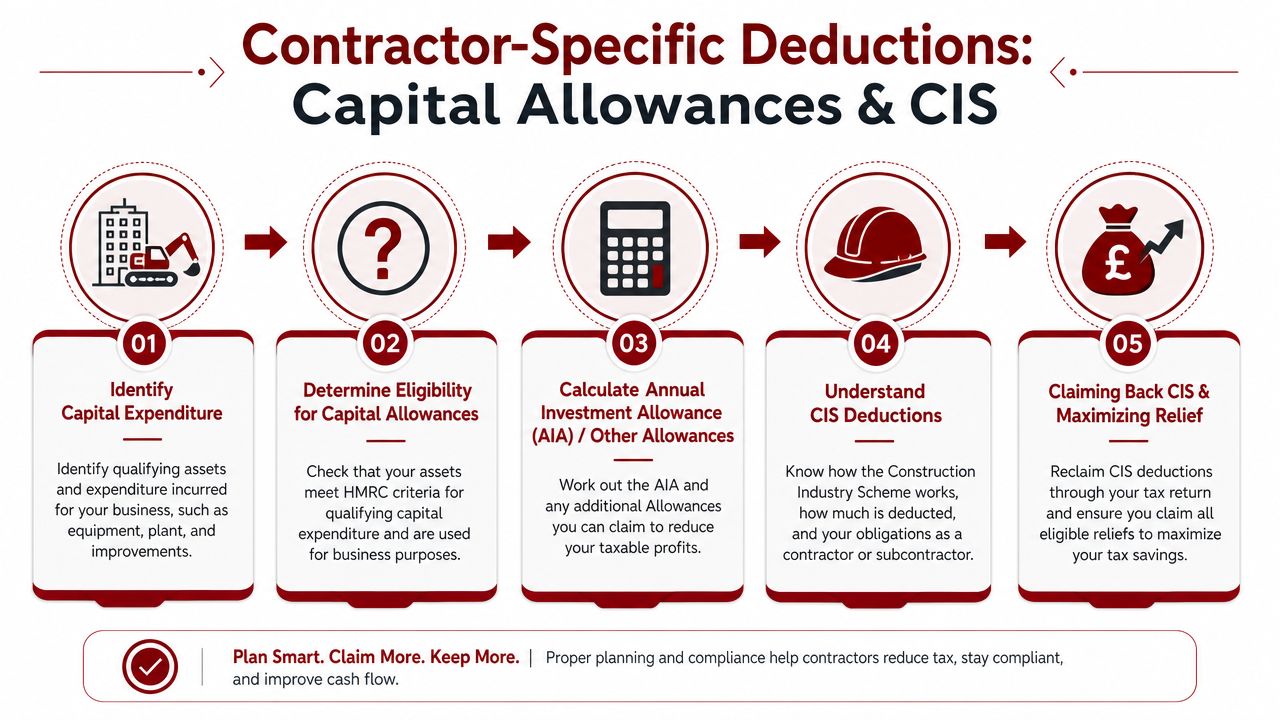
Contractors around Colindale, Queensbury, and Edgware often mix up three very different things. Ordinary running costs. Bigger equipment purchases. CIS deductions. Once those get tangled, the tax return usually gets messy.
Capital purchases are not the same as running costs
If you buy materials you use up on jobs, that's one type of cost. If you buy more substantial equipment, HMRC may treat it as capital expenditure instead of an ordinary day-to-day expense.
Typical contractor examples include:
- Tools and equipment: Items with ongoing use in the business.
- Computers and larger kit: Hardware used to run jobs, pricing, or admin.
- Vehicle-related assets: Depending on the item and context, some purchases need separate treatment rather than being dumped into fuel or repairs.
That distinction matters because the tax relief may come through capital allowances rather than the general expenses line. The treatment affects timing and presentation. If you're not sure where an item belongs, pause before posting it.
If you work in construction and want a more focused explanation of how records, tax, and deductions fit together, this page on CIS and self-employed accounting support is relevant.
CIS deductions are tax paid, not business expenses
This is the big one. If a contractor deducts CIS from your payment, that deduction is not one of your business expenses. It is tax paid in advance.
So what should you do?
- Track the gross income: Record the full amount earned before CIS deduction.
- Track your actual business expenses separately: Materials, fuel, phone costs, software, protective gear, and similar trade costs.
- Record CIS suffered properly: It sits in a different box, conceptually and practically, from ordinary expenses.
If you treat CIS as an expense, you can distort your profit figure. That can create the wrong tax result and confuse mortgage applications, borrowing, or internal decision-making.
For North West London subcontractors, this matters more than people think. You might have jobs in Barnet one month, Brent the next, and a private domestic job in between. Your paperwork needs to show what you earned, what tax was deducted under CIS, and what you spent to do the work.
A CIS statement is not a shopping receipt. It proves tax deducted, not money spent on running the business.
Flawless Record Keeping and Claiming on Your Self Assessment
You can know every allowable expense in theory and still overpay tax if your records are sloppy. HMRC cares about evidence. You should too.
Start with a straightforward system and keep it boring. Boring works.
What to keep and how to keep it
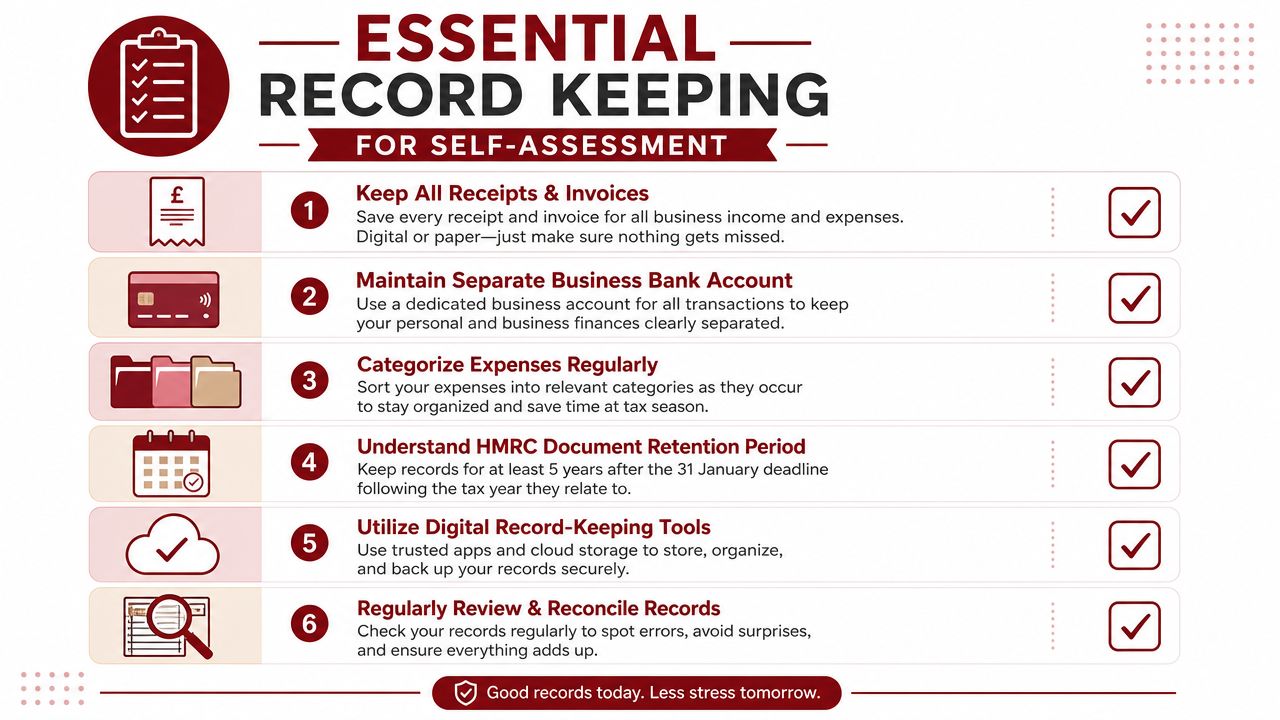
For most sole traders, I recommend a separate business bank account, digital copies of receipts, and regular categorisation in software or a spreadsheet. Don't wait until year end. Monthly is better. Weekly is even better if you're busy.
Keep these as standard:
- Receipts and invoices: Digital copies are fine if they're readable.
- Bank statements: Especially from your business account.
- Mileage log: Date, journey, purpose, and miles if you claim vehicle travel.
- CIS statements: If you're in construction, keep every one.
- Subscription records: Useful for software and recurring charges.
- Notes on apportionment: A short explanation of how you split phone, broadband, or home costs.
If you're trying to get ahead of digital compliance, this guide on navigating MTD ITSA requirements in the first 30 days is a sensible read.
A lot of sole traders also need basic bookkeeping support before they need tax planning. That's where structured systems matter. Options include software, a disciplined spreadsheet setup, or external help such as bookkeeping for sole traders.
Here's a useful overview of the kind of habits that make record-keeping easier in practice:
How that turns into your tax return
Your Self Assessment return does not require you to upload every receipt with the filing. But the totals you enter need to come from real records. That's the point.
The usual workflow is simple:
- Total income for the tax year
- Classify allowable business expenses
- Separate anything capital in nature
- Apply the correct treatment to mixed-use costs
- Enter the figures on the self-employment section of the return
If you're a CIS subcontractor, add one more step. Make sure the CIS tax deducted is recorded in the correct place, not buried inside general expenses.
Clean books make tax returns faster, calmer, and easier to defend.
Avoiding Common Mistakes and Optimising Your Claims
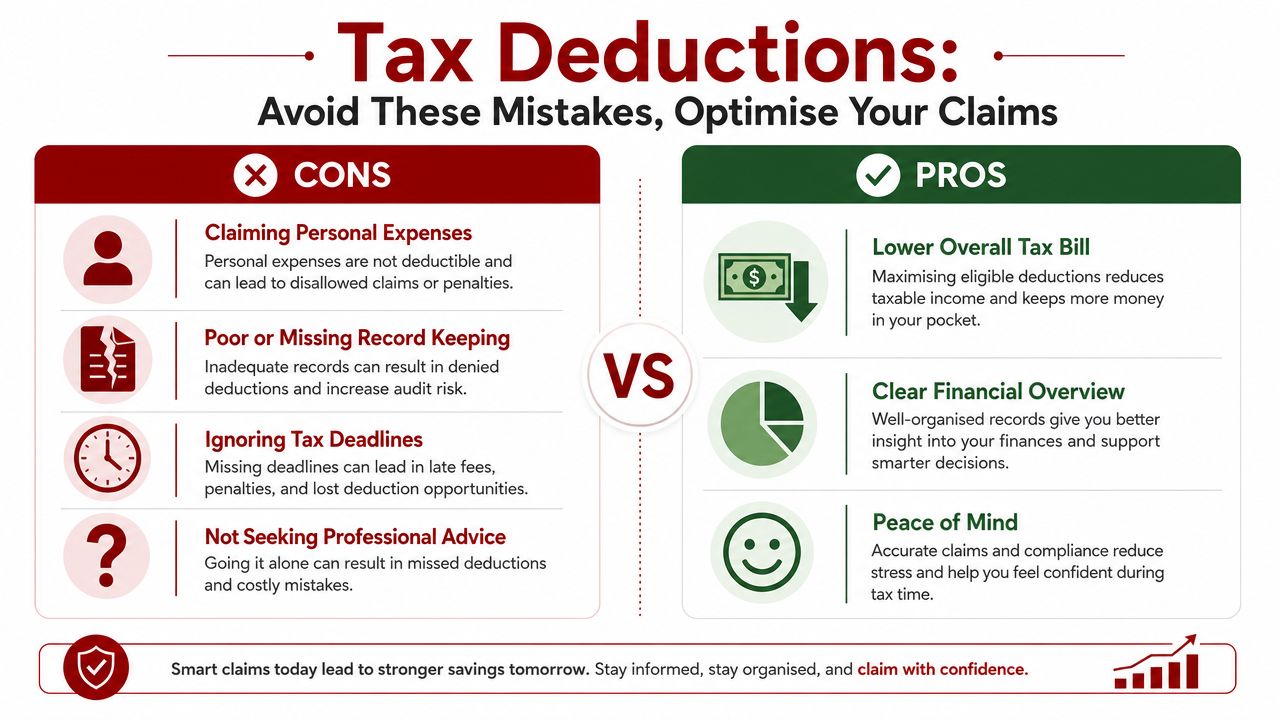
The biggest mistakes are usually ordinary ones. People claim private spending, miss small recurring business costs, muddle commuting with business travel, or guess the business share of home bills without any logic behind it.
Hybrid and home-based working have made that last problem more common. With 28% of working adults in Great Britain hybrid working in autumn 2024, mixed-use home expense claims have become far more common, as noted in this summary discussing hybrid working and home expense apportionment.
Here's the short version.
Do:
- Review expenses regularly: Small monthly costs are easy to miss.
- Split mixed-use bills sensibly: Keep a short note showing your method.
- Keep CIS separate from expenses: Treat it as tax deducted, not a running cost.
- Choose the simpler method when records are weak: Complexity doesn't impress HMRC.
Don't:
- Claim ordinary commuting: Self-employed status doesn't make every journey allowable.
- Dump capital purchases into general expenses: Bigger assets need proper treatment.
- Rely on memory: If it isn't recorded, it often gets lost or challenged.
- Leave everything until the deadline: Last-minute tax work leads to bad claims and missed ones.
If you're a sole trader or contractor in North West London, the smartest move is to build the habit now. Good expense management saves tax, reduces stress, and gives you cleaner numbers for everything else in the business.
If you want a second pair of eyes on your tax deductible expenses for self employed work, Action Accountants Limited can help with Self Assessment, bookkeeping, CIS-aware records, and the practical side of keeping your claims accurate and supportable.