

You're staring at a new business idea, a spare evening, and a browser full of half-useful guides telling you to “just register online”. That's where most founders go wrong. In the UK, how to register a new business isn't one filing, it's a sequence, and if you get the order wrong you create delays, tax problems, and avoidable admin from day one.
For a lot of London founders, the question is not whether to register, but what to register first. Choose the legal structure, file with Companies House if that's the right route, then sort HMRC registrations, payroll, VAT, and any sector-specific obligations. If you're trying to work out the wider founder journey as well, how to become an entrepreneur is a useful companion read, because structure and compliance sit inside the bigger startup decision, not outside it.
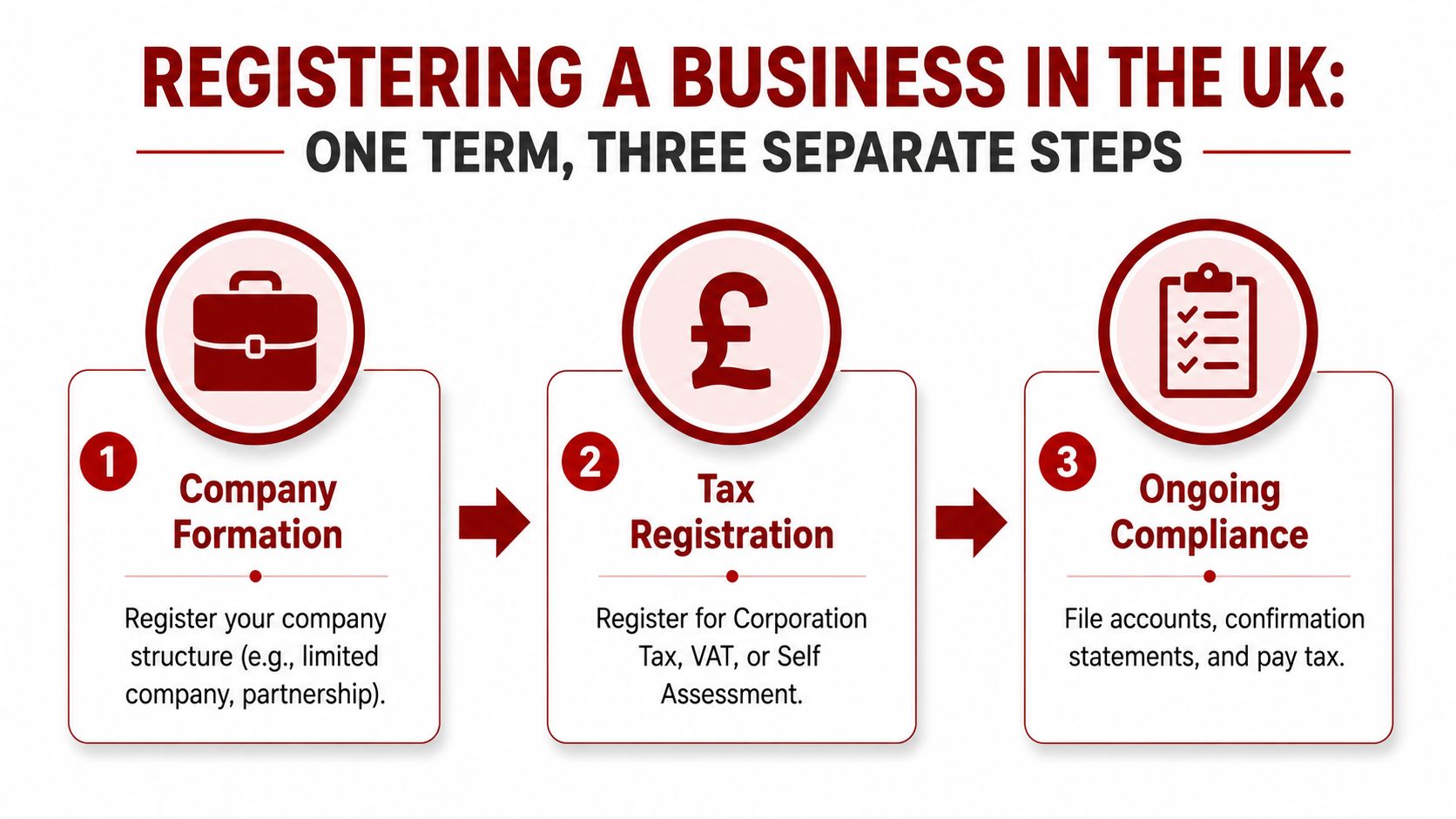
Table of Contents
- What Registering a New Business Actually Means in the UK
- Choosing the Right Legal Structure for Your Business
- Forming a UK Limited Company Through Companies House
- Registering as a Sole Trader or Partnership
- Post-Registration Tax and Compliance Steps with HMRC
- Common Mistakes London Founders Make When Registering
- Your 30, 60, and 90 Day Compliance Roadmap
What Registering a New Business Actually Means in the UK
A founder rings me up after filing a company and asks why HMRC is still not set up, why the bank wants more paperwork, and why the job on site cannot start until CIS is sorted. That is the true answer to “register a business” in the UK. You are not doing one filing. You are dealing with three separate tracks, the legal structure, the tax registrations, and the sector-specific rules that may apply to the work itself.
The mistake is thinking Companies House is the finish line. It is only one part of the job. A private limited company can be incorporated online for £50 and usually in 24 hours, while paper filing costs £71 and can take 8 to 10 days. The registration still needs at least one director and a registered office address, so this is a legal step, not a branding exercise. Keep GOV.UK's company formation guidance in view, but treat it as the first filing in a wider compliance sequence.
The right way to register a new business is to start with the business model, then line up the rest. If you want a practical comparison of structures before you choose, limited company vs sole trader guidance is a better starting point than guessing from the name on the form. A contractor heading into construction work needs a different setup from a consultant working alone, and a founder planning to hire needs to think about PAYE before the first payslip is due. That is why how to become an entrepreneur should never be treated as a purely motivational question, it is a paperwork question as well.
The questions you should answer before you file
Before you touch a form, answer these properly:
- How much turnover do I expect? That affects whether VAT becomes a live issue.
- Will I hire anyone soon? If yes, PAYE matters earlier than people expect.
- Do I work in construction or another regulated sector? If yes, CIS or other sector rules may apply.
- Do I want limited liability, or am I comfortable trading personally? That shapes the structure.
- How much admin can I realistically handle? A sole trader route is lighter than a company, but it gives you less separation between you and the business.
Practical rule: start with your commercial reality, not the filing screen. The right structure is the one that matches your turnover, hiring plan, and risk profile.
There is also a habit among first-time founders to stop at incorporation and assume the job is done. It is not. Once the entity exists, you still need to deal with the tax side, the payroll side if you are hiring, and any sector registration that sits outside Companies House. Construction is the classic trap here. A lot of generic guides ignore CIS until it causes a problem on the first contract. If you register in the wrong order, you end up with a company that exists on paper but cannot operate cleanly.
Most online guides stop at incorporation. That is lazy advice. The better way to think about how to register a new business is simple, structure first, then tax, then ongoing compliance. If you treat registration as a single event, you will miss the registrations that keep you trading properly.
Choosing the Right Legal Structure for Your Business
This is the decision that drives everything else. A freelancer who wants low admin, two friends opening a design studio, and a contractor heading into CIS work should not file the same way. The structure affects liability, tax treatment, paperwork, and how banks and clients read your business.
A good rule is this, don't choose a company because it sounds serious. Choose it because the commercial reality justifies the extra formalities. If you're still testing a market, a sole trader setup can be the sensible first move. If you're taking on clients who care about governance, or you want cleaner separation between personal and business affairs, a private limited company often becomes the better fit. For a deeper side-by-side view, Stewart Accounting Services advice is worth reading alongside the basic rule of thumb.
UK Business Structures at a Glance
| Structure | Liability | Tax Treatment | Setup Cost | Ongoing Compliance |
|---|---|---|---|---|
| Sole Trader | You're personally exposed to business debts and claims | Business profits are taxed through your personal return | Low | Lighter record-keeping and Self Assessment |
| Partnership | Partners share the business risk and obligations | Profits are split between partners | Low | More coordination, shared filing duties |
| Private Limited Company | The company is separate from you, which helps ring-fence liability | Corporation Tax and company-level filings apply | Higher than the unincorporated routes | More formal filings and company secretarial work |
A freelance consultant testing demand can stay simple as a sole trader, especially if the business is small and the admin needs to stay lean. Two friends starting a design studio need to think about how profits will be split, who signs contracts, and whether they want the legal discipline of a company from day one. A contractor working under CIS pressures should think harder about the company route, because tax sequencing and cash flow become more important quickly.
If you're comparing structures for the first time, look at the tax burden, not just the title on the letterhead. That's where founders make expensive mistakes.
For a quick internal comparison, the practical differences are also summarised in this limited company vs sole trader guide. My view is blunt, if your business is still experimental, don't overcomplicate it. If you already know you'll be hiring, invoicing regularly, or working in a compliance-heavy field, stop pretending a lightweight setup will stay lightweight for long.
Forming a UK Limited Company Through Companies House
A limited company is the route many London founders choose because it gives the business a formal identity and keeps the legal boundary cleaner than an unincorporated setup. Companies House still expects more than a name and a card payment. The filing needs to be accurate from the start, because small errors spill into bank checks, HMRC records, and onboarding paperwork later.
Get the basics right before you submit
Start with the company name. It must be available, and you should avoid anything likely to be rejected or confused with an existing registration. Then appoint at least one director, confirm the persons with significant control, and choose a UK registered office address. That address becomes part of the company's official record, so do not pick it casually.
Get the incorporation details lined up before you submit. The director information, control information, and office details all need to match the rest of the paperwork. If they do not, the company may still be formed, but you will create avoidable delays when the bank, HMRC, or another compliance check asks for matching records.
The speed choice is simple. GOV.UK says online incorporation is £50 and usually takes 24 hours, while paper filing is £71 and can take 8 to 10 days. If you care about speed, file digitally and check the director, PSC, and registered-office details before you press send.
Direct filing or formation agent
If the filing is straightforward, direct submission is usually enough. If you need someone to check the structure, avoid name issues, or align the incorporation with tax setup, a formation agent can earn its fee. The value shows up when it prevents a mismatch, a rejection, or a messy correction later.
Practical rule: the cheapest formation is the one that does not force you to fix three records afterwards.
After incorporation, do not treat the job as finished. The company still needs proper housekeeping, and the confirmation statement keeps the public record current. If you want a clear run-through of that filing, see this confirmation statement guide. Form the company cleanly, document it properly, and keep the records aligned with the way the business operates.
Registering as a Sole Trader or Partnership
Not every founder needs a company. If you're a freelancer, a tradesperson, or a small partnership testing demand, the lighter HMRC route is often the smarter first move. You get less administrative weight, and you can spend more time trading.
What HMRC expects from you
A sole trader registers for Self Assessment with HMRC and starts keeping proper records from day one. A partnership does the same in principle, but the structure needs to reflect who the partners are and how the business is being run. Don't treat a partnership like two sole traders sharing a logo. That's how record-keeping becomes a mess.
The useful mindset here is simple. Register the way the business operates. If you're billing clients in your own name, carrying the risk personally, and not ready for company-level compliance, a sole trader setup is usually the cleaner route. If two or more people are running the business together, partnership registration needs to reflect that reality.
The information you should have ready is basic but often missing when people start the process in a hurry. Keep your personal details, trading name, business address, and records of income and spending organised before you apply. Once you're registered, keep the bookkeeping tight from the first invoice, not after your first tax letter arrives.
A lot of first-time founders make the same mistake. They register quickly, then start rebuilding their records from memory six months later. That's the expensive bit.
If you're unsure whether the unincorporated route still fits, the question is not ego, it's control. As your turnover, risk, and client requirements grow, the case for limited company status becomes stronger. Until then, don't over-engineer the structure just because online advice makes incorporation sound glamorous.
Post-Registration Tax and Compliance Steps with HMRC
This is the part most guides underplay, and it's the part that causes real trouble. Incorporation or Self Assessment registration is not a green light to forget about HMRC. You still need to line up the tax registrations that fit how the business operates.
The registrations that usually come next
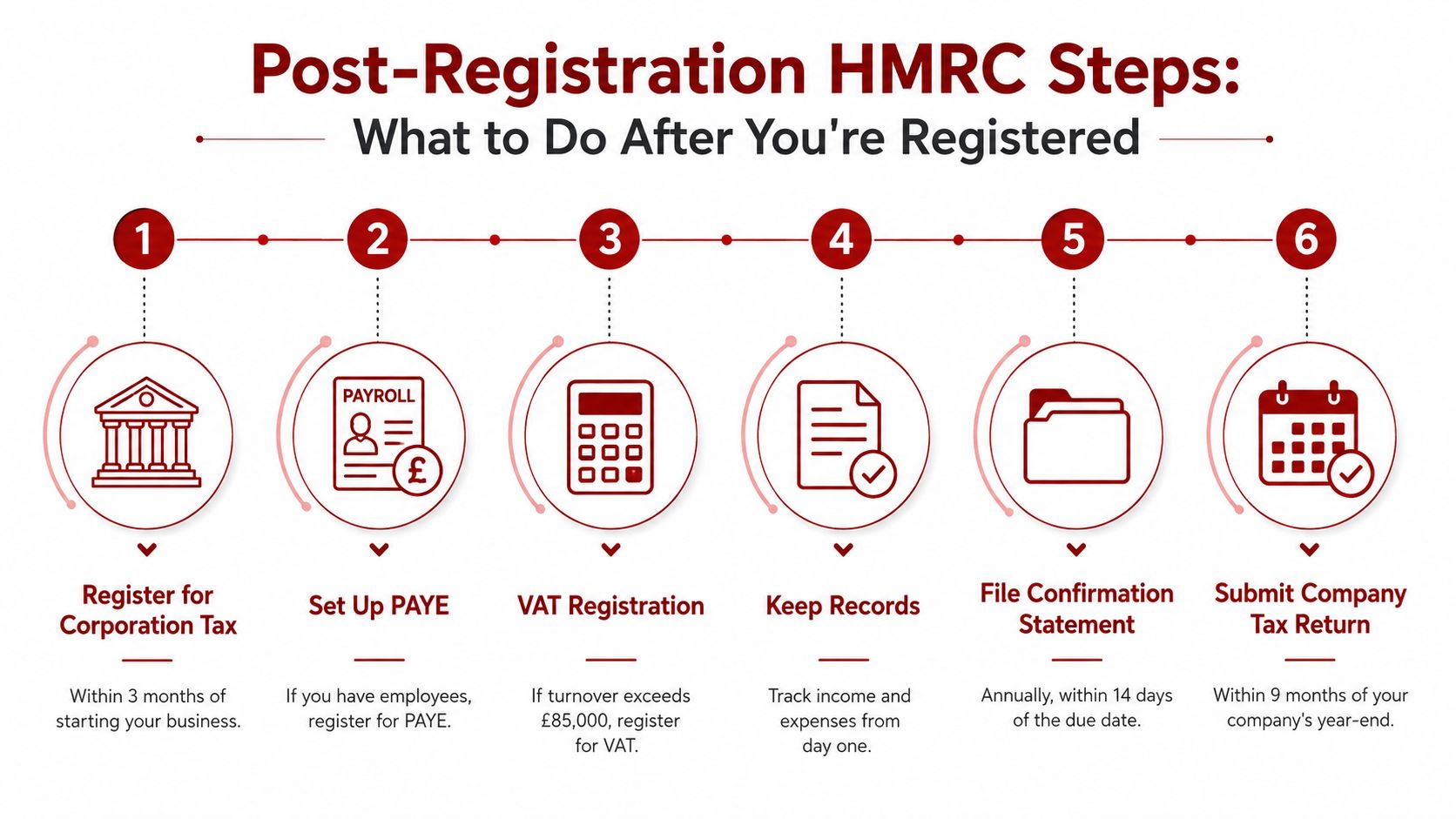
For a limited company, the practical sequence is straightforward, register for Corporation Tax, then add VAT or PAYE only if the business needs them. HMRC guidance requires VAT registration once taxable turnover exceeds the threshold in a rolling 12-month period, and PAYE is needed before paying employees above the payroll trigger. That's why turnover forecasts and hiring plans matter before you choose the filing path. Late registration can force backdated liabilities and administrative clean-up.
For companies, remember the timing too. HMRC expects Corporation Tax registration within 3 months of starting to trade, as reflected in the official guidance referenced earlier in the brief. If you're paying staff, don't wait until the first payroll run to think about PAYE. Set it up before money goes out.
The compliance burden doesn't stop there. Businesses often need separate registrations depending on structure and activity, and construction firms have an extra layer because CIS processes come into play when subcontractors are involved. That's the bit generic guides ignore, and it's one reason founders get cash flow wrong in the first few months.
Cash flow beats optimism
Open banking, bookkeeping, and tax registration should be planned together, not in isolation. If your business needs a bank account that can cope with operational complexity, it's worth checking UK bank accounts with crypto integration before you commit to a setup that can't support your transaction flow. I'd rather see a founder choose one clean banking setup now than switch halfway through the first trading quarter.
For practical setup help on the HMRC side, the route into registering for Self Assessment matters even if you later move into a company. The rule is simple, incorporation doesn't automatically solve tax. You need the right registrations, in the right order, before the first revenue turns into a headache.
Common Mistakes London Founders Make When Registering
The biggest myth is that registration is quick and harmless. It isn't. It's quick only if your data is clean, your structure is right, and you know which registrations follow the first one. Miss that, and you create work for yourself that's harder to unwind than doing it properly in the first place.
The errors that keep coming up
The first mistake is choosing the wrong structure because the founder wants to sound bigger than they are. A limited company can be right, but not because it feels more serious. It's right when liability, client expectation, or tax planning justify it.
The second mistake is skipping HMRC registration steps after incorporation or Self Assessment setup. That's where people assume Companies House has done everything for them. It hasn't.
The third mistake is using a residential address as the registered office without understanding what becomes public. That's not always wrong, but it needs to be a conscious decision. Too many founders discover privacy issues after the filing is already live.
The fourth mistake is ignoring VAT until the business is already busy. If turnover is rising, tax planning can't wait for a surprise. The fifth is missing payroll setup before the first pay run, which creates unnecessary corrections and makes a small team feel administratively messy from the start.
The construction mistake deserves its own mention. Some founders assume CIS doesn't apply because they're “just self-employed” or because the work feels informal. That's a bad assumption. If your work touches construction, check the scheme properly before money changes hands.
A fast self-check
Before you file anything, ask yourself whether your name, address, structure, tax position, and sector obligations all line up. If one of them doesn't, fix it now. That's easier than explaining a mismatch to a bank, accountant, or tax authority later.
Your 30, 60, and 90 Day Compliance Roadmap
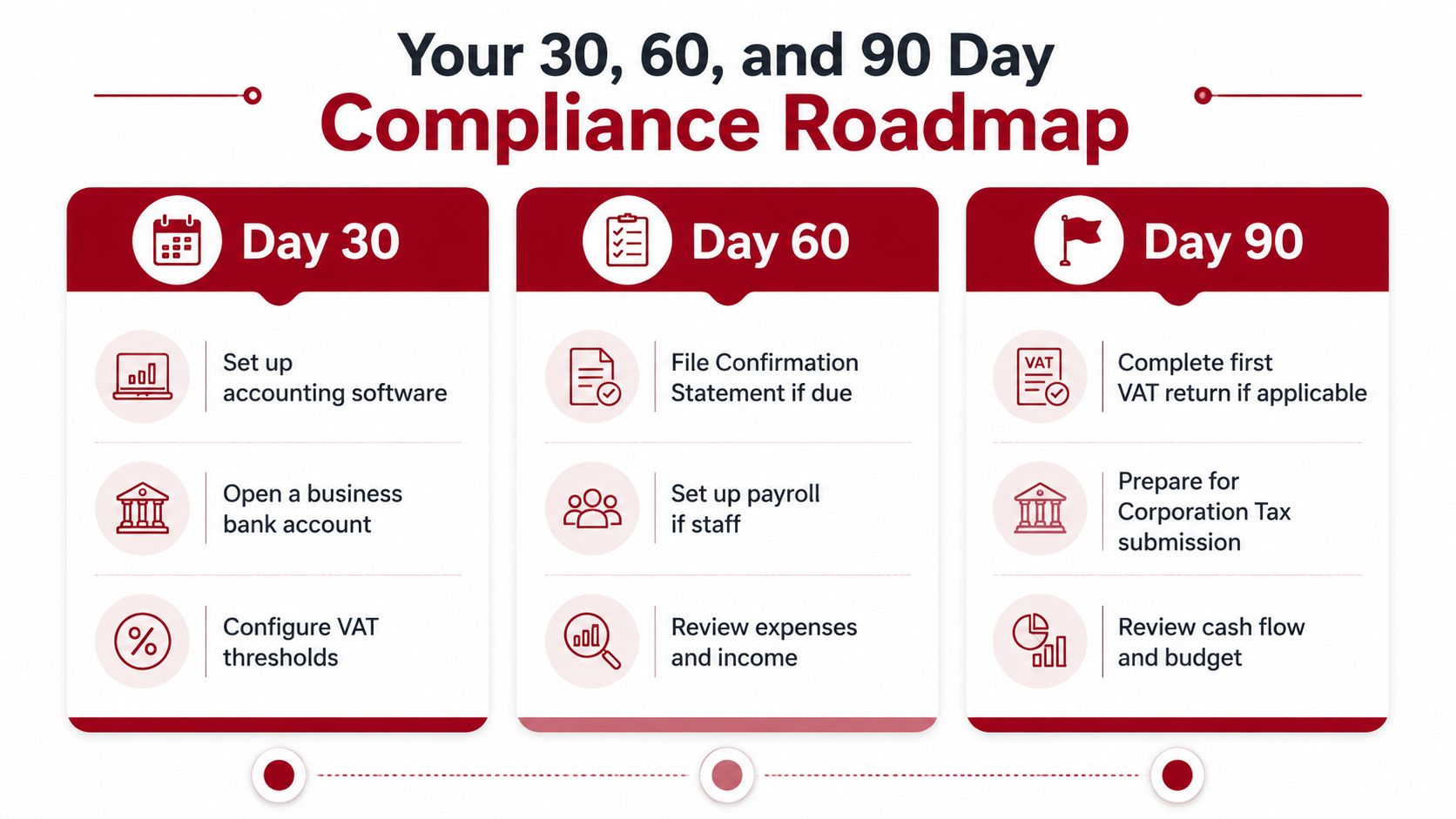
A good registration process doesn't end with the filing receipt. The first 90 days are where founders either build a tidy compliance base or create a backlog they never fully clear. Discipline matters more than enthusiasm.
The first month
Set up your accounting software, open the right business bank account, and make sure the tax profile matches how the business is trading. If you expect VAT to become relevant, build for that now rather than later. For a practical bookkeeping base, bookkeeping for startups is worth putting in place early.
The second month
Use month two to tighten the operational details. If staff are coming in, get payroll ready before the first payment. If you're operating in construction, confirm CIS status before you issue invoices or pay subcontractors. Check whether your records are clean enough to support tax filings without a scramble.
The third month
By month three, you should know whether the structure still fits. Review cash flow, obligations, and any deadlines that are now close enough to matter. If the business is trading properly, your company records, tax setup, and bookkeeping should already feel like one system rather than three disconnected tasks.
If you want help getting the formation, company secretarial work, bookkeeping, and compliance sequence right from day one, Action Accountants Limited supports founders in Colindale and across the UK with exactly that kind of setup. Visit Action Accountants Limited if you want a clean registration process and ongoing support that keeps the paperwork under control.