


You've received your self-assessment calculation, and the figure doesn't match the money left in your bank account. The rent hasn't changed, the mortgage has become more expensive, and yet HMRC appears to be taxing profit you never received. For a higher-rate landlord, that isn't a calculation error. It's usually the practical effect of landlord mortgage interest relief after Section 24.
The central mistake is treating mortgage interest as though it still reduces rental income before tax. For individual residential landlords, it generally doesn't. The finance cost is reported separately, and relief arrives as a basic-rate tax credit, not as a deduction at your marginal tax rate. That difference can create a painful cash-flow gap, particularly across a portfolio with borrowing.
This guide gives you the working method. You'll see how the rules developed, how to calculate the credit, how to report finance costs through self-assessment, and which planning decisions deserve proper modelling. For a wider review of property deductions, the PadPulse guide for hosts is a useful companion, while landlords who want to understand the broader rental calculation can review how much tax applies to rental income.
Table of Contents
- Why Your Property Tax Bill May Have Jumped
- How Section 24 Changed Landlord Mortgage Interest Relief
- Calculating Your Relief with Worked Examples
- Claiming Relief Through Self-Assessment
- Tax Planning Options to Reduce Your Bill
- Common Pitfalls and the FHL Abolition Impact
- When to Bring in a Property Accountant
Why Your Property Tax Bill May Have Jumped
A landlord can have a healthy rent roll and still feel short of cash. Mortgage payments, repairs, insurance, agent charges and compliance costs leave the bank account long before the tax calculation is complete. The surprise arrives when the return treats rental profit as higher than the amount available after finance costs.
Take a portfolio landlord who owns several personally held properties. Their rents are stable, but interest consumes a large part of the monthly receipts. Under the old approach, mortgage interest was taken off rental income before the landlord's marginal tax rate was applied. Under the current regime, the taxable property profit is calculated without that finance-cost deduction, then the landlord receives relief separately at the basic rate.
That matters most when the landlord's wider income already places them in a higher band. The tax charge can reflect the gross property profit after ordinary allowable expenses, while the mortgage relief covers only 20% of eligible finance costs. The landlord funds the mortgage at its full commercial cost but receives relief calculated at a lower rate.
Practical rule: Never judge a property's tax position from rent minus mortgage interest alone. Calculate taxable property profit and finance-cost relief as two separate lines.
The issue becomes sharper when several properties are financed. A modest difference on one mortgage can become a material annual funding requirement across a portfolio. It can also affect decisions about refinancing, retaining a low-yield property, buying through a company, or moving ownership between partners.
The first step is to stop calling the relief a deduction. HMRC's guidance explains that individual residential landlords can't deduct mortgage interest and other qualifying finance costs from rental income when calculating taxable profit. Instead, the tax bill is reduced by a basic-rate credit based on eligible finance costs. That is the rule your return must reflect.
How Section 24 Changed Landlord Mortgage Interest Relief
Section 24 of the Finance (No. 2) Act 2015 changed the way individual landlords receive relief for residential borrowing costs. Before the reform, an individual landlord could deduct mortgage interest from rental income and receive relief at their marginal income tax rate. A higher-rate landlord could therefore obtain relief at 40% or 45%, depending on their tax band, rather than at a single basic rate. The historical treatment is summarised in this explanation of the buy-to-let mortgage tax relief changes.
The reform was staged rather than imposed immediately. The deduction was reduced across four tax years, with the finance-cost credit increasing as the deduction disappeared.
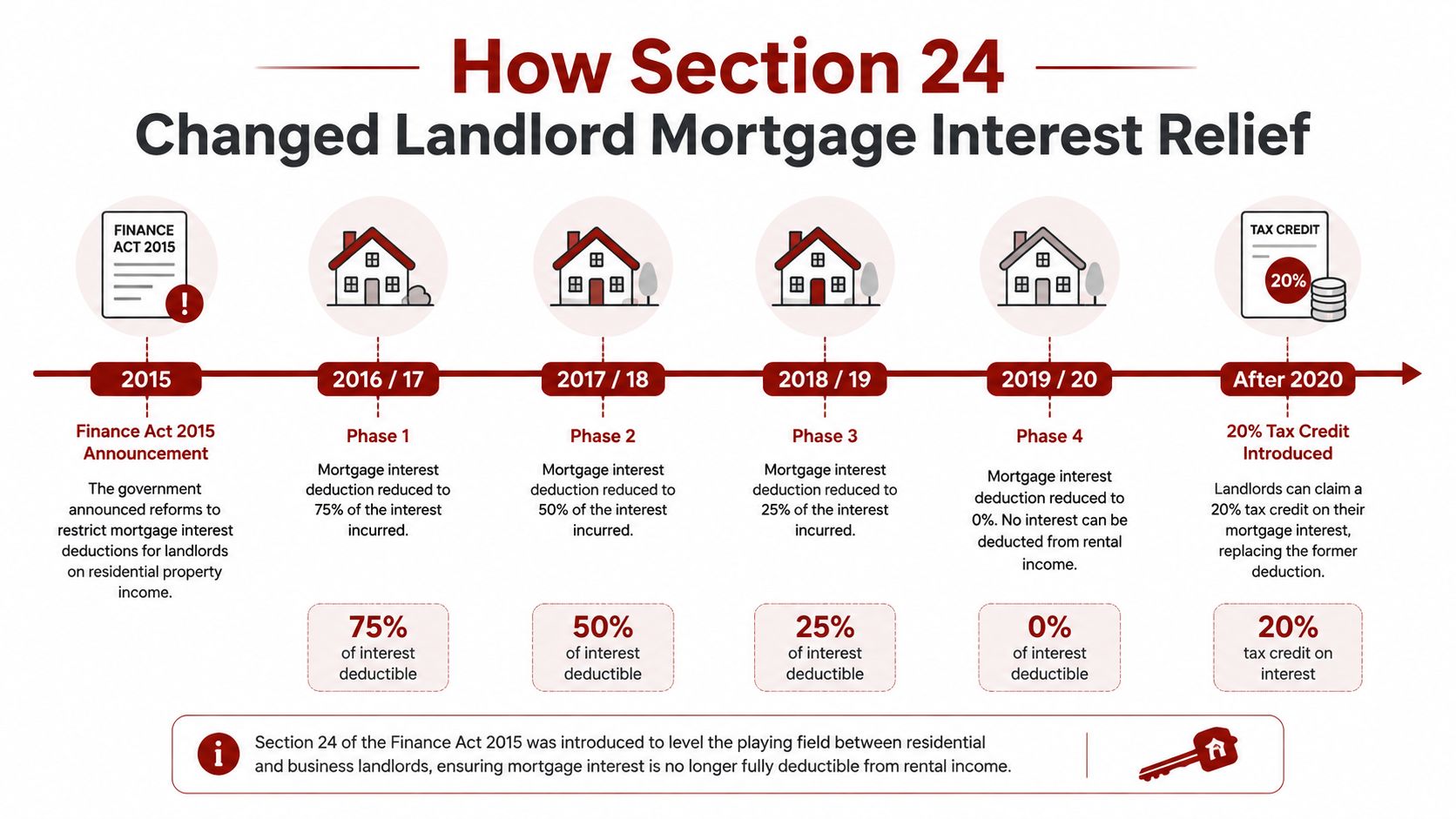
The phased transition
The staged treatment was:
| Tax year | Finance costs deductible | Finance-cost credit |
|---|---|---|
| 2017/18 | 75% | 20% credit on the balance |
| 2018/19 | 50% | 20% credit on the balance |
| 2019/20 | 25% | 20% credit on the balance |
| 2020/21 onwards | 0% | 20% credit on eligible finance costs |
The figures in this timeline are set out in the published Section 24 mortgage tax relief summary. HMRC states that the measure was fully in place from 6 April 2020, so the current regime applies from the 2020/21 tax year onwards.
The distinction between a deduction and a credit is decisive. A deduction reduces the income on which tax is calculated. A credit reduces the resulting tax bill. A landlord taxed at a higher marginal rate can therefore pay tax on property profit that includes finance costs, then receive relief calculated at only 20% of those costs.
What counts as the current rule
For an individual landlord, qualifying finance costs are entered separately from ordinary property expenses. Mortgage interest and other qualifying finance costs don't reduce the property profit used in the income tax calculation. The resulting credit is limited by the rules governing the tax liability, so it shouldn't be treated as cash reimbursement of the mortgage interest.
The practical consequence is straightforward. The mortgage remains a real cash expense, but tax relief no longer follows the landlord's marginal tax rate. Landlords reviewing filing methods and ownership structures can also compare the current position with INTELLI landlord tax strategies before making structural decisions.
The following video provides a visual explanation of the regime and its effect on individual landlords.
Calculating Your Relief with Worked Examples
The calculation has two separate stages. First, work out the property profit after ordinary allowable expenses, excluding restricted finance costs. Second, calculate the tax credit on eligible finance costs and apply it against the tax liability. The HMRC property income guidance confirms this treatment.
For a simple illustration, assume annual rent of £20,000, mortgage interest of £12,000, and no other allowable expenses. These figures reproduce the familiar contrast between the old deduction model and the current credit model.
Basic-rate landlord
Under the old system:
- Rental income: £20,000.
- Less mortgage interest: £12,000.
- Taxable rental profit: £8,000.
- Tax at 20%: £1,600.
Under the current system:
- Rental income taxable as property profit: £20,000.
- Tax before finance-cost credit at 20%: £4,000.
- Finance-cost credit: £12,000 × 20% = £2,400.
- Final tax attributable to the rental calculation: £1,600.
For a landlord whose relevant income remains within the basic rate, the credit can produce the same arithmetic result as a 20% deduction. That doesn't make the two mechanisms identical, but it explains why some basic-rate landlords notice little change in the final liability.
Higher-rate landlord
Use the same rent and interest, but assume the landlord's wider income places the property profit in the higher-rate band.
Under the old system, the taxable rental profit would still be £8,000. Tax at 40% would be £3,200, with the mortgage interest receiving relief through the deduction.
Under the current system:
- Taxable property profit: £20,000.
- Tax before credit at 40%: £8,000.
- Finance-cost credit: £12,000 × 20% = £2,400.
- Final tax attributable to the rental calculation: £5,600.
The difference is the £2,400 gap between the old and current treatment in this simplified comparison. The landlord still pays the £12,000 interest in cash, but the current credit covers £2,400 of tax relief rather than giving relief on the interest at the higher marginal rate.
The tax return can be correct while the property's cash flow is uncomfortable. That's the commercial problem Section 24 creates.
Comparison table
| Taxpayer Type | Old System Taxable Profit | Old System Tax | Current System Taxable Profit | Current System Tax Before Credit | 20% Credit | Current System Final Tax |
|---|---|---|---|---|---|---|
| Basic-rate landlord | £8,000 | £1,600 | £20,000 | £4,000 | £2,400 | £1,600 |
| Higher-rate landlord | £8,000 | £3,200 | £20,000 | £8,000 | £2,400 | £5,600 |
This table excludes other income, personal allowances and ordinary expenses, so it's a teaching model rather than a personal tax computation. For the full treatment of costs that remain deductible before the credit, review rental income allowable expenses. A portfolio calculation must include every property, all other income and any restrictions affecting the credit.
Claiming Relief Through Self-Assessment
The most common filing mistake is entering the net interest after relief. Don't do that. HMRC's process expects the full qualifying finance cost to be reported, then calculates the basic-rate credit separately.
For individual landlords, the relevant reporting area is the SA105 property pages. The finance-cost figure belongs in the designated finance-cost field, commonly identified as Box 16 in the property pages. The figure should come from lender documentation and should be reconciled to the property accounts.
A clean reporting process
- Separate ordinary expenses from finance costs. Repairs, insurance and agent charges are treated differently from mortgage interest and qualifying borrowing costs.
- Collect lender evidence. Keep mortgage statements, annual interest certificates and loan agreements. If you've remortgaged, retain documents showing the old and new borrowing.
- Enter the gross eligible finance cost. Don't reduce the number to reflect the credit.
- Check the calculation summary. The credit should appear as a reduction against the overall tax liability, rather than as a deduction from property income.
- Reconcile the return to your records. The property schedule, bank transactions and lender statement should tell the same story.

Records that protect the claim
Mortgage statements should show the interest component clearly. A repayment mortgage also contains capital repayment, which isn't the same as interest. Don't claim the capital element as finance cost.
Keep records for each property rather than combining the whole portfolio into one unexplained figure. This makes it easier to identify refinancing costs, apportion borrowing used for different purposes and answer questions if HMRC asks how the amount was calculated.
Arrangement and incidental borrowing costs need careful treatment too. Some may fall within finance costs and be relieved through the credit rather than deducted as ordinary property expenses. If the lender's statement doesn't give enough detail, ask for supporting information before filing.
For support with reviewing the completed return and correcting avoidable errors, see self-assessment tax return help. Software can process the mechanics, but it can't decide whether the borrowing relates to the rental business or whether a cost has been classified correctly.
Tax Planning Options to Reduce Your Bill
Section 24 is not solved by one universal election. The right response depends on borrowing, tax bands, property growth plans, ownership and whether profits need to be withdrawn personally. I'd compare the options in this order.
Incorporation
A company can generally treat mortgage interest as a business expense when calculating its taxable profit, so incorporation is often considered by landlords with substantial borrowing and long-term reinvestment plans. It's most compelling where profits will remain inside the company to fund further purchases rather than being extracted immediately.
The transfer itself is the danger point. Moving existing properties can create stamp duty and capital gains tax consequences, alongside legal, valuation, refinancing and company administration costs. A company also introduces annual accounts, corporation tax compliance and potential personal tax when profits are distributed.
Recommendation: Model incorporation before buying the next property. Don't transfer an existing portfolio because an online comparison makes the company rate look attractive.
Spreading ownership
Where commercially and legally appropriate, joint ownership with a spouse or civil partner can allocate rental income between people with different tax positions. This may reduce the amount exposed to higher-rate tax, but the ownership documentation and beneficial-interest position must match the intended income split.
A transfer can also have wider consequences. Review mortgage consent, legal ownership, capital gains treatment and any required HMRC election before changing the arrangement.
Best suited to: couples where one person has unused capacity in a lower tax band and the ownership change reflects a genuine long-term arrangement.
Maximising allowable costs
Ordinary allowable property expenses still matter because they reduce taxable property profit before the finance-cost credit is considered. Review repairs, insurance, letting-agent charges and other costs carefully, while separating improvements from repairs and restricted finance costs.
Good record-keeping is not aggressive planning. It's basic profit protection. A landlord who misses a genuine allowable cost pays tax on an avoidably high property profit.
For investors trying to understand the wider exposure, including tax on eventual disposal, a structured tool such as PropLab's guide to master rental property tax liability can help frame the questions for a professional review.
My recommendation: Use incorporation for future acquisitions only after modelling extraction and exit costs. Use ownership planning only where the legal and commercial arrangement is real. Claim every legitimate expense, but don't reclassify finance costs to manufacture a deduction.
Common Pitfalls and the FHL Abolition Impact
The most dangerous assumption in 2026 is that a holiday let still enjoys its previous finance-cost treatment. It doesn't. The Furnished Holiday Letting regime was abolished from 6 April 2025, and former FHL owners now face the same residential finance-cost restriction as other individual landlords.
That change matters for anyone with a mixed portfolio. A landlord may have one long-term rental and one property previously operated under the FHL rules, with forecasts built around different tax treatment. Those forecasts must now be rebuilt. The holiday property's mortgage interest is no longer a route to relief at the owner's marginal rate. The individual landlord receives the same basic-rate credit approach described earlier.

The errors I see most often
Calling the credit a deduction. This produces the wrong taxable profit and can understate the tax due. The tax return must show the property income calculation and the finance cost separately.
Using the old FHL forecast. A holiday let's previous regime can no longer be assumed in current planning. Recalculate profitability using the residential restriction, including seasonal income volatility and financing costs.
Ignoring total income. The credit doesn't operate in a vacuum. Salary, pension income and other taxable income can affect the rate applied to property profit and the practical value of the credit. Personal allowance restrictions can also make a simple property-only calculation misleading.
Overlooking affordability. A lender may assess income differently from your own cash-flow spreadsheet. Taxable property profit can look stronger than retained cash once mortgage payments are made, so refinancing or purchasing decisions need both tax and lending analysis.
Landlords moving from FHL operation to standard letting should review the consequences through a specialist furnished holiday let tax guide. The question isn't just whether the property remains profitable. It's whether the property still works after finance costs, tax, management and the revised operating model.
When to Bring in a Property Accountant
You can handle a straightforward property schedule if you have one property, simple borrowing and clear records. The case for professional input becomes strong when the portfolio contains multiple mortgages, mixed property types, joint ownership, refinancing or a former FHL.
Bring in an accountant before making a structural move, not after the transfer. A proper review should compare personal ownership with company ownership, estimate the effect of the 20% credit across the whole portfolio, examine extraction needs and identify transfer taxes and financing costs.
You should also ask for scenario modelling if your tax calculation shows property profit that feels disconnected from cash retained. That gap may be manageable, but it may also signal that a property, mortgage or ownership structure needs changing.
Prepare mortgage statements, annual interest certificates, rent schedules, expense records, ownership documents and details of other income. Run the worked examples against your own figures, then take the results to an adviser who can test the assumptions rather than just input the numbers.
Action Accountants Limited provides property accounts, personal and corporate tax returns, bookkeeping and tax-planning support for landlords considering Section 24, refinancing or incorporation. Visit Action Accountants Limited to discuss your finance-cost records and model the tax consequences before your next filing or ownership decision.