

Self Assessment Tax Return Help: Your 2026 Guide
Action Accountants •5 July 2026
You've got the HMRC letter open, a laptop full of tabs, a pile of receipts that seemed organised a few months ago, and a growing suspicion that one wrong box could cost you money. That's a common place to start.
Most first-time filers don't struggle because they're careless. They struggle because Self Assessment mixes rules, deadlines, income categories, and tax jargon in a way that isn't obvious until you sit down to do it. That's especially true if you're a CIS subcontractor, a landlord, or someone with a PAYE job plus side income.
Good self assessment tax return help should do two things. It should make the process clear, and it should reduce risk. That means knowing when you can sensibly file it yourself, when DIY becomes expensive, and how to avoid the mistakes that trigger penalties or inflate your bill.
Table of Contents
- Conquering Your Self Assessment Tax Return
- Getting Started with HMRC and Your UTR
- Gathering Records and Claiming Every Allowable Expense
- How to Fill In and Submit Your Tax Return
- Paying Your Tax Bill and Understanding Deadlines
- Common Mistakes and How to Avoid Costly Penalties
- When to Hire an Accountant for Your Tax Return
Conquering Your Self Assessment Tax Return
It usually starts the same way. A contractor checks a CIS statement and assumes the tax already taken off settles everything. A landlord sees rent coming in and is less sure which costs count, or whether the mortgage affects the tax figure in the way they expect. A PAYE employee picks up some freelance work on the side and assumes HMRC already has the full picture.
That is the point where a simple tax return starts to go wrong.
Self Assessment is not difficult because the form is mysterious. It becomes difficult when income comes from more than one place, records are incomplete, or a taxpayer relies on what “should” be right instead of checking what HMRC asks for. For CIS subcontractors and landlords, those problems show up early. The practical route is to handle the job in order, register properly, gather the records, complete the correct pages, then check the tax due before filing and paying.
If you are filing for the first time, our guide to registering for Self Assessment with HMRC will help you get the setup right before deadlines start to squeeze you.
Who tends to need help first
Some taxpayers run into avoidable mistakes sooner than others:
- CIS subcontractors: Tax may already be deducted from your payments, but you still need to report your income, claim allowable expenses, and make sure the CIS deductions are entered correctly. If they are not, you can miss a refund or pay the wrong amount.
- Landlords: Rental income is rarely just rent less mortgage. Repairs, replacements, agent fees, insurance, service charges, and private use all need careful treatment.
- PAYE employees with side income: The distinction matters because people with a salary often assume their side work is too small to count if their main job is already taxed through PAYE.
- People with mixed income streams: Freelance work, property income, dividends, savings, or overseas income increase the chance of leaving something out or putting it in the wrong part of the return.
Practical rule: If you have more than one income source, build the return from records, not memory.
For this reason, the most useful self assessment tax return help is specific. Generic reminders to “file on time” do not help much if you are trying to work out whether a van cost belongs in your CIS accounts, whether a landlord repair is revenue or capital, or whether doing it yourself is still sensible.
At Action Accountants, we are often brought in after a client has already spent hours on the return and lost confidence halfway through. Sometimes the fix is quick. Sometimes the safer decision is for us to take over, usually where CIS deductions, rental property figures, or multiple income sources need to line up properly. As a working rule, a straightforward return can often be turned around within a few working days once records are complete. A return with missing paperwork, property adjustments, or year-end queries takes longer, but it is still faster and safer than correcting errors after HMRC asks questions.
Getting Started with HMRC and Your UTR
A common first-time filing problem starts like this. A CIS subcontractor finishes a busy year, or a landlord collects rent for months, then realises in December that HMRC still does not know they need to file. At that point, the tax return is no longer the first task. Registration is.
HMRC needs to issue your UTR, or Unique Taxpayer Reference, before you can file properly. Without it, you cannot set up the return in the normal way, and waiting for HMRC letters can eat into the time you thought you had.
The deadline that catches first-time filers
January gets most of the attention, but the earlier date often causes the first problem. If you need to join Self Assessment, you are expected to register by 5 October after the end of the tax year in which the untaxed income arose.
For UK contractors under CIS, this is often missed because tax has already been deducted from payments, so the filing obligation feels less urgent. For landlords, the same mistake happens when rent starts mid-year and the property is treated as “not much to report yet”. HMRC still expects the position to be declared.
If you want a step-by-step setup guide, this article on registering for Self Assessment covers the process clearly.
The £1,000 rule is often read the wrong way
The test relates to your self-employed income, not your combined income from every source.
Quality Company Formations explains that HMRC requires a return where self-employed income goes over £1,000, even if you also have a job taxed through PAYE. This is significant because people with a salary often assume their side work is too small to count if their main job is already taxed already.
A payslip does not report your freelance work, CIS income, or rental profit for you.
That catches people in predictable ways. A part-time employee who invoices for weekend work may still need to file. A new landlord with one property may still need to file. A CIS subcontractor may have tax deducted at source, but still needs to report income, expenses, and deductions properly so the final liability or refund is calculated correctly.
What to do first
Keep the order simple:
- Check whether Self Assessment applies. Self-employment, rental income, foreign income, and other untaxed income are common triggers.
- Register as soon as the obligation starts to look likely. Leaving it late creates avoidable pressure.
- Wait for your UTR and HMRC login details. Keep both in one secure place.
- Use the correct tax year. First-time filers often mix current-year figures with the year being reported.
- Start storing records straight away. This includes invoices, CIS statements, rent statements, and bank entries.
For contractors and landlords, the trade-off is straightforward. If income is simple, records are tidy, and there are no grey areas, a DIY return may be reasonable. Once CIS deductions need reconciling, rental expenses need sorting, or you have more than one income source, mistakes become much easier to make and slower to fix. That is usually the point where professional help pays for itself in time saved and risk reduced. We can often turn around a straightforward first return within a few working days once records are complete.
Some clients also ask about related costs outside the return itself, including health insurance tax savings for self-employed, but the first priority is getting HMRC registration and your UTR in place so the return can be filed correctly.
Gathering Records and Claiming Every Allowable Expense
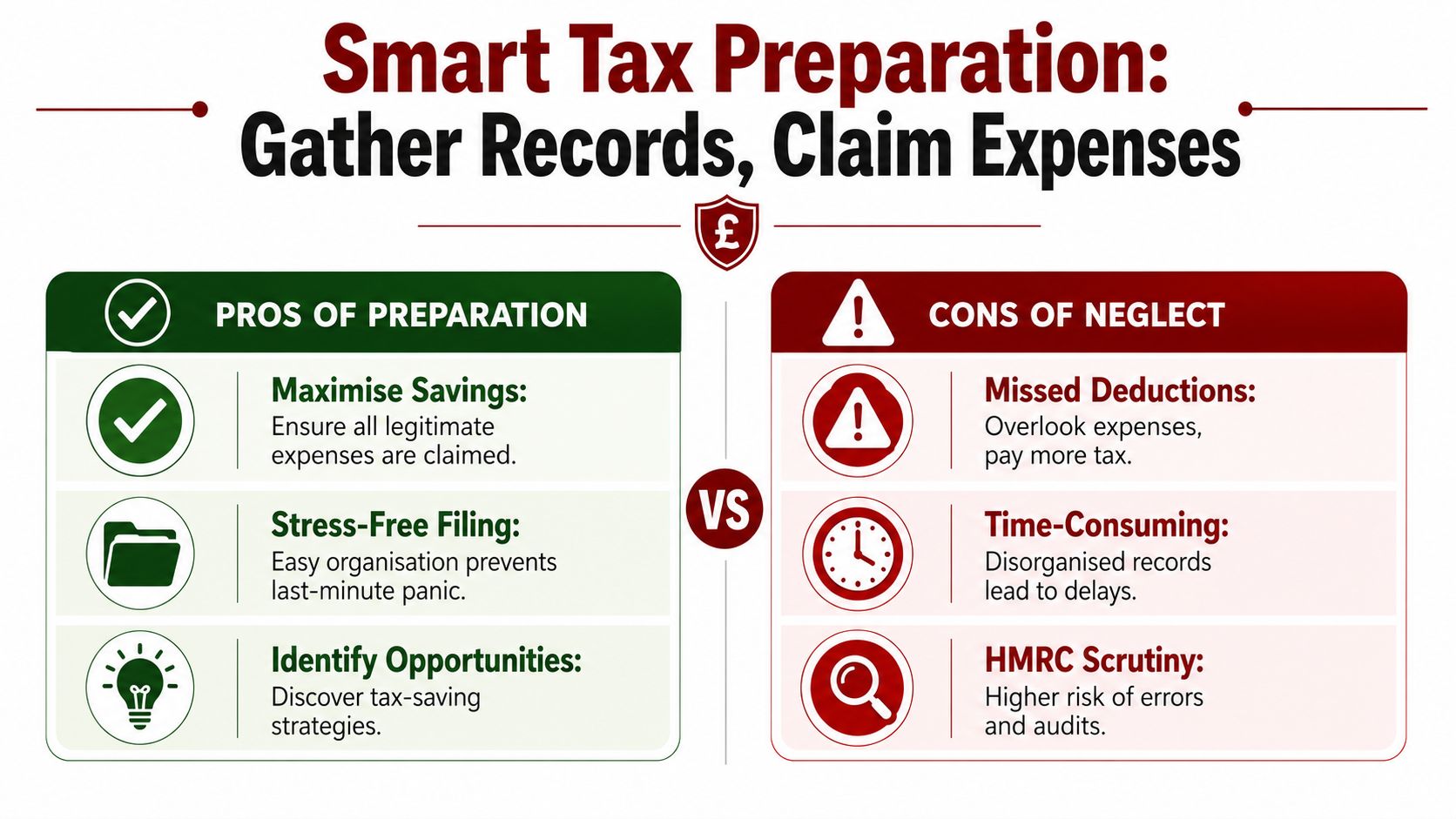
The easiest tax return to file is the one you've been preparing all year without realising it. Good records shorten the job, reduce guesswork, and stop you missing claims that you were entitled to make.
For first-time clients, I usually see one of three patterns. The freelance consultant has invoices in email folders and expenses split across two cards. The CIS subcontractor has payment statements but hasn't kept smaller costs together. The landlord has rent records, but the repair bills, agent statements, and mortgage-related paperwork are scattered.
What landlords should gather
Landlords often underestimate how much detail sits behind a “simple” rental return. Start with the documents that prove what came in and what went out.
A workable landlord file usually includes:
- Rental income records: Tenancy schedules, rent statements, and bank entries showing rent received.
- Letting agent paperwork: Statements, management fees, tenant-find fees, and end-of-year summaries.
- Property costs: Repairs, maintenance invoices, safety certificates, insurance, and service charges where relevant.
- Finance paperwork: Mortgage statements and any lender correspondence that affects how you read the year's costs.
- Ownership evidence: Documents showing who owns the property and in what proportions, where applicable.
The key trade-off for landlords is this. If the property is straightforward and records are tidy, DIY can be realistic. If ownership is split, there were periods of vacancy, or costs blur between capital and repair work, DIY becomes riskier fast.
What CIS contractors should keep
Construction clients often assume their contractor statements are enough. They're essential, but they're not the whole file. CIS returns are safer when you build from deduction statements and support them with your actual trading records.
For a CIS subcontractor, I'd want to see:
- CIS deduction statements: These show what's been deducted before you were paid.
- Sales invoices or payment records: Even when work is paid through contractor systems, your own income record matters.
- Materials and tools costs: Keep supplier invoices, not just card statement lines.
- Vehicle and travel records: Mileage logs, fuel records, parking where allowable, and job-related travel evidence.
- Subcontract and site paperwork: Work orders, site records, and anything that explains timing if payments cross tax years.
A lot of overpaid tax in construction comes from poor expense capture, not from high earnings. Small costs disappear when they're paid in cash, put on a personal card, or left in the van until they fade.
Keep CIS statements as they arrive. Reconstructing them near the deadline is slow and often incomplete.
Later in the process, many contractors also benefit from reviewing tax deductible expenses for self-employed workers so they don't miss routine claims.
Here's a practical explainer worth watching before you sort your records:
What freelancers and sole traders often miss
Freelancers are often better at tracking revenue than costs. That creates a familiar result. The return gets filed, but the tax bill is higher than it needed to be.
Common categories people miss include:
- Office costs: Software subscriptions, printing, stationery, and work-related phone use.
- Travel costs: Business journeys that were never logged properly.
- Training and professional costs: Courses, memberships, and subscriptions where they're connected to the business.
- Bank and platform charges: Payment processor fees, account charges, and marketplace deductions.
- Insurance and protection costs: Some self-employed people also review related guidance on health insurance tax savings for self-employed when considering which costs may be relevant to their wider finances, though any claim on a UK return should always match UK tax rules and the nature of the expense.
What works and what doesn't
What works is a simple system you'll maintain. A separate bank account helps. So does uploading receipts weekly, not annually. Accounting software can make this easier, but even a clean spreadsheet and a named folder structure will outperform a shoebox of mixed papers.
What doesn't work is trying to “remember the year” in January. That approach misses expenses, causes duplicate entries, and creates the exact uncertainty HMRC enquiries feed on. Preparation doesn't just save time. It changes the quality of the return.
How to Fill In and Submit Your Tax Return
A first draft of a tax return can look fine and still be wrong. I see that a lot with new clients who have done the hard part of gathering records, then get stuck when HMRC asks them to put each figure in the right box.
For straightforward PAYE plus a small amount of untaxed income, online filing is usually manageable. For CIS contractors, landlords, and anyone with mixed income, the risk is not the form itself. The risk is putting the right number in the wrong section, missing a supplementary page, or filing before the figures reconcile.
Online versus paper
Online filing suits nearly all first-time filers because HMRC's system prompts you through the relevant sections and gives more flexibility if you are still finalising records. Paper returns still exist, but they are a poor fit if information tends to arrive late or you want time to check the numbers properly.
| Method | Best for | Main drawback |
|---|---|---|
| Online return | Sole traders, landlords, CIS subcontractors, and mixed-income filers | Good software and prompts do not fix incorrect figures |
| Paper return | Limited cases where someone insists on a manual process | Earlier deadline and less time to correct errors |
If you are working with bookkeeping records, contractor statements, and rental schedules across more than one device, it can help to host your tax software in the cloud so your working papers and draft return stay in one place.
The pages that usually cause problems
The main return is the SA100. After that, HMRC adds supplementary pages based on the income you need to report.
The ones that regularly matter for Action Accountants clients are:
- SA103 for self-employment
- SA105 for UK property income
CIS subcontractors often need extra care on the self-employment pages because turnover, expenses, and tax already deducted by contractors all need to line up. Landlords usually come unstuck on the property pages by mixing mortgage payments with mortgage interest, or by entering repair costs without a clean record of what was spent.
If you have both trading income and rent, plus perhaps some PAYE wages, the return stops being simple admin. It becomes a reconciliation exercise.
Where filing errors usually happen
The common problems are predictable.
- Income entered in the wrong place: PAYE, self-employment, CIS income, and rental income each belong in specific sections.
- CIS deductions not matched to statements: If the deduction figure does not agree with contractor records, HMRC may not give full credit.
- Property figures grouped too loosely: Rent received, agent fees, repairs, insurance, and finance costs need to be separated properly.
- Supplementary pages missed: A return can be submitted with key sections omitted if the taxpayer does not realise HMRC expects extra pages.
- Draft figures filed as final figures: Bank totals, software reports, and year-end summaries should agree before submission.
A simple rule helps here. If you cannot trace a figure back to a statement, invoice, or summary report, do not file it yet.
For contractors, I also recommend checking whether the final tax calculation could trigger advance payments for the next year. If that point is unclear, read our guide to Payments on Account and what they mean for your next tax bill before you submit.
DIY works for some returns. It works best where income is limited, records are clean, and there are no grey areas over expenses or tax deducted at source. Once CIS deductions, rental income, or multiple income streams are involved, professional self assessment tax return help often pays for itself by reducing filing errors, avoiding missed claims, and getting the return turned around in a clear timeframe. At Action Accountants, we normally tell new clients upfront whether we can handle a straightforward return in a few working days or whether missing records will slow the process. That clarity matters when deadlines are close.
Paying Your Tax Bill and Understanding Deadlines
A common first-year scenario goes like this. A contractor files in January, sees a tax bill that feels manageable, then notices HMRC is also asking for advance payments for the next tax year. Landlords often hit the same problem after a year with decent rental profit. The return was filed correctly, but the cash planning was too late.
Paying Self Assessment is a separate job from submitting the return. You need the right amount, the right deadline, and the right payment reference so HMRC allocates the money to your account properly.
Key dates to keep in one place
Keep these dates in your calendar from the start of the tax year, not when HMRC starts sending reminders.
| Task | Deadline |
|---|---|
| Register for Self Assessment | 5 October following the end of the relevant tax year |
| Paper tax return | 31 October |
| Online tax return | 31 January to file the return and pay any bill owed |
| Late filing penalty starts | After 31 January |
The online filing date matters because many first-time filers leave both the return and the payment until the final week. That is where rushed errors and missed banking cut-off times create trouble.
How to handle the payment side
HMRC accepts several payment methods, including bank transfer and card payments. The practical point is simpler than the list of options. Use the correct payment reference every time. If the reference is wrong, HMRC may not match the payment properly, and sorting that out is slower than people expect.
For contractors under CIS, another trap is assuming deductions suffered during the year will automatically cover the final bill. Sometimes they do. Sometimes they only cover part of it, especially if there is other untaxed income, expenses have been claimed incorrectly, or the CIS figures recorded by HMRC do not match the statements held by the subcontractor. Check the position before January, not after filing.
Landlords need the same discipline. Rental profit can look healthy across the year, then a tax bill arrives at the same time as insurance, mortgage costs, or repairs. If you own more than one property, a single reserve account for tax usually works better than trying to estimate property by property.
A workable routine is:
- Set aside tax regularly: move a share of business or rental income into a separate account each month
- Recheck the estimate during the year: update the reserve if profit rises or a planned expense does not happen
- Allow for Payments on Account: budget for more than the balancing payment if HMRC is likely to ask for advance payments
Payments on Account without the confusion
Payments on Account are advance payments towards the next tax year. In practice, the first year they appear is the one that catches people out. You pay the balancing amount for the year just ended, and you may also pay the first instalment for the year ahead.
For a CIS contractor with uneven work, that can put pressure on cash at exactly the wrong time. For a landlord, a good rental year followed by a large repair bill can create the same squeeze.
If you are unsure whether your bill will include them, read our guide to Payments on Account and what they mean for your next tax bill before you file.
At Action Accountants, we raise this point early with new clients because it affects decisions long before submission day. A straightforward return with clean records can often be turned around in a few working days. If CIS statements are missing, rental records need sorting, or the figures point to a larger January payment than expected, that timetable can stretch. Knowing that in advance gives you time to check the numbers and put money aside properly.
Common Mistakes and How to Avoid Costly Penalties
A new client often comes to us after HMRC has issued a calculation that looks far too high. In many cases, the return was not wildly wrong. It was incomplete. A missed PAYE figure, CIS deducted but not entered, rent omitted for part of the year, or expenses claimed without proper support can all create the same result. Extra tax, letters from HMRC, and time spent correcting something that was avoidable.
Where mistakes usually happen
Late filing gets the attention, but the core problems usually start earlier. People register late, rely on incomplete records, or assume HMRC will fill in missing details from payroll or CIS statements. HMRC expects the return to be complete when you submit it.
The PAYE point is more significant than people realise. If you have employment income alongside subcontracting work, freelance income, or rental profit, the tax already deducted through your payslips still needs to be reflected correctly. I see this with first-time filers who focus on the untaxed income and forget the salary pages or P60 figures. The return then shows too much tax due, and the client assumes HMRC has made the mistake.
For CIS contractors, the common risk is entering turnover but not matching it to the CIS tax deducted. For landlords, the weak spot is usually record quality. Mortgage interest, repairs, insurance, agent fees, and periods of vacancy all need to be treated properly. DIY can work if records are clean and the income streams are simple. It becomes riskier once the return mixes PAYE, CIS, and property income in the same year.
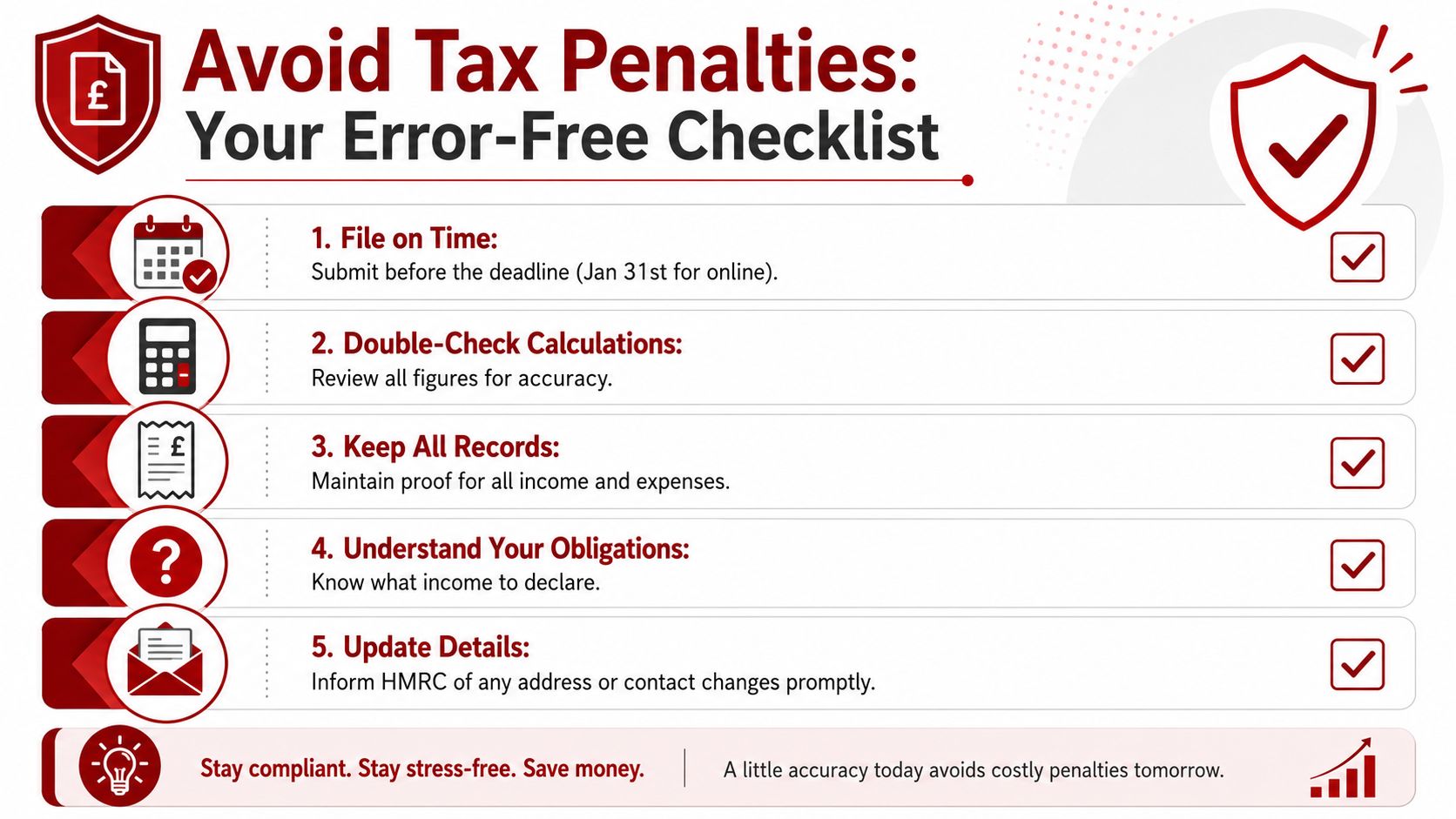
The checks I would do before pressing submit
Use this as a practical final review:
- Personal details: your UTR, National Insurance number, address, and HMRC login must line up with the record HMRC holds.
- All income sources: include employment, self-employment, CIS income, rental income, bank interest, and anything else that belongs on the return.
- Tax already deducted: enter PAYE and CIS deductions from the actual documents, not from memory.
- Expenses and reliefs: only claim what you can support with invoices, statements, receipts, or a reliable log.
- Property figures: separate repairs from improvements and check that loan interest is treated correctly.
- Timing: file early enough to leave room for questions, missing paperwork, or a final sense check.
A safe tax return is complete, supported, and submitted with enough time to fix anything that looks odd.
A routine that prevents expensive errors
Keep one place for records. That can be a cloud folder, bookkeeping software, or a simple digital filing system, as long as you use it consistently.
Then reconcile as you go. CIS contractors should keep every payment and deduction statement together with the matching bank entry. Landlords should keep tenancy agreements, rent schedules, mortgage statements, and repair invoices in date order. Once figures have to be rebuilt in January, accuracy drops and stress rises.
If you want a clearer picture of where professional support saves time and reduces risk, our guide on ways an accountant can help your small business covers the practical benefits.
At Action Accountants, a straightforward return with tidy records can often be turned around in a few working days. If CIS statements are missing, rental records need sorting, or the figures do not reconcile cleanly, it usually takes longer because the checking work matters more than speed. That is the trade-off. Filing on your own may save a fee, but correcting errors later often costs more in tax, penalties, and time.
When to Hire an Accountant for Your Tax Return
It is 20 January. You have CIS statements from more than one contractor, a rental property with repair costs that do not fit neatly into one category, and a tax return still sitting in draft. That is usually the point where DIY stops being efficient.
A straightforward return can often be filed without professional help. If you have one income source, complete records, and no uncertainty over expenses or disclosures, doing it yourself may be reasonable. The risk rises once the return needs judgement rather than data entry.
Where professional help starts to pay for itself
The shift usually happens when your return includes CIS deductions, property income, a mix of PAYE and self-employment, overseas income, or uncertainty about what you can claim. In those cases, the main question is not whether you can submit the form. It is whether the figures are complete, supported, and likely to stand up if HMRC asks questions later.
That matters for two groups in particular.
For CIS subcontractors, the common problems are missing deduction statements, turnover that does not match bankings, and expense claims that are too broad. Mileage, tools, protective clothing, phone use, and subcontractor costs all need a sensible basis and clear records. One wrong assumption can mean paying too much tax, or claiming too much and creating a future problem.
For landlords, the usual pressure points are repairs versus improvements, mortgage interest treatment, part-year letting, jointly owned property, and work done before a property is first let. Many first-time landlords underestimate how often a “simple rental” return needs careful review.

Signs DIY is becoming risky
Be cautious about filing on your own if any of these apply:
- You are under CIS and statements are missing or incomplete.
- You are a landlord and are unsure whether a cost is revenue or capital.
- Your records do not reconcile cleanly to the bank.
- You have left the return until January and there is no time to correct mistakes.
- You want certainty on claims and disclosures, not guesswork.
At that point, an accountant is not just typing numbers into software. A good one checks the weak points, asks for the missing records, and spots issues before submission. That is where fees often pay for themselves.
For clients who want support beyond one tax return, our guide to eight practical ways an accountant can help your small business explains where year-round advice saves time and reduces mistakes.
What to ask before you hire
Ask who will prepare the return, what records they need, how they deal with queries, and how long the process usually takes. Turnaround time should be clear. A typical turnaround of 2 to 4 weeks is a sensible expectation when records are complete and supplied promptly. Straightforward returns can be faster. CIS cases with missing statements, or landlord cases with poor records, often take longer because the checking work matters.
Local support helps here. At Action Accountants, we regularly see where contractors overclaim, where landlords miss valid deductions, and where mixed-income returns go wrong. That experience shortens the back-and-forth and gives you a return that is accurate, properly supported, and filed with less stress.