

You open the VAT return, trace one figure back to a ledger line, and realise something doesn't tie out. Maybe output VAT was overstated on one sale. Maybe input VAT was missed on a supplier invoice. Maybe the numbers have been carried forward for more than one quarter and now you're not even sure whether the problem is small enough to fix on the next return or serious enough to report separately.
That's the point where many business owners freeze. They worry about penalties, they second-guess the bookkeeping, and they often make one expensive mistake before fixing the first one. They add up every VAT error they can find, treat that gross total as the reportable figure, and choose the wrong correction route.
That's avoidable. HMRC's rules are strict, but they are workable when you approach them in the right order. The practical job is to identify the error, calculate the net error correctly, decide the reporting method, and document the correction clearly. If you've ever had to untangle old indirect tax issues in another system, the discipline is similar to resolving unlodged BAS statements. The pressure feels heavy, but the fix still starts with records, dates, and method.
For smaller businesses already trying to stay on top of cash flow, payroll, and bookkeeping, VAT mistakes often start with ordinary admin strain rather than anything reckless. That's why practical VAT guidance matters more than theory. If you want the broader compliance background first, this guide on VAT for small businesses is a useful companion before you deal with the correction itself.
Table of Contents
- That Sinking Feeling Discovering a VAT Mistake
- First Step Identifying and Quantifying Your VAT Errors
- Correction Thresholds Deciding Your Reporting Method
- How to Make the Correction Practical Examples and Journals
- Common Pitfalls for Contractors and Property Businesses
- Avoiding Future Errors Recordkeeping and Final Checks
That Sinking Feeling Discovering a VAT Mistake
Finding a VAT mistake after submission is unsettling because you don't yet know whether you've got a tidy admin correction or a problem HMRC will expect you to disclose formally. The instinct is often to rush straight to the return and reverse something. That's usually the wrong move.
A VAT error rarely sits in isolation. One wrong sale invoice can affect output tax, customer balances, and nominal ledger coding. One missed purchase invoice can affect input tax, supplier balances, and expense treatment. If you correct only the visible number, you can leave the underlying bookkeeping wrong and create another reconciliation problem in the next period.
What usually goes wrong first
Most business owners don't struggle with spotting that something is off. They struggle with deciding what the error is.
Common examples include:
- Sales coded with the wrong VAT treatment: A standard-rated sale is posted incorrectly, or a reverse charge transaction is handled as ordinary output tax.
- Purchase VAT claimed when the evidence is weak: The entry exists in Xero, QuickBooks, or another system, but the invoice support is incomplete or misfiled.
- Timing issues: The transaction belongs in a different VAT period from the one in which it was reported.
- Mixed errors being treated as one-directional: Overpaid VAT and underclaimed VAT get added together instead of offset.
Practical rule: Don't decide the reporting method until the bookkeeping and VAT analysis agree.
That matters because the wrong method can increase scrutiny, delay repayment, or leave you under-disclosing. It also matters because HMRC's framework separates minor, non-deliberate corrections from larger or deliberate ones. The distinction is procedural, but the consequences are commercial. Cash flow, admin time, and penalty exposure all sit behind it.
If the error was an honest mistake, the best response is calm, documented, and prompt. Businesses usually get into deeper trouble when they improvise, use rough estimates, or assume the software VAT report must be right merely because the return has already been filed.
First Step Identifying and Quantifying Your VAT Errors
The first clean-up job is not the return. It's the evidence. Before you touch the next VAT submission or think about disclosure, build the error file from source documents upward.
Start with source records not summaries
VAT reports are useful, but they are not the starting point when something has gone wrong. Start with what created the VAT entry.
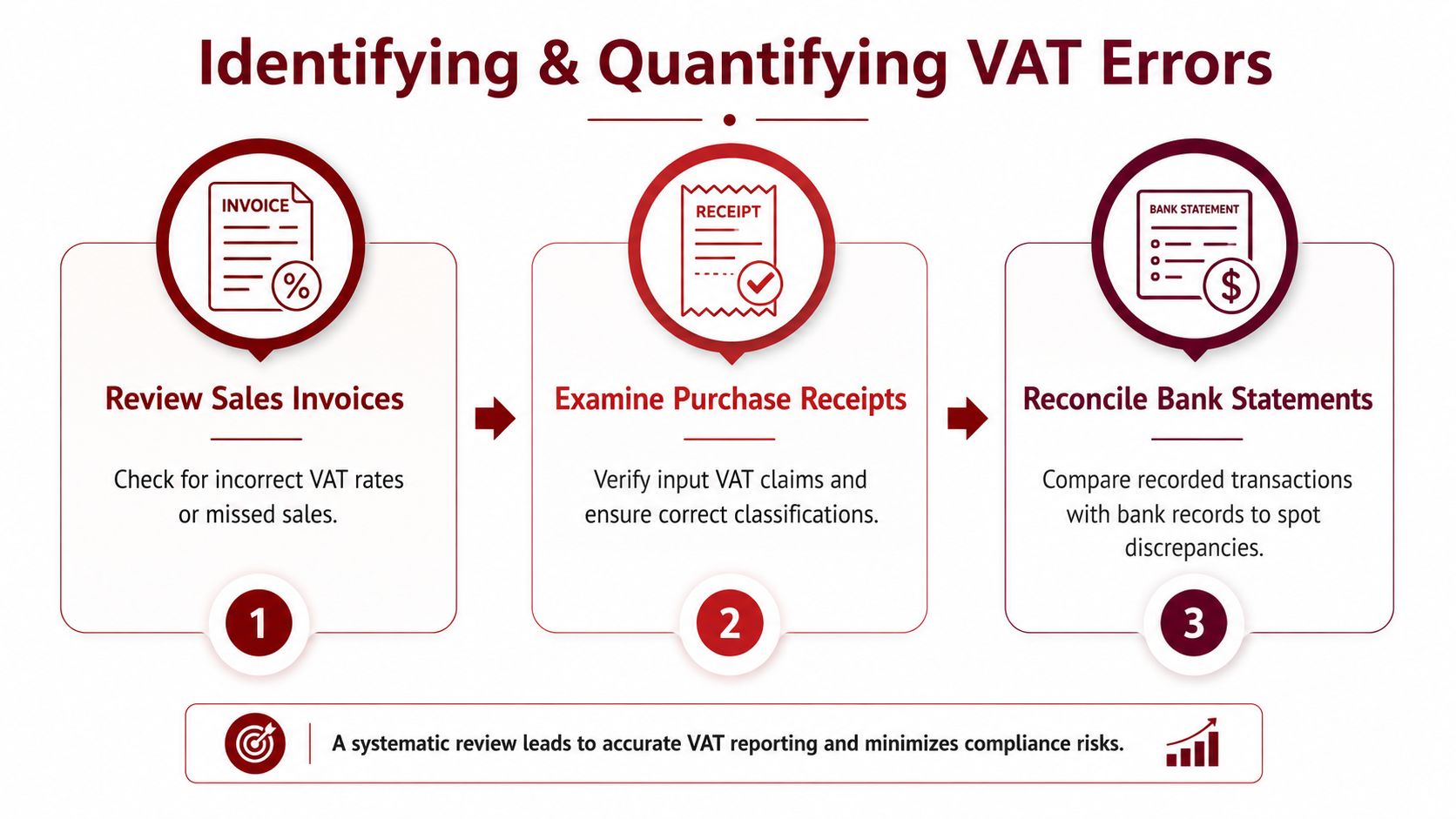
Review these in order:
Sales invoices
Check whether VAT was charged correctly, whether any sales were omitted, and whether credit notes were reflected properly.Purchase invoices and receipts
Confirm that input VAT was claimed only where the document supports it and the VAT treatment is correct.Bank transactions and payment records
Reconcile cash movement against the bookkeeping to catch invoices that were paid but not posted, or posted with the wrong tax code.The filed VAT returns for the affected periods
Match the underlying transactions back to what was submitted.
If you're a sole trader or founder doing much of this yourself, clean records make the whole exercise faster. Good day-to-day processes matter long before there's an error to fix, which is why structured bookkeeping for sole traders tends to prevent a lot of VAT mess from building up in the first place.
The net error trap that changes the outcome
Many guides conclude their advice prematurely. HMRC does not want you to total every overstatement and understatement separately and treat that gross amount as the correction figure. The key figure is the net error.
That means you aggregate the relevant input and output tax errors and offset overpaid VAT against underpaid VAT. The result is the figure you use to decide the correction method. RossMartin gives a clear example: £12,000 overclaimed input tax and £3,000 overpaid output tax produces a £9,000 net error, which still allows Method 1 despite the larger total error volume, as explained in RossMartin's VAT error correction guidance.
Here's the practical consequence. If you add £12,000 and £3,000, you might conclude the error is £15,000 and assume separate notification is required. That would be the wrong reading of the rules. Netting changes the answer.
Businesses often spend hours debating thresholds when the real problem is that they have calculated the wrong number.
The second trap is the 1% Box 6 test. Verified guidance notes that 34% of UK startups fail VAT error corrections because they misapply the 1% Box 6 turnover threshold, especially where zero-rated construction supplies or property income make Box 6 less intuitive, as discussed in Stewart Accounting's note on correcting VAT errors.
A workable file for VAT error correction should include:
- A schedule by VAT period: Show each error line by line.
- A description of how it arose: Wrong rate, omission, duplication, timing, or classification.
- Direction of error: State whether it increased VAT paid or reduced it.
- Netting calculation: Show clearly how overpayments and underpayments were offset.
- Supporting documents: Keep copies of invoices, credit notes, reconciliations, and ledger extracts.
When this schedule is done properly, the next decision becomes far simpler.
Correction Thresholds Deciding Your Reporting Method
You have finished the hard part. The errors are listed, the overpayments and underpayments have been netted properly, and now one decision matters. Does the correction go through your next VAT return, or do you tell HMRC separately?
Many businesses still make errors in this area. They calculate the net figure correctly, then choose the reporting route based on habit, pressure, or the gross total sitting in the nominal ledger. That is how the net error calculation trap turns into a filing mistake.
The threshold rules in plain English
The rule is based on the net error, not the total of every mistake found. HMRC's manual at VATREC12030 sets out the correction limits. A non-deliberate error can usually be adjusted on the next VAT return if the net value is £10,000 or less. If it is more than £10,000 but not more than £50,000, you can still use the next return if the amount is less than 1% of Box 6 for that return. Above that, or where the behaviour was deliberate, HMRC expects a separate disclosure.
That gives you three checks:
- What is the net error?
- What is 1% of Box 6 on the return you plan to adjust?
- Was the error careless, or was it deliberate?
The order matters. We often see businesses jump straight to the £10,000 to £50,000 band and forget that Box 6 can change the answer.
VAT error correction methods at a glance
| Net Error Value | Condition | Action Required |
|---|---|---|
| £10,000 or less | Non-deliberate | Adjust on the next VAT return |
| Between £10,000 and £50,000 | Less than 1% of Box 6 total sales and non-deliberate | Adjust on the next VAT return |
| Between £10,000 and £50,000 | 1% of Box 6 total sales or more | Formal disclosure to HMRC |
| More than £50,000 | Any non-deliberate error | Formal disclosure to HMRC |
| Any value | Deliberate error | Formal disclosure to HMRC |
A practical point often gets missed. Box 6 is not always intuitive, especially in construction and property businesses where exempt income, reverse charge entries, or zero-rated sales can distort what owners expect to see. If Box 6 has been posted inconsistently, check the VAT control and nominal ledger structure before deciding the method.
Method 1 is usually easier. It saves time and keeps the correction inside the normal return cycle. Method 2 takes more preparation, but it can be the safer route where records are messy, the history is long, or you want HMRC to see the issue as a standalone disclosure.
The expensive mistake is choosing the method from the wrong number. If a business adds every error together instead of netting them, it can push itself over a threshold that does not apply. The reverse is worse. If the net figure has been understated and the business adjusts the next return when a disclosure was required, HMRC may treat the correction itself as a separate compliance failure.
For businesses trading across borders, that review should also tie back to wider EU VAT accounting compliance, because domestic correction errors often sit alongside coding issues in cross-border sales and purchase entries.
If your file does not show the netting clearly, the threshold decision is not ready to sign off.
When we review these cases, we do not start with the VAT return. We start with the workings behind it. Once the net figure, Box 6 test, and behaviour point all agree, the reporting method usually becomes clear very quickly.
How to Make the Correction Practical Examples and Journals
You have worked out the right route. The next job is to post it cleanly, file it in the right place, and leave a trail that still makes sense six months later.

Method 1 adjusting the next VAT return
For smaller, non-deliberate errors that fall within the limits already covered, the correction goes through the next VAT return. The practical risk here is not usually the filing step. It is posting the wrong figure because the business has added up every mistake instead of calculating the net error first.
That netting point matters more than many owners expect. If one period includes underdeclared output tax and overclaimed input tax, those increase the amount due to HMRC. If another item in the same review shows overdeclared output tax or underclaimed input tax, that pushes the other way. The figure you adjust on the return is the net result of the errors being corrected together, not the gross total of every line in the spreadsheet.
A straightforward example shows the trap.
A business finds:
- output tax underdeclared by £6,000
- input tax overclaimed by £2,000
- output tax overdeclared by £1,500
The gross errors add up to £9,500. Some businesses stop there. The correction figure is £6,500 payable to HMRC, because the £1,500 overdeclaration reduces the net error. That is the number that should drive the posting and the reporting method.
On the next VAT return, that usually means:
- extra VAT due is reflected through Box 1
- extra input tax reclaim is reflected through Box 4
- the underlying sales or purchase values are corrected in the bookkeeping records where needed, rather than forced into the return with no ledger support
Keep the process disciplined:
- post the bookkeeping correction before the return is filed
- reconcile the VAT control account to the draft return
- keep a short working paper showing how the net figure was calculated
- note which VAT period picked up the adjustment
We often see businesses leave the correction off the ledger and try to remember it at filing time. That is where the audit trail starts to fall apart.
Method 2 notifying HMRC separately
Where the correction falls outside the self-adjustment route, or the behaviour point means a separate disclosure is safer, treat the submission like a file you may need to defend later. HMRC does not just need the number. It needs to see how you arrived at it, which periods are affected, and whether the workings are internally consistent.
Johnston Carmichael explains that larger errors and deliberate errors need to be notified separately, and notes the move to the newer online process in place of the older paper-led approach in many cases, in its article on VAT penalties and correcting VAT errors.
A good disclosure pack usually includes:
- the VAT periods affected
- whether each error relates to input tax or output tax
- the value of each error before netting
- the net amount being disclosed
- a short explanation of the cause
- copies of key invoices, credit notes, or schedules if the position is not obvious from the summary
There is a real trade-off here. A short disclosure is quicker to send, but if the numbers are unusual or the business has mixed supplies, partial exemption issues, or sector-specific VAT treatment, a thin explanation can create follow-up questions that take longer to answer than the original submission would have taken to prepare properly.
For businesses trading internationally, it can help to compare your UK VAT procedures with broader EU VAT accounting compliance processes, especially if your finance team is trying to standardise how tax adjustments are documented across jurisdictions.
This explainer gives a visual overview of the reporting process and is useful if you want to sense-check the admin flow before filing:
Simple journals that keep the books clean
The VAT return corrects the tax position. The journals prove how you got there.
If historic entries are messy, review the nominal ledger structure and VAT control postings before posting adjustments. The VAT control account should reconcile to the submitted position after the correction is entered.
Typical journal logic looks like this:
| Scenario | Debit | Credit |
|---|---|---|
| Underdeclared output VAT | Relevant income correction or suspense, depending on how error is being cleared | VAT control |
| Underclaimed input VAT | VAT control | Relevant expense or balance sheet account, depending on original posting |
| Overclaimed input VAT | Relevant expense or correction account | VAT control |
The exact nominal code matters less than the logic. Correct the VAT control. Preserve the link back to the original transaction. Avoid dumping everything into a generic adjustments account unless you also keep a schedule that explains each line.
A clean journal does two jobs. It fixes the current VAT position and leaves a credible reconciliation for the next review.
Common Pitfalls for Contractors and Property Businesses
Generic VAT guidance usually breaks down when a business has sector-specific rules layered on top. Contractors and property businesses run into this constantly. The error often isn't a simple arithmetic issue. It's a classification issue with VAT consequences.
Contractors where VAT and CIS collide
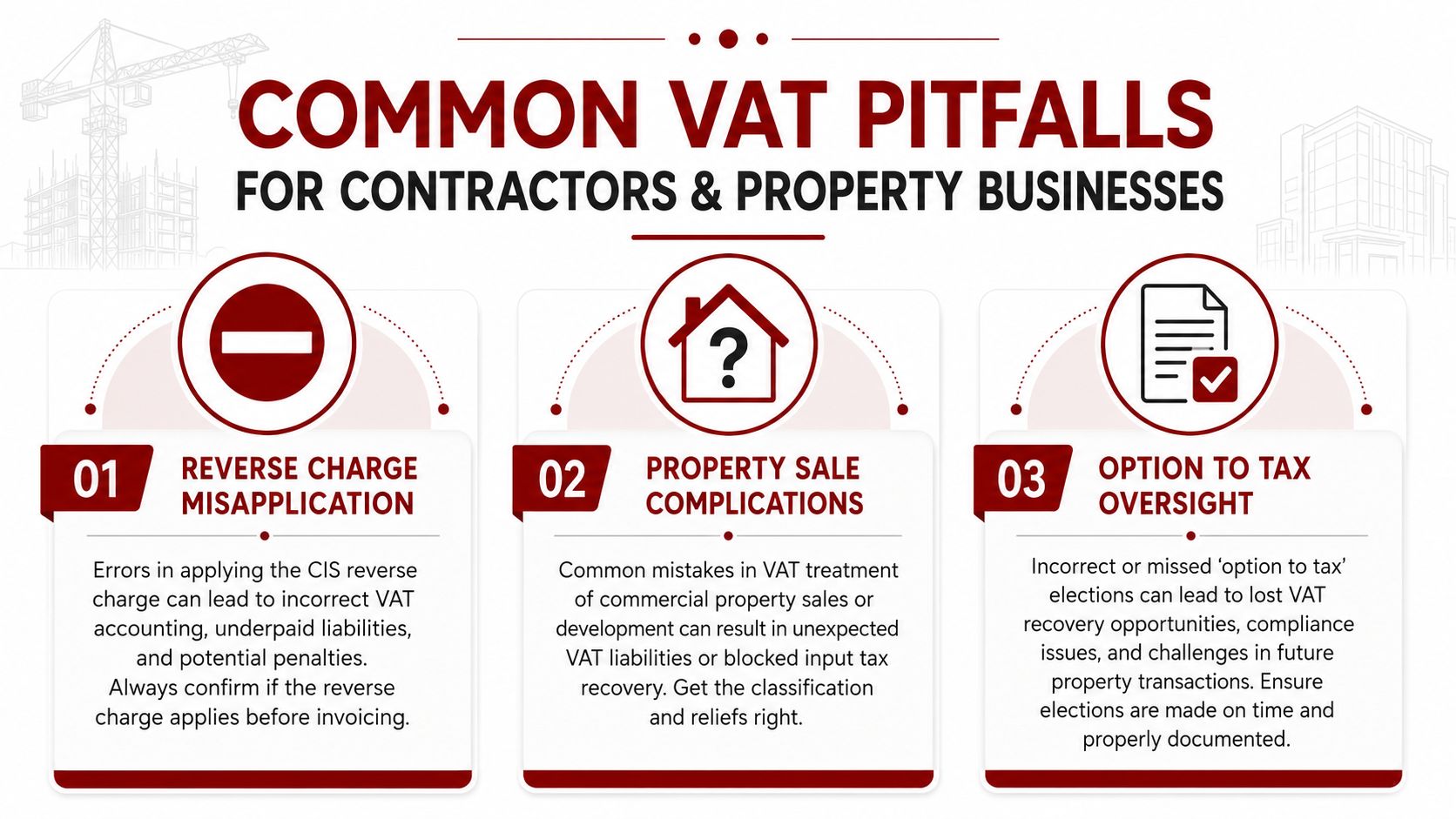
Construction businesses often have one extra problem when correcting VAT errors. The transaction narrative matters as much as the number. Reverse charge treatment, subcontractor relationships, and CIS-linked admin can make a plain correction note too thin.
Verified commentary from ICAEW notes that online VAT error correction became the standard route from July 2025, but a gap remains for agents acting for clients exempt from MTD VAT, and this is particularly acute for construction contractors because the digital tool lacks specific fields for sector-specific narratives that written letters previously allowed, as explained in ICAEW's article on HMRC's updated process.
That matters in real life because contractor errors are often fact-heavy:
- Reverse charge applied when it shouldn't have been
- Ordinary VAT charged where reverse charge treatment was required
- Sales invoice wording not matching the VAT treatment
- Subcontract costs posted with the wrong tax code
If you're operating in that sector, specialist construction accounting support usually helps because the bookkeeping, CIS compliance, and VAT coding affect each other directly.
Property businesses where classification drives everything
Property businesses face a different pattern. The pain point is often whether an item belongs in a taxable, exempt, or mixed activity bucket and how that affects VAT recovery or Box 6 treatment.
Typical trouble spots include:
Repairs versus capital improvement
The invoice may look ordinary, but the VAT consequence can differ depending on the nature of the work and how the asset is used.Commercial property decisions
Transactions can be recorded in the accounts one way while the VAT treatment needs a more careful review.Mixed income streams
Property income can make turnover-based tests less intuitive when the business owner is trying to apply them quickly.
A pattern we see often is that the bookkeeping software entry looks tidy, but the commercial reality behind it hasn't been documented well enough. That becomes a problem during VAT error correction because HMRC will care how the error arose, not just the final amount.
In contractor and property cases, the note behind the correction often matters almost as much as the number itself.
Avoiding Future Errors Recordkeeping and Final Checks
A lot of VAT problems start long before the return is filed. We see it when a business spots several mistakes at once, adds the gross figures together, and assumes the correction has to go down the more formal route. In practice, the better recordkeeping point is earlier than that. Keep enough detail to separate overpaid VAT from underpaid VAT, so you can calculate the net error properly and choose the right correction method.
Good records do more than support a claim. They show how the mistake happened, who reviewed it, and whether the business acted quickly once it was found. That matters if HMRC ever asks whether the error came from a reasonable process that failed once, or from weak controls that were left uncorrected.
A submission routine that prevents repeat mistakes
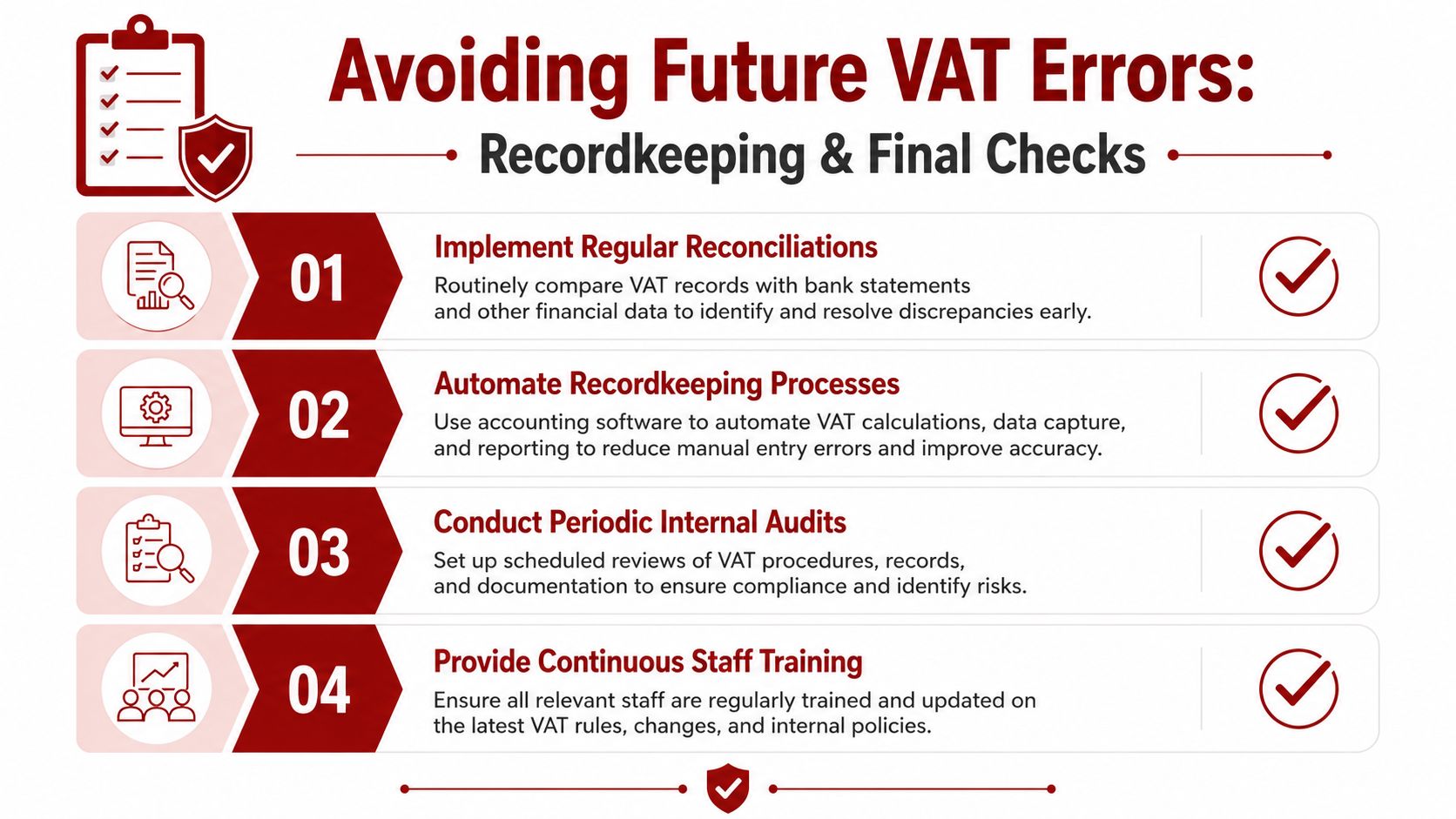
The strongest routines are simple enough to follow every month, not just at quarter end. We usually recommend a process that gives you a clean audit trail and flags unusual items before they distort the VAT return.
- Reconcile monthly: Match sales, purchases, and bank entries while the transactions are still fresh.
- Keep the VAT logic with the transaction: If a property cost, credit note, or contractor invoice needs judgement, add a short note at the point of posting.
- Review exceptions separately: Manual journals, reversals, bad debt adjustments, and one-off invoices should not pass through on autopilot.
- Check tax codes regularly: Software helps only if the setup still matches what the business is doing.
- Retain evidence in one place: The invoice, contract, and explanation should be easy to retrieve together.
For teams tightening reporting processes more generally, the Wistec financial reporting guide gives useful background on building cleaner reporting systems around finance software.
Pre VAT submission checklist
Before filing, run through the return as if you were checking an error correction case after the event. That small habit catches a surprising number of avoidable issues.
| Check | What to confirm |
|---|---|
| Sales review | Large, unusual, or manual invoices have the correct VAT treatment |
| Purchase review | Input VAT claims are backed by valid VAT evidence |
| Bank reconciliation | Cash movements agree to the underlying postings |
| VAT control review | The VAT ledger agrees with the draft return |
| Net error sense check | Overpayments and underpayments have been netted correctly, not added gross |
| Exception review | Credits, write-offs, and manual journals have been checked by someone who understands the VAT impact |
| Retention of evidence | Key documents and explanations can be produced quickly if HMRC asks |
Penalty exposure usually turns on behaviour and disclosure, not just the arithmetic. As noted earlier, penalties can increase sharply where HMRC sees deliberate action or concealment, and early unprompted disclosure generally puts you in a better position.
The practical trade-off is straightforward. A tighter monthly process takes a little more discipline, but it is far cheaper than revisiting old quarters, rebuilding evidence, and discovering too late that the net error was calculated the wrong way.
If you've found a VAT error and want calm, precise help fixing it properly, Action Accountants Limited can help you work through the records, calculate the net error correctly, and choose the right correction route with confidence.