
What Is Nominal Ledger: Your 2026 UK Business Guide
Action Accountants •7 July 2026
You've probably seen this happen already. Money comes in, bills go out, VAT deadlines appear faster than expected, and your accounting software shows a list of codes that seems written for someone else. You know the business is trading, but when someone asks what you spent on tools, rent, software, fuel, or subcontractors last month, the answer isn't obvious.
That's usually the point where business owners start searching for what is nominal ledger and get buried in definitions that feel more academic than useful. The good news is that the nominal ledger isn't some obscure accountant's relic. It's the organising system that turns transactions into usable financial information.
If you're running a small company, a startup, or a construction business, understanding it helps with more than tidy books. It affects cash flow visibility, VAT accuracy, CIS tracking, and the quality of decisions you make from your reports. If you want a second plain-English perspective alongside this article, Stewart Accounting Services has a simple guide for your finances. If you're still getting the basics in place, this overview of small business accounting support is also useful.
Table of Contents
- Your Guide to The Nominal Ledger
- The Nominal Ledger Your Business's Financial Blueprint
- How Nominal Codes Bring Order to Your Bookkeeping
- Real-World Examples for UK SMEs and Contractors
- Setting Up Your Nominal Ledger in Modern Software
- Essential Best Practices and Getting It Right
Your Guide to The Nominal Ledger
A nominal ledger is easiest to understand when you stop treating it like jargon.
Think of a busy week in a small business. You raise an invoice, pay for stock, cover a software subscription, buy materials, receive a customer payment, and maybe refund a client. Those transactions don't just need recording. They need organising in a way that tells you what happened, where the money went, and what it means for tax and profit.
That's the job of the nominal ledger. It acts as the master filing system for your business finances. Instead of one long, messy list of bank movements, it sorts transactions into meaningful accounts such as sales, rent, motor expenses, bank, VAT, or director's loan. Once that structure is right, your reports start saying something useful.
Practical rule: If your bookkeeping doesn't let you answer “what did we spend money on?” quickly and confidently, your nominal ledger probably needs work.
For a new business owner, that matters because most mistakes don't start with the tax return. They start earlier, when transactions are posted to the wrong place, lumped into vague codes, or left unreconciled. By the time you look at your Profit and Loss account, the damage is already baked in.
A good nominal ledger gives you three things at once:
- Clarity for decisions: You can see the underlying drivers of revenue and cost.
- Cleaner compliance: VAT, year-end accounts, and CIS records become easier to support.
- Better cash flow control: You spot patterns, missed postings, and unusual costs sooner.
The Nominal Ledger Your Business's Financial Blueprint
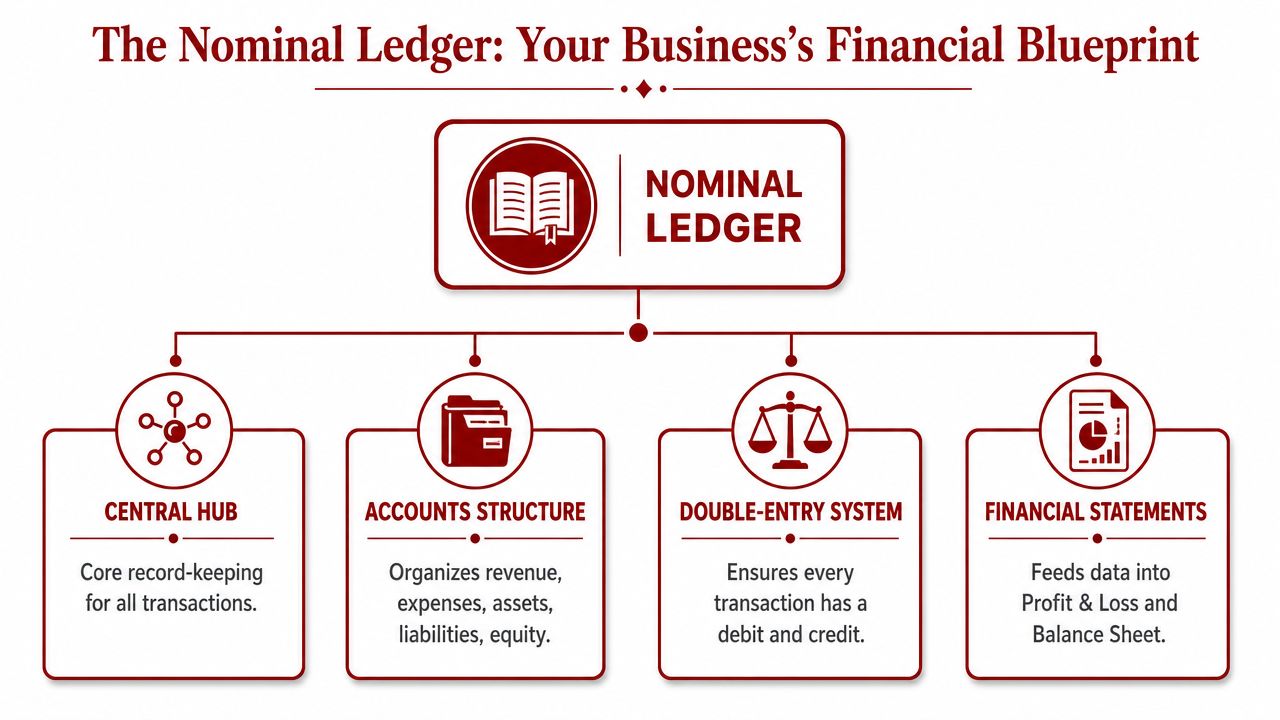
The nominal ledger is the backbone of UK bookkeeping. HMRC describes it as the “keystone” of the entire book-keeping system and the central hub where financial transactions are recorded as formal journal entries in non-personal accounts, with the information then supporting the Profit and Loss statement and Balance Sheet in HMRC's guidance.
Why the UK term matters
In UK practice, people often say nominal ledger. In many software products and US-based guides, you'll usually see general ledger. Functionally, they're the same thing. The difference is mainly language and tradition.
That matters because small business owners often assume they're looking at two separate systems. They're not. If Xero, QuickBooks, or another platform talks about the general ledger, it's pointing to the same core record set that many UK accountants still call the nominal ledger.
What sits inside it
The nominal ledger isn't typed up from nowhere. It's built from the records feeding into your books, including the cash book, petty cash book, purchase ledger, sales ledger, and day books, as described in the HMRC material above. The result is a structured set of accounts rather than a pile of disconnected entries.
A well-built ledger usually includes accounts for:
- Income accounts, such as sales or other operating income
- Expense accounts, such as rent, software, travel, or telephone
- Asset accounts, such as bank, equipment, and debtors
- Liability accounts, such as creditors, VAT, or loans
- Equity accounts, including retained profit and capital introduced
The chart of accounts sits over the top of this structure. It indexes the accounts so transactions land in the right place and can later be used for accruals, prepayments, budgets, and reporting.
When the nominal ledger is clean, the year-end process becomes easier because the logic of the business is already visible in the books.
This is why I think of the nominal ledger as a blueprint rather than a report. Reports are outputs. The nominal ledger is the structure that makes those outputs trustworthy.
When that structure is weak, every downstream task becomes harder. VAT checks take longer. Management accounts need more explanation. Year-end adjustments become more expensive. If you're preparing for statutory work, a practical year-end accounts checklist helps, but the key is getting the underlying ledger right throughout the year.
How Nominal Codes Bring Order to Your Bookkeeping
A nominal ledger only works if transactions are coded properly. That's where nominal codes come in.
A nominal code is the label or reference used to post a transaction to the right account. Different software packages format these differently. Some use numbers, some use names, and some use both. The principle is the same. The code tells the system whether a transaction belongs in sales, rent, stationery, bank charges, plant hire, VAT control, or somewhere else.
The chart of accounts is the index
The chart of accounts is the full list of those codes and account names. If the nominal ledger is your filing cabinet, the chart of accounts is the drawer plan.
The practical value is simple. It stops unlike transactions being grouped together. If you dump fuel, software, insurance, and repairs into one broad overhead code, your reports become less useful. If you split them sensibly, you can track patterns and ask better questions.
Patriot Software's explanation of nominal accounts highlights several core points. Nominal accounts hold income statement items such as revenue, expenses, gains, and losses; they are closed at the end of the fiscal year and reset for the new year; and each transaction is first assigned a nominal code from the chart of accounts so the accounting equation stays balanced in this reference article.
Here's a simple example structure.
| Nominal Code | Account Name | Account Type | Example Transaction |
|---|---|---|---|
| 4000 | Sales | Income | Customer invoice raised for services |
| 5000 | Rent Expense | Expense | Monthly office rent paid |
| 5100 | Software Subscriptions | Expense | Monthly Xero or CRM payment |
| 5200 | Motor Expenses | Expense | Fuel or vehicle running cost |
| 1200 | Bank | Asset | Customer payment received into bank |
| 2200 | VAT Control | Liability | VAT element of a supplier bill |
What works is a chart of accounts that reflects how you run the business. What doesn't work is copying a generic list and never reviewing it.
How double entry works in practice
The nominal ledger sits inside a double-entry system. Every transaction affects at least two accounts. That's how the books stay balanced.
The basic rule from the reference above is this: debit all expenses and losses and credit all income and gains. For a business owner, the better question is what that means in day-to-day bookkeeping.
Take rent. If you pay office rent from the bank:
- The rent expense account increases
- The bank account decreases
Take a customer payment for a sale already invoiced:
- The bank account increases
- The debtor or sales-related account is reduced or matched, depending on how the invoice was recorded
This doesn't need to become a theory lesson. You just need to know that every posting has a pair, and the pair matters. If one side is wrong, your reports may still look neat on the surface but they won't reflect reality.
A few practical habits make a big difference:
- Use distinct codes for material costs: Contractors especially need clear separation between labour, materials, plant, and overheads.
- Create departments or cost centres where needed: If one part of the business is profitable and another isn't, a single shared code can hide it.
- Don't overbuild the chart: Too many near-duplicate codes cause confusion and inconsistency.
- Avoid vague dumping grounds: “Miscellaneous” is often where reporting quality goes to die.
The best nominal ledgers are detailed enough to support decisions, but not so complicated that nobody posts to them consistently.
Real-World Examples for UK SMEs and Contractors
A contractor finishes a job, raises an invoice, gets paid less than expected because CIS has been deducted, and then wonders why the bank balance, VAT return, and profit report all seem to tell a different story. That is where the nominal ledger stops being bookkeeping jargon and starts becoming a control tool.

For UK SMEs, the value of the nominal ledger is practical. It separates costs properly, keeps VAT postings clean, and shows whether cash pressures are coming from slow payments, weak margins, or coding errors. For contractors, that level of detail often needs to go further, with project, department, or cost centre tracking built into the ledger so one profitable job is not masking losses on another.
Example one paying office rent
A small design agency pays monthly rent from the business bank account.
The posting is simple. Rent goes to a Rent Expense nominal code, and the payment reduces the Bank account. If that happens the same way every month, the Profit and Loss account gives the owner a clear view of fixed overhead.
The common mistake is less dramatic but more damaging over time. Rent gets posted to broad headings such as “admin costs” or “general expenses”, usually because someone accepts the software default without checking it. The payment still leaves the bank, but management accounts become less useful because a predictable overhead is now buried inside a mixed category.
Example two buying equipment with VAT
A VAT-registered company buys a laptop for the business.
One payment creates several accounting entries. The net cost belongs in an equipment or fixed asset code. The VAT goes to the VAT control account. The gross amount reduces the bank. If all of it is pushed into one expense code, the business can lose sight of what it owns and submit a VAT return based on poor records.
This is one of the trade-offs I see in practice. Owners want speed, and modern systems can help with that, especially if they use accounting software for small businesses. Speed only helps if the nominal codes underneath are sensible. A fast posting into the wrong code still creates slow problems later.
Example three recording a CIS deduction
CIS is where a generic chart of accounts often falls short.
If a subcontractor raises an invoice for work done and the contractor deducts CIS before payment, the ledger needs to show the full sales value, the CIS tax suffered, and the net cash received. Posting only the bank receipt to income understates turnover and weakens the records you need to support tax compliance.
For construction firms, the nominal ledger often needs to reflect how the business runs. Separate codes for labour, materials, plant hire, subcontractor costs, and retentions give a far better read on job performance and cash flow than a flat overhead structure. Businesses that need that level of detail usually benefit from bookkeeping designed around construction accounting and contractor requirements rather than a generic setup.
A good nominal ledger records the transaction. A well-designed one also shows what happened, why it matters, and what needs attention next.
Setting Up Your Nominal Ledger in Modern Software
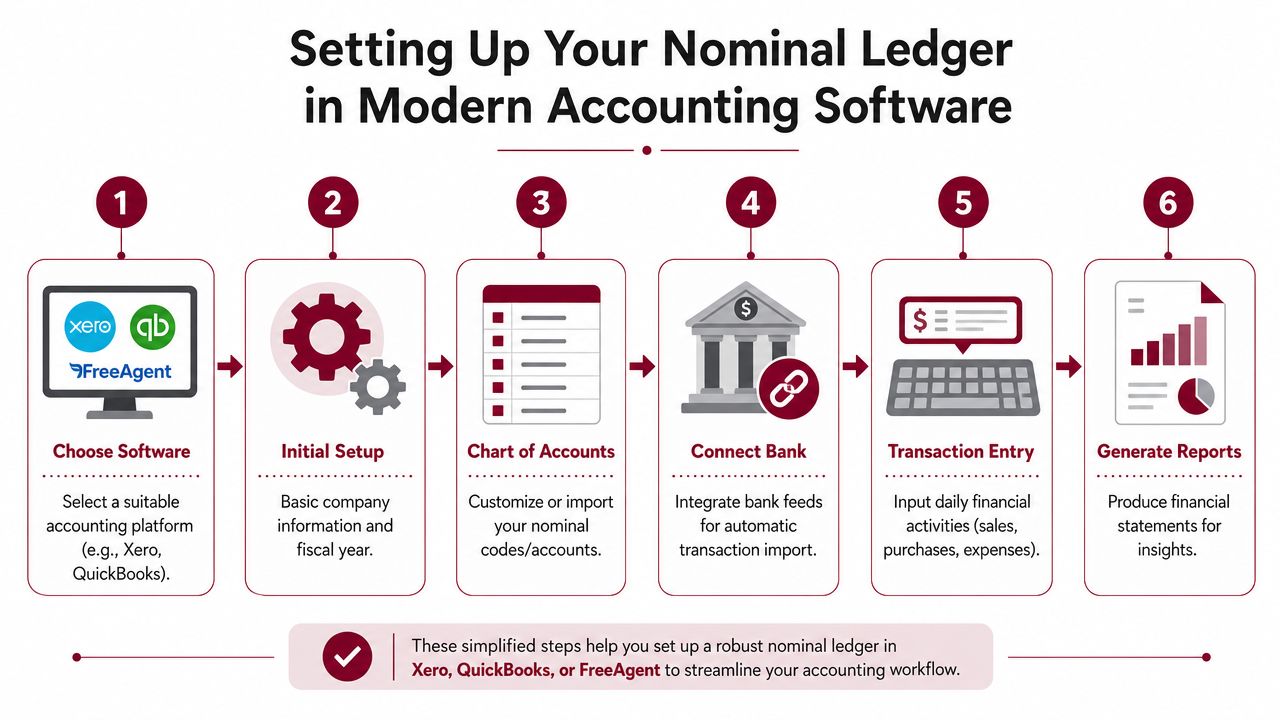
Modern software makes posting faster, but it doesn't remove the need for judgement. Xero, QuickBooks, and FreeAgent can import bank feeds, suggest categories, and automate recurring entries. Underneath all of that, the nominal ledger still decides whether your reports are useful or misleading.
Start with the software default then improve it
Most platforms give you a default chart of accounts. That's a starting point, not a finished system.
Review the list early. Add accounts that reflect the actual shape of your business. A consultant might need clearer separation of subcontractor costs, travel, software, and training. A contractor may need codes for materials, plant hire, retained amounts, or CIS-related items. A landlord may want distinct property cost categories rather than one broad repairs code.
If you're comparing tools, this overview of accounting software for small businesses is a useful primer on the software side. The key point from an accounting perspective is simpler: the best software still depends on good nominal coding.
A practical setup usually follows this order:
- Choose the platform that fits your business and reporting needs.
- Set company basics such as financial year and VAT settings correctly.
- Review the chart of accounts and tailor it before too much data piles up.
- Connect bank feeds so transactions flow in regularly.
- Create posting rules carefully for recurring transactions only.
- Test reports early to see whether the output makes commercial sense.
Reconciliation is what makes it trustworthy
Bank reconciliation is the routine that turns software data into dependable records. If the bank account in the books doesn't match the actual bank activity, the nominal ledger can't be trusted.
That's why reconciliation should happen consistently, not just before VAT filing or year-end. Imported bank lines still need checking. Software suggestions can post to the wrong code. Supplier payments can be duplicated. Customer receipts can be matched incorrectly. The feed saves time, but it doesn't replace review.
Reconcile first, analyse second. If the bank doesn't agree, the reports are only a draft.
For VAT-registered businesses, this discipline matters even more. It supports the accuracy of the return and gives you a cleaner audit trail if questions arise. If you're preparing for digital VAT record-keeping and filing, a focused guide to Making Tax Digital for VAT compliance is worth keeping close to hand.
Essential Best Practices and Getting It Right
The businesses that get real value from their nominal ledger treat it as a management tool, not just a compliance file.
Keep the chart of accounts lean and relevant. Review it when the business changes. If you add a new revenue stream, start employing staff, take on projects with different cost structures, or move into construction work with CIS implications, the ledger should change with you. If it doesn't, your reports will lag behind reality.
A few habits usually separate clean ledgers from chaotic ones:
- Review codes regularly: Old, duplicate, or unclear accounts create posting errors.
- Use automation carefully: Bank rules are helpful, but only for transactions that are repetitive and predictable.
- Separate tax-sensitive items: VAT, CIS, loan balances, and director transactions need clear treatment.
- Reconcile on schedule: Waiting until quarter-end often turns a simple review into a repair job.
- Challenge vague categories: If “general expenses” grows every month, drill into it.
Common mistakes are just as predictable. Owners create too many nominal codes, then nobody uses them consistently. Or they create too few, so the reports are too blunt to support decisions. Another frequent problem is relying on the bank feed alone. A bank feed imports activity. It doesn't think.
A reliable nominal ledger gives you cleaner compliance, better conversations with your accountant, and stronger control over cash.
That's the practical answer to what is nominal ledger. It's the system that organises the financial life of your business so your reports, VAT records, year-end accounts, and day-to-day decisions rest on something solid.
If you want help setting up or cleaning up your nominal ledger, Action Accountants Limited supports UK businesses with bookkeeping, VAT, year-end accounts, and construction-focused accounting that takes CIS and cash flow seriously.