

Guide on How to File Vat Return: UK Businesses 2026
Action Accountants •21 July 2026
Your first VAT deadline usually arrives at the worst moment. You're busy chasing invoices, answering customers, and trying to keep cash moving, then HMRC confirms your VAT period and the task stops feeling theoretical. It becomes a fixed deadline with real consequences if you get it wrong.
That's why most new business owners don't need another vague checklist. They need to understand what the VAT return is doing. In practice, it's a summary of the VAT flowing through your business. What you charged on sales. What you paid on purchases. What HMRC should receive, or repay.
For straightforward businesses, the process is manageable once the records are clean. For construction, property, and import-heavy businesses, the detail matters much more. A return can look tidy on screen and still be wrong underneath. That's where problems usually start.
Table of Contents
- Your First VAT Return A Guide for UK Business Owners
- The Groundwork Before You File Your VAT Return
- Calculating Your VAT Due Outputs Minus Inputs
- Submitting the Return and Making Payment
- Navigating Common VAT Pitfalls and Complexities
- When to Call an Accountant for Your VAT Returns
Your First VAT Return A Guide for UK Business Owners
The first return is usually the hardest because nothing feels familiar yet. You're looking at software boxes, HMRC terminology, and reports that seem more technical than they really are. Most owners aren't struggling with arithmetic. They're struggling with confidence.
A good VAT return starts with a simple question. Do the figures reflect what happened in the business? If the answer is yes, filing is often straightforward. If the answer is “I think so”, that's where you need to slow down.
In day-to-day practice, the businesses that cope best with VAT aren't always the most advanced. They're the ones that keep orderly records, separate personal and business spending, and review transactions before quarter end instead of on deadline day.
Practical rule: VAT returns are easier when you treat bookkeeping as a weekly habit, not a quarterly rescue job.
That matters even more in sectors where one transaction can be treated differently from another that looks almost identical. A builder may have sales that fall under the domestic reverse charge. A landlord may have property costs that feel business-related but don't give the VAT recovery they expected. An importer may reclaim VAT correctly only if the paperwork and coding are aligned.
Here's the reassuring part. Once you understand the logic, learning how to file a VAT return becomes much less intimidating. The software does the mechanics. Your job is to make sure the records underneath are complete, correctly coded, and reviewed with a bit of commercial sense.
The Groundwork Before You File Your VAT Return
Start with registration and the right setup
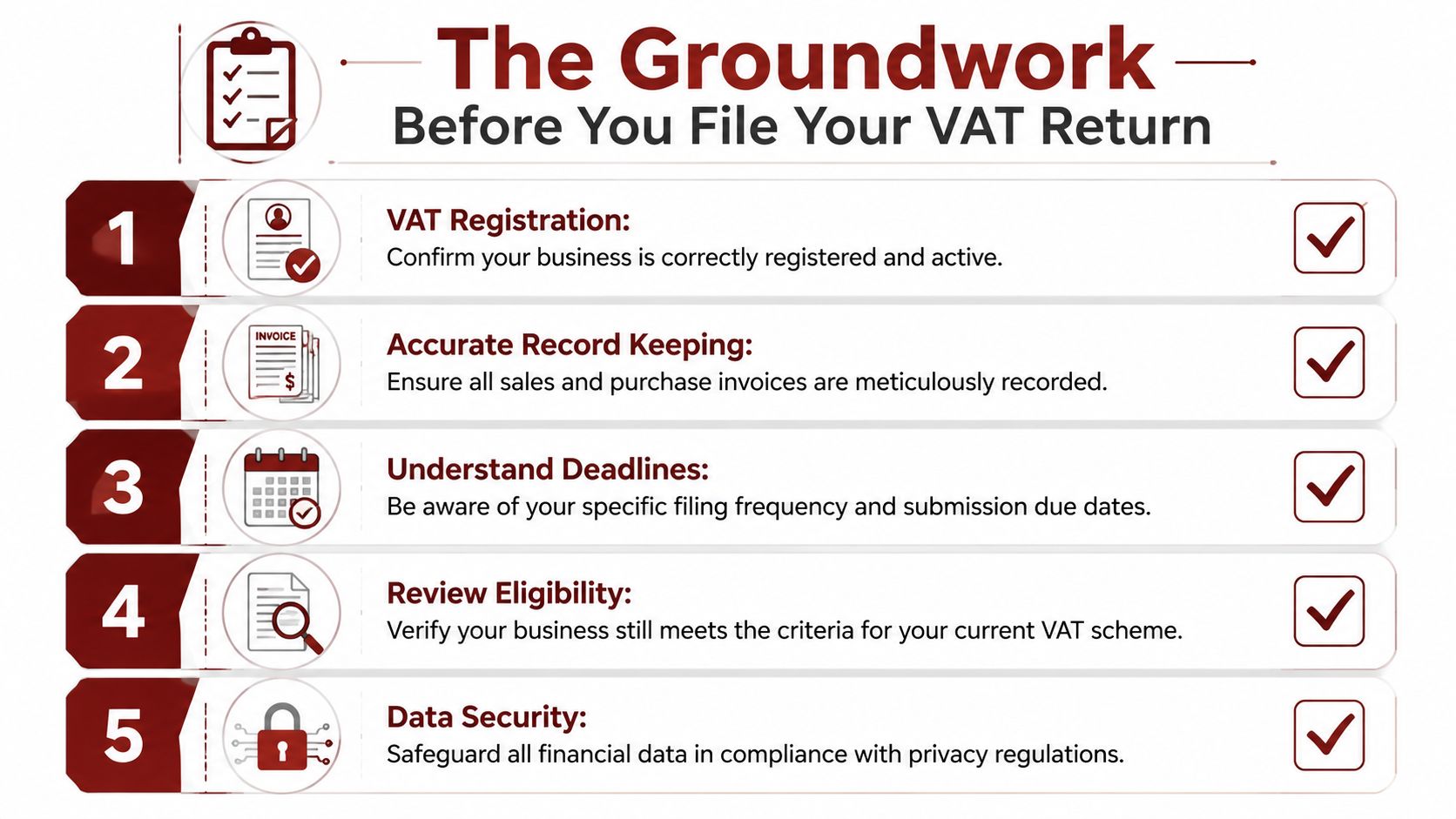
Before you calculate anything, make sure you should be filing in the first place and that your filing setup is active.
The UK VAT registration threshold is £90,000 of taxable turnover, effective from April 2024, and most registered businesses then file quarterly, submit electronically through MTD-compatible software, and work to a deadline of one calendar month and seven days after the end of the VAT period, according to Taxually's UK VAT manual. The same guidance notes that late returns trigger penalty points and that quarterly filers typically face a £200 fine once the threshold is reached.
Voluntary registration can still make sense before that threshold if your customers expect VAT invoices or if reclaiming input VAT matters to your cash flow. But voluntary registration also means ongoing compliance. Once you're in, you need a system that can support regular filing properly.
Build your records before the deadline arrives
Making Tax Digital isn't just about submission. It's about keeping digital records in software that can produce an accurate VAT return without manual patchwork at the end. If your numbers live partly in emails, partly in paper folders, and partly in a spreadsheet someone updates when they remember, the return becomes harder than it needs to be.
A clean setup usually includes:
- Sales records: Every sales invoice needs to be entered with the correct VAT treatment.
- Purchase records: Supplier invoices and receipts need to be captured and coded properly.
- Bank feeds or imports: Transactions should flow into your accounting software so you can match them against invoices and bills.
- Document storage: You need supporting evidence that can be found quickly if a figure is questioned.
If your admin is scattered, a resource like this practical guide to document processing is useful because it shows how to organise invoice capture and approval in a way that reduces missed paperwork.
A lot of VAT stress is really document stress. Missing purchase invoices lead to underclaimed input VAT. Poorly labelled supplier bills lead to wrong VAT coding. Duplicate uploads create confusion that only shows up when the bank won't reconcile.
Keep one source of truth. The software should show the same story your bank, invoices, and receipts show.
For smaller companies, that often means choosing one bookkeeping platform and sticking to it. If you're still deciding how to structure things, this guide on VAT for small businesses is a useful next step because it helps place the return inside the wider VAT picture rather than treating filing as a stand-alone task.
Calculating Your VAT Due Outputs Minus Inputs
What output VAT and input VAT really mean
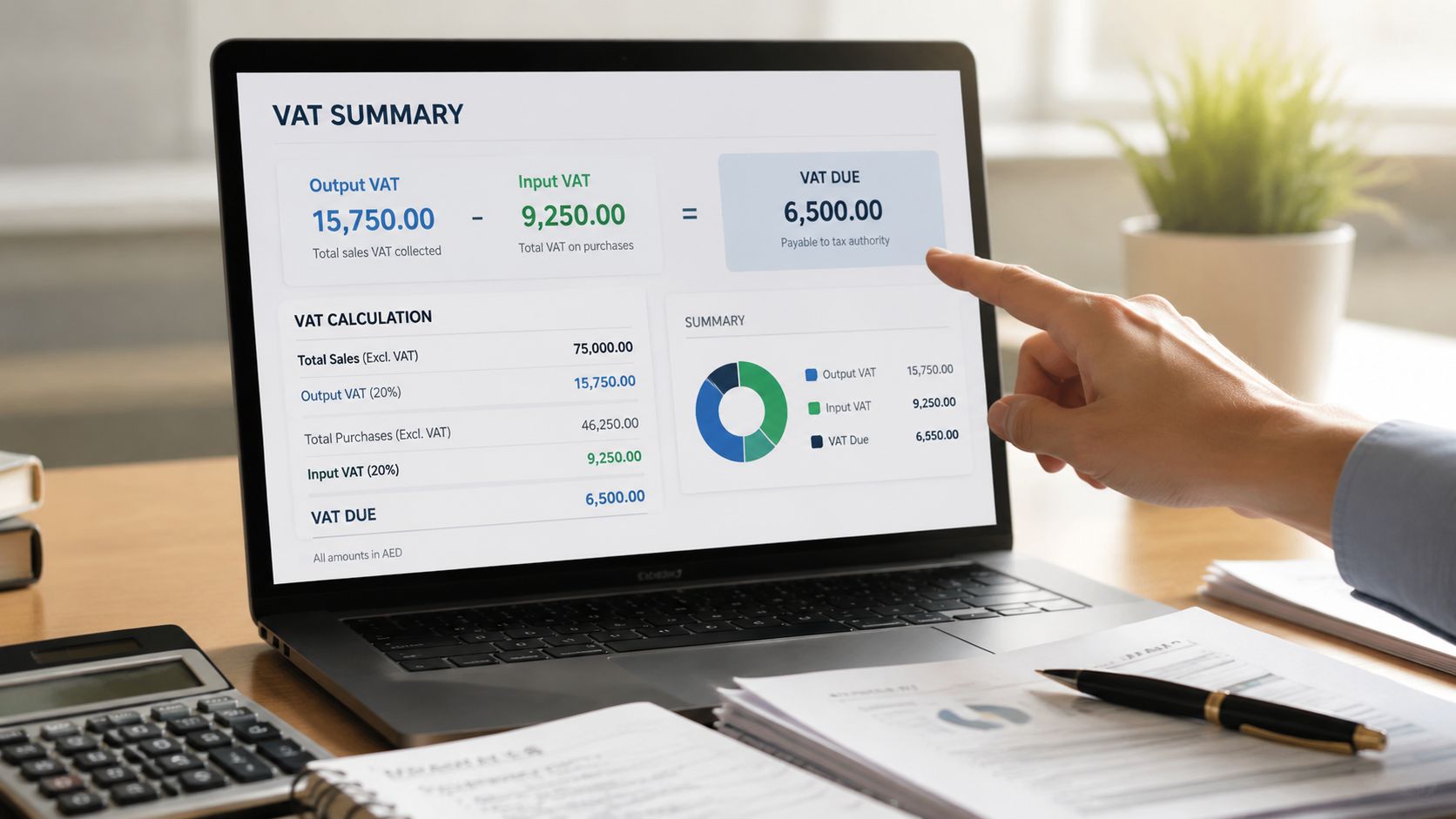
At the centre of how to file a VAT return is one basic calculation. Output VAT minus input VAT.
Output VAT is the VAT you've charged your customers on sales. You collected it, but it isn't your money to keep. Input VAT is the VAT you've paid on eligible business purchases and expenses, which you may be able to reclaim. Your VAT liability is the difference between the two.
That sounds simple because, at a high level, it is. What complicates things is classification. If a sale is coded wrongly, your output VAT can be wrong. If a purchase is entered without a valid VAT amount or the expense isn't recoverable, your input VAT can be overstated.
A practical example helps. Say you've issued sales invoices across the quarter and received supplier invoices for materials, software, fuel, and subcontract costs. Your software will usually total the VAT on sales into Box 1 and the VAT you're reclaiming on purchases into Box 4. The difference becomes the amount payable to HMRC or repayable to you.
For quick sense-checking before you post entries into your accounts, tools that simplify your VAT calculations can help you verify whether the VAT element on an invoice looks plausible.
Why bank reconciliation matters before you trust the totals
This is the step new business owners most often underestimate. They look at the VAT report before they've confirmed that the underlying transactions are complete.
The MTD filing process requires more than pressing submit. The workflow described in this MTD VAT return walkthrough on YouTube includes linking compatible software to HMRC, carrying out a full bank reconciliation, aggregating total output VAT from sales and input VAT from purchases, calculating the liability, and then submitting the digital VAT100 through the software.
If the bank isn't reconciled, your return can still be wrong even if the totals look neat. Unmatched payments often hide duplicate entries, missing bills, or sales posted to the wrong period.
Common reconciliation issues include:
- Customer receipts with no invoice match: This often means income has been received but the sales record isn't complete.
- Supplier payments with no bill attached: You may have paid an expense but don't yet hold the VAT evidence needed to reclaim it.
- Personal transactions in the business bank: These muddy the audit trail and waste time during review.
- Timing errors around period end: A cost from the next quarter can easily slip into the wrong return if entries are rushed.
Here's a useful visual explanation of the moving parts before submission.
Review the return like a business owner not just a bookkeeper
Software produces figures. It doesn't always spot whether they make commercial sense.
Before filing, review the draft return with questions like these:
- Does sales VAT look broadly consistent with turnover for the quarter?
- Are there any large purchase claims that need supporting invoices checked again?
- Were any unusual transactions posted this quarter, such as deposits, credit notes, or asset purchases?
- If you use a scheme such as the flat rate scheme, has the software been configured accordingly? If that applies to you, this overview of the VAT Flat Rate Scheme helps clarify when the normal output-minus-input logic changes.
A VAT return should never be filed on blind trust in the software. Review the exceptions, not just the totals.
Submitting the Return and Making Payment
What the key VAT boxes mean in plain English
Once the figures are right, submission is usually the easiest part. Your MTD-compatible software sends the VAT100 digitally to HMRC. The important point is not technical skill. It's understanding what the software is sending.
For most small businesses, the key boxes are the ones tied to VAT on sales and VAT on purchases. Box 1 is generally the VAT due on sales. Box 4 is generally the VAT reclaimed on purchases. The software often populates these automatically from your transaction coding, which is why the earlier bookkeeping work matters so much.
A simple owner-level review can focus on the commercial story behind the numbers:
| VAT box area | What it usually reflects | What to check |
|---|---|---|
| Sales VAT | VAT arising on your invoiced sales | Sales coding, credit notes, unusual invoices |
| Purchase VAT | VAT you're reclaiming on business costs | Valid invoices, blocked items, mixed-use expenses |
| Net VAT due | The balance after set-off | Whether it broadly fits the quarter's activity |
If you want a broader view of the filing framework itself, this Making Tax Digital VAT compliance guide is helpful for understanding the digital submission side.
Submit only after the bookkeeping, reconciliation, and review are complete. Filing early is good. Filing early with the wrong data isn't.
Choose a payment method that suits how you operate
Payment needs the same deadline discipline as submission. If the return is due, the payment is due as well. That catches people out because they focus on filing and assume the money can follow later.
The right payment method depends on how your business manages cash and approvals.
| Payment Method | Processing Time | Best For |
|---|---|---|
| Direct Debit | Depends on HMRC collection timing and setup already being in place | Businesses that want payment handled automatically once the return is filed |
| Bank transfer | Depends on your bank and when you release the payment | Businesses that want direct control over the amount and timing |
| Faster Payments | Usually suited to routine electronic payments where prompt clearance matters | Smaller businesses paying from online banking |
| CHAPS | Same-day bank payment service subject to bank cut-offs | High-value or urgent payments where certainty matters |
Direct Debit reduces the risk of forgetting, but it requires setup and confidence that cash will be there when HMRC collects. Bank transfer gives you more control, which some owners prefer, especially if they manage working capital tightly. The trade-off is obvious. More control means more responsibility to make sure the payment clears on time.
Navigating Common VAT Pitfalls and Complexities
The mistakes that cause most VAT corrections
Most VAT errors don't come from unusual tax law. They come from ordinary transactions being recorded carelessly.
The recurring problems are familiar. A personal expense goes through the business account and gets claimed by mistake. A supplier invoice is missing, but the cost is still included in the return. A sales invoice is raised with the wrong VAT treatment because the person creating it copied the last one without checking whether the same rule applied.
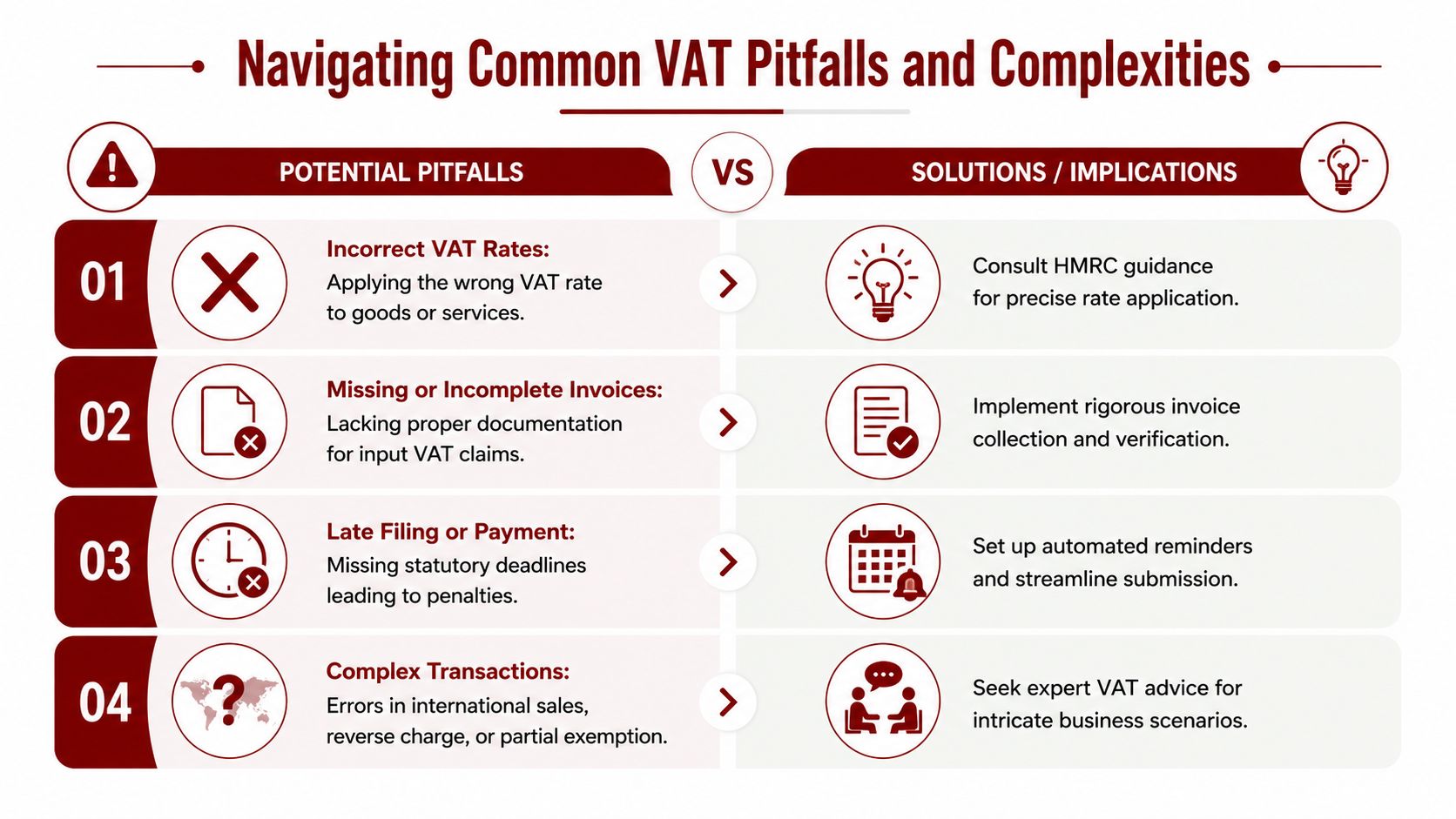
A few habits reduce most of that risk:
- Separate spending properly: Don't run personal purchases through the business unless they're clearly adjusted and documented.
- Check invoices before posting: If the invoice is incomplete or unclear, sort it before quarter end.
- Review unusual balances: Large repayment positions or sudden drops in VAT due often deserve another look.
- Correct errors promptly: If you spot a mistake after filing, deal with it rather than hoping it will cancel out next quarter.
If you're already dealing with a historic issue, this guide on VAT error correction is useful for understanding the practical next step.
Construction and property need extra care
Construction clients often have a false sense of security because they're used to CIS and regular invoicing. But CIS and VAT are not the same system. A subcontractor can be perfectly organised for CIS deductions and still have VAT errors because domestic reverse charge treatment, materials, labour, and invoice wording weren't handled properly.
In practice, builders and contractors should pay close attention to:
- Who the customer is: VAT treatment can change depending on whether the customer is an end user or another VAT-registered business in the supply chain.
- What the invoice covers: Labour and materials may be bundled, but the VAT treatment still needs to be correct.
- Whether the timing is right: Construction jobs often span periods, and rushed invoicing near quarter end can distort the return.
Property businesses have a different problem. Owners often assume property is either fully taxable or fully exempt. It rarely feels that clean in real life. Refurbishment costs, commercial property arrangements, and mixed activities can all affect whether VAT is recoverable. That's why a property client's return often needs more review than a standard trading business, even when the bookkeeping appears tidy.
A transaction can look routine in the ledger and still need specialist VAT treatment underneath.
PVA is where importers often slip
Postponed VAT Accounting, usually shortened to PVA, is one of the areas many small business guides barely explain. That's a problem because importers can miss legitimate VAT recovery or trigger avoidable questions if they post it incorrectly.
HMRC guidance notes that PVA was used for over 40% of EU imports in 2025, while many small business tutorials still don't explain how to record it properly in Box 4, according to HMRC's VAT return guidance. The practical issue is that reclaiming import VAT through PVA depends on recording it correctly from the PVA statement. If the import is real but the entry is missing or misposted, the return may underclaim or look inconsistent.
For importers, the discipline is straightforward even if the detail isn't. Match the import paperwork, the PVA statement, and the accounting entry before filing. Don't rely on the courier paperwork alone. Don't assume the software has guessed correctly. And if goods are moving through a construction or property business with mixed transactions, check the coding with extra care.
When to Call an Accountant for Your VAT Returns
A lot of owners leave the VAT return on their own desk for too long. Then quarter end arrives, the bookkeeping looks mostly complete, but there are a few invoices you are not fully sure about, one supplier has charged VAT in an odd way, and a property or CIS job has left you second-guessing the boxes. That is usually the point where an accountant stops being a nice-to-have and starts saving time, rework, and avoidable mistakes.
Handling your own return can work well if the business is straightforward, the records are up to date, and the VAT treatment is consistent from quarter to quarter. The problem is not effort. The problem is uncertainty. Once you are regularly asking, "Is this invoice coded correctly?" or "Can I reclaim that VAT?", the risk is no longer just a slow filing process. It is filing a return that looks tidy but is wrong underneath.
I see this most often where bookkeeping and VAT treatment have drifted apart.
Construction businesses run into domestic reverse charge issues, subcontractor costs, retention payments, and invoices raised in one period but disputed in another. Property businesses face their own pressure points. Option to tax decisions, repairs versus improvements, deposits, mixed-use costs, and exempt income can all change what belongs on the return and what can be reclaimed. None of that means the records are poor. It means the VAT position needs judgement, not just data entry.
A simple test helps. If the return takes several hours every quarter because you are checking the same grey areas again and again, the cost is already there.
An accountant should also be involved if you are correcting older returns, dealing with imports, changing VAT schemes, or preparing figures from incomplete records. Those are the jobs where a small error can carry forward into the next quarter and become harder to unwind later. In practice, many owners do not need someone to take over everything. They need a proper review before submission, clear rules for coding, and someone to flag the exceptions.
Action Accountants Limited provides VAT return preparation and submission as part of wider bookkeeping and compliance support. For many businesses, especially in construction and property, that support is less about pressing "submit" and more about making sure the numbers mean what you think they mean.