

You're looking at a subcontractor's invoice, the project is moving quickly, and the CIS line is the only part you're unsure about. The dangerous response is to pay the invoice in full and “sort out the tax later”. Under the Construction Industry Scheme, that decision can leave you responsible for deductions, records and HMRC reporting that should have been handled before the money left your account.
Calculating CIS deductions is straightforward once you control the workflow. Verify the subcontractor first, separate labour from materials, apply the correct rate, issue the deduction statement and report the payment in the right tax month. The arithmetic is rarely the problem. Verification failures, unclear invoices and missed deadlines cause damage.
Table of Contents
- What CIS Deductions Are and Who Must Calculate Them
- Verifying a Subcontractor's CIS Status Before You Pay
- Understanding the 20%, 30% and 0% Deduction Rates
- Splitting Labour From Materials on Every Invoice
- Working Through Monthly Returns and HMRC Payments
- Common CIS Mistakes and When to Bring in an Accountant
What CIS Deductions Are and Who Must Calculate Them
The Construction Industry Scheme, or CIS, is HMRC's method of collecting subcontractors' tax at source. It isn't a separate tax on top of the subcontractor's liability. The contractor withholds an amount from the subcontractor's payment and accounts for that deduction to HMRC. The subcontractor then receives credit for the amount deducted against their tax and National Insurance position.
If you're the business paying a subcontractor for construction work, you're usually the person who must calculate and operate CIS. That responsibility sits with the contractor, not the person sending the invoice. HMRC's official CIS guidance for contractors and subcontractors sets out the deduction structure and the contractor's withholding obligations.
The rule that catches new contractors
A subcontractor can be a sole trader, partnership or limited company. The key question isn't whether the supplier has a company number or sends a professional invoice. Ask whether the work is construction-related, whether it includes labour, and whether the person is being paid outside your payroll.
Practical rule: If the work is construction-related, labour-based and the payee isn't on payroll, assume CIS may apply until you've checked it.
CIS commonly covers work carried out on a construction site and related construction operations. A homeowner paying a builder for a private domestic project generally isn't treated as a CIS contractor, and small one-off domestic jobs can fall outside the scheme. A construction business paying a self-employed electrician, bricklayer, plasterer or groundworker is in a different position.
You may also be both contractor and subcontractor. You're a subcontractor when a main contractor pays you, but you become a contractor when you engage another construction worker and pay them for work. That change in role brings verification, deduction and return obligations with it.
Before paying the invoice, you need a process that covers:
- Status: Confirm whether HMRC has verified the subcontractor and which rate applies.
- Invoice split: Identify the labour amount separately from materials and other allowable costs.
- Calculation: Apply the verified rate only to the correct deduction base.
- Reporting: Include the payment in the correct monthly CIS return and issue the relevant statement.
If your company also handles a high volume of property repairs or maintenance calls, operational support such as a property management maintenance call solution can help keep job information organised before invoices reach your accounts process. For a plain-English introduction to the scheme, you can also use this CIS explained simply guide.
Verifying a Subcontractor's CIS Status Before You Pay
Never choose the CIS rate from the subcontractor's invoice alone. The contractor must verify the subcontractor through HMRC before making the first payment under the relevant arrangement. The result tells you whether to deduct at the standard rate, use the higher rate or make no deduction because the subcontractor has gross payment status.
Registration with HMRC as a taxpayer isn't the same as CIS registration. You need the subcontractor's Unique Taxpayer Reference, or UTR, and accurate identifying information. A mismatch in the business name or UTR can prevent HMRC from matching the record, even where the subcontractor believes they're registered.
The verification workflow
Ask the subcontractor for their UTR before work starts. For a sole trader, you'll need the identifying details HMRC requests. For a limited company, use the company's correct legal details. Then:
- Log into HMRC's CIS online service through your Government Gateway.
- Enter the subcontractor's details exactly as supplied.
- Review HMRC's verification response.
- Save the response or reference with the subcontractor's records.
- Apply the confirmed rate to the first payment and later payments covered by your process.
The critical timing point is simple. Verification must happen before payment, not after you've settled the invoice. If HMRC can't verify the subcontractor because the UTR or business name is wrong, the 30% rate applies under the circumstances described in HMRC's guidance on getting paid under CIS. You can't treat the payment as 20% first and wait for the subcontractor to fix their details later.
The same verification process identifies gross payment status. A subcontractor with that status receives payments without a CIS deduction, but the contractor still needs evidence of the HMRC response. Gross payment status isn't an informal waiver and shouldn't be accepted because a subcontractor says they “usually get paid gross”.
Keep this checklist beside your invoice approval screen:
- UTR received: Don't process a construction labour invoice without it.
- Details matched: Check the exact legal name and business information.
- Response saved: Retain the HMRC verification evidence.
- Rate recorded: Store the confirmed rate against the subcontractor.
- Payment held if necessary: Don't release funds while verification remains unresolved.
The higher deduction is often treated as a subcontractor problem, but the contractor creates the risk by paying before completing the check.
Understanding the 20%, 30% and 0% Deduction Rates
The rate on a CIS invoice follows the subcontractor's HMRC status, not a commercial agreement between you and the subcontractor. Once verification is complete, record the confirmed rate in your payment process and use it consistently.
A verified registered subcontractor normally attracts the standard 20% deduction. If the subcontractor is not registered, cannot be verified, or supplies incorrect details, the higher 30% deduction applies. A subcontractor with gross payment status receives a 0% deduction, provided HMRC has confirmed that status. These rates are set out in HMRC's contractor guidance on making deductions and paying subcontractors.
One payment, three possible outcomes
Use a labour payment of £1,000 to check the arithmetic:
- At 20%, deduct £200 and pay the subcontractor £800.
- At 30%, deduct £300 and pay the subcontractor £700.
- At 0%, deduct £0 and pay the subcontractor £1,000.
The deduction is an advance payment towards the subcontractor's tax and National Insurance. It is not an extra project cost. You retain the deducted amount, report it through the CIS process, and the subcontractor receives credit for it.
Registered status and gross payment status are different. Registration supports the standard rate, while only confirmed gross payment status supports the zero rate. Do not pay gross because a new subcontractor is awaiting approval or says another contractor pays them that way. The guide to applying for CIS gross payment status explains the application route, but your own HMRC verification response controls the payment.
CIS deduction rates at a glance
| Subcontractor Status | Deduction Rate | Amount Deducted | Net Paid to Subcontractor |
|---|---|---|---|
| Verified and registered | 20% | £200 from £1,000 labour | £800 |
| Unregistered or unable to be verified | 30% | £300 from £1,000 labour | £700 |
| Gross payment status | 0% | £0 from £1,000 labour | £1,000 |
Apply these rates to the labour amount used for the CIS calculation, not automatically to the invoice total. Materials and other excluded costs must be separated before you calculate the deduction. Getting that split wrong distorts the subcontractor's cash payment and can create a correction in your monthly return.
Splitting Labour From Materials on Every Invoice
The CIS deduction base is the labour element, not automatically the invoice total. Materials supplied by the subcontractor are excluded from the deduction calculation. The same principle applies to qualifying plant hire and other costs that aren't payment for the subcontractor's labour, provided the invoice identifies them clearly.
A £4,000 invoice might contain:
- Materials supplied at cost, £2,200
- Labour, £1,000
- Plant hire, £600
- Other qualifying costs, £200
The CIS calculation starts with the £1,000 labour line. At the standard 20% rate, the deduction is £200, leaving the relevant net payment after the deduction is accounted for. The materials, plant and other non-labour lines don't become part of the deduction base because they appear on the same invoice.
Read the wording, not just the total
“Labour only” is clear. “Materials supplied at cost” is also useful because it shows that the subcontractor is passing on a cost rather than charging for additional labour. “Supply and fix” needs more care. It combines supply and installation, so the subcontractor should separate the material value from the installation labour rather than provide one unexplained figure.
Sloppy descriptions create disputes in both directions. If you deduct from materials, you reduce the subcontractor's payment unnecessarily. If you fail to deduct from labour, HMRC can still hold the contractor responsible for the amount that should have been withheld.
| Invoice Line Item | CIS Deduction Applies? | HMRC Rationale |
|---|---|---|
| Labour only | Yes | It represents construction labour. |
| Materials supplied at cost | No | Materials aren't the labour element. |
| Plant hire without labour | No | The charge is for equipment rather than labour. |
| Plant with an operator | Review the labour element | Separate the operator's labour from the equipment charge. |
| Supply and fix | Apply to the identified labour only | Split the supply cost and installation work. |
Before approving payment, check:
- Descriptions: Each line explains what was supplied.
- Labour total: The invoice shows a distinct labour amount.
- Materials evidence: Material costs are identifiable and reasonable.
- Plant treatment: Equipment and operator charges are separated where relevant.
- VAT treatment: VAT isn't accidentally included in the CIS deduction base.
- Recalculation: Your figures agree with the verified rate and labour total.
For wider bookkeeping controls covering construction businesses, accounting for contractors in construction can help you build a consistent invoice review process.
Working Through Monthly Returns and HMRC Payments
A contractor can calculate a deduction correctly and still submit the wrong CIS return. The usual cause is using calendar months instead of CIS tax months. Each reporting period runs from the 6th of one month to the 5th of the next, so assign every payment to the period in which it was made before preparing the return.
Suppose Smith is verified at 20% and submits a labour invoice for £3,000. The deduction is £600, Smith receives £2,400, and the contractor reports the £600 deduction to HMRC. Those figures must match the invoice, payment record, deduction statement and monthly return. A mismatch creates avoidable queries and can distort the contractor's cash position.
Build the month-end file
Extract every subcontractor payment made between the 6th and the 5th. Do not use invoices received or approved as your only source. A payment made during the tax month belongs in that return, even if the invoice was approved earlier.
Reconcile each payment against:
- the subcontractor's verified status;
- the labour and materials breakdown;
- the gross amount;
- the deduction rate;
- the deduction amount;
- the net bank payment.
Resolve differences before filing. Once the figures agree, submit the CIS300 return through HMRC's online service. The online filing deadline is the 22nd of the following month, while the paper deadline is the 19th. Set the online deadline as a fixed payment-control date, rather than leaving the return until site work is finished.
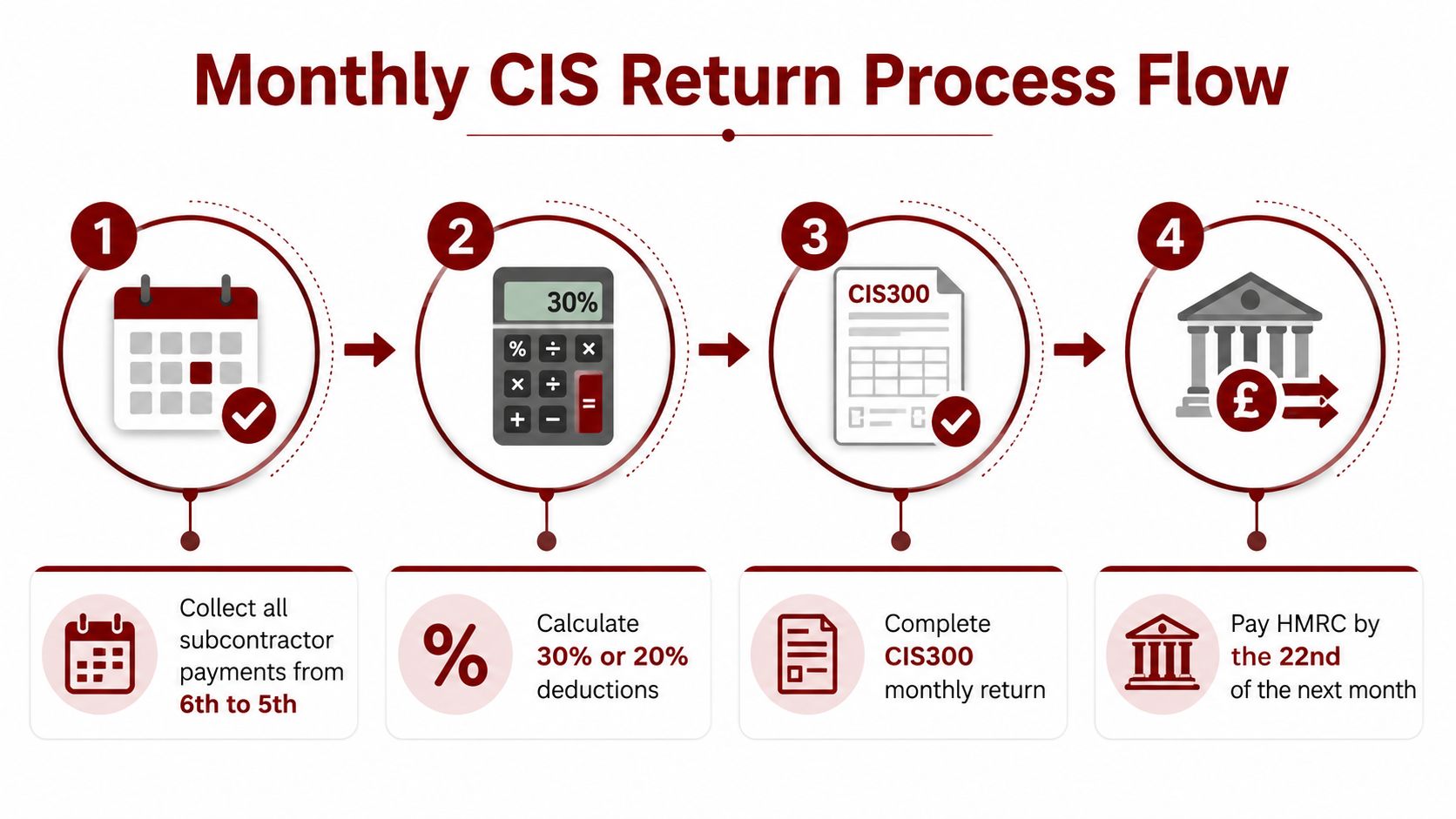
The amount due to HMRC is the total of deductions withheld during the tax month. It is not the total value of subcontractor invoices. If several subcontractors were paid, calculate and check each deduction separately before adding the totals. A filing error can leave you funding a shortfall after the subcontractor has already received payment.
Keep evidence that tells the full story
Issue a Payment and Deduction Statement to each subcontractor within 14 days of the end of the tax month. Include the contractor and subcontractor details, tax month, gross payment, materials amount, CIS deduction and net payment. One consolidated statement can cover multiple payments to the same subcontractor within the period.
Your records should let another person reproduce the return without guessing. Keep:
- Invoices: Retain the original labour and materials breakdown.
- Verification log: Record the HMRC response and date before payment.
- Payment evidence: Match the net amount to the bank record.
- Deduction statements: Keep copies of every statement issued.
- Return confirmation: Save the CIS300 submission and payment evidence.
Use this CIS monthly returns guidance to organise the recurring filing process. A spreadsheet that records only the rate is incomplete. Keep the verification response, calculation and payment trail together so you can explain the return if HMRC asks.
Common CIS Mistakes and When to Bring in an Accountant
The assumption that CIS is “just deduct 20%” causes most avoidable errors. The rate is only one decision. You also need the right contractor status, the right verification result, the right deduction base and the right reporting period.
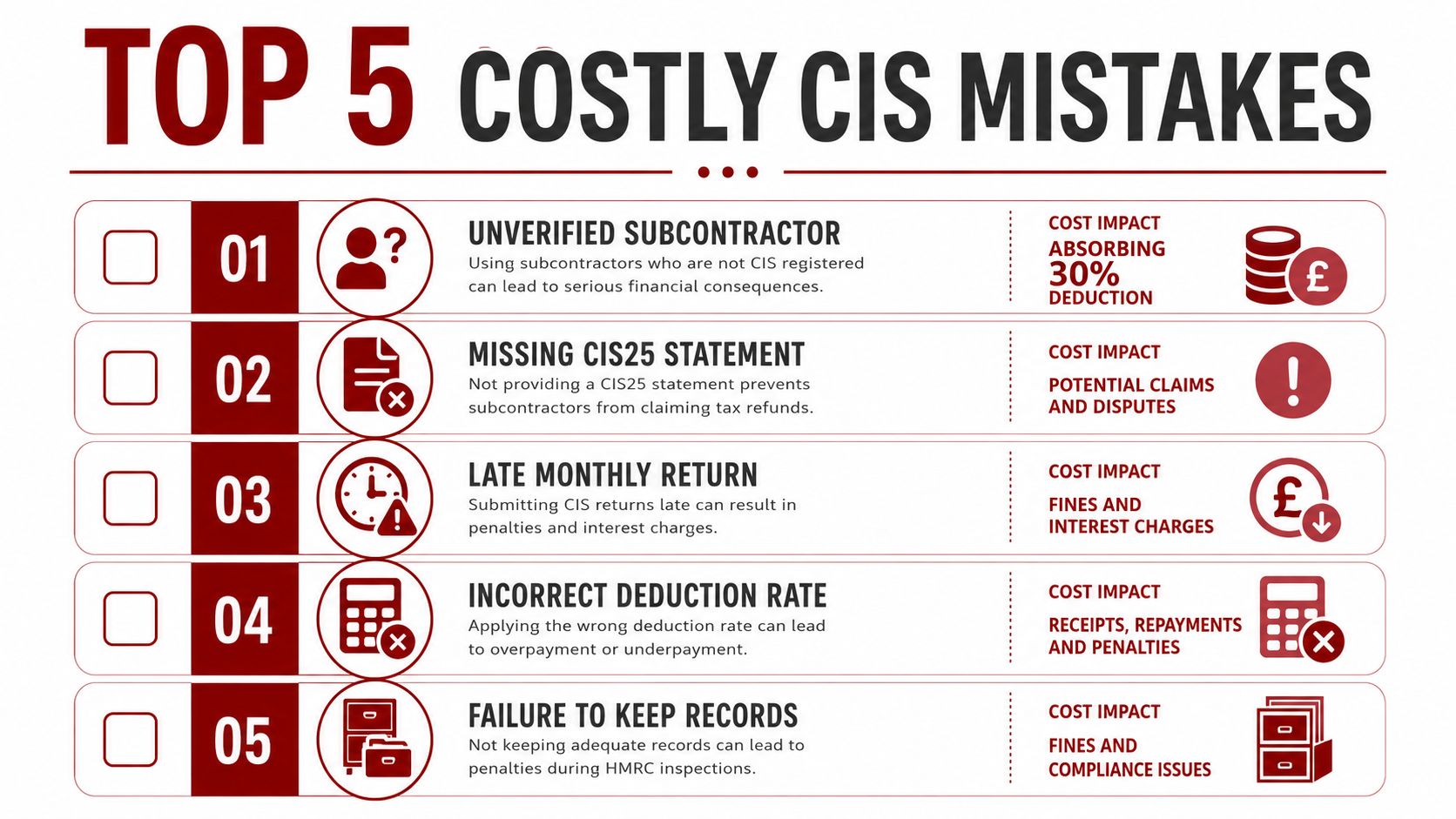
The costliest mistakes usually appear in this order:
- Paying before verification: You release the subcontractor's money first, then discover that HMRC required the higher rate. The contractor may have to fund the shortfall rather than recover it from a subcontractor who has already been paid.
- Missing the deduction statement: The subcontractor needs written evidence of the deduction, and your records need to show what you issued.
- Using calendar months: Payments from the 6th to the 5th define the CIS tax month. A calendar-month report can place payments in the wrong return.
- Applying the rate to the full invoice: This over-deducts where materials and other excluded costs are included.
- Losing the audit trail: A correct figure without verification evidence is still a weak compliance position.
Don't confuse cash flow with tax saved
A CIS deduction reduces the subcontractor's immediate payment, but it doesn't erase the subcontractor's tax liability or create a saving for the contractor. It's an advance payment mechanism. If the wrong rate is applied, the subcontractor's cash flow suffers and the contractor may face reconciliation work, disputes and potential HMRC action.
HMRC's official guidance confirms the core rate structure, including 20% for registered subcontractors, 30% where registration or verification fails, and 0% for gross payment status. Apply the result returned by HMRC, not the rate printed by a supplier who hasn't provided matching details.
Watch the penalty exposure closely. HMRC guidance states that a late contractor registration penalty can be £100 per missed subcontractor per month, up to £3,000 per year, and underpaid deductions can also attract interest. Those figures come from the specified HMRC compliance guidance, so they should be treated as a real cost-control issue rather than a theoretical warning.
Bring in an accountant when the workflow has outgrown informal checking. The trigger isn't only the number of subcontractors. It's also whether you're combining CIS with VAT, operating through a limited company, handling gross payment status questions or responding to HMRC correspondence.
Stop doing it alone if:
- Gross payment status is unclear: One incorrect assumption can affect every payment to that subcontractor.
- CIS and VAT overlap: Domestic reverse charge decisions create a separate control problem from CIS deductions.
- An HMRC enquiry is approaching: Preserve the verification log, invoices, statements and returns before responding.
- Your payment process is expanding: More subcontractors mean more opportunities for rate, date and labour-split errors.
- You're correcting historic payments: Don't improvise a fix without reconciling the contractor and subcontractor records.
Watch the video below for another practical explanation of CIS deduction handling before you decide whether your current process is good enough.
Action Accountants Limited can help contractors with CIS bookkeeping, verification records, monthly returns, deduction statements and related VAT and tax compliance. Visit Action Accountants Limited to discuss your current invoice process and put the checks in place before the next payment run.