

How to Apply for CIS Gross Status: A 2026 UK Guide
Action Accountants •16 July 2026
You finish a job, send the invoice, and then the remittance advice lands with a familiar sting. The contractor has taken the CIS deduction before the money even reaches your account. You've done the work, paid lads, covered fuel, tools, and insurance, yet part of your cash is sitting with HMRC instead of helping you run the business.
That's the moment many subcontractors in Colindale, Edgware, Kingsbury, and Finchley start asking the right question. Not “how do I claim it back later?” but how do I stop the deduction in the first place?
If you want to apply for CIS gross status, the main issue isn't the form. It's whether your records, turnover calculation, and tax history will survive HMRC's checks. That's where applications are won or lost. The subcontractors who get this right usually treat it as a cash flow decision first, and an admin task second. For businesses already juggling jobs, labour, and deadlines, that shift matters. If you also want a broader view of construction contractor accounting, it helps to see gross status as one part of a tighter financial system, not a standalone badge.
Table of Contents
- Stop Losing 20% of Your Turnover
- Meeting the Three Tests for Gross Payment Status
- Your Application Action Plan
- Common Application Mistakes That Cost You Money
- What to Do If Your Application Is Refused
- Take Control of Your Construction Business Cash Flow
Stop Losing 20% of Your Turnover
For most subcontractors, CIS deductions feel less like tax and more like a constant drag on the business. You complete the work, invoice on time, and still receive less than the value you earned. On paper, you'll sort it later. In real life, wages, suppliers, van costs, and VAT don't wait.
That's why gross payment status matters. If HMRC approves it, contractors pay you without the usual CIS deduction. The difference is immediate. Your own money stays in your own bank account, where it can cover the next job instead of creating pressure between invoices.
In North West London, I've seen this pinch hardest with growing subcontractors who are busy but still run lean. One delayed payment, one materials bill, one payroll week, and cash gets tight quickly. Gross status doesn't solve every business problem, but it removes a recurring one that shouldn't be there if the business is strong enough to qualify.
Practical rule: If CIS deductions are forcing you to juggle supplier payments or delay taking on work, gross status is no longer a nice extra. It's a priority.
There's also a mindset shift that comes with it. Subcontractors who move onto gross status often become more disciplined across the board. They track turnover more carefully, keep cleaner bank records, and treat filing deadlines as operational deadlines, not admin afterthoughts. That discipline is what HMRC wants to see, and it's usually what makes the business sturdier anyway.
What doesn't work is applying too early, guessing the numbers, or assuming a busy year automatically means you qualify. Plenty of firms are active enough to deserve gross status in principle, but still fail because the paperwork doesn't prove the case cleanly.
Meeting the Three Tests for Gross Payment Status
A subcontractor can be flat out all year, have decent money coming in, and still fail gross status. I see that in North West London more often than people expect. The reason is simple. HMRC is not judging effort. It is judging whether the business passes three separate tests cleanly.
Those tests are the turnover test, the business test, and the compliance test. Turnover gets the attention. Compliance is usually where the application comes unstuck.
The turnover test
The turnover test is about net construction turnover, not the top line on your sales invoices. HMRC looks at construction income after stripping out VAT and the direct cost of materials. If your bookkeeping is loose, the figure often gets overstated, and that creates problems before the application is even reviewed properly.
For subcontractors, this is the first practical check I make. Are labour and materials clearly split on invoices? Do the bank receipts support the turnover claimed? Do the deduction statements match the story the accounts are telling? If the answer is not a clear yes, fix that first.
Thresholds are commonly summarised as follows, based on Finistry on CIS gross payment status:
| Business Type | Turnover Threshold |
|---|---|
| Sole trader | £30,000 net construction turnover |
| Partnership | £30,000 per partner or £100,000 total |
| Limited company | £30,000 per director or £100,000 total |
If you need the numbers in context before applying, our guide on what CIS deduction means for subcontractor payments helps clarify what is being withheld and why gross status changes the cash position so much.
The business test
The business test is about whether there is a real construction business in operation in the UK. HMRC expects to see ordinary signs of trade. Proper invoices. A business bank account. Regular payment flows. Records that match the type of work being done.
Smaller firms in North West London sometimes trip themselves up with their administrative practices. The work is genuine, but the admin is patched together from WhatsApp confirmations, personal bank spending, and invoices raised weeks late. That does not automatically kill an application, but it gives HMRC more reasons to ask questions.
A cleaner file usually looks boring. That is a good thing.
If your work also depends on local approvals, site access rules, or wider contractor licensing requirements, keep those records in order too. They do not replace the CIS tests, but they help show you are running an actual trade rather than operating informally.
The compliance test
The compliance test is the one I treat as the deciding factor. HMRC wants a clean record for the period it reviews. That means returns filed on time, taxes paid on time, and no pattern of arrears or late submissions across the taxes that apply to your business.
A lot of subcontractors think they are fine because the business is profitable and the tax will get paid eventually. HMRC does not look at it that way. Late is late.
In practice, I tell clients to check four areas before they even think about applying:
- Self Assessment, if you trade personally
- Corporation Tax, if you trade through a company
- PAYE, if you have staff
- VAT, if you are VAT-registered
VAT is a common weak point. One late quarter can make an otherwise decent application harder to win. In North West London, I see this with growing subcontractors who start taking on larger jobs, register for VAT, then miss a deadline because the bookkeeping never caught up with the pace of work.
The practical trade-off is straightforward. If the record is clean, apply. If it is not, wait, get the filings and payments back under control, then apply from a stronger position. A delayed application is cheaper than a refusal built on problems that could have been fixed in advance.
Your Application Action Plan
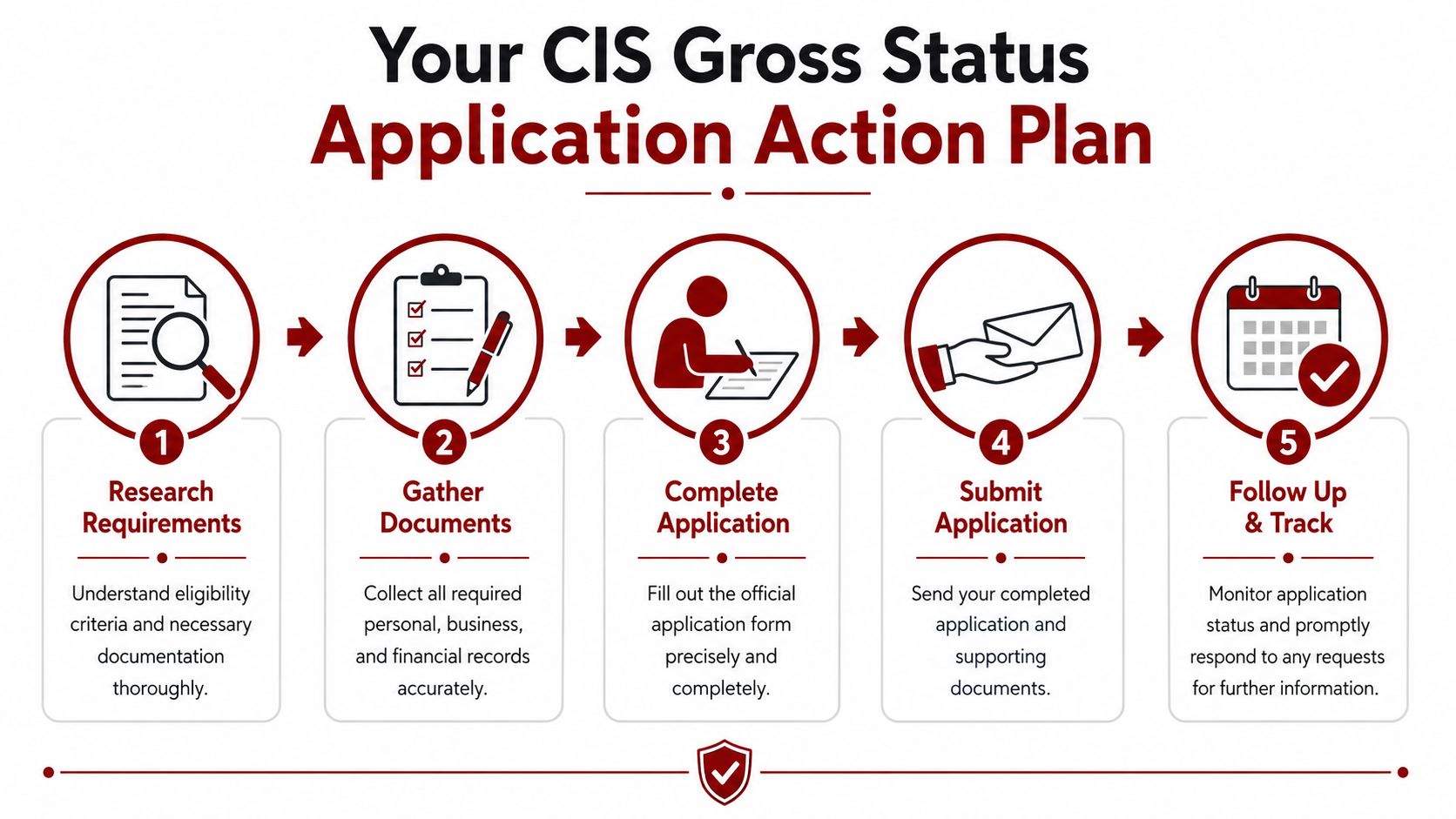
A good CIS application is won before you submit it. I've seen plenty of North West London subcontractors lose weeks because they treated the form as the job, when the primary task was getting the records straight first. If the paperwork is clean, the application is usually straightforward. If it is patchy, HMRC will either ask questions or refuse it.
Gather your proof before you touch the form
Start with the evidence, not the application form. That saves rework and shows quickly whether you are ready now or better off waiting until the records are cleaner.
Pull together the documents that support the trading figures and the way money has moved through the business. In practice, I ask clients for four things first:
- Invoices: Full invoice history for the review period, with labour and materials shown separately where possible.
- Bank statements: Statements that match the invoices and show a pattern consistent with genuine subcontract work.
- Payment and deduction statements: Contractor statements kept in order, so deductions and receipts can be checked quickly.
- Tax records: Copies of submitted returns and proof that liabilities have been dealt with properly.
In North West London, the weak spot is often simple admin. The work has been done, the money has come in, but the invoices are incomplete or the bank account is mixed with personal spending. That does not always kill an application, but it makes the review slower and harder than it needs to be.
If you are still getting the basics in place, sorting your CIS registration properly from the start makes the later application much easier.
Choose the right route and form
The form depends on the business structure. Sole traders use CIS302. Partnerships use CIS304. Limited companies use CIS305.
That sounds simple enough, but the form is only part of the job. HMRC still wants figures that tie back to the records behind them. If the turnover number has been pulled from a rough spreadsheet, or the paperwork does not support what is on the form, delays start there.
For limited companies, I pay extra attention to how the director has kept the company records. In small building firms around Wembley, Harrow, and Park Royal, I often see companies that are trading well but still relying on year-end cleanup. That is fine for getting accounts filed. It is not the best basis for a gross status application, where the numbers need to stand up immediately.
This wider piece on contractor licensing requirements is also worth a look if you're tightening your overall compliance setup. It isn't about CIS specifically, but it's useful for subcontractors who want their admin house in order across the board.
A quick visual summary can help if you're mapping the process with your admin team or bookkeeper.
DIY or agent-led
Some subcontractors can apply themselves. If the books are tidy, the figures have been checked properly, and there are no old filing or payment issues waiting to surface, a DIY application can work perfectly well.
The trade-off is time versus risk. Doing it yourself saves fees. It also means you need to spot the problems before HMRC does.
The mistakes I see most often are predictable:
- Using total sales instead of the qualifying construction figure.
- Leaving material costs inside the turnover calculation.
- Finding an old compliance issue after the application has already gone in.
- Sending an incomplete pack and then scrambling to answer follow-up queries.
An accountant does not change the rules. A good one checks whether the application is ready, challenges the numbers, and tells you to wait if the timing is wrong. That advice saves money. A refusal costs more than a few extra weeks spent getting the file into shape.
Submit once. Submit clean. That is the shortcut.
Common Application Mistakes That Cost You Money
The expensive mistakes aren't usually dramatic. They're the ordinary ones. A figure copied from the wrong report. A VAT quarter filed late and forgotten. A bank statement missing from the pack. That's how applications that look “basically fine” end up refused.
The turnover figure is often wrong
The most common rookie error is using total invoiced sales instead of net construction turnover. If materials sit inside your invoice value and you don't strip them out, your figure can look stronger than it really is. HMRC won't accept that shortcut.
I've seen this happen with builders, electricians, and fit-out subcontractors who bill labour and materials together on almost every job. The business feels comfortably above the line, but once VAT and material costs come out, the qualifying turnover is much tighter.
A simple check helps. Match invoices to bankings, then isolate the construction element only. If your records don't make that easy, fix the records before you apply.
Small compliance slips aren't small to HMRC
Many subcontractors still assume HMRC will overlook a minor delay if the tax was eventually paid. That assumption causes real damage. The compliance test is the hardest part because HMRC expects a clean record, not a “mostly sorted” one.
One late return or one missed payment can have a bigger effect on your application than a weak month of trading. That feels harsh to business owners. It's still how the system works.
If you're asking whether a late filing “will probably be fine”, you're already thinking about the test the wrong way.
Weak evidence slows everything down
Even where the business qualifies, poor presentation creates friction. Unclear invoice descriptions, mixed personal and business payments, missing deduction statements, and inconsistent dates all make HMRC's job harder. When that happens, your application stops being a clean approval exercise and turns into a query file.
Common problems I see include:
- Mixed banking: Business income lands in one account, then gets transferred around with no clear trail.
- Messy invoice wording: Labour and materials aren't split clearly enough to support the turnover figure.
- Gaps in statements: Contractors have paid, but the deduction statements haven't been kept properly.
- Last-minute filing: The application goes in before someone has reviewed the tax position properly.
The practical fix is boring but effective. Keep a clean folder for invoices, deduction statements, VAT records, and bank statements. Reconcile them regularly. When it's time to apply for CIS gross status, you want an evidence pack that reads like a finished job, not a box of receipts after a van clear-out.
What to Do If Your Application Is Refused
A refusal is frustrating, but it isn't the end of the road. The worst response is panic or guesswork. The right response is to work out exactly why HMRC said no, then decide whether the issue should be appealed or corrected.

Read the refusal properly
Start with the letter. Don't skim it. HMRC's reason matters because the next move depends on whether the problem was turnover, business evidence, or compliance.
If the refusal is linked to a factual mistake, you need to identify the exact point of disagreement. If it's linked to late filing or payment history, the answer is usually less about arguing and more about rebuilding a clean record.
According to Tax Insider's summary of losing or regaining CIS gross status, if a business loses its status due to a breach, it has the right to appeal within 30 days of receiving the withdrawal letter, and reapplying after refusal or loss generally means showing a full year of perfect compliance before HMRC will consider the application again.
Appeal when the facts support you
An appeal makes sense when the records support you and HMRC has misunderstood something. It doesn't make sense when the refusal is based on a genuine compliance failure that can be seen clearly on the file.
Use this filter before appealing:
- Appeal if the evidence was strong but misunderstood: For example, if qualifying turnover was calculated correctly and supported, but not read properly.
- Don't appeal just because the outcome hurts: If the filing history shows a real breach, an appeal won't clean the record.
- Get the paperwork in order first: Any appeal should be built on documents, not explanation alone.
A rushed appeal often wastes the same thing a bad application wastes. Time.
Build the next application the right way
If the problem can't be appealed successfully, the task becomes simple, even if it isn't quick. Build the next clean period properly and protect it.
That means disciplined filing, disciplined payment timing, and records that can stand on their own. For subcontractors who've been refused, I usually suggest treating the next year like a monitored probation period for the business. Every return matters. Every payment date matters. Every bank trail matters.
A refusal often improves businesses that take it seriously. They tighten bookkeeping, separate personal spending from business banking, and stop relying on memory for tax deadlines. By the time they're ready to reapply, the application is stronger because the business is stronger.
A refusal is manageable. Repeating the same mistake isn't.
There's also an important point after approval that many people forget. Gross status isn't a one-off prize you keep forever without effort. It comes with ongoing scrutiny. The businesses that keep it are the ones that treat compliance as part of normal operations, not a scramble before deadlines.
Take Control of Your Construction Business Cash Flow
Monday morning on a North West London job. Wages are due, the builders merchant wants paying, and a contractor has knocked 20% off your invoice before the money even lands. That squeeze is exactly why gross status matters. It puts you back in control of the timing.
Paid gross, you can use your own cash for the business instead of waiting for over-deducted tax to come back later. That gives you more room to cover labour, buy materials in sensible quantities, and keep a proper buffer for VAT and tax bills. The subcontractors who feel the benefit fastest are usually the ones doing solid numbers on busy local sites around Edgware, Kingsbury, Finchley, and Colindale, where one delayed payment can throw the whole month off.
Gross status on its own does not fix weak cash flow. It works best in a business that invoices promptly, chases debtors early, and knows which jobs are making money. That is why broader systems matter as much as the HMRC application. If you want a wider operational view, this guide to mastering the quote-to-cash process is worth reading.
I see the same pattern repeatedly. Good subcontractors lose ground because the tax side is tidy enough to trade, but not tidy enough to protect cash. Late returns, mixed personal and business spending, and poor invoice records make it harder to keep hold of money, even after approval. The firms that do well treat compliance and cash flow as part of the same routine.
If you are trading under CIS on a self-employed basis, start with the basics and get your record straight before you file anything. This guide for CIS self-employed subcontractors will help you check the setup properly.
For North West London subcontractors and small construction businesses, the practical point is simple. If the turnover is there and the compliance record is clean, there is no sense letting deductions starve the business of working cash.