
UK Business Mileage Rate 2026: A Complete HMRC Guide
Action Accountants •17 July 2026
The business mileage rate for cars and vans is 55p per mile for the first 10,000 business miles in the 2026/27 tax year, then 25p per mile after that. It's the first increase in 15 years, and that change matters because many business owners will either miss relief they're entitled to or claim the wrong rate entirely if they don't apply the rules properly.
Mileage looks simple until you put it into a live business. New founders mix up personal cars with company cars. Directors assume an electric vehicle always gets the full mileage rate. Employers carry on paying the old figure after April and forget to correct it. Sole traders keep rough notes and hope that will do if HMRC ever asks.
That's where most mileage mistakes start. Not with bad intent, but with a partial understanding of how the rules work in practice.
The useful part of the current change isn't just the higher rate. It's knowing how to use it properly. The two issues I'm seeing most often are the retroactive increase from April 2026 and the difference between AMAP for a personally owned vehicle and Advisory Fuel Rates for a company-owned vehicle, especially electric cars. Get those wrong and you can easily overclaim, underclaim, or leave payroll and tax returns inconsistent.
Table of Contents
- Your Guide to the 2026 Business Mileage Rate Changes
- HMRC Business Mileage Rates Explained for 2026/27
- Who Can Claim Business Mileage Allowances
- Mileage Allowance vs Actual Vehicle Costs
- How to Calculate and Report Your Mileage Claim
- Essential Record-Keeping for a Bulletproof Claim
- Maximise Your Claim and Ensure Compliance with Action Accountants
Your Guide to the 2026 Business Mileage Rate Changes
The headline change is straightforward. The UK's Approved Mileage Allowance Payment for cars and vans increased by 10p per mile, moving from 45p to 55p for the first 10,000 business miles from 6 April 2026, and it was the first adjustment since 2011 after a 15-year freeze according to this review of the 2026 HMRC AMAP increase.
That's good news for anyone using their own car or van for work. It gives more tax-free headroom on legitimate business journeys and better reflects the actual cost of using a vehicle for business than the old figure did.
What catches people out is that a higher rate doesn't automatically mean a correct claim. You still need the right vehicle ownership position, the right records, and the right reporting method. That matters whether you're a sole trader, a subcontractor, a startup founder running a limited company, or an employee travelling between client sites.
Why this change creates both opportunity and risk
A mileage claim is often one of the easiest legitimate deductions to use. It can also be one of the easiest to get wrong because the numbers look simple and the rules underneath them aren't.
Common problems include:
- Using the wrong method: Claiming mileage on a company car instead of using the company vehicle rules.
- Missing early-year adjustments: Forgetting that the increased rate applies from April even though the announcement came later.
- Blurring private and business travel: Including ordinary commuting in a business mileage log.
- Treating EVs as all the same: Assuming a personally owned EV and a company-owned EV are reimbursed under the same system.
Practical rule: Mileage is only easy when the paperwork matches the tax treatment.
Business owners usually don't need more theory. They need a clear route to the correct claim, a sensible record-keeping routine, and a way to avoid creating avoidable issues later in payroll, bookkeeping, or Self Assessment.
HMRC Business Mileage Rates Explained for 2026/27
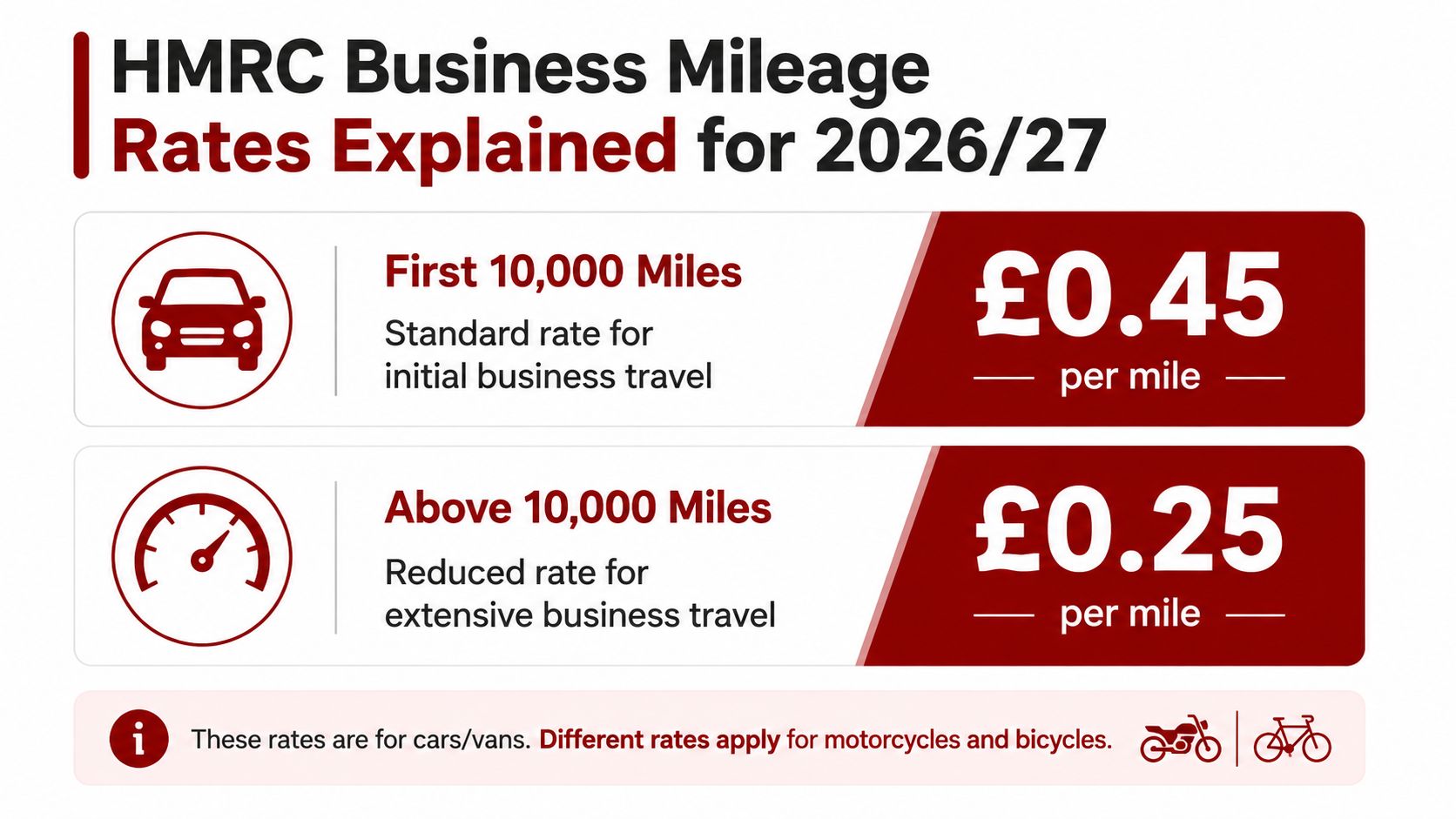
From 6 April 2026, the main mileage rate for cars and vans increased to 55p per mile for the first 10,000 business miles. After that, the rate stays at 25p per mile. That single change will affect a large number of claims filed this year, especially where reimbursements were processed before the announcement.
The core rates for each vehicle type
For cars and vans, the approved mileage allowance rates are:
- 55p per mile for the first 10,000 business miles
- 25p per mile for any additional business miles
For other vehicle types, HMRC applies separate fixed rates:
- Motorcycles: 24p per mile
- Bicycles: 20p per mile
- Passenger allowance: 5p per mile per business passenger
The 55p and 25p rates are AMAP rates. They apply where someone uses their own vehicle for business travel. HMRC's published note on the 2026 increase confirms the change and its start date from 6 April 2026.
That distinction matters more with electric vehicles than many owners expect.
If the EV is personally owned, the mileage claim usually falls under the same AMAP rules as a petrol or diesel car. If the EV is company-owned, those mileage allowance rates do not apply in the same way. In that case, reimbursement is normally handled under the company car rules, using the Advisory Fuel Rates framework for electric cars rather than the employee-owned vehicle system.
A lot of errors start here. Directors often assume an EV automatically qualifies for the 55p rate because they paid for the charging personally. The tax treatment depends on who owns the car, not just on who paid for the electricity on a particular trip.
What the retroactive increase means in practice
The awkward part of the 2026 change is timing. The increase was announced on 21 May 2026, but it applies from 6 April 2026. So any business that reimbursed mileage at the old rate in the opening weeks of the tax year may now have underpaid valid claims.
That creates two jobs. First, identify the qualifying business miles already logged from 6 April. Second, compare what was paid against what could have been paid tax-free under the revised rate.
For a business owner or employer, the correction usually means:
- Review the mileage log for journeys from 6 April onward.
- Check the reimbursement already processed through payroll or expenses.
- Recalculate the amount due using 55p for qualifying car and van miles within the first 10,000-mile band.
- Post the adjustment clearly so the books, payroll records, and tax position all agree.
The practical risk is not only missing tax relief. It is creating mismatched records. I see this regularly with owner-managed companies where the director updates the bookkeeping but forgets to correct the payroll working papers or expense claim backup.
One final point often gets missed. The retroactive increase helps only where the claim was eligible for AMAP in the first place. It does not convert a company-owned EV into a personal mileage claim. If the vehicle sits in the company, use the company car reimbursement rules. If the vehicle is personally owned, use the mileage allowance rules. Getting that split right is what keeps the claim tax-efficient and defensible.
Who Can Claim Business Mileage Allowances
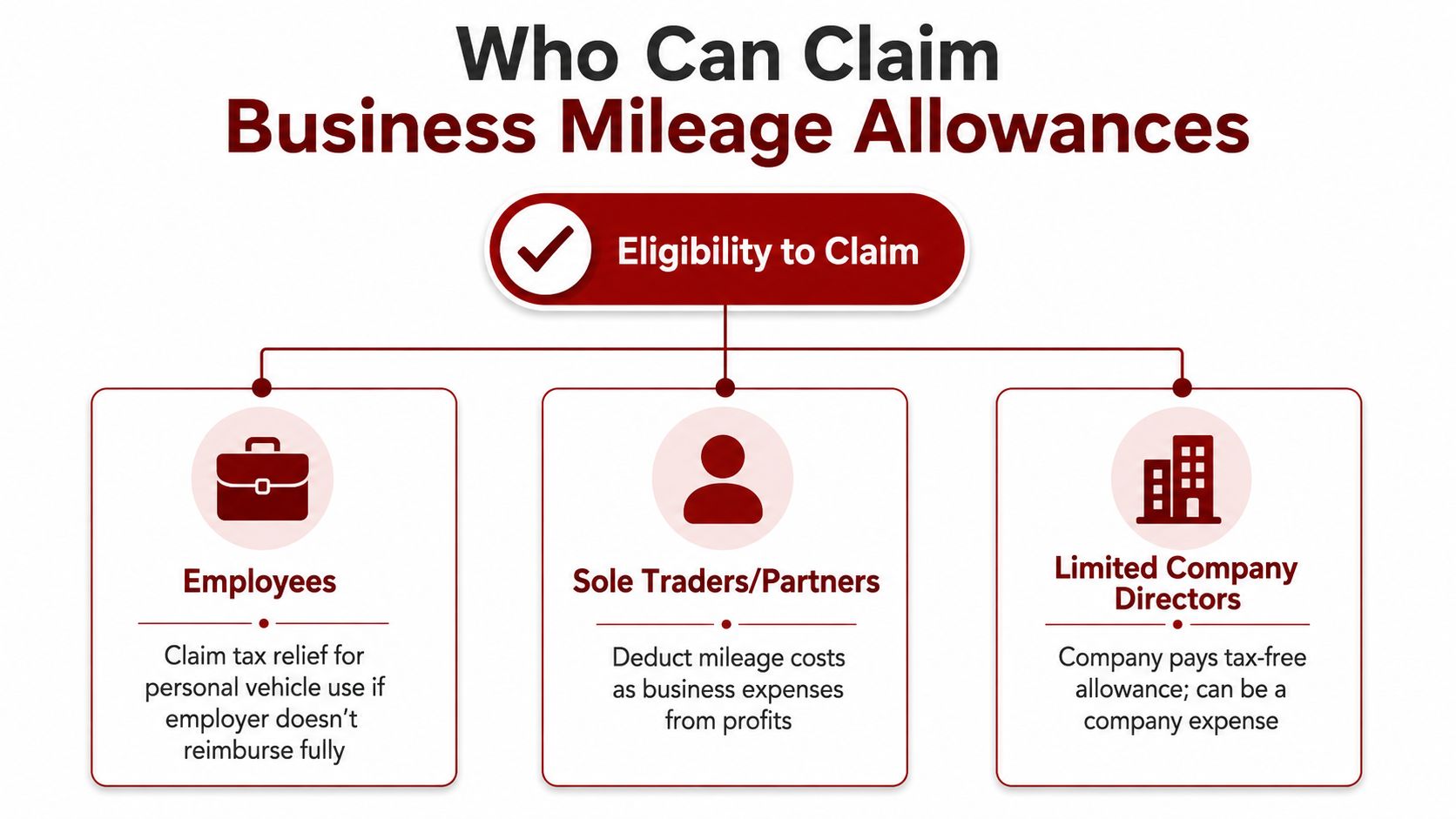
Eligibility depends less on your job title and more on who owns the vehicle and how your business is set up. That's the point many new owners miss.
Employees using their own vehicle
Employees can usually claim or receive mileage allowance when they use their own vehicle for qualifying business travel. If the employer reimburses at or below the approved level, that can be tax efficient. If the employer pays less than the approved rate, the employee may be able to claim tax relief on the difference through the proper route.
The key phrase is their own vehicle. If the employer owns the car, the mileage allowance system for employee-owned vehicles doesn't apply in the same way.
Typical employee mistakes include:
- Counting ordinary commuting: Home to permanent workplace journeys usually aren't business mileage.
- Using round figures from memory: HMRC expects a proper journey record.
- Assuming any work-related drive qualifies: The purpose of the trip matters.
Sole traders and partners
Sole traders and partners often use the mileage rate as a simplified expense method against business profits when they use a personal car for business.
Why this works well:
- Less admin: You track business miles instead of apportioning every receipt.
- Cleaner records: It's easier to review one mileage log than a stack of fuel, insurance, and repair documents.
- Fewer judgement calls: You don't have to split every vehicle bill between business and private use in the same way.
That doesn't make it automatic. You still need accurate mileage records and a consistent approach in your books. If your wider expenses need reviewing, tax-deductible expenses for the self-employed is worth reading alongside your mileage position because mileage usually sits within a bigger profit-planning decision.
Limited company directors and the EV trap
Directors get caught by one issue more than any other. They assume that because they drive the car personally, they can always claim the full mileage allowance from the company.
That's wrong if the company owns the vehicle.
A particularly common point of confusion is the electric vehicle position. A personally owned electric car can use the AMAP rate, but if the business owns the EV, the director can only claim the much lower electricity rate for charging under the company vehicle rules. The contrast is highlighted in this explanation of personal EV mileage versus company EV charging claims, which notes 7p per mile for home charging in that company-owned EV scenario.
A personal EV and a company-owned EV are not the same tax answer. The ownership drives the treatment.
That single distinction prevents a lot of overclaims. If you're a new founder choosing between buying a car personally or through the company, this point should be checked before you put anything through payroll or the director's loan account.
Mileage Allowance vs Actual Vehicle Costs
Most business owners have two broad ways to deal with vehicle expenses. They can use the mileage allowance method for a personal vehicle, or they can claim actual vehicle costs where the rules allow it. The right choice depends on your setup, your appetite for admin, and how cleanly you want the records to run.
When the mileage allowance works best
The mileage allowance method is popular because it's practical. You record business journeys, total the miles, and apply the approved rate. That usually suits founders and sole traders who want a defensible claim without turning vehicle costs into a bookkeeping project.
It's often the better fit when:
- Your records need to stay lean: One mileage log is easier to maintain than collecting every vehicle receipt.
- Private use is mixed in heavily: Mileage keeps the business-only element clearer.
- You want predictable bookkeeping: The numbers are easier to check and post consistently.
This method also reduces the risk of forgetting smaller running costs or applying the wrong business-use percentage across multiple bills.
When actual costs may be worth the admin
The actual cost method can be valid in the right circumstances, but it asks more from you. You need thorough records, consistency, and a clear basis for separating business from private use.
That usually means tracking costs such as:
- Fuel and charging
- Insurance
- Repairs and servicing
- Other running costs linked to the vehicle
The trade-off is simple. The actual cost route can be more precise, but it creates more room for error. If your bookkeeping isn't already disciplined, the admin burden often outweighs the benefit.
| Feature | Mileage Allowance (AMAP) | Actual Cost Method |
|---|---|---|
| Basis of claim | Business miles recorded | Vehicle costs recorded and business use identified |
| Admin level | Lower | Higher |
| Evidence needed | Strong mileage log | Mileage log plus cost records |
| Best for | Simplicity and consistency | Owners willing to maintain detailed records |
| Common risk | Claiming non-business journeys | Poor private-use apportionment |
Where Advisory Fuel Rates fit
Advisory Fuel Rates are not a third version of the mileage allowance. They sit in a different place.
For company-owned vehicles, HMRC uses Advisory Fuel Rates, not AMAPs. From 1 June 2026, the rate for a company-owned petrol car over 2000cc is 26p per mile, and for a company-owned diesel over 2000cc it is 23p per mile, as set out in Hillier Hopkins' summary of HMRC mileage and fuel rates for 2026/27. Those rates cover fuel only, not the full running cost of the vehicle.
That distinction matters. If the company owns the car, trying to use the personal mileage allowance creates the wrong tax treatment from the start.
How to Calculate and Report Your Mileage Claim
The calculation itself is not complicated. What matters is getting the inputs right, then putting the figure in the right place for your tax position.
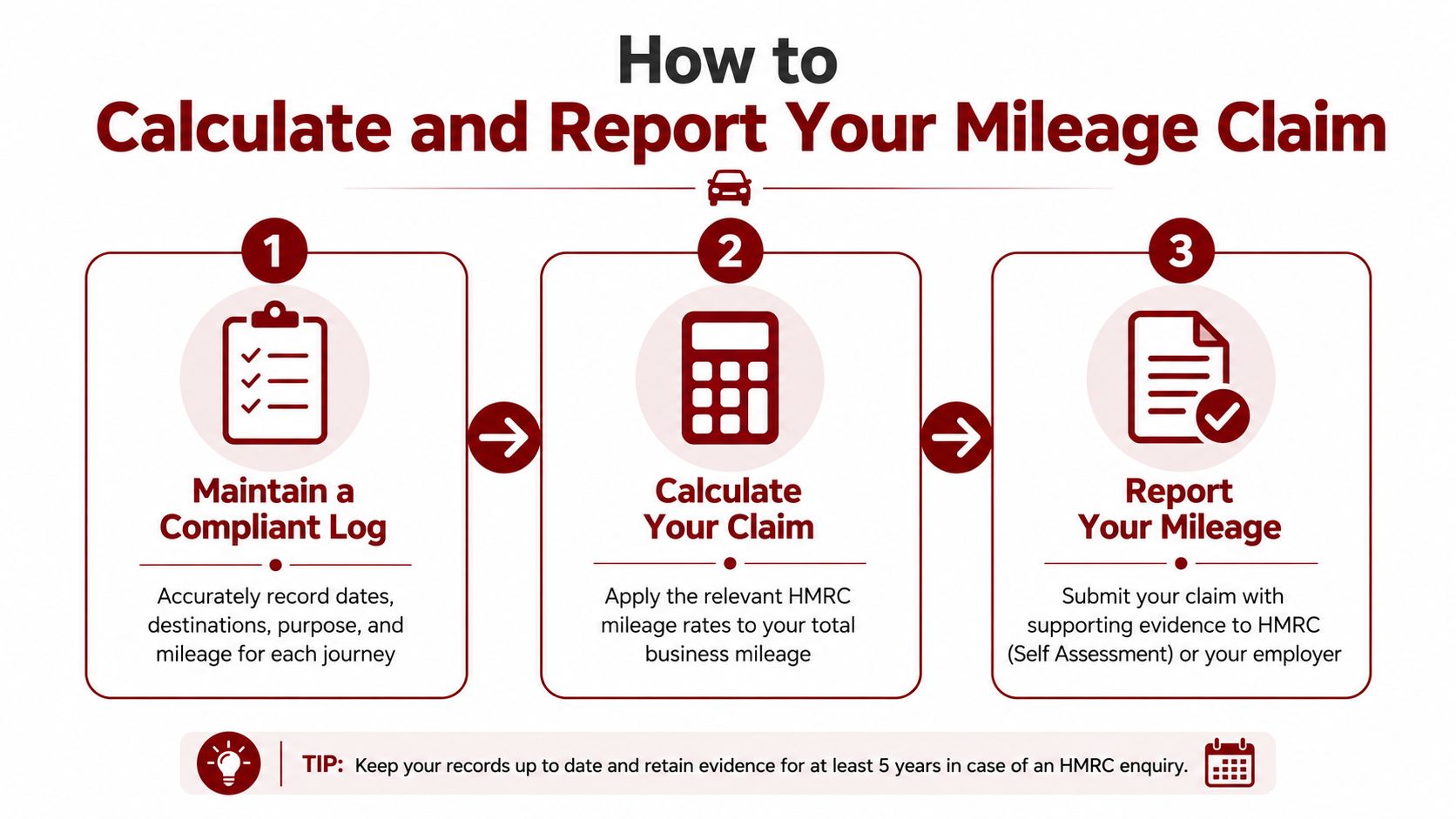
A simple process keeps this under control.
Start with a compliant mileage log
Before you calculate anything, make sure every qualifying journey is recorded. A good log should show the date, where you went, why you went, and how many business miles were driven.
Don't wait until year end and rebuild it from memory. That usually leads to rounded figures, missing journeys, and avoidable questions if HMRC reviews the claim.
If you work in motor trade or you're comparing mileage treatment with VAT handling on cars, a practical reference on how car dealers claim mileage VAT can help you separate mileage reimbursement issues from VAT issues, which are related but not identical.
Apply the rate correctly
Once you've totalled your business miles for the tax year, apply the correct band.
The clearest worked example is a high-mileage contractor. A contractor driving 15,000 business miles in 2026/27 can claim £5,500 for the first 10,000 miles at 55p, plus £1,250 for the remaining 5,000 miles at 25p, giving a total claim of £6,750, as shown in this mileage calculation example for 2026/27.
That example matters because it shows where people go wrong. They often keep applying the higher rate after crossing the threshold.
A spreadsheet approach is usually enough for small businesses. Keep columns for:
- Date of journey
- Start point and destination
- Business purpose
- Miles for the trip
- Running total of business miles
- Applicable rate
- Claim value
The running total is what stops the year-end mistake. Without it, people often misapply the higher rate for too long.
For some owners, video guidance is easier than text. This walkthrough can help reinforce the reporting process:
Report it in the right place
Where you report mileage depends on the business structure.
- Employees usually deal with employer reimbursement first, then tax relief if there's a shortfall.
- Sole traders include the claim through their Self Assessment records.
- Directors need to make sure the company reimbursement and accounting treatment match the underlying vehicle ownership.
If you're preparing or correcting your own tax return, Self Assessment tax return help is a useful reference point before filing, especially if your mileage position changed after the retrospective rate update.
Essential Record-Keeping for a Bulletproof Claim
A mileage claim is only as strong as the records behind it. If the log is vague, incomplete, or reconstructed after the event, the claim becomes harder to defend.
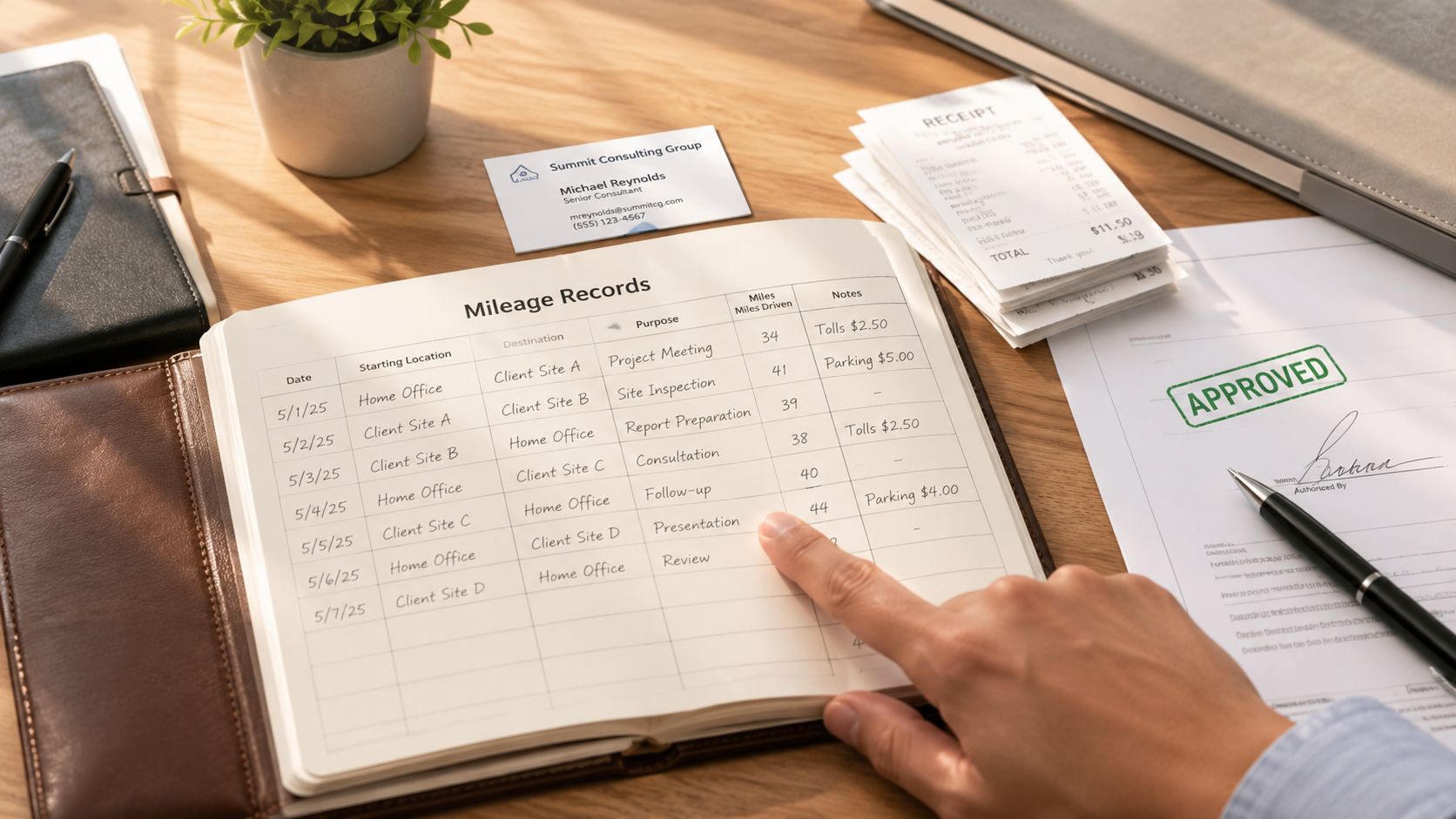
What your mileage log needs to show
A reliable mileage log should include:
- Date of travel: The day the business journey happened.
- Start and end location: Enough detail to identify the route properly.
- Business purpose: Client meeting, site visit, supplier collection, and so on.
- Mileage for the trip: The business miles for that journey only.
You can keep that record in a spreadsheet, an app, or a paper logbook. The format matters less than the quality and consistency.
If you're using digital tools, it can help to cross-check journeys against telematics or route history. For example, systems that let you access your car's full travel history can make it easier to verify routes and spot gaps before a claim is submitted.
Business travel versus ordinary commuting
Not every work-related drive counts as business mileage, leading to many overstated claims.
Business travel generally relates to genuine business journeys such as visiting clients, travelling between sites, or attending work-related appointments away from your normal base. Ordinary commuting is different. Driving from home to your regular workplace usually doesn't become allowable just because you're self-employed or because you discussed work during the trip.
A sensible routine is to review mileage weekly, not months later. That's usually enough to catch missing details while the journey is still fresh.
For sole traders especially, mileage records work best when they're kept as part of the wider bookkeeping system. If that side of the business needs tightening up, bookkeeping for sole traders is a practical next step.
Maximise Your Claim and Ensure Compliance with Action Accountants
The current business mileage rate gives business owners a better allowance than they've had for years, but the value only shows up when the claim is handled properly. The biggest pressure points are clear. Apply the correct rate, keep a proper log, and don't confuse a personal vehicle claim with the rules for a company-owned car.
For new businesses, that's often where time gets lost. Founders are juggling payroll, VAT, bookkeeping, CIS, and year-end reporting at the same time. Mileage seems small until it creates an inconsistent tax return or an overclaim that should never have been made.
That's why good advice matters more than generic guidance. A careful accountant won't just tell you the headline rate. They'll look at who owns the vehicle, how the journeys are recorded, whether the company has reimbursed correctly, and whether the treatment fits the wider tax position. If you want a broader view of what that support looks like, 8 ways an accountant can help your small business is a useful place to start.
Action Accountants supports sole traders, startups, landlords, SMEs, and construction businesses in North West London and across the UK. If you want to maximise legitimate tax relief without creating compliance problems later, it's worth getting the mileage position right from the beginning.
If you want clear advice on mileage claims, Self Assessment, bookkeeping, CIS, payroll, or day-to-day tax compliance, Action Accountants Limited can help. The team works with startups, sole traders, contractors, and growing businesses across North West London and the UK, with practical guidance that keeps claims accurate, efficient, and fully supportable.