

You're staring at the bank statement, the bookkeeping software, and a spreadsheet that no longer seems to agree with any of them. A customer payment arrived without an obvious reference, a direct debit was posted late, and a bank charge has reduced the balance without appearing in your ledger. By the time you investigate everything at month-end, the cash position feels less like information and more like a puzzle.
A disciplined bank reconciliation process removes that uncertainty. It compares your accounting records with the bank's transaction record, explains every difference, and leaves an evidence trail for the next review. For UK businesses, it also supports reliable VAT and Making Tax Digital records, clearer CIS bookkeeping, and more dependable landlord accounts.
Table of Contents
- Why Your Business Needs Better Reconciliation Habits
- The Complete Bank Reconciliation Process Step by Step
- Using Accounting Software to Simplify Reconciliation
- Building Strong Internal Controls Around Reconciliation
- Sector-Specific Reconciliation Considerations
- Creating Your Reconciliation Schedule and Staying Consistent
Why Your Business Needs Better Reconciliation Habits
Month-end reconciliation often becomes an exhausting search through old emails, receipts, payment confirmations, and spreadsheets. The work feels difficult because several weeks of small omissions have accumulated into one large investigation. A missed bank fee is easy to fix when it's recent. The same fee becomes harder to identify when it sits among many later transactions.

Regular reconciliation changes the task from detective work into routine maintenance. You check the latest bank activity against your books, investigate exceptions while the transaction is still familiar, and keep your reported cash balance connected to reality. That gives you better information before deciding whether to pay a supplier, draw funds, settle a tax liability, or commit to a new expense.
Small checks prevent large clean-ups
The right cadence depends on the account's activity and risk. UK practice commonly treats daily reconciliation as appropriate for high-volume or higher-risk cash flows, while lower-risk accounts are often checked weekly, as described by the Insolvency Practitioners Association guidance on estate bank accounts. Monthly review may be convenient, but convenience alone isn't a sound control if transactions move quickly.
A short daily review can focus only on new items and unresolved exceptions. You don't need to rebuild the entire history each time. The important discipline is to record why an item remains unmatched and who owns the follow-up.
Practical rule: Reconcile at the frequency that gives you time to correct an error before it affects a payment, filing, payroll run, or management decision.
The process also supports statutory accuracy. HMRC describes reconciliation as a control that matches accounting records to bank statements and identifies differences for correction in its internal account reconciliation guidance. That isn't merely administrative tidying. It's part of the control environment that keeps financial records defensible.
For founders who feel uncomfortable with finance, the answer isn't to ignore the numbers. It's to create a repeatable routine and get help where the process becomes difficult, as discussed in this guide for business owners who don't feel confident with numbers. Once the routine is clear, reconciliation becomes a source of confidence rather than a monthly threat.
The Complete Bank Reconciliation Process Step by Step
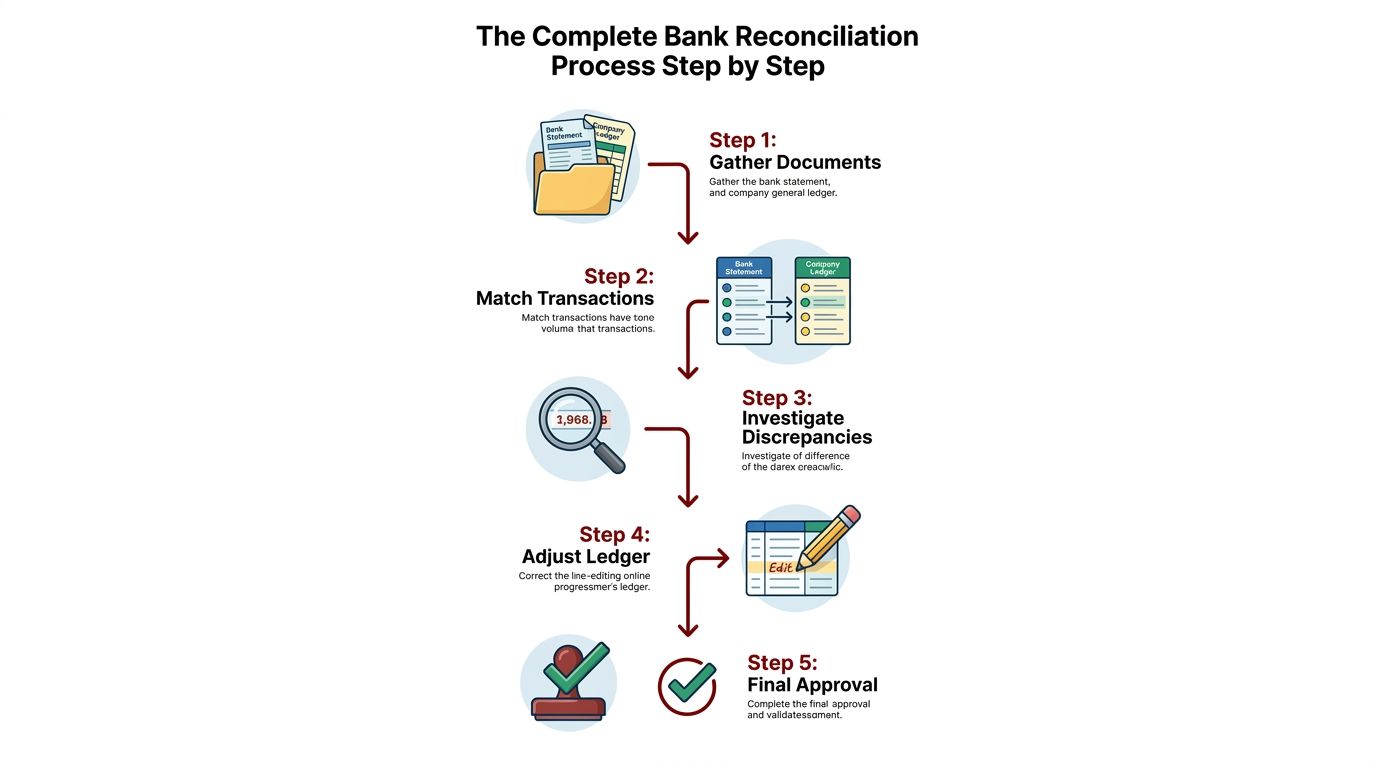
A sound reconciliation starts with two records covering the same period, the bank statement and the cash account in your ledger. Don't begin by changing figures to force a match. First establish the difference, then identify whether it reflects timing, an omitted entry, an incorrect posting, or a genuine bank issue.
Start with complete source records
Download the relevant bank statement and open the ledger for the matching account and period. Gather supporting records such as sales receipts, supplier invoices, payment runs, transfer confirmations, and any deposit records. If you use a platform such as QuickBooks, Xero, or FreeAgent, confirm that the bank feed covers the full period before relying on its suggested matches.
Compare the opening balance first. An incorrect opening figure can make every later transaction appear wrong, even when individual entries have been posted correctly. Then compare deposits, card settlements, transfers, direct debits, standing orders, withdrawals, and bank charges.
Match, investigate, and adjust
Work through the transactions in a consistent order. Match by amount, date, payee or payer, and reference, but remember that a payment may reach the bank on a different date from the date it was entered in the books.
Typical exceptions include:
- Timing differences: A transfer or receipt may be recorded internally before the bank processes it.
- Bank charges: Fees can appear on the statement without a corresponding ledger entry.
- Duplicate postings: The same receipt or payment may have been entered twice.
- Missing transactions: A direct debit, refund, card settlement, or transfer may never have been recorded.
- Classification errors: The amount may be correct but posted to the wrong nominal account.
Suppose the statement includes a £50 bank charge that isn't in QuickBooks. The bank balance is already correct because the charge has been deducted. Your book balance is overstated, so you post the charge to the appropriate bank-fee expense account and reduce the bank ledger by £50. Attach or reference the statement line, record the date and explanation, and leave the item available for reviewer approval.
Don't delete unexplained entries just because they prevent the reconciliation from balancing. A clean audit trail shows the original problem, the correction, the evidence used, and the person who approved it. Businesses handling complex transaction streams can also benefit from a dedicated resource on step-by-step Amazon reconciliation, particularly where platform settlements and fees create several layers between the sale and the bank receipt.
Watch the practical walkthrough before applying the process to your own accounts.
Close the loop properly
After adjustments, review every outstanding item. A legitimate timing difference should have an explanation and an expected resolution, not just remain on a growing list. Escalate items that are old, unusual, repeated, or unsupported.
The final reconciliation should show the bank balance, the book balance, all reconciling items, adjustments posted, and the preparer and reviewer sign-off. When the adjusted figures agree, lock or approve the reconciliation in line with your software and internal procedures. Guidance on the nominal ledger and its role in accounting records can help if you're unsure where an adjustment belongs.
Using Accounting Software to Simplify Reconciliation
Accounting software reduces repetitive data entry, but it doesn't remove the need for judgement. QuickBooks, Xero, and FreeAgent can import transactions through bank feeds and suggest matches against invoices, bills, transfers, and previously recorded payments. Those suggestions are useful starting points, not automatic proof that the transaction has been classified correctly.
A software match can look convincing because the amount is identical. It may still be wrong if the payment relates to a different invoice, represents a transfer between your own accounts, includes a reimbursable expense, or contains a settlement deduction. Review the description, date, counterparty, VAT treatment, and supporting document before accepting it.

Use rules carefully
Rules work well for repetitive items. A regular software subscription, rent payment, or known bank charge may be assigned consistently when the payee, amount pattern, and account treatment are stable. Rules become risky when they rely on only one feature, such as a vague bank description or an amount that changes regularly.
Set up a review queue for exceptions rather than trying to automate everything. Keep transfers between bank accounts separate from income and expenses, and don't allow a rule to post VAT or CIS-related transactions without checking the underlying treatment.
A practical review checklist is:
- Coverage: Confirm the feed includes the complete period and all relevant accounts.
- Unmatched items: Review every remaining transaction, not just the total difference.
- Duplicates: Search for repeated amounts, references, and dates.
- Transfers: Check that internal movements appear once in each relevant account.
- Evidence: Attach receipts, invoices, settlement reports, or payment confirmations.
- Exceptions: Document why unusual items remain open and assign follow-up responsibility.
Software also needs reliable connections and sensible system ownership. If payroll, HR, and finance data interact, guidance on how to integrate HR with Business Central may be relevant for businesses using Microsoft's wider business systems. The principle is simple, keep the source of each financial entry clear and prevent disconnected systems from creating unexplained differences.
Cloud tools can support shared access, bank-feed imports, and organised records, but the setup still determines whether they help. Action Accountants Limited provides bookkeeping guidance that includes matching accounting records to bank records and clearing unreconciled items. Its overview of cloud accounting benefits is useful when deciding whether your current system supports the control you need.
Building Strong Internal Controls Around Reconciliation
Reconciliation protects more than the accuracy of a cash figure. It can reveal unauthorised payments, duplicated entries, missing deposits, weak approval practices, and process failures. The control only works, however, when someone investigates exceptions rather than treating the reconciliation screen as a box to tick.
The most practical structure is maker-checker. One person prepares the reconciliation, another reviews the evidence and signs it off. The reviewer should question unexplained adjustments, recurring breaks, old outstanding items, and any unusual change in the account's normal pattern.
Make responsibility visible
The NetSuite UK bank reconciliation guidance recommends a maker-checker workflow, an audit trail, mapped cash pathways, secure bank-feed intake, business-specific matching rules, and an exceptions playbook. These controls work for a growing company, but they must be scaled sensibly.
A sole trader may prepare the reconciliation personally and use an external accountant for review. In a larger business, the person who processes supplier payments shouldn't also approve the reconciliation without independent oversight. If staffing makes full segregation impossible, document the compensating review and keep access rights as narrow as practical.
Map every route through which cash enters or leaves the business. Include current accounts, savings accounts, card processors, payment platforms, payroll accounts, client-money arrangements, and any account used for property or project activity. Each source should have an owner, a defined feed or import method, and a documented reconciliation frequency.
Build an exceptions playbook
Your team shouldn't have to invent a response every time an exception appears. Create a short procedure for bank fees, foreign exchange differences, chargebacks, returns, stale cheques, duplicate entries, card settlement deductions, and transfers in transit.
Each procedure should state:
- What evidence the preparer must obtain.
- Which ledger account or transaction type normally applies.
- When the item needs escalation.
- How the resolution is recorded.
- Who reviews and approves the correction.
Secure connectivity through an API or SFTP can reduce manual imports, but automation won't explain an unusual settlement or prove that safeguarded funds are complete. Evidence retention matters just as much as matching speed.
Control that scales: Every reconciliation should answer who prepared it, who reviewed it, which source records were used, what remained unresolved, and what happened next.
UK public-sector guidance treats reconciliation as foundational to statutory reporting, including matching transaction streams and balances before eliminations in Whole of Government Accounts. In regulated financial services, the FCA safeguarding reconciliation rules require firms to reconcile at least once on each business day, identify shortfalls, and report reconciliation activity through REP020. That standard is not appropriate for every ordinary trading account, but it shows why frequency and evidence must reflect risk.
For businesses that need help maintaining the routine alongside wider bookkeeping, payroll, and payment controls, payroll and bookkeeping services can provide structured support without removing management accountability.
Sector-Specific Reconciliation Considerations
A simple bank reconciliation assumes one account, direct sales receipts, and no deductions between invoicing and payment. UK contractors and landlords often work with several records at once. Bank activity must connect to tax records, project or property information, and payments received or made after deductions and charges.
CIS contractors and subcontractors
A contractor may owe a subcontractor the gross invoice amount but transfer only the net amount after a CIS deduction. The bank statement shows the cash movement. The bookkeeping records must separately explain the gross cost, the deduction, and the resulting liability. Posting only the net transfer as an expense breaks the link between the subcontractor invoice, the CIS deduction, and the amount due through the compliance process.
Keep the payment evidence, subcontractor invoice, deduction statement, and CIS records together. Match the bank payment to the net transfer, then check that the gross cost and deduction entries create the correct outstanding liability. A difference between the invoice and bank payment may be expected. Check for a CIS deduction before treating it as a bank error.
Payroll and supplier payments require the same discipline. The bank may show only the net amount paid, while PAYE, National Insurance, or other liabilities are recorded separately. Reconciliation should explain the complete payment flow, not just find a matching figure.
Landlords and property investors
Landlord accounts become harder to reconcile when rent from several properties enters one account, a managing agent sends a net settlement, or service charge money follows a separate route. A net receipt can include deductions for management fees, repairs, reserve movements, or other property costs. Matching only the amount received can leave rental income and expenses incomplete.
Use property references and maintain a schedule linking each receipt to the property, tenant or agent statement, rental period, and deductions. If service charges are held or administered separately, reconcile those balances on their own. Combining them with the landlord's ordinary operating account makes ownership and cash movements harder to establish.
Action Accountants' service charge accounting support includes reconciliations for landlords, property investors, and managing agents. The practical point is to distinguish each cash pathway and retain the statement that explains the net movement.
For rent paid into a shared account, identify the property allocation before accepting a software match. The managing agent's statement may support the breakdown of a net receipt, while the bank statement confirms what arrived.
Making Tax Digital and filing readiness
HMRC's Making Tax Digital guidance for digital records says digital records must be updated when income or expenditure is confirmed. Reconciliation should therefore be part of the bookkeeping routine, rather than a task left until a filing deadline. An incomplete bank feed or unclear transaction can affect the records used for a submission.
Many small businesses and sole traders still use spreadsheets for reconciliation. That can suit a simple account, but the process becomes fragile when receipts arrive late, refunds follow the original sale, or transfers move between several accounts.
Before a VAT or MTD submission, confirm that the bank feed is complete, classify unmatched items, review refunds and transfers, and retain evidence for every adjustment. Reconciliation does not replace tax advice. It gives your adviser a cleaner, traceable record and makes unresolved items easier to identify before filing.
Creating Your Reconciliation Schedule and Staying Consistent
A workable schedule starts with risk, not habit. High-volume or higher-risk accounts should generally be checked daily, while lower-risk accounts may suit weekly review, as UK reconciliation practice recognises. Choose a cadence you can complete and evidence, then increase it when transaction activity, cash exposure, or regulatory obligations demand closer control.
Build the task into an existing routine. Review new bank-feed items after posting sales, check supplier payments after the payment run, and clear exceptions before the weekly finance review. Keep one exception list with an owner and next action, rather than scattering unresolved questions across emails and notebooks.
A sensible first week might look like this:
- First review: Reconcile one operating account and list every unresolved item.
- Process setup: Create categories for fees, transfers, refunds, and timing differences.
- Evidence routine: Attach or reference the source document for each adjustment.
- Review point: Ask another person to challenge the reconciliation, even if they only perform a short independent check.
- Repeat: Use the same account and routine until the process feels predictable.
Don't wait for a perfect system. Start with one account this week, establish a clear review habit, and expand once the evidence and ownership are working. Action Accountants Limited can help you organise bookkeeping, tax, CIS, payroll, and property-related controls so your reconciliation process supports lasting financial control.
Action Accountants Limited helps UK businesses set up practical bookkeeping and bank reconciliation routines, with support for CIS contractors, landlords, sole traders, and growing companies. Visit Action Accountants Limited to discuss your current records, unresolved items, and the finance process you want to make reliable.