
Limited Company vs Sole Trader: The 2026 UK Guide
Action Accountants •9 June 2026
Your business has probably reached the awkward middle stage. It started as a side income, a freelance project, a few contractor invoices, or a small online shop. Now the money is real enough that “I'll sort the paperwork later” stops being a sensible plan.
That's usually the point when the limited company vs sole trader question lands on your desk. Not as a theory exercise, but as a practical decision with consequences. If a client doesn't pay, if you need a bank account in the business name, if you want to bring in a partner later, or if your profits are climbing, the structure you choose starts affecting your day-to-day life.
Most new founders look at tax first. That matters, but it's only part of the answer. The better question is this: what structure gives you the right balance of protection, admin, flexibility, and room to grow? If you want a second opinion before deciding, this guide to sole trader or limited company is a useful companion read because it looks at the same choice from a startup founder's point of view.
Table of Contents
- Your First Big Business Decision
- Legal Structure and Personal Liability
- Tax National Insurance and Profit Extraction
- The Admin Burden Compliance and Costs
- Take-Home Pay Real World Scenarios
- Making the Right Choice A Decision Framework
- Your Next Steps with Action Accountants
Your First Big Business Decision
A new business owner usually asks the wrong first question. They ask, “Which one pays less tax?” The better first question is, “What problems am I taking on if this business gets bigger than I expected?”
That shift matters because your structure affects more than your tax bill. It decides whether the business is legally you, how much formality you need, how you get paid, and how much risk sits on your own shoulders. A sole trader setup can be exactly right when you need speed, low admin, and direct control. A limited company can be exactly right when the business is becoming more exposed, more profitable, or more ambitious.
Here's the practical approach:
| Issue | Sole trader | Limited company |
|---|---|---|
| Legal status | You and the business are the same | The company is separate from you |
| Liability | Personal exposure to business debts | Liability generally limited to investment |
| Setup | Faster and simpler | More formal incorporation |
| Ongoing admin | Lighter | Heavier compliance workload |
| Tax approach | Income Tax and National Insurance on profits | Corporation Tax in the company, then salary/dividends |
| Scalability | Fine for simple operations | Better suited to more structured growth |
A lot of founders don't need a company on day one. They need clarity on when staying simple stops being the smart option.
The limited company vs sole trader decision is really a question about fit. If you're testing an idea, keeping costs low, and working in a low-risk service business, sole trader status often works well. If you're signing contracts, taking on financial commitments, or expecting the business to grow into something bigger than a one-person operation, the company route often starts making more sense.
Legal Structure and Personal Liability
The biggest difference isn't tax. It's liability.
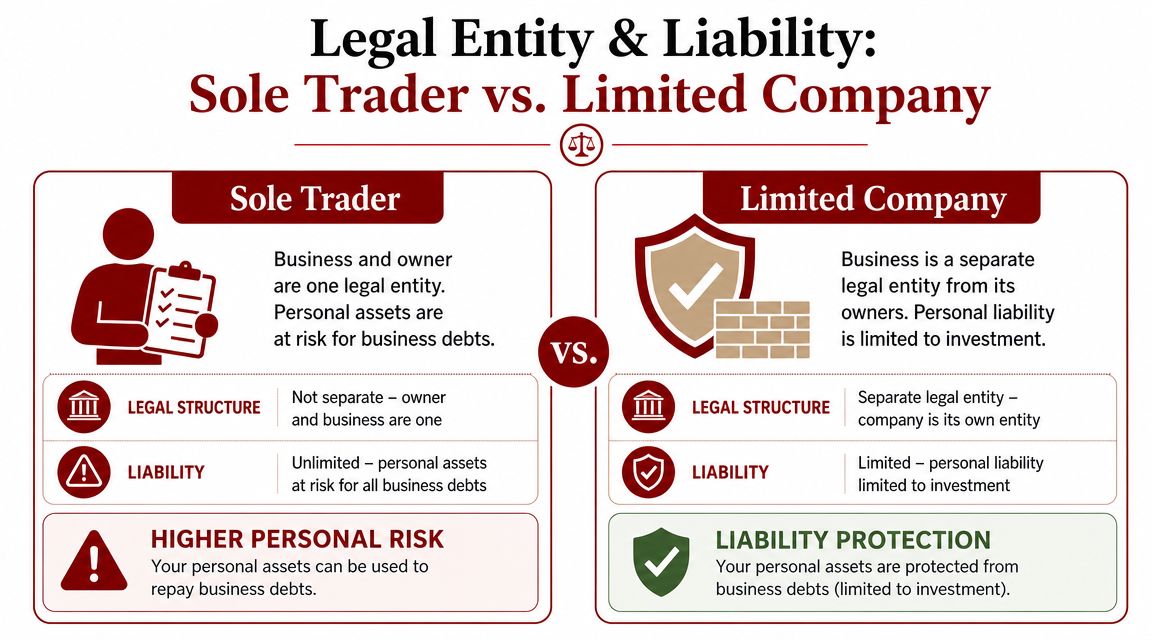
A sole trader is the simplest structure because there's no separate legal entity. The owner and the business are the same person. That means the owner has unlimited liability for business debts. A limited company is different because it is a separate legal person, and shareholders' exposure is generally restricted to their investment or shares, as set out in HSBC's explanation of sole trader and limited company status.
Why this matters in real life
Think of a sole trader as trading in your own name, even if the business has a brand. If the business owes money and can't pay it, the problem doesn't stop at the business. It can reach your personal finances because there is no legal wall between you and the trading activity.
With a limited company, that wall exists. The company enters contracts. The company invoices clients. The company owes its own debts. That separation is one of the main reasons owners choose to incorporate when they want better protection for personal assets.
This matters most when your work includes any of the following:
- Client contracts that could turn into disputes
- Credit arrangements with suppliers
- Upfront costs before you're paid
- Staff or subcontractors where mistakes can become expensive
- Physical work or regulated work where claims are more likely
Separate legal person means formal responsibilities
The protection of a limited company comes with structure. You're not just running a business. You're running a legal entity with duties attached to it. That's one reason directors need proper records, clear filing routines, and an understanding of basic governance. If you're unclear on the role behind the scenes, this overview of what a company secretary does helps explain the formal side of company administration.
Practical rule: If one bad debt or one dispute would put pressure on your personal finances, liability should move ahead of tax in your decision.
When sole trader risk is often acceptable
Not every business needs a company from day one. A low-risk consultant with few fixed costs and straightforward client work may be comfortable trading as a sole trader, especially at the start. The key is to be honest about risk, not optimistic about it.
Many founders underestimate exposure because the business feels small. Small businesses still sign agreements, still make promises to clients, and still face payment delays. The legal structure you choose decides whether those problems stay in the business or follow you home.
Tax National Insurance and Profit Extraction
A lot of founders fixate on the headline tax rate, then miss the part that affects real take-home pay. The structure you choose changes how profit is taxed, how money reaches you, and how much work sits behind that process.
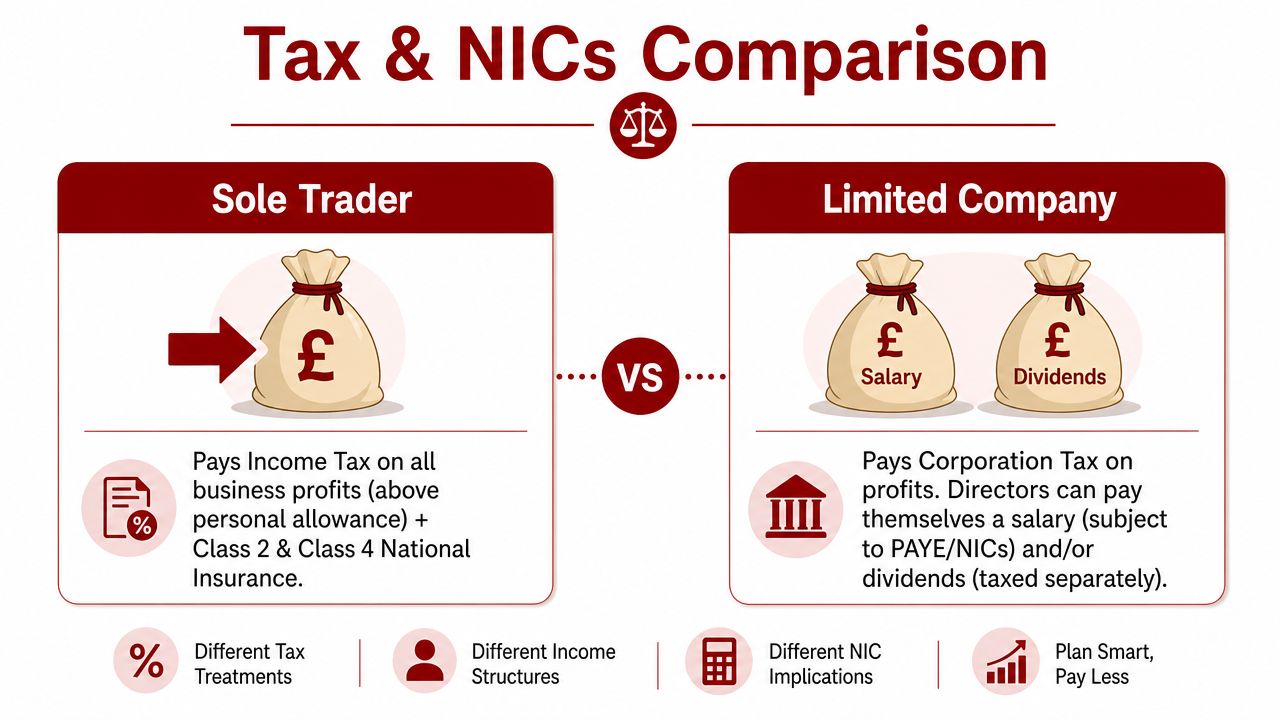
For the 2025/26 tax year, companies with profits under £50,000 face Corporation Tax at 19%, while sole traders pay Income Tax starting at 20% on profits, plus National Insurance, according to Stewart Accounting's 2025/26 comparison.
How a sole trader is taxed
As a sole trader, the business profit is your personal income for tax purposes. You keep the records, work out the profit, and pay Income Tax and National Insurance through Self Assessment.
The appeal is obvious. It is easier to understand, easier to administer, and there is no separate decision about whether to take salary, dividends, or leave money behind in the business.
The downside is just as clear. Once the profit is there, the tax follows you personally. You cannot usually reshape the timing of extraction in the same way a company owner can, because there is no legal separation between you and the business income.
Cash flow often catches sole traders out before tax rates do. HMRC can ask for advance tax payments based on the previous year, so if profits rise quickly, the bill can feel disproportionate. If that risk is on your radar, read our guide to how payments on account work in practice.
How a limited company is taxed
A limited company pays Corporation Tax on its profits. After that, the owner usually takes money out through salary, dividends, or a mix of both.
That creates planning opportunities, but it also creates process. Payroll has to be run properly. Dividends need to be supported by available profits and records. The timing of drawings matters more, and mistakes are easier to make if bookkeeping is late or unclear.
In practice, a company structure tends to work better where profits are consistently strong, where some profit can be retained in the business, or where the owner wants more control over how and when money is extracted. If nearly all profit needs to come straight out to cover personal living costs, the tax advantage often narrows once you allow for payroll, accounts, and compliance work.
For businesses selling online, VAT can add another layer of operational admin alongside profit extraction. If that applies to you, this article on integrating UK VAT in checkout shows how tax compliance quickly becomes part of the sales process, not just the year-end accounts.
Profit extraction is where the company structure can justify itself
The benefit of a company is control. A director-shareholder can choose a sensible mix of pay and dividends, and can leave profit inside the company for stock, equipment, hiring, or a cash buffer. That matters if you are building something that needs working capital rather than pulling every pound out as soon as it is earned.
A sole trader has fewer decisions to make, which is often an advantage early on. A limited company gives you more choices, but each choice brings admin, documentation, and more room for error.
Here is the practical comparison:
- Sole trader usually means simpler tax treatment and faster access to your money.
- Limited company usually gives more control over extraction and timing.
- The key consideration is whether the extra flexibility saves enough tax or supports enough growth to cover the added compliance cost and risk.
I regularly see new business owners compare structures on percentages alone. That is too narrow. The better question is whether the tax planning options of a company are worth the ongoing effort needed to use them properly.
A quick visual summary helps if you prefer the short version:
The Admin Burden Compliance and Costs
This is the part most founders undervalue. They compare structures on tax, then discover later that the actual cost sits in admin time, filing discipline, and the risk of getting formal obligations wrong.
A sole trader setup is lighter. A limited company is more demanding. That difference isn't a minor detail. It's the ongoing price of having a separate legal entity.
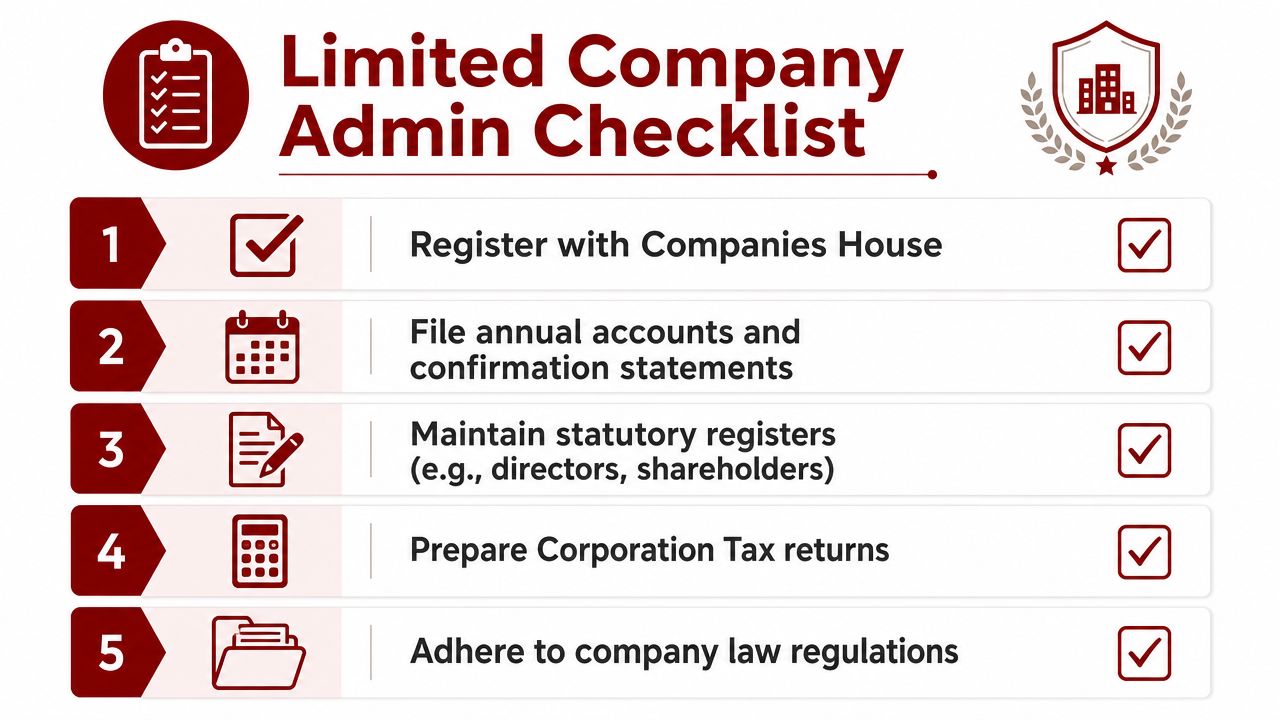
A limited company must handle Companies House incorporation, annual accounts, a confirmation statement, and a Corporation Tax return, while a sole trader will typically only need HMRC self-employment registration and an annual Self Assessment return, as explained in Zempler Bank's breakdown of the filing gap.
What the lighter route looks like
A sole trader normally has a cleaner admin path. You register as self-employed, keep records, track income and expenses, and submit your annual tax return. That doesn't mean you can be disorganised, but it usually means fewer moving parts.
For many one-person businesses, that simplicity is a genuine advantage. If the business model is straightforward and risk is low, reduced admin can preserve time and attention for sales, delivery, and cash collection.
What the company route really adds
A company creates recurring obligations. Even a small owner-managed company has formal deadlines, filing expectations, and internal records to maintain. If payroll is involved, that introduces another compliance stream. If the bookkeeping falls behind, everything else gets harder.
The total cost of compliance includes more than accountant fees. It includes:
- Owner time spent reviewing records, approving filings, and dealing with paperwork
- Process discipline so payroll, expenses, and dividends are handled properly
- Penalty risk if deadlines are missed
- Decision friction because extracting money is less casual than taking drawings as a sole trader
More structure helps good businesses scale. It also punishes disorganised ones faster.
For founders building systems properly, governance frameworks become useful surprisingly early. This isn't only for large corporates. Even a small company benefits from basic controls around record keeping, approvals, and risk ownership. That's why some owners find broader reading on AuditReady for compliance leaders helpful. It shows how governance and compliance thinking starts long before a business feels “big”.
Where founders usually go wrong
The most common mistakes aren't technical. They're behavioural.
-
Mixing personal and business spending
This creates messy bookkeeping and weak evidence trails. -
Treating Companies House deadlines like tax deadlines
They're separate obligations. Missing one doesn't excuse the other. -
Assuming software replaces judgement
Xero, QuickBooks, FreeAgent, and similar tools help, but they don't decide whether a transaction has been handled properly. -
Underestimating bookkeeping volume
If you trade often, invoice regularly, or deal with expense claims, the work stacks up quickly. Sole traders who need better records often benefit from tightening their processes with support such as bookkeeping for sole traders.
The right structure isn't the one with the lowest admin in isolation. It's the one whose admin burden matches the value you get back from it.
Take-Home Pay Real World Scenarios
A new client asks this all the time. “If I set up a limited company, how much more do I keep?” The honest answer is that take-home pay only matters once you subtract the admin, accountancy fees, payroll work, and the risk of getting the compliance wrong.
Tax is only part of the decision.
A sole trader usually gets money out in the simplest way because the profit is already theirs. A limited company gives more control over how profits are extracted, but that control comes with extra process. You need to run payroll properly, keep dividend paperwork in order, and stay on top of company filings. If that discipline is missing, the theoretical tax saving can disappear into clean-up work, penalties, or poor record keeping.
A practical comparison
The table below stays broad on purpose. Actual take-home pay changes with your costs, how much you withdraw, whether you leave profit in the business, and how well the books are kept.
| Business Profit | Sole Trader Net Pay | Limited Company Director Net Pay |
|---|---|---|
| Lower profit level | Often close to, or better than, a company once lower setup and compliance costs are factored in | Often less attractive if most of the profit is taken out and the company is carrying extra admin costs |
| Mid-range profit level | Still workable, but the tax position can start to feel heavier when all profits are taxed personally | Often starts to pull ahead if salary, dividends, and timing are handled properly |
| Higher profit level | Simpler to run, but there is less flexibility in how profits are taxed or retained | Usually stronger where profits can be retained, reinvested, or drawn with a clear plan |
What changes the answer in real life
Two businesses can make the same profit and still end up with very different outcomes.
Take a graphic designer earning solid fees but drawing nearly all the profit each month to cover household costs. In that case, a limited company may give less of an advantage than expected once payroll, annual accounts, corporation tax returns, dividend records, and accountancy fees are added in. The company may still be the right call for legal or commercial reasons, but the take-home benefit is often smaller than people expect.
Now take a consultant with the same profit who can leave part of it in the business. A company often works better there. Retained profits create planning options. They also support growth, smoother cash flow, and a cleaner route if the business starts to scale.
That is the trade-off. The structure affects both tax and operating friction.
A few factors usually matter more than headline tax comparisons:
- How much profit you need to withdraw for personal living costs
- Whether you can leave money in the business
- What the annual compliance work will cost in time and fees
- How reliable your bookkeeping is
- Whether the business needs the extra credibility or legal separation of a company
I rarely advise owners to choose a company based on tax alone. If the numbers are marginal and the admin will be a constant burden, sole trader status can leave you in a better practical position. If profits are rising, systems are decent, and you want more control over risk and future growth, the company route often starts to justify itself.
If you are still trading as a sole trader, tighten the basics first. A surprising amount of take-home pay is lost through missed claims and weak records. Our guide to tax-deductible expenses for self-employed people will help you spot allowable costs before you compare structures.
Making the Right Choice A Decision Framework
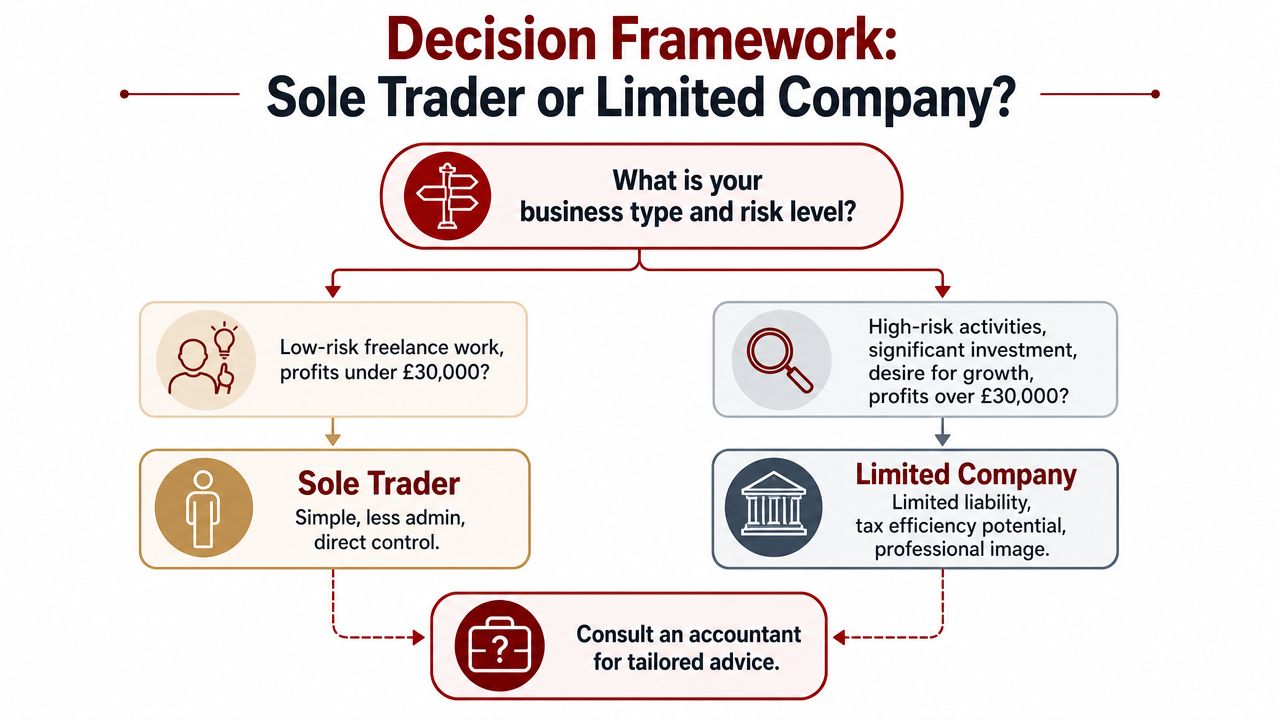
The right answer depends on the business in front of you, not on a generic checklist copied from a forum. A web designer working from home, a subcontractor in construction, and a landlord building a portfolio don't face the same risks or the same growth path.
That's why a decision framework works better than a blanket rule.
When sole trader status often makes sense
A sole trader setup usually suits founders who want to start quickly, keep costs down, and avoid unnecessary formality while the business is still proving itself.
That often includes people like:
- Freelancers in low-risk services where contracts are simple and overhead is modest
- New founders testing demand before committing to a more formal structure
- One-person businesses with straightforward income and no plans to bring in owners or investors
This route works best when simplicity is a genuine business advantage, not just an excuse to postpone organisation.
When a limited company is usually the stronger move
A company tends to make more sense when the business is moving beyond basic self-employment and into something that needs more protection or structure.
That often applies when:
- Risk is higher because of contracts, delivery obligations, or financial exposure
- Profits are rising consistently and you want more flexibility around extraction and reinvestment
- You want a more formal trading vehicle for larger clients, lenders, or future business partners
- You may need to scale with staff, shareholders, or a more defined ownership setup
For contractors, this is often a commercial question as much as an accounting one. Some clients expect a company structure, cleaner payroll handling, and stronger compliance routines. For landlords, the answer can depend on whether the long-term plan is simple rental income or a broader investment strategy.
A no-nonsense test
Ask yourself these questions:
- If the business ran into debt, could I absorb the personal risk comfortably?
- Do I want the simplest possible admin, or am I ready to run a formal entity properly?
- Will this stay a one-person income stream, or am I building something with growth in mind?
- Do clients, lenders, or partners expect a company structure?
- Am I choosing based on a headline tax idea, or on the full cost of compliance and risk?
If most of your answers point toward simplicity and low exposure, sole trader status is often still the right call. If they point toward protection, structure, and growth, a limited company is usually the better fit.
Choose the structure your business can operate well, not the one that looks cleverest on a spreadsheet.
Your Next Steps with Action Accountants
Once you've narrowed the choice, the next step is execution. That's where many founders lose momentum. They know broadly what they want, but they haven't turned it into registrations, systems, records, and filing routines.
A clean start usually follows a simple sequence.
Step one is to decide based on risk and workload
If your work is low-risk and you need a lean setup, sole trader status may still be the practical answer. If personal protection, growth, or formal credibility matters more, the company route is usually worth the extra administration.
What matters is making the choice deliberately. Don't drift into a structure because a friend said it was “better for tax”.
Step two is to organise the records from day one
Before the first year-end arrives, get the basics in place:
- A separate process for business money so transactions are easy to track
- Consistent bookkeeping using software such as Xero, QuickBooks, or FreeAgent
- A clear file for invoices and receipts
- A calendar for filing deadlines so nothing is left to memory
Good records don't just help at tax time. They make every later decision easier.
Step three is to review the structure as the business changes
The best choice now might not be the best choice later. A founder can sensibly start as a sole trader, then incorporate when profits rise, risk increases, or clients demand a more formal setup.
That review should happen before the change is urgent. It's easier to move from a position of control than from a position of panic.
Step four is to get proper support before mistakes become habits
Formation, payroll, bookkeeping, VAT, accounts, and tax all connect. If you treat them as separate jobs, problems build in the gaps between them. If you deal with them as one system, the business runs more cleanly.
That's the core value of accountant support at this stage. Not just form filling, but helping you choose a structure that you can manage well over time.
If you want clear advice on whether sole trader or limited company status fits your business, speak to Action Accountants Limited. They help startups, contractors, landlords, and growing businesses set up properly, stay compliant, and make practical decisions with confidence.