


You've opened an email from Companies House and your stomach has dropped. A confirmation statement was missed, a director's details weren't updated, or a verification requirement has landed with no obvious owner inside the business. The filing itself may look like a small administrative task, but the underlying problem is larger: your company's legal records, board decisions and public information are no longer moving together.
That's why company secretarial duties now need to be treated as a live governance operation. In 2026, a technically accurate filing may still leave a company exposed if identity verification, authorised corporate service provider processes and internal registers aren't aligned. The practical question for a founder isn't who holds the secretary title. It's who owns the compliance calendar, checks the evidence and makes sure every corporate change is properly approved and recorded.
Table of Contents
- Why Company Secretarial Duties Matter More Than Ever
- The Legal Foundation for UK Company Secretaries
- Core Duties Every Company Secretary Must Handle
- Critical Filing Deadlines and Compliance Timelines
- The 2026 ECCTA Changes That Caught Many Off Guard
- In-House Versus Outsourced Company Secretarial Services
- Your Practical Compliance Checklist for 2026
Why Company Secretarial Duties Matter More Than Ever
A confirmation statement filed late can expose several problems at once. The public register may still show a former director, an outdated person with significant control or an address no one monitors. By the time a founder spots the discrepancy, a bank, investor, solicitor or Companies House may already be asking for an explanation.
Company secretarial duties protect directors as well as the company. Accurate minutes, registers and filing records show what was approved, by whom and when the related update was completed. They give directors evidence of a controlled process, rather than leaving them dependent on memory, scattered emails or an informal spreadsheet.
The work is now a live digital control function. Companies House reported 17.3 million filings in 2025 to 2026 and set out plans to drive identity-verification compliance or enforcement action by the end of the year (Companies House identity-verification management information). More online filing increases the speed of administration, but it does not replace judgement. Someone still needs to verify the change, confirm the approval route, retain the evidence and check that the public record reflects the company's own registers.
Practical rule: A filing is not complete when someone clicks submit. It is complete when the underlying change has been checked, approval evidence is retained and the public record matches the internal record.
The risk founders tend to underestimate
A private company may not need to appoint a formal secretary, but it still needs the work done. Directors remain responsible for lawful administration, accurate statutory information and records that support the company's decisions. Treating the absence of a secretary as an absence of responsibility is a costly mistake.
The roles and responsibilities of the board of directors sit alongside these controls. A secretary, director or outsourced provider can carry out the task, while the board must understand what changed, approve matters within its authority and ensure a dependable process exists.
“Someone in finance handles it” is a weak control. Finance may track accounts deadlines, but company secretarial work also includes board approvals, ownership changes, officer records, constitutional documents and identity verification. Without a named owner, documented handovers and a backup, a holiday, resignation or funding round can leave an important obligation unattended. In 2026, register management and digital filing need active ownership, not occasional paperwork.
The Legal Foundation for UK Company Secretaries
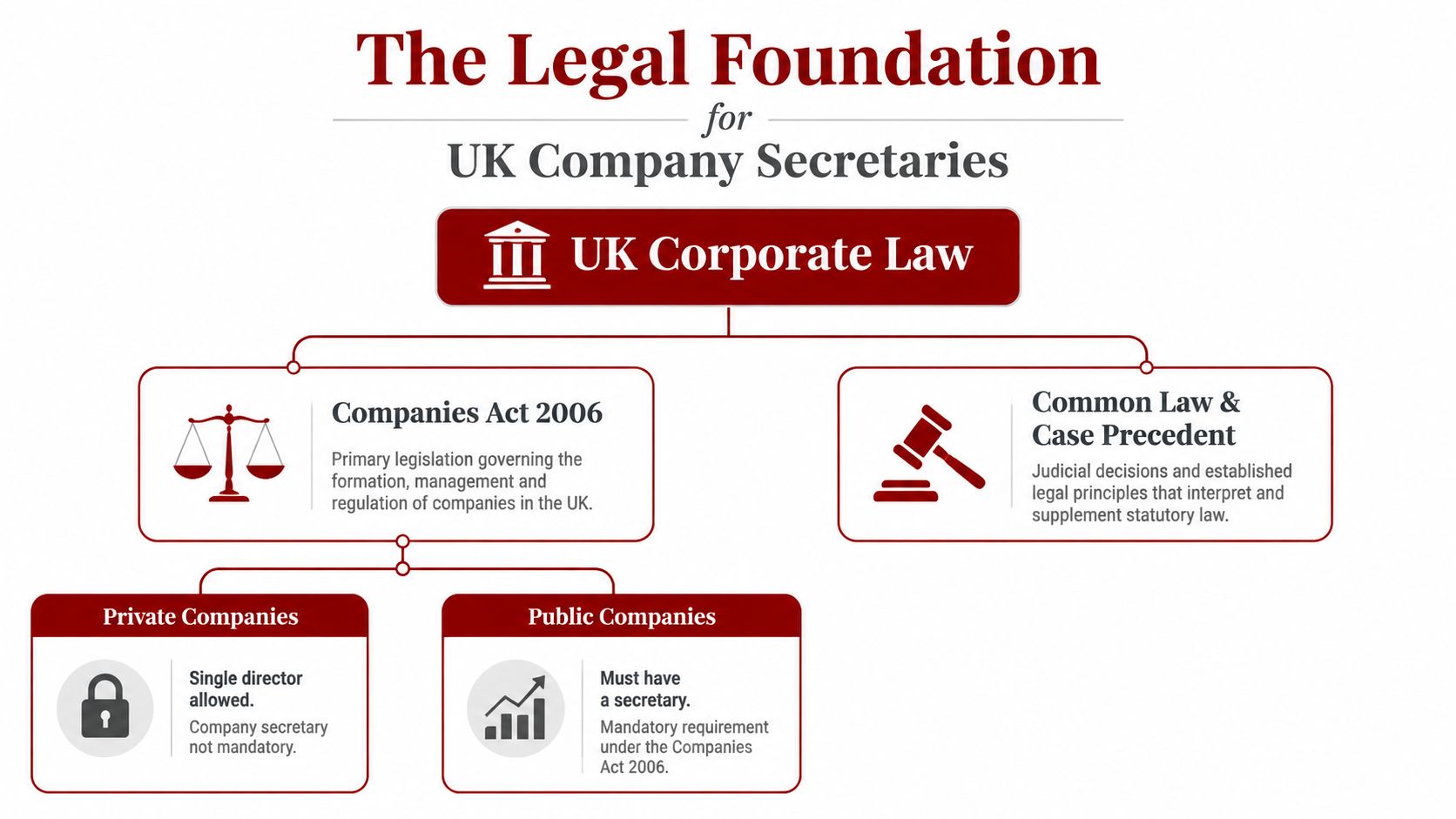
A startup can submit a Companies House filing on time and still have a governance problem if its internal records, approvals and public information do not agree. The legal foundation remains the Companies Act 2006. It sets the appointment framework: public companies must appoint a company secretary, while private companies may choose whether to do so unless their articles of association require one. The relevant provisions are in Companies Act 2006, Part 12.
That distinction affects the appointment, not the work. A private company still needs accurate statutory information, documented decisions, controlled constitutional arrangements and timely filings. Directors retain responsibility for ensuring those controls operate, whether tasks sit with an employee, an external provider or a formally appointed secretary.
Appointment is optional, control is not
For a private company, appointing a secretary creates a clear owner for recurring work and event-driven changes. Without that owner, responsibility can become scattered across directors, finance and legal advisers. A funding round, director change or identity-verification request then exposes gaps quickly, particularly where digital filings must match the company's registers.
The company must keep a register of secretaries where applicable and maintain its statutory records. The role therefore connects legal administration with board governance. It includes checking the effect of a proposed change, preserving approval evidence and confirming that the public record reflects the company's own records.
The FRC Corporate Governance Code and guidance places the company secretary within the board's governance arrangements. The secretary supports the chair, advises on procedures, helps the board and committees work effectively, and ensures directors can access appropriate support.
For a startup, use four controls:
- Check the articles: Confirm whether the constitution requires a secretary.
- Assign responsibility: Name the person accountable for each recurring and event-driven task.
- Preserve evidence: Store signed resolutions, minutes, approvals and filing confirmations together.
- Review the public record: Reconcile Companies House information with the company's internal records.
A filing is complete only after the change, approval trail and resulting public record have been checked.
Core Duties Every Company Secretary Must Handle
A founder approves a share transfer on Friday, updates Companies House the following week and discovers during a bank review that the register of members still shows the old ownership. That gap is the practical risk company secretarial work must prevent. In 2026, identity verification, register management and digital filing workflows make the role a live governance operation, not paper administration.
Statutory records and company data
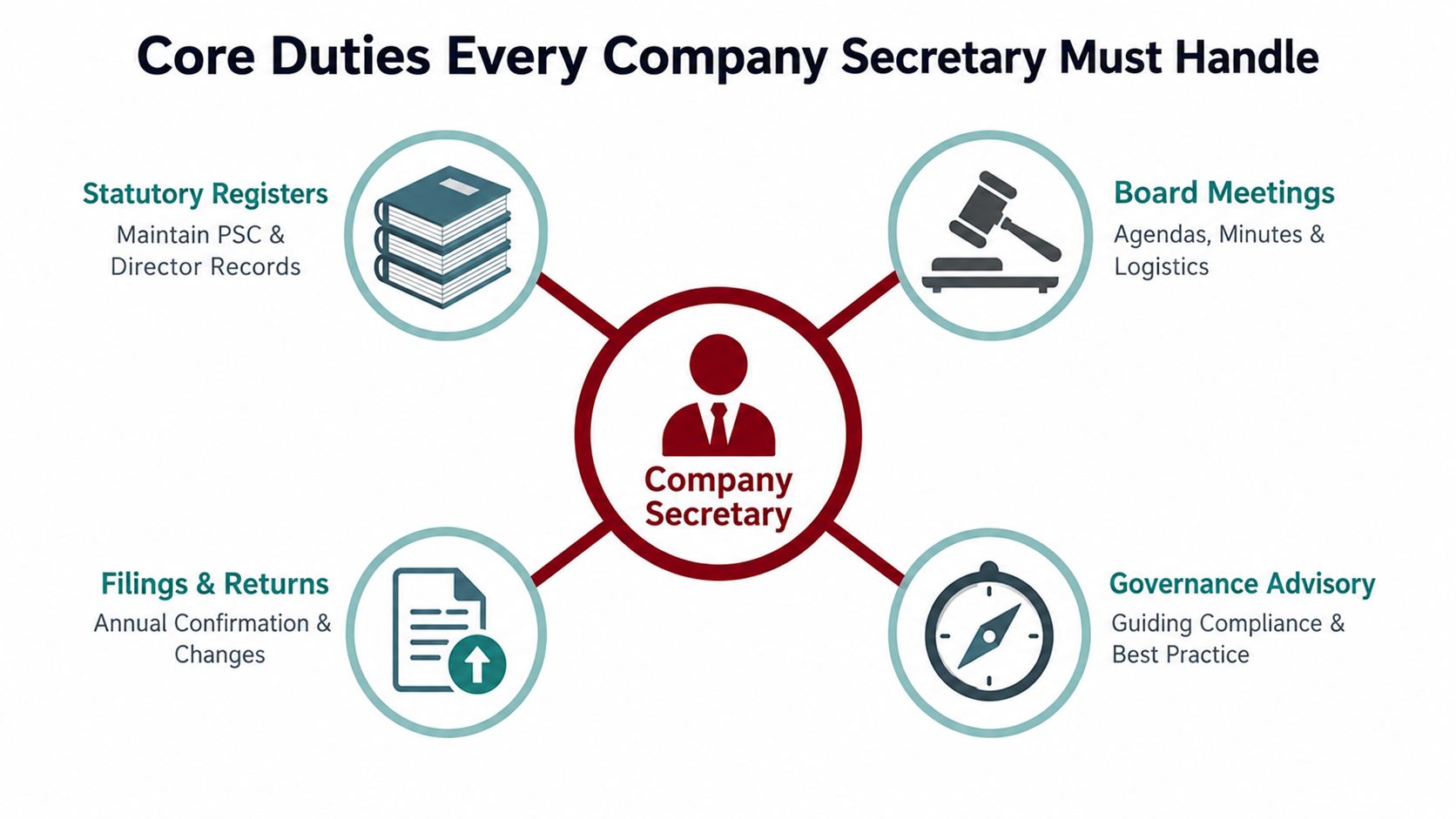
Give every register a named owner, an update trigger and a review point. Depending on the company's circumstances, records may cover directors, secretaries, people with significant control and members, as well as constitutional documents and other statutory information. Use this guidance on statutory registers to check what the company must hold and where each record is maintained.
Consistency matters more than the software used. If a share transfer has been approved but the register of members remains unchanged, the company has created an ownership problem even if no Companies House form was required immediately. Reconcile internal records before submitting a related digital filing.
Meetings, resolutions and minutes
The secretary turns a proposed decision into a valid approval process. Duties can include scheduling board meetings, identifying matters reserved for directors, preparing agendas, circulating papers, checking notice requirements, recording attendance and capturing decisions accurately.
Minutes should state the decision, the authority for making it and any material conditions. They do not need to reproduce every conversation. They must leave a clear approval trail that a director, investor or adviser can understand later. Written resolutions require the same care. Keep the signed final version with supporting papers in a location directors can retrieve.
Filings and inspections
The technical remit includes maintaining statutory registers, filing required information, arranging and documenting board and general meetings, circulating resolutions and ensuring entitled persons can inspect company records. A secretary may authenticate Companies House forms, but cannot authenticate the company's annual accounts. The government's guidance on Companies House event-driven filings keeps filing authority separate from accounts approval.
That separation matters in a small company where one provider handles bookkeeping, accounts and administration. Assign preparation, approval and submission as distinct steps, even when one person performs more than one task.
Governance support
Public companies may also rely on the secretary for information flows, induction, board training and committee administration. Private companies need the same disciplines at a proportionate level. A founder-led board still needs timely papers, clear authority and decisions recorded well enough to withstand scrutiny. Ensure the digital record, statutory registers and board evidence tell the same story.
Critical Filing Deadlines and Compliance Timelines
A missed filing rarely starts on the due date. It usually begins when a director change, share transfer or address update sits in an inbox without an owner. Build the company secretarial calendar around both recurring obligations and events that can make the public record inaccurate.
For UK private companies, a confirmation statement must be filed at least once every 12 months, while annual accounts are due 9 months after the financial year-end. The confirmation statement filing guidance sets out the filing requirement. Before submission, check directors, secretary details, registered office information, PSC data and the company's principal particulars. The filing should confirm the current position, not merely satisfy the calendar.
For a practical explanation of confirmation statement filing deadlines and fees, use a separate review note alongside the statutory calendar.
| Filing Type | Deadline | Online Fee | Postal Fee |
|---|---|---|---|
| Confirmation statement | At least once every 12 months | £50 | £110 |
The digital fee rose to £50 from February 2026, from £34 previously. That makes rejected filings and repeat submissions more frustrating for smaller companies, particularly where inaccurate register data caused the problem rather than the form itself.
Build the calendar around decisions
Use separate triggers instead of one annual reminder:
- Board changes: Start the update when a director or secretary joins, resigns or changes details.
- Ownership changes: Record share transfers, allotments and PSC changes through an approval and update workflow.
- Accounts preparation: Work backwards from the financial year-end deadline, allowing time for director review and approval.
- Confirmation statements: Complete the data review before the filing window, rather than on the submission date.
Digital tools improve visibility, but a named person still owns each action. A shared compliance calendar, standard change form and locked evidence folder provide a workable audit trail. After a rejection, record the reason, correct the underlying data and retain the replacement submission.
Businesses managing several jurisdictions can also plan compliance with Benely. The specific rules differ, but the control remains practical: assign an owner, verify the deadline and preserve submission evidence.
The 2026 ECCTA Changes That Caught Many Off Guard
A founder can approve the correct filing and still face a compliance problem if a director or controlling shareholder has not completed the required identity verification. That is the practical shift created by the Economic Crime and Corporate Transparency Act. Company secretarial duties now connect filing decisions, identity checks, authorised corporate service provider processes and register management in one live workflow.
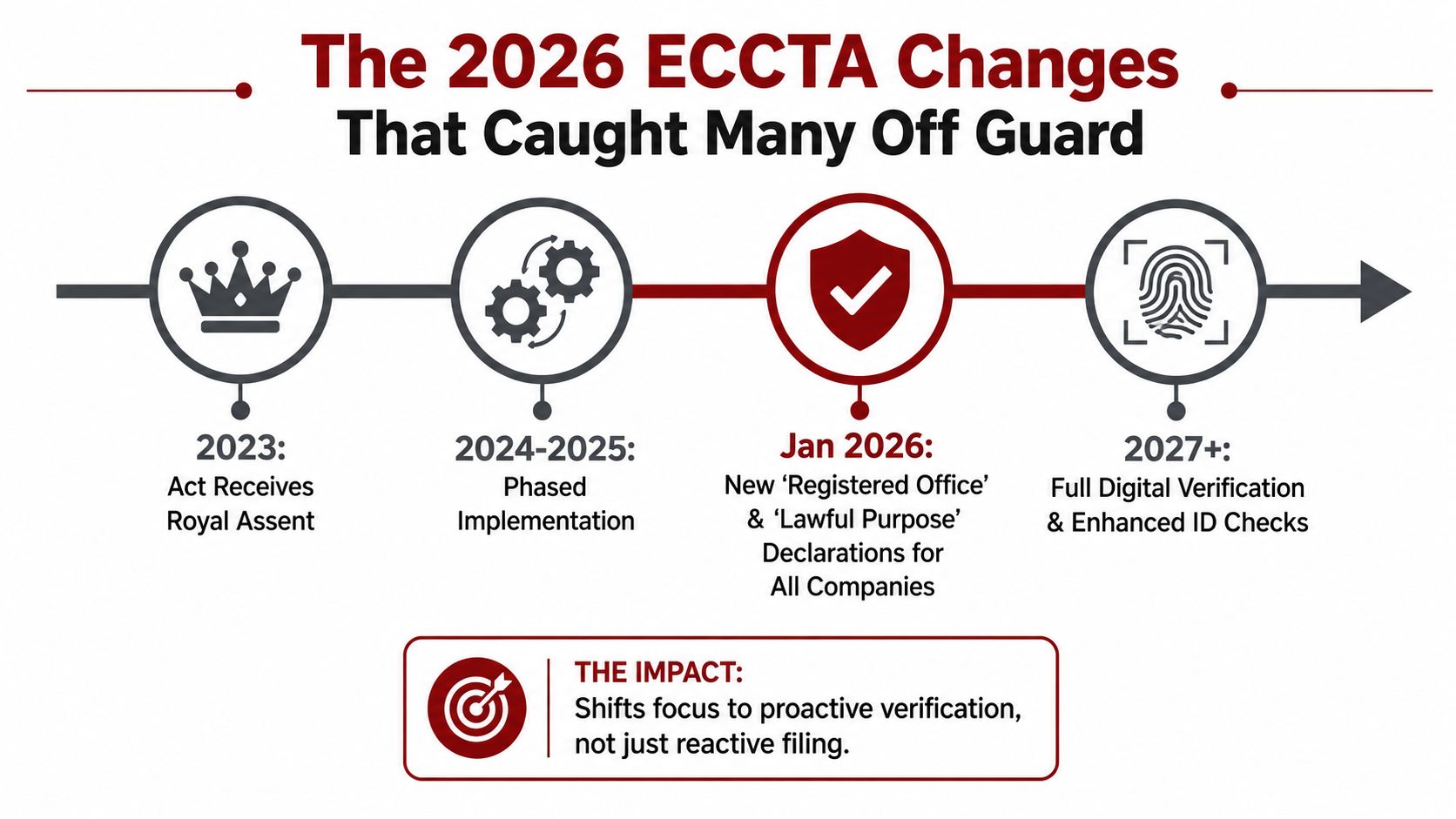
Companies House reported 983,000 non-compliance letters issued between November 2025 and May 2026 to directors and controlling shareholders who had not completed verification. The figures are published in its identity-verification management information. The message for founders is direct: verification cannot wait until an application is rejected. It belongs in the filing timetable, with responsibility assigned before submission.
What belongs where
Companies House remains the public register and filing channel. The company also needs an internal governance record showing how information was checked, approved and updated. A secretary's working file should connect each public filing with the underlying board decision, verification status and relevant register entry.
Register management has changed as well. Companies no longer need to keep certain internal registers from 18 November 2025. The option to keep the register of members centrally was removed from 26 January 2026, so some records must be brought back in-house. Companies should review their existing arrangements instead of assuming that an older central-register process remains valid. Current government guidance on the register-management changes should form part of that review.
The practical 2026 control questions are:
- Has every relevant individual completed the required verification?
- Does the company know whether an ACSP is involved and what it is responsible for?
- Are internal records maintained where the current rules require them?
- Does each Companies House filing match the latest approved company information?
A secretary who checks only annual deadlines will miss this operational layer. Maintain a live register and change log, then review both whenever ownership, officers or company particulars change. The control is simple: confirm the change, complete the verification, update the relevant record and retain evidence of approval and submission.
In-House Versus Outsourced Company Secretarial Services
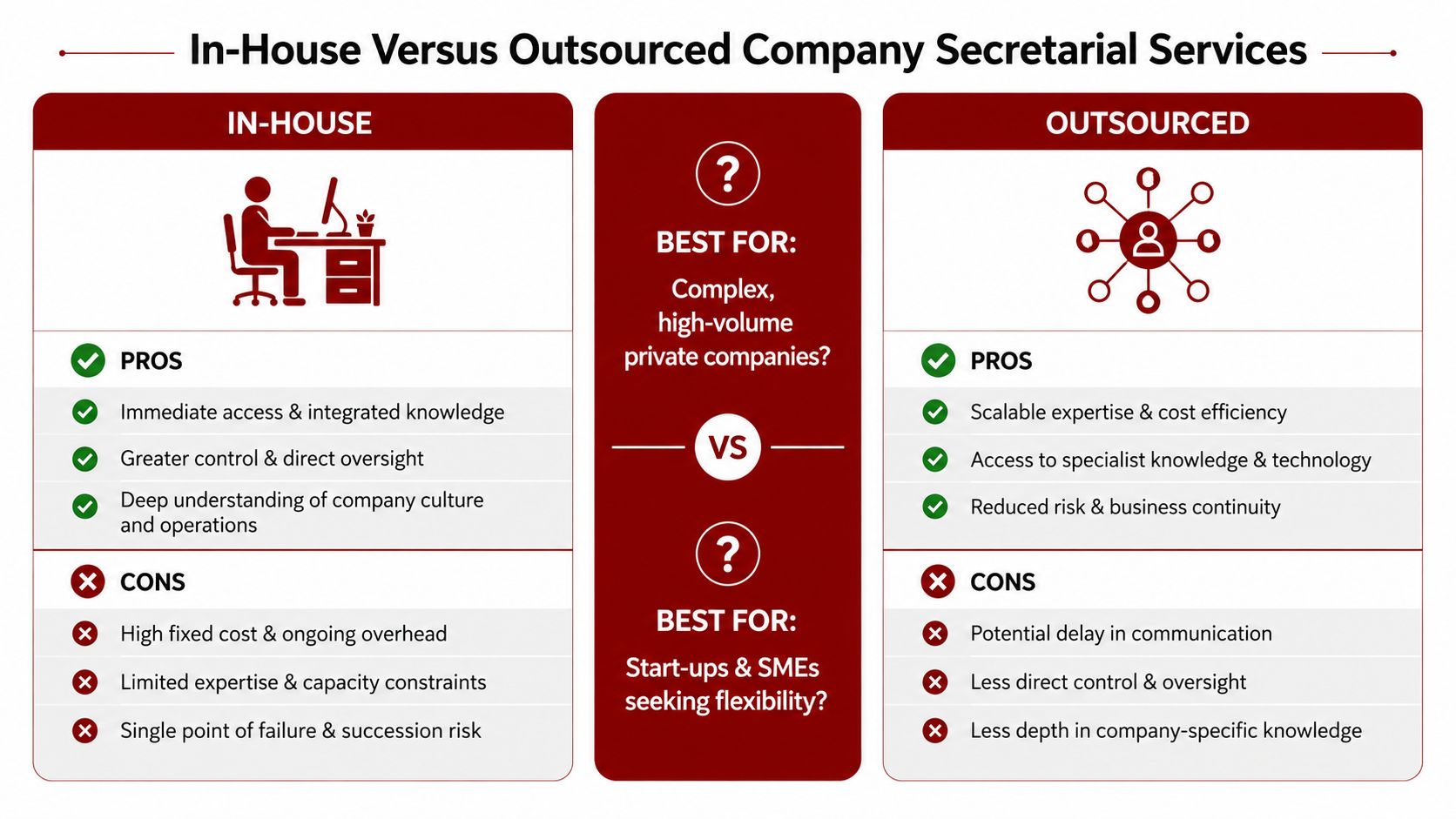
The right arrangement depends on transaction volume, ownership complexity and whether someone can cover the work when the usual contact is unavailable. In-house administration keeps decisions close to the business, but it can leave one employee responsible for the calendar, registers, verification status and digital filing workflow. If that person is absent, deadlines and records can quickly fall out of step.
When internal ownership works
An in-house model suits a company with an experienced operations, finance or legal team, straightforward ownership and regular access to directors. Context is the main advantage. The person preparing a board pack may already understand which decisions need approval, which register entries will change and what evidence belongs with the filing.
Continuity remains the pressure point. Roles change, customer work takes priority and a filing can be postponed because one person assumed someone else was handling it. A process that relies on an employee remembering to update PSC information after a share transaction is not a dependable control.
When external support earns its place
Outsourcing provides repeatable procedures and specialist capacity without adding a permanent governance role. It can suit startups with limited internal resources, SMEs managing ownership changes, or companies preparing for funding, refinancing or due diligence.
The trade-off is less immediate control over timing and context. Directors must still approve decisions and give accurate instructions. An external provider cannot reconstruct an undocumented transaction or identify an ownership change from an incomplete email. Agree service standards for reminders, approval cut-offs, evidence storage, escalation and responsibility for each digital filing.
The first tasks to outsource are usually those where mistakes create rework or leave public information stale:
- Compliance calendar ownership: Track recurring and event-driven deadlines with a named backup.
- Register reviews: Reconcile director, PSC, member and secretary details with approved changes.
- Board documentation: Prepare agendas, resolutions and minutes from consistent templates.
- Verification coordination: Monitor identity-verification status and ACSP responsibilities.
- Pre-filing review: Confirm that the form, approval evidence and underlying records agree.
Before appointing a provider, review the articles for governance problems and consult Lighthouse Consultants legal red flags. For support covering incorporation, registers, minutes, confirmation statements and PSC or RLE records, review the company secretarial services from Action Accountants Limited. The provider should fit the company's approval process, not replace director accountability.
Your Practical Compliance Checklist for 2026
A missed filing or stale register can expose a wider governance failure. Use this checklist at the next board or operations meeting:
- Confirm verification: Identify directors and controlling shareholders affected by identity verification, then record completion and any outstanding action.
- Review registers: Reconcile internal registers and Companies House particulars with approved appointments, resignations, allotments and ownership changes.
- Test the workflow: For a recent change, check the order of decision, register update, filing and evidence storage.
- Audit the calendar: Record confirmation statement and accounts deadlines, event-driven triggers, a named owner and a backup.
- Check the articles: Confirm whether a secretary is required and whether the articles impose extra procedures.
- Inspect evidence: Ensure minutes, resolutions, filing acknowledgements and verification records are retrievable.
- Escalate gaps: Seek advice where PSC data is stale, ownership is unclear, filings are rejected or approvals are missing.
For broader legal administration planning, consult the Coto & Waddington small business guide.
Action Accountants Limited provides support with incorporation, statutory registers, board and shareholder minutes, confirmation statements, and PSC or RLE records. Visit Action Accountants Limited to discuss a workflow that keeps filings, verification status and governance records aligned.