


In the UK, the first £1,000 of gross rental income is tax-free under the property allowance. Anything above that is taxed through normal Income Tax bands at 20%, 40% or 45% depending on how it stacks with your other income, with separate property rates rising to 22%, 42% and 47% from 6 April 2027.
That answer sounds straightforward until you add a salary, pension, mortgage interest, repairs and the way HMRC calculates rental profit. A landlord receiving rent each month can easily assume the tax is 20% of the money reaching the bank account. That assumption is often wrong.
Table of Contents
- The Real Question Behind How Much Tax on Rental Income
- What Counts as Taxable Rental Income
- Expenses That Actually Reduce Your Tax Bill
- Calculating Tax on Rental Income Step by Step
- Mortgage Interest and Section 24
- Holding Property Personally Versus Through a Company
- Making Tax Digital and Your 2026 Filing Deadlines
- Practical Tax-Planning Tips and Where a Specialist Adds Value
The Real Question Behind How Much Tax on Rental Income
You earn a salary that already uses most of your basic-rate band. Your rental property produces a healthy surplus, but after mortgage interest, agent fees, insurance and repairs, the figure left over is lower than the rent collected. A generic guide tells you to multiply the rent by 20%. It sounds reassuring, but it can leave you underprepared for the actual bill.
The first question is not “What rate applies to my rent?” It's “What is my taxable property profit, and where does that profit sit after my other income?” UK rental profit normally stacks on top of salary, pension or self-employment income. That means the same property can create a different tax bill for two landlords with identical rent.
This article takes the practical route. It separates gross rent from taxable profit, identifies expenses that can reduce that profit, then shows how Income Tax bands interact with other income. It also deals directly with Section 24, the mortgage-interest restriction that generic landlord guides regularly gloss over, and the planned April 2027 change to property-income rates.
If your rental activity includes short-term or holiday accommodation, the reporting treatment can require additional care. A useful complementary resource is this guide to reporting vacation rental income, particularly where booking income and property costs need to be organised separately.
By the end, you should be able to estimate the shape of your bill, spot the assumptions that make online calculators unreliable, and decide when a specialist review is justified. The headline rate is only the starting point.
What Counts as Taxable Rental Income
HMRC's calculation starts with the income connected to letting the property, not just the amount you think of as monthly rent. That can include rent received from tenants, premiums paid for granting a lease and income from furnished holiday accommodation where the relevant rules apply.
The property allowance provides an important first filter. In the UK, the first £1,000 of gross property rental income is tax-free, and the allowance was introduced from 6 April 2017, as confirmed by GOV.UK guidance on tax when renting out a property. If you jointly own the property, each owner can claim a £1,000 allowance against their own share of rental income.
You generally choose between the property allowance and claiming actual allowable expenses. You don't claim the allowance and then deduct the same expenses again. That choice matters because the allowance is based on gross income, while actual expenses reduce the profit after genuine property costs.
The allowance versus actual costs
The allowance can be convenient where the property has very low running costs. It avoids collecting every small receipt and may produce a better result where actual expenses are below the allowance.
Actual expenses are usually more appropriate for landlords with meaningful letting costs. Agent fees, insurance, repairs, service charges and other allowable items can quickly exceed a flat allowance. A landlord with substantial finance costs must also understand that mortgage interest is treated separately under the finance-cost rules, rather than being handled like an ordinary repair or management expense.
The key distinction is simple:
- Gross rent: The total property income before deductions.
- Allowable expenses: Genuine revenue costs incurred wholly and exclusively for the letting activity.
- Taxable property profit: Gross rent minus the relevant allowable expenses, subject to the specific treatment of finance costs.
Practical rule: Don't calculate tax from the rent paid into your account. Start with declared property profit, then place that profit alongside your other taxable income.
That mental model resolves much of the confusion around how much tax on rental income. The figure taxed through Income Tax is normally the profit after allowable deductions, not the gross amount shown on the tenancy agreement.
Expenses That Actually Reduce Your Tax Bill
Good expense records directly affect your taxable property profit. They show the genuine cost of operating the property instead of leaving you taxed on an overstated figure.
Common revenue expenses include buildings insurance, repairs, letting-agent fees, accountant fees, utilities paid by the landlord and council tax during vacant periods. Advertising for tenants, mileage for property visits, ground rent and service charges may also qualify where the cost relates directly to the rental activity and meets the relevant HMRC conditions.
Use this rental income allowable expenses checklist alongside your records. Do not claim every payment connected with a property. Claim costs that arise from letting it and can be supported if HMRC asks for evidence.
Repairs are not improvements
The repair-versus-improvement distinction causes expensive mistakes.
Fixing a broken boiler is normally a revenue repair that can reduce rental profit. Replacing a bathroom suite may be capital expenditure if the work improves or substantially alters the property instead of restoring it to its previous condition. Capital costs do not reduce this year's rental profit. They may instead matter under the capital rules when the property is sold, subject to the conditions that apply.
Keep invoices, dates, property details and payment evidence together. A bank statement proves that money left your account, but it may not show whether the payment covered a repair, an improvement, a private expense or another property.
Build the records before filing
Organise expenses by property, not in one general landlord folder. Use clear categories:
- Property running costs: Insurance, service charges, ground rent and landlord-paid utilities.
- Tenant and letting costs: Advertising, agent fees and qualifying management charges.
- Maintenance: Repairs that restore the property rather than improve it.
- Professional support: Accountancy and compliance costs connected with letting.
- Travel records: The date, destination, purpose and mileage for qualifying property journeys.
Mortgage interest and other finance costs require a separate calculation because Section 24 changes how relief works. Treating them as ordinary deductions can understate the eventual tax credit or distort your calculation. The restriction matters particularly where salary and rental profit already stack into higher-rate bands, so a rent figure alone will not show the final bill.
Keep a running record during the year rather than reconstructing costs before filing. Expense discipline is the first practical tax-planning move, before incorporation, refinancing or an elaborate structure is considered. Properly supported costs can produce a materially different result from the same rent figure where another landlord misses them.
Calculating Tax on Rental Income Step by Step
Use a sequence, not a headline percentage.
Assume a landlord receives £24,000 of rent and has £9,000 of allowable expenses, leaving £15,000 of rental profit. The landlord also earns a £45,000 salary. The figures in this illustration are applied to the UK bands described by GOV.UK's rental property tax guidance.
The calculation works as follows:
Identify rental profit.
£24,000 rent less £9,000 allowable expenses leaves £15,000 before considering finance costs under the separate rules.Place salary first.
The £45,000 salary occupies the taxpayer's available bands before the property profit is added.Use the remaining basic-rate capacity.
The basic-rate band in England, Wales and Northern Ireland runs up to £50,270, so £5,270 of capacity remains after the £45,000 salary.Apply the marginal rates.
£5,270 of the rental profit falls within the remaining basic-rate capacity and is taxed at 20%. The balance, £9,730, moves into higher-rate territory and is taxed at 40%.
The rental-profit tax before considering any separate finance-cost credit is therefore:
- £5,270 at 20% = £1,054
- £9,730 at 40% = £3,892
- Total = £4,946
That is an effective rate of about 33% on the £15,000 rental profit, even though the landlord has never entered an additional-rate calculation. The result comes from stacking, not from a special rental surcharge.
The bands hide the marginal result
The main rates in England, Wales and Northern Ireland are currently 20% for basic-rate income, 40% for higher-rate income and 45% for additional-rate income. The additional-rate threshold is £125,140, while the basic-rate limit used in this example is £50,270, as set out in the cited GOV.UK guidance.
A higher-earning landlord may have most or all of the rental profit falling into the 40% band. A landlord whose total taxable income already exceeds the additional-rate threshold may face the 45% marginal rate on relevant rental profit. Salary, pension and self-employment income can therefore matter more than the rent itself.
| Band | Rate to 5 April 2027 | Rate from 6 April 2027 |
|---|---|---|
| Basic property-income rate | 20% | 22% |
| Higher property-income rate | 40% | 42% |
| Additional property-income rate | 45% | 47% |
The planned change from 6 April 2027 is documented in HMRC's policy publication on property, savings and dividend income rates. It replaces the current 20%, 40% and 45% structure for property income with 22%, 42% and 47%.
That makes 2026 a planning year, not a year to wait passively. A landlord should model the profit after expenses, the position of other income and the treatment of mortgage interest before assuming the current headline rate tells the whole story.
Mortgage Interest and Section 24
Mortgage interest is where many online explanations become misleading.
Under Section 24, individual landlords generally don't deduct residential finance costs in full from rental income when calculating property profit. Instead, the finance cost is dealt with through a basic-rate tax reduction. The restriction has applied since April 2020, and Action Accountants' Section 24 guide provides a useful practical explanation of the mechanism.
Consider a landlord with a £200,000 interest-only mortgage at 5% and annual interest of £10,000. The landlord doesn't deduct the entire £10,000 from rental income and then apply the marginal tax rate to the reduced profit.
The finance-cost credit is calculated at 20% of £10,000, producing a £2,000 tax credit. The remaining mortgage interest doesn't generate further Income Tax relief through the personal landlord calculation.
Why high borrowing changes the result
A highly geared property can look profitable in cash terms while producing a much less comfortable after-tax return. The rent may cover the mortgage payment and operating expenses, yet Section 24 can leave the landlord paying tax on a profit figure that doesn't reflect the full cash interest payment as a deduction.
That problem becomes more severe when the landlord's salary or pension has already pushed rental profit into higher-rate territory. The credit remains calculated at the basic-rate level, while the marginal tax on the stacked property profit can be higher.
Don't confuse a tax credit with a deduction. A deduction reduces the profit being taxed. A basic-rate credit reduces the tax calculated after the profit has been included.
From 6 April 2027, the property basic rate and the finance-cost credit are set to align at 22%, according to Charcol's explanation of the rental-income tax changes. On £10,000 of finance costs, a 22% credit would be £2,200 rather than £2,000, assuming the landlord qualifies for the relevant treatment.
That uplift may improve cash flow for basic-rate property-income taxpayers, but it doesn't restore full mortgage-interest deduction. Landlords shouldn't assume that a change in borrowing costs will automatically return the tax efficiency they had before Section 24. Every refinancing decision now has two sides, the lender's affordability calculation and HMRC's treatment of the finance cost.
Holding Property Personally Versus Through a Company
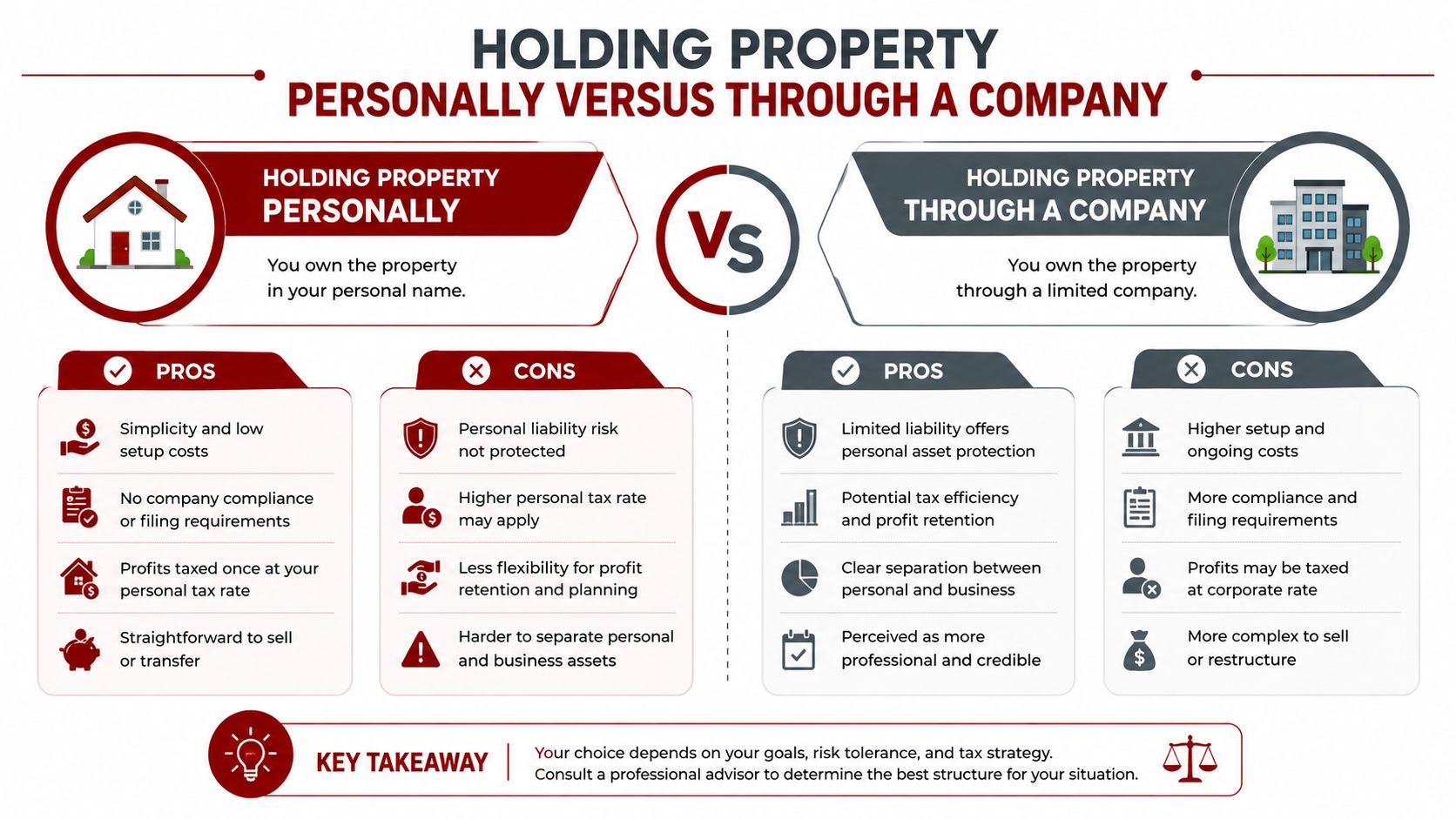
Personal ownership is usually the simpler route, but it can produce a higher personal tax bill once rental profit is stacked on top of salary, pension and other taxable income. Company ownership can improve flexibility, yet incorporation is not an automatic tax solution. The right choice depends on borrowing, profit retention and how you plan to extract money.
Personal ownership
With personal ownership, you report the property income through your own tax return. You may use the property allowance where appropriate, and the individual landlord rules provide the Section 24 finance-cost credit.
The trade-off is exposure to personal marginal rates. Rental profit joins your other taxable income, so the headline rate can hide the actual bill. Property income tax rates are projected to rise to 22%, 42% and 47% from 6 April 2027, which may change the comparison for landlords who retain property personally.
Company ownership
A company calculates its rental profit separately and pays Corporation Tax under the company rules. Mortgage arrangements, lender criteria, transfer costs and legal consequences differ from personal ownership, so model the position before transferring a property.
Keeping profits inside the company changes the timing of taxation rather than making tax disappear. Taking money out later as salary or dividends can create another personal tax charge, depending on the extraction method and your wider income.
| Decision factor | Personal ownership | Company ownership |
|---|---|---|
| Administration | Usually more direct | Separate accounts, records and filings |
| Rental-profit tax | Personal marginal-rate framework | Corporation Tax framework |
| Finance costs | Section 24 credit for individuals | Different company treatment, subject to company rules |
| Access to profits | Direct personal income | Extraction may create further personal tax |
| Future restructuring | Transfer can have tax and legal consequences | Incorporation and later disposal require modelling |
The projected 2027 property-rate change does not itself alter company tax rates. It may make a company comparison more attractive, but only where the numbers support it. Test expected rental profit, mortgage costs, the amount you will retain, salary and dividend extraction, ownership objectives and the likely sale plan.
Get tax advice and property-solicitor input before changing ownership. For borrowing, mortgage advice from EHF Mortgages can help assess limited-company buy-to-let lending alongside the tax model. Action Accountants' guide to limited company versus sole trader covers wider structural differences, but property incorporation requires property-specific advice.
Making Tax Digital and Your 2026 Filing Deadlines
Making Tax Digital changes the landlord's routine before it changes the tax calculation.
From 6 April 2026, most landlords with gross annual rental income over £50,000 must keep digital records and submit quarterly updates to HMRC under Making Tax Digital for Income Tax, as noted by ICAEW's overview of the MTD timetable. This isn't compatible with keeping receipts in a drawer until January.
You'll need a digital bookkeeping process, software that can submit the required information and a habit of recording income and expenses throughout the year. The quarterly updates aren't a replacement for understanding whether a cost is a repair, improvement or finance cost. They make poor classification easier to expose.
The practical deadline problem
The 5 October deadline for registering for Self Assessment for the 2025 to 2026 tax year remains relevant where registration is required. The 31 January payment deadline also doesn't disappear because quarterly MTD reporting begins.
Keep these responsibilities separate:
- Annual Self Assessment: Register and file where required, then settle the tax under the existing payment timetable.
- Digital records: Maintain property income and expense records in a compatible system.
- Quarterly updates: Submit the information required by the MTD timetable once the rules apply to you.
- Supporting evidence: Retain invoices, bank records, mileage details and finance statements.
Landlords with gross annual rental income above £20,000 are scheduled to enter the regime from April 2027, according to the same ICAEW timetable. That gives affected landlords a reason to build the process early, rather than waiting for the next threshold change.
The final comfortable window to replace the shoebox method is now. Clean records reduce filing errors, make Section 24 calculations easier and give your adviser usable information before a return is due. For support with the annual timetable, see this guide to the tax return filing deadline.
Practical Tax-Planning Tips and Where a Specialist Adds Value
Start with the basics, then model the bigger decisions.
If actual annual expenses are higher than the property allowance, claiming the genuine costs may produce the better result. Keep mortgage-interest records even though Section 24 restricts the relief. The interest statement still matters to the calculation, and losing the document can make a correct claim harder to prepare.
Repairs can sometimes be scheduled across tax years where the work is discretionary and doing so reflects the property's maintenance needs. Don't delay urgent repairs merely for timing. The tax saving should never dictate unsafe or commercially foolish property management.
A few checks deserve particular attention:
- Review your income stack: Salary, pension and self-employment income can push property profit into a higher marginal band.
- Separate repairs from improvements: Describe the work accurately on invoices and retain contracts, before-and-after details and payment records.
- Check short-term letting conditions: Don't assume furnished holiday accommodation receives special treatment without checking the applicable requirements, including the relevant 14-day rule.
- Consider pension contributions: A higher-rate landlord may wish to model whether pension contributions change the position created by stacked income.
- Stress-test borrowing: Section 24 means the tax result doesn't move in lockstep with the cash interest payment.
DIY software can handle straightforward income and expense entry. It becomes less reliable when you own several properties, use mixed finance structures, receive salary and dividends, or are considering a company restructure. At that point, the issue isn't typing figures into a return. It's choosing the right treatment before the figures are entered.
Action Accountants Limited provides property and landlord accounts, rental accounts and tax-return support, alongside bookkeeping, tax and compliance services. The Colindale practice, led by Georgie Zdrenghea, can also help landlords across North West London and elsewhere in the UK assess property income alongside broader personal or business tax considerations.

Book a tax-planning review before the 2027 rate change takes effect. Ask for a property-profit calculation, a Section 24 review, an ownership comparison and a 2026 record-keeping plan, rather than relying on a headline rate.
Action Accountants Limited can prepare rental accounts and property tax returns, organise bookkeeping and model the impact of stacked income, finance costs and ownership changes. Visit Action Accountants Limited to book a focused review of your rental-income tax position and plan before the next filing deadline.