
Tax Return Filing Deadline: Dates, Penalties & What to Do
Action Accountants •31 July 2026
You've got the email, the shoebox, the spreadsheet, and the uneasy feeling you've left it too late. Maybe you paid some tax already, maybe your accountant said “we'll sort it”, or maybe you've just realised HMRC still expects a return and the clock is already running. That's the problem with the tax return filing deadline, it looks like one date until you miss the wrong one.
Table of Contents
- Why the Tax Return Filing Deadline Catches So Many People Out
- The Four UK Tax Deadlines You Need to Know
- Paper vs Online Filing and Why the Channel Matters
- Penalties and Interest When You Miss the Deadline
- The Final-Week Surge and the Hidden Risk in the Online Deadline
- Specific Advice for Founders, Contractors, Landlords and SMEs
- What to Do If You Have Missed or Are About to Miss the Deadline
Why the Tax Return Filing Deadline Catches So Many People Out
A first-year founder often makes the same mistake. They assume that because they've paid something to HMRC, or because their company is “too small”, there's nothing to file. Then the penalty letter lands, and the issue is not the payment, it's the fact that HMRC expected a return and didn't get one.
That is the actual trap. The tax return filing deadline is not just a date, it's a set of linked obligations with different triggers and consequences. For sole traders, landlords, contractors, newly incorporated founders and SME owners, the practical question is never “what's the deadline?”, it's “which deadline applies to me, and what happens if I miss the wrong one?” If you're still trying to keep the paperwork straight, start with your books and records through bookkeeping for sole traders, because late filing is usually the end result of messy records, not bad intention.
Practical rule: if you cannot tell whether you need to file, register, or pay, stop treating this as a calendar problem. Treat it as a compliance problem.
HMRC's own deadline rules make the split clear. Paper and online filing are not the same thing, and payment is separate again. That's why people who read a single blog post or remember one date from last year get caught out. The article is written for the people who feel that pressure first, founders, contractors, landlords and SME owners in North West London and beyond, especially the ones who only realise they have a filing duty after the tax year has already closed.
The important distinction is simple. Filing means sending the return. Paying means settling the tax owed. They often fall on different dates, and if you only remember one of them, you're already behind.
The Four UK Tax Deadlines You Need to Know
The cleanest way to stop deadline confusion is to separate the obligations. HMRC's system has four moving parts, and they do not all sit on the same date. Keep them in one mental bucket and you will make mistakes.
| Obligation | Deadline | Applies To | Typical Trigger |
|---|---|---|---|
| Self Assessment registration | 5 October after the tax year ends | People who need to send a return for the first time | New self-employment, rental income, side work, or other untaxed income |
| Self Assessment filing | 31 October for paper, 31 January for online | Individuals who must file Self Assessment | HMRC expects a return for that tax year |
| Self Assessment payment | 31 January | People who owe tax under Self Assessment | Tax due after the return is calculated |
| Corporation Tax return cycle | Accounting period end, then 9 months for paper and 12 months for online | Limited companies | Company has a Corporation Tax filing obligation |
HMRC says you need to register for Self Assessment by 5 October after the tax year ends if you need to send a return. That is the first deadline people miss, because they assume the obligation only starts when the return itself is due. For a new sole trader or landlord, that is the mistake that turns a straightforward compliance job into a penalty conversation.
For limited company directors, do not mix up Self Assessment with Corporation Tax. A company's return runs on its own clock, and that is why a director can be compliant personally and still miss the company deadline. If your business is incorporated, keep the company side separate and track it through your Corporation Tax return process rather than assuming the personal return date covers everything.
A PAYE salary does not automatically mean you have a personal filing deadline, but untaxed income can still create one. That is where many people trip.
PAYE, VAT and CIS sit outside the Self Assessment filing clock. They may create reporting duties, cash flow pressure or deductions, but they are not the same deadline system. Put one calendar in place, mark the registration date, both filing dates, the payment date, and the company return date if you run a limited company. That stops you relying on memory, which is how deadline mistakes start.
Paper vs Online Filing and Why the Channel Matters
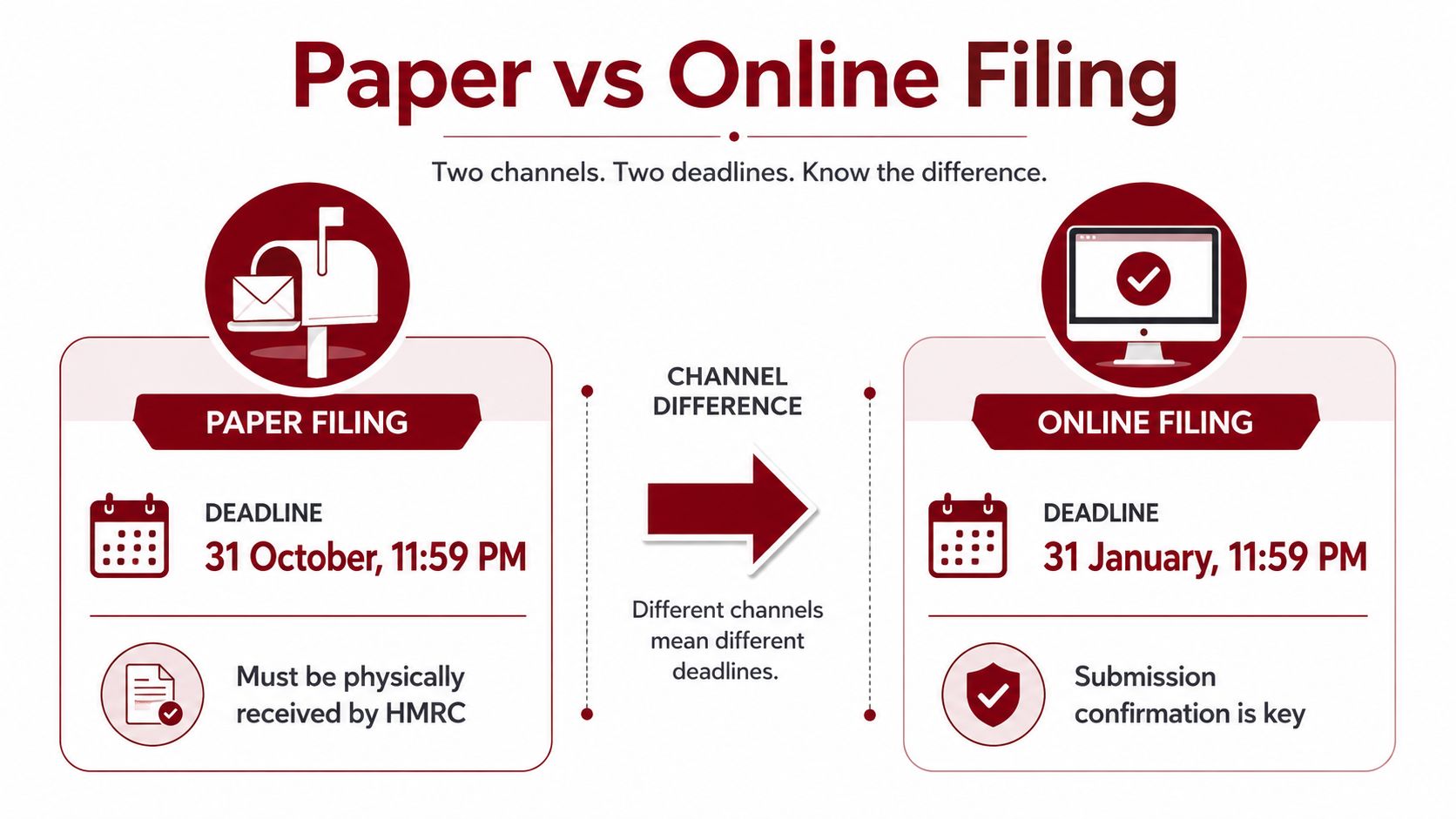
HMRC's channel split is blunt. A paper return must be received by 11:59pm on 31 October 2026, while an online return gets an extra three months and must be submitted by 11:59pm on 31 January 2027. That is a real deadline advantage, but it only helps if you use the time properly. The clock runs from the filing timestamp, not from how long you have spent preparing the figures. HMRC's filing-season release also shows where the pressure sits, with 11,173,825 returns filed online, equal to 97.25% of returns after adjustments, which tells you exactly why the digital route is where last-day failures happen. The underlying rules are on HMRC's Self Assessment deadlines page.
The practical difference is simple. Paper filing gives you no forgiveness once the envelope misses the cut-off. HMRC either has it or it does not. Online filing gives you more time, but only if your software works, your identity checks pass, and your figures validate before the deadline closes. Leave that to the final evening and you are gambling with a system that will not wait for you.
There is also a less-known partnership rule. HMRC applies a different deadline for some partnerships with an accounting date between 1 February and 5 April where one partner is a limited company. In that case, the online deadline can extend to 12 months from the accounting date, and paper to 9 months from the accounting date. If you are in that structure, do not rely on generic Self Assessment advice. The wrong deadline costs time and money, and it usually gets discovered only after the return is already late.
A sole trader trying to file on 31 January can lose hours to avoidable problems. Portal authentication can stall. Software can reject a missing field. A last-minute correction can send you back to the bank feed or the bookkeeping records. The deadline looks fixed, but your usable working time is much shorter.
For directors and owner-managed businesses, the channel also affects how you plan the job. If you are using a limited company, split the personal Self Assessment filing from the company's reporting timetable and keep the two systems separate. If you also want to keep on top of cash flow around the same period, use a guide on payments on account rather than assuming the filing date covers every obligation.
Penalties and Interest When You Miss the Deadline
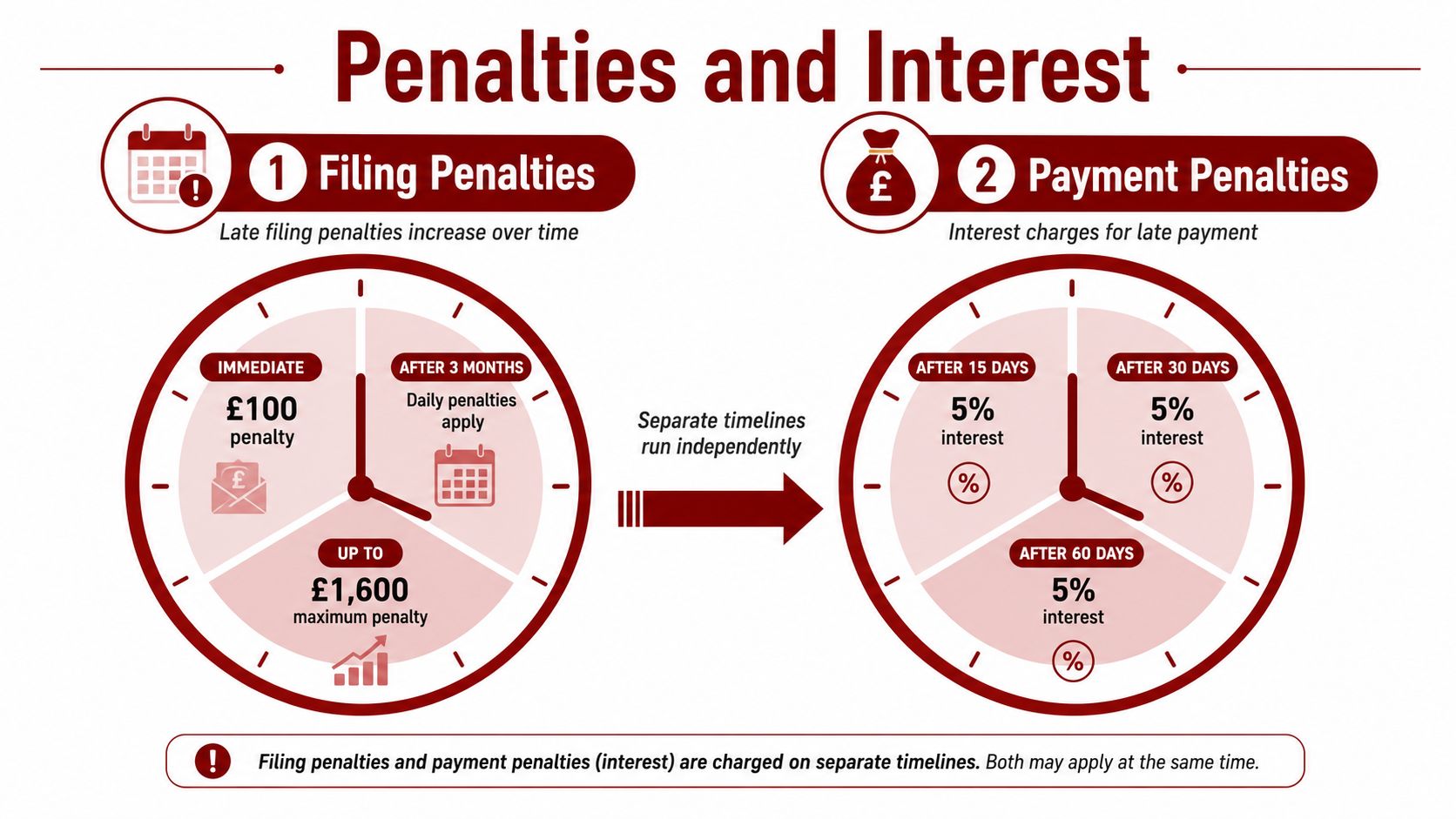
The first thing to understand is that filing and payment run on separate clocks. Miss the filing date, and you face filing penalties. Miss the payment date, and you face late-payment charges and interest. Those are different problems, and HMRC treats them differently for good reason.
If you miss the Self Assessment filing deadline, the usual starting point is an automatic £100 penalty. Leave it longer, and HMRC escalates the position through further late-filing charges. That is why “I'll file later” is not a harmless delay. It is a decision to let the penalty system begin. Once the return remains outstanding for months, the position gets worse, not better.
Payment is a different story. HMRC says the tax owed is due by 31 January, and its late-payment regime starts with a 5% charge on unpaid tax at 30 days, 6 months, and 12 months after the due date. Interest also runs on the unpaid balance. So a taxpayer who files late but pays later is not in the same position as a taxpayer who pays on time but files late. One problem is administrative. The other is cash and debt.
Take a straightforward example. A sole trader owes £4,000, files the return on 1 March, and does not pay until 1 July. The filing side is already a penalty issue because the return missed the deadline. The payment side is also a separate issue because the tax sat unpaid after the due date. In practice, that means two tracks of trouble, not one.
Filing late is the easier mistake to fix. Paying late is the one that quietly compounds.
If you need breathing room, look at payments on account and your wider payment plan before you ignore the deadline. HMRC can also move taxpayers onto Time to Pay arrangements in suitable cases, but do not confuse that with forgiveness. It is still a debt problem, just one you are managing rather than denying.
Continued non-payment can lead to collections action and more pressure from HMRC. Some reliefs and procedural protections can also become harder to access once the matter has drifted. The right response is quick action, not hope.
The Final-Week Surge and the Hidden Risk in the Online Deadline
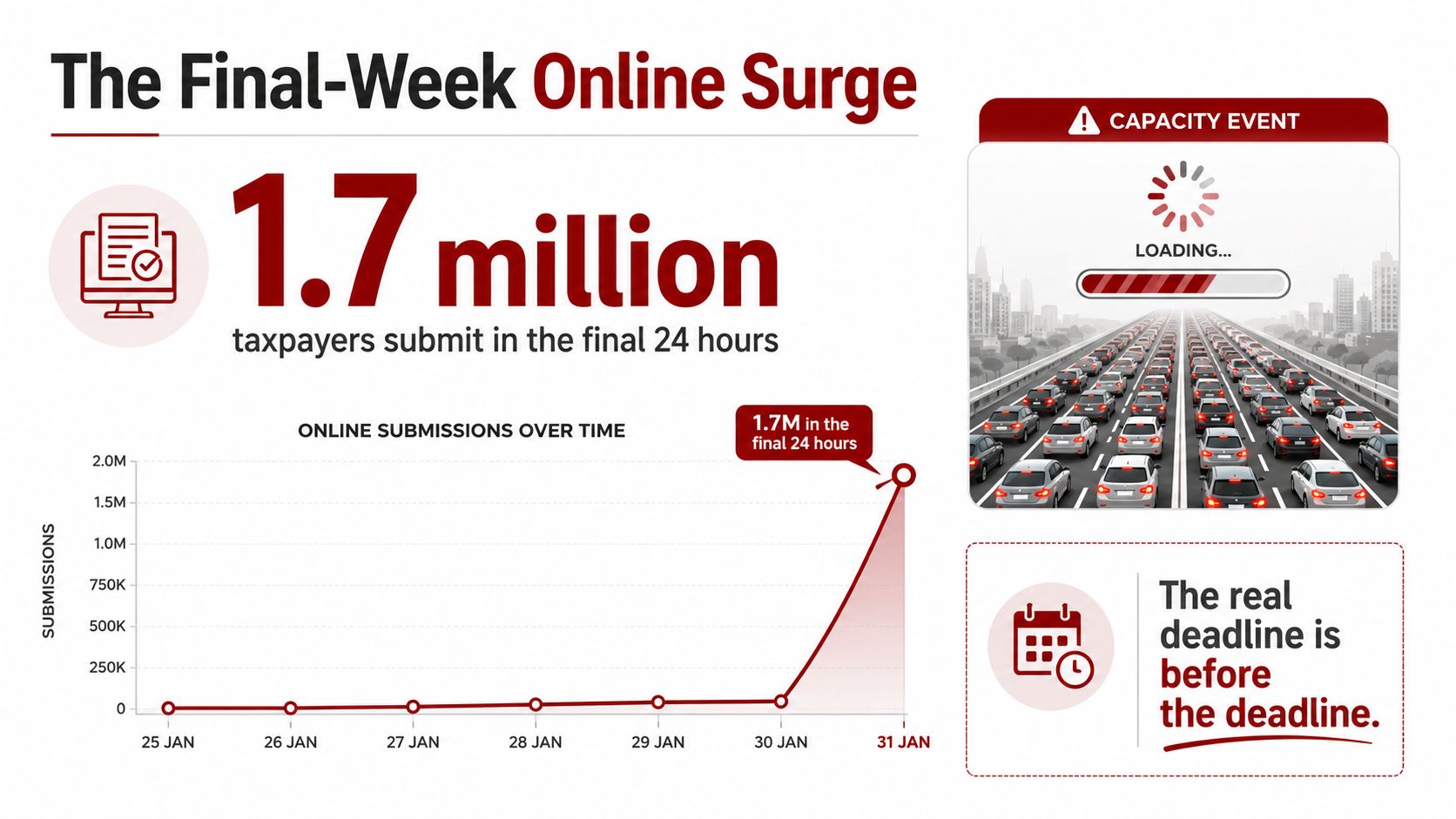
By late January, the tax return filing deadline stops being a normal deadline and starts acting like a capacity event. HMRC reported 1.7 million tax returns were filed on 31 January 2025 alone, which is exactly why the final day is a technical bottleneck as much as a tax date. If you leave it to the end, you are competing with a huge number of other taxpayers trying to do the same thing at the same time.
The practical failures are boring and predictable. Gateway accounts get locked, identity checks take longer than expected, UTR records do not match what the software expects, and agent authorisation delays stop someone else from filing for you. None of that is about tax theory. It is about access, timing and system load.
If you want a useful external reference on delays after filing, the CPA firm refund delay guide is a sensible read because it focuses on why a return can be “submitted” but still not move cleanly through the next stage. That distinction matters when people assume pressing submit finishes the job.
Practical rule: your real deadline is not 31 January. It's the point at which you can still fix a problem without needing HMRC support.
The mistake is thinking you can use the whole of January as working time. You can't, not if you want a clean filing. The serious filer starts in December, checks the numbers in early January, and leaves enough room for one round of corrections before the portal gets crowded. I'd treat the practical deadline as the Friday eleven days before the statutory one. That gives you time to breathe when the system does what systems do.
Specific Advice for Founders, Contractors, Landlords and SMEs
A founder can get tripped up by the wrong deadline very quickly. Your personal Self Assessment filing date, your company's Corporation Tax cycle, and your first accounts are separate duties. If you have just incorporated, set the company filing calendar early and use tax section 24 only where your property or profit structure brings that issue into play, because plenty of founders do not need that route at all.
Contractors and CIS-affected workers need a different filter. If you have construction income with CIS deductions, that income still has to go through Self Assessment properly, even when tax has already been withheld at source. The trigger is untaxed income and the need to reconcile what HMRC already knows, not the comfort of seeing deductions on a statement.
Landlords are the group most likely to miss the point at which filing becomes necessary. Rental income, jointly held property, and the need to correct an earlier overpayment can all pull someone into Self Assessment for the first time. If you want a specialised property angle, the World Property Investor tax guide is useful context for cross-border landlord issues, but the main point is simpler. If your rental position is not straightforward, do not guess at it late in the season.
SMEs should treat deadline control as part of year-end planning, not an afterthought. An accounting period ending 31 March creates a very different filing pressure profile from one ending 31 December, because the work on accounts and tax lands at a different point in the year. That choice changes when the books need to be closed, when the company return is prepared, and how much overlap you create with personal filing obligations.
My rule is direct. Founders should bring in an accountant before incorporation if they expect mixed income or more than one filing obligation. Contractors should do it as soon as CIS receipts become regular. Landlords should get help the moment rental income stops being incidental. SMEs should bring in an accountant before year-end, not after, because once the deadline is close, the work becomes more expensive in time and risk. Action Accountants Limited can handle the filing, bookkeeping, payroll and compliance side if you want one team to keep the calendar honest, and that is usually the sensible move when deadlines start to overlap.
What to Do If You Have Missed or Are About to Miss the Deadline

If you are already late, stop guessing and triage it properly.
- Identify the missed deadline. Registration, filing and payment are not the same failure, and the fix is different for each.
- File the return immediately if you can. Even if you cannot pay today, getting the return in usually matters more than waiting until everything feels complete.
- Check whether a Time to Pay arrangement is realistic. If the tax bill is the issue, this is the route that buys breathing room without pretending the debt does not exist.
- Assess whether a reasonable excuse exists. Don't invent one. Use only a genuine statutory reason if it applies.
- Bring in an accountant before the HMRC letter lands. That is when your options are widest and the position is still manageable.
I'd rather see a client file an imperfect return today than spend another week “getting organised”. The longer you wait, the more likely the late-filing penalty becomes the more expensive part of the problem. If you're a landlord, contractor or founder and you're unsure whether your facts create a filing duty, professional help is cheaper than a penalty letter.
If you need a clear filing plan, clean bookkeeping, or support getting a late return back under control, speak to Action Accountants Limited. They handle tax returns, bookkeeping, VAT, payroll and company compliance for owners who want the deadline dealt with properly, not guessed at.