

Tired of spreadsheets and shoeboxes of receipts? For many UK small business owners and contractors, “doing the books” means chasing invoices, untangling bank statements, and hoping nothing slips past a deadline. Cloud accounting changes that by putting your financial records in one live system that you and your accountant can both see, from wherever you're working. For UK SMEs, contractors, landlords, and founders, the value isn't buzzwords, it's faster decisions, tighter control, and less time lost to admin.
Action Accountants sees the same pattern again and again. The businesses that get the most from cloud systems use them to stay on top of cash flow, compliance, and day-to-day bookkeeping, not just to replace desktop software. That matters in the UK, where cloud accounting is increasingly judged by accessibility, productivity, and time savings, not just by software cost alone, as shown in Wolters Kluwer's UK-focused survey on cloud accounting trends (UK cloud accounting trends).
If you're wondering whether cloud accounting is worth the switch, this guide gets straight to the practical benefits, the trade-offs, and where it makes the biggest difference for UK businesses, including CIS contractors.
Table of Contents
- 1. Real-Time Financial Visibility and Decision-Making
- 1. Real-Time Financial Visibility and Decision-Making
- 2. Seamless Collaboration Between Accountants and Clients
- 4. Cost Savings Through Reduced Manual Data Entry and Admin Time
- 5. Enhanced Security and Data Protection Compliance
- 6. Scalability to Support Business Growth Without System Overhaul
- 6. Scalability to Support Business Growth Without System Overhaul
- 7. Anywhere, Anytime Access for Mobile and Remote Work
- 8. Integrated Reporting and Financial Analysis for Better Insights
- 9. Seamless Integration with Third-Party Business Tools
- 10. Tax Planning and Compliance Optimisation Through Automation
- 10-Point Cloud Accounting Benefits Comparison
- Ready to Make the Switch? Your Next Steps
1. Real-Time Financial Visibility and Decision-Making
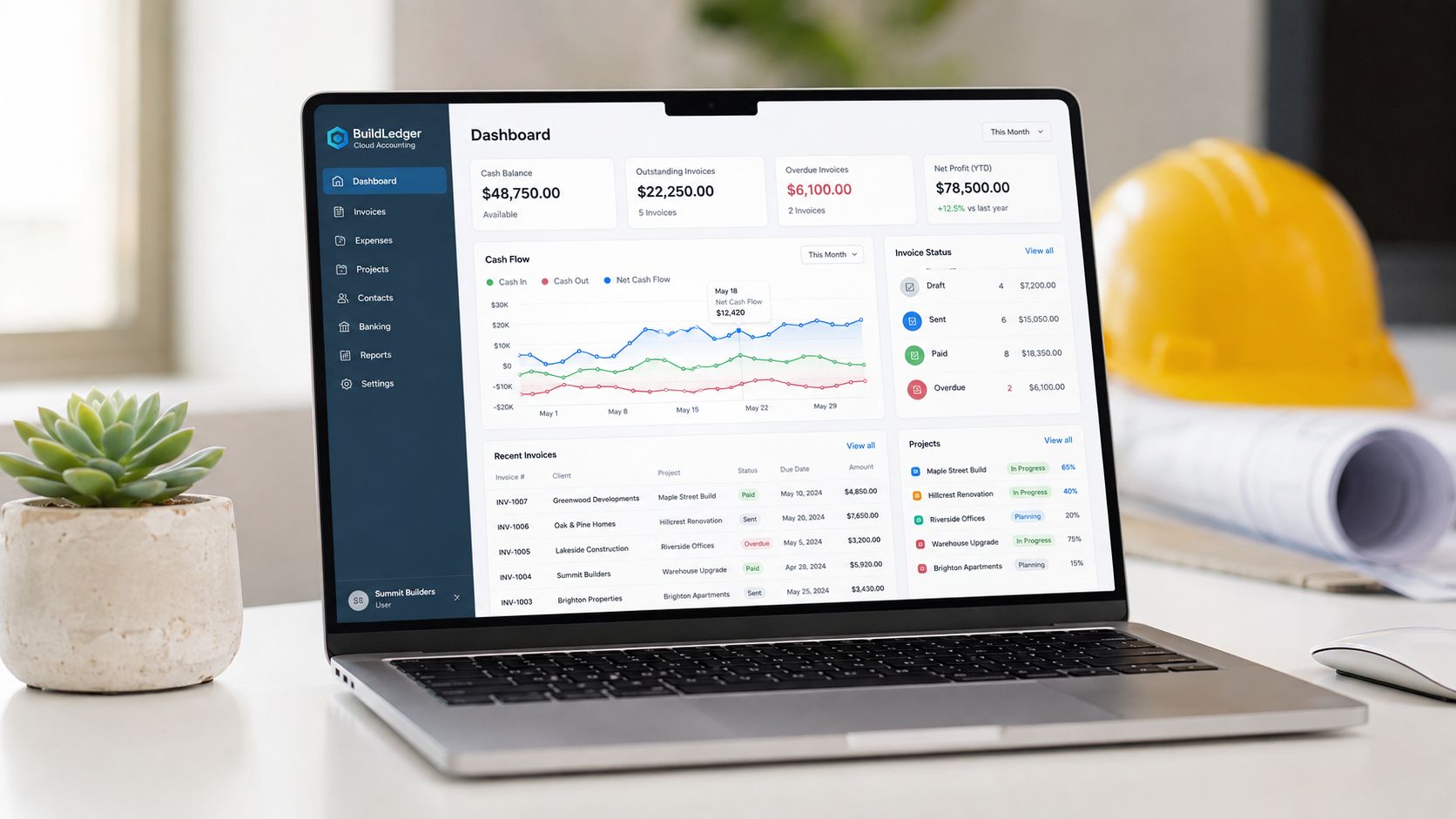
A cloud accounting system gives you a live view of the numbers that matter. Cash coming in, bills due, unpaid invoices, project spend, and tax liabilities all sit in one place, so you are not waiting until month-end to see whether the business is on track. That kind of visibility helps founders make spending decisions sooner, and it lets contractors spot a job going off course before the margin disappears.
For UK SMEs, that matters because small timing issues often turn into cash flow pressure. A client payment that lands late, a supplier bill that arrives early, or a CIS deduction that has not been recorded properly can distort the picture if the books are always a step behind. With cloud accounting, those figures update as transactions are entered and bank feeds clear, so you and your accountant can work from the same current view.
A North West London construction contractor can check CIS-related invoices and payments during the week instead of searching through email threads at month-end. That makes it easier to see whether labour, materials, and deductions are landing where they should. For a startup founder, the same live view can show a rising burn rate before cash gets tight. For a landlord, rental income and maintenance costs are visible across properties without stitching together separate spreadsheets.
At Action Accountants, we use that visibility to support better decisions, not just cleaner bookkeeping. We review the figures with clients, flag cash flow pressure early, and help shape practical actions before a small issue becomes a costly one. For UK contractors and SMEs, that can mean adjusting payment terms, tightening invoice follow-up, or checking whether CIS records and forecasts still line up with the work on hand.
What to do in practice
Set up bank feeds so transactions land automatically instead of being typed in later. Create alerts for low cash balances and overdue invoices so nothing sits unnoticed. Then review the key numbers weekly with Action Accountants, not just at filing time, so you can adjust forecasts before small issues become expensive ones.
1. Real-Time Financial Visibility and Decision-Making
Cloud accounting gives you the one thing spreadsheets never really do well, a live view of the business. Cash in, bills due, unpaid invoices, and project spend all sit in the same place, so you are not waiting for month-end to find out whether the numbers still stack up. In practice, that means founders can change spending decisions sooner, and contractors can see whether a job is drifting before it becomes a problem.
For a North West London construction contractor, that could mean checking CIS-related invoices and payments daily instead of hunting through email chains at the end of the month. For a startup founder, it could mean spotting a rising burn rate before cash runs tight. For a landlord, it means rental income and maintenance costs are visible across properties without piecing together separate files.
What to do in practice
Set up bank feeds so transactions land automatically instead of being typed in later. Create alerts for low cash balances and overdue invoices so nothing sits unnoticed. Then review the key numbers weekly with Action Accountants, not just at filing time, so you can adjust forecasts before small issues become expensive ones.
Practical rule: if you can only look at one dashboard each week, make it cash flow, not profit. Profit is useful, but cash pays the bills.
Wolters Kluwer's UK survey found that 48% of accountants named accessibility as the main cloud benefit, and 44% selected productivity and time savings (UK cloud accounting trends). That lines up with what good advisers see every day, cloud accounting is strongest when it helps people act sooner, not when it just stores data more neatly.
For UK SMEs and CIS contractors, that same live view also supports cleaner compliance work. It is easier to keep VAT records current, check whether subcontractor paperwork matches the ledger, and spot gaps before they turn into avoidable queries. If you want a practical example of how that ties into filing discipline, see our guide to Making Tax Digital VAT compliance.
2. Seamless Collaboration Between Accountants and Clients
Cloud accounting removes the mess of emailed spreadsheets, duplicate versions, and the constant question of which file is current. You and your accountant work in the same live ledger, so receipts, invoices, and notes sit against the same records. That cuts down on back-and-forth and makes it easier to correct errors while the source documents are still fresh.
A sole trader in Finchley can photograph a receipt on the Xero mobile app and send it straight into the system. A construction subcontractor can upload CIS invoices each week, while Action Accountants checks the coding and compliance position at the same time. An SME owner can review the profit and loss report while the accountant reconciles the bank, so monthly review meetings are more useful and less about chasing paperwork.
The real benefit is timing. When client and accountant are working from the same records, questions get answered before they turn into delays, and missing information stands out quickly.
Why collaboration gets better
- Less version drift: everyone works from the same figures, so nobody wastes time reconciling old exports.
- Clearer audit trail: you can see who entered what and when, which helps when a query comes up later.
- Faster responses: accountants do not have to wait for a bundle of attachments before they can act.
A good cloud setup still needs discipline. Clients need onboarding, clear rules about what gets uploaded, and a simple routine for receipts and invoices. If you get that right, Action Accountants can spend more time interpreting the numbers and less time chasing missing files.
Client discipline matters more than software choice in the first month. A clean process beats a fancy platform that nobody uses properly.
4. Cost Savings Through Reduced Manual Data Entry and Admin Time
Cloud accounting cuts admin time because it removes repeat tasks that used to sit on a bookkeeper's desk for hours. Bank reconciliation, invoice coding, expense categorisation, and payment chasing all become more efficient when the system handles the first pass automatically. For UK SMEs and contractors, that usually means a quicker month-end close, fewer mistakes, and lower admin costs.
The savings are practical, not abstract. Less time spent typing figures by hand means fewer interrupted workdays, fewer corrections, and less reliance on paper files or forwarded email threads.
For CIS businesses, that matters even more. A contractor dealing with subcontractor invoices, materials, and CIS deductions can waste a lot of time if records arrive in different formats and need to be checked line by line. With the right setup, Action Accountants can tidy the bookkeeping flow, keep CIS records organised, and make sure the figures are ready for review without a long manual chase.
UK small-business findings from Open Banking's cloud accounting and payment research showed that businesses reported benefits in late payment management, internal savings, external cost savings, and reduced need for outside accountancy support. Those figures matter because they show cloud accounting is not just a convenience. It can change how quickly a business gets paid, how much admin it carries in-house, and how much support it needs to buy in.
Where the savings usually come from
The biggest wins usually start with bank feeds, then invoice reminders, then recurring supplier bills. Once the system learns your coding rules, the workflow gets easier and the team spends less time on repetitive checking. That frees Action Accountants to focus on advisory work, VAT planning, and business decisions instead of chasing paper.
Startup clients feel this early too. A clean bookkeeping process, backed by bookkeeping support for startups, reduces the amount of manual sorting needed at month end and gives owners a clearer view of what still needs attention.
There is a trade-off. Cloud software only saves money if the setup is disciplined. If bank rules are messy or receipts are uploaded inconsistently, the team still spends time fixing avoidable errors. Good onboarding and a clear filing routine are what turn the software into real time savings.
That is why Action Accountants builds the process around the client's actual workflow, not around default settings. For a small business, that can mean less internal admin, tighter records, and more time available for work that generates revenue.
5. Enhanced Security and Data Protection Compliance
Security is often the first concern business owners raise before they move bookkeeping into the cloud. In practice, the stronger platforms are designed to protect records, not expose them. They usually include encryption, multi-factor authentication, backups, and disaster recovery processes that many small firms would struggle to maintain on their own. That reduces the risk from a lost laptop, a failed hard drive, or records being stored on one local desktop with no proper fallback.
For Action Accountants clients, that matters in day-to-day work. CIS records, payroll data, supplier invoices, and landlord documents all need to stay available to the right people and out of the wrong hands. If a contractor's office system fails, daily backups mean the records can still be recovered. If a landlord needs to share tenant data, access can be limited more carefully than by sending files around by email.
The value is control.
Security only works if the process is disciplined
- Turn on multi-factor authentication for every user, including the accountant.
- Check access logs regularly so old permissions do not stay in place after staff changes.
- Use a password manager instead of sharing logins through email or messaging apps.
- Choose the provider to fit your needs so the security standards match your lender, insurer, or sector requirements.
A better system does not remove every risk. It cuts the common risks and makes them easier to manage. That matters for UK SMEs and CIS contractors who need records that are both accessible and properly protected. At Action Accountants, we use that setup to support cleaner compliance, tighter controls, and faster recovery if something goes wrong.
6. Scalability to Support Business Growth Without System Overhaul
A business can outgrow manual processes quickly, but cloud accounting is built to expand with the work instead of forcing a system replacement each time the company changes shape. Add staff, open another site, take on more jobs, or move from basic invoicing to project reporting, and the same platform can usually keep pace. That matters because growth already brings enough pressure without adding a disruptive software migration on top.
For UK SMEs, contractors, and landlords, that flexibility has a direct practical value. A startup can begin with simple invoicing, then add payroll and job tracking as the team grows. A property business can bring more rental units into the same reporting process without rebuilding everything from scratch. A construction contractor can keep multiple live jobs in one place, with separate visibility for each project, which is far easier than relying on spreadsheets or scattered desktop files.
Action Accountants sees the same pattern with CIS clients. A contractor may start with a small crew and a handful of monthly invoices, then later need tighter job costing, subcontractor records, and clearer reporting for cash flow and tax planning. Cloud systems let us shape the setup around that growth, so the accounting process stays organised as the workload increases. That avoids the common problem of having to patch together different tools after the business has already moved on.
Growth works best when the setup is planned early
If the business is likely to expand, the chart of accounts and project structure should be set up with that in mind from the start. Software should also have good integration options, so payroll, CRM, or invoicing tools can be added later without rebuilding the whole system. At Action Accountants, we review pricing tiers and system fit before clients outgrow the plan they began with, which usually saves time and avoids avoidable disruption.
The bigger point is control. Cloud accounting gives UK businesses room to grow while keeping the records structured, the reporting consistent, and the compliance work manageable.
6. Scalability to Support Business Growth Without System Overhaul
One of the quiet benefits of cloud accounting is that it grows with the business instead of forcing a painful software switch every time the company changes shape. Add employees, open another location, take on more projects, or move from simple invoicing to multi-entity reporting, and the system usually expands with you. That matters because growth already creates enough operational pressure without adding a migration project on top.
A startup in Kingsbury can begin with straightforward invoicing, then move into payroll and project tracking as the team expands. A London property investor can add more rental properties without rebuilding the entire reporting structure. A construction contractor can manage several live jobs in one place, with separate visibility for each project, which is far easier than juggling spreadsheets or disconnected desktop files.
Growth works best when the setup is planned early
If you know the business will expand, design the chart of accounts and project structure with that in mind from day one. Choose software with strong integration options so the system can connect to payroll, CRM, or invoicing tools later. Then review pricing tiers with Action Accountants before you outgrow the plan you started on.
Wolters Kluwer's 2024 survey found cloud-based firms were 15% more likely to report revenue growth and 16% more likely to report profitability growth than on-premise or hybrid firms, with 74% reporting year-over-year revenue growth and 71% reporting year-over-year profitability growth (cloud accounting and firm growth). That doesn't mean cloud software creates growth by itself. It does show that scalable systems are part of how stronger firms operate.
7. Anywhere, Anytime Access for Mobile and Remote Work
Cloud accounting is useful because it goes where the business goes. If you've got internet access, you can review records on a laptop, tablet, or phone without waiting to get back to the office. That flexibility is especially useful for contractors, landlords, and busy owners who work across multiple sites or spend much of the week away from a desk.
A contractor can photograph invoices on-site and log expenses before the paperwork gets lost in a van or toolbox. A landlord can check rental income and maintenance spend while travelling. An Action Accountants team member can approve claims or review entries from home, which keeps month-end moving even when people aren't in the same building.
The benefit here is not just convenience. It's continuity. Work keeps moving when people are off-site, and urgent checks don't get stuck until someone is back at a desktop. That makes cloud accounting a practical fit for modern SMEs where work is already split between the office, the site, and the home.
Keep mobile use controlled
Mobile access should be used for review, receipt capture, and quick approvals. Complex reconciliations still belong on a desktop where the screen space and controls make the work easier. It also helps to set clear approval rules so not every user can sign off every transaction from every device.
For businesses that live on the move, that balance matters. The cloud is strongest when it supports day-to-day work without encouraging rushed approvals or sloppy record-keeping.
8. Integrated Reporting and Financial Analysis for Better Insights
Cloud accounting is most useful when the numbers are used for decisions, not just for filing records. Standard reports still matter, but the value comes from seeing cash flow, project profitability, budget comparisons, and trends in one place. That gives owners a clearer answer to practical questions such as which jobs are making money, which costs keep creeping up, and where the business needs tighter control.
For a construction contractor, that might mean spotting a job that has drifted out of profit because the scope changed and the price did not. For a UK SME, it could mean seeing that marketing spend has gone over plan and adjusting the next budget before the gap widens. A property landlord can compare rental income and maintenance costs across periods and decide whether a property still earns its place in the portfolio.
The value is strongest when the reports lead to action. Action Accountants uses that kind of reporting to turn raw figures into decisions that improve margins, pricing, and planning. For businesses that want a clearer grip on those numbers, this financial ratio analysis guide is a useful starting point, and this intelligent BI for founders perspective fits well with cloud-led finance. The software provides the figures, but the adviser helps turn them into the next practical move.
Good reports do not just describe the past. They show what needs to change next.
For contractors working under CIS, that extra visibility helps with labour costs, subcontractor spend, and timing around tax cash flow. For firms that also need to keep software, payroll, and reporting aligned, the guide to accounting compliance and security is a useful reference, and Action Accountants can help clients apply those insights to day-to-day control rather than leaving them buried in a dashboard.
9. Seamless Integration with Third-Party Business Tools
Cloud accounting works best as part of a connected setup, not as a stand-alone ledger. Payroll platforms, e-commerce stores, payment processors, CRM tools, and expense apps can feed data into the accounts without someone typing every transaction by hand. That cuts down on silos and lowers the risk of mismatched records between systems.
A London e-commerce startup can connect Shopify to Xero so sales flow into the books automatically. A contractor can link job costing or project tools to accounting software so project data stays visible. An SME using Stripe can reduce the number of payments that need to be matched manually. A landlord can connect property management software so rent collection records update without extra admin.
The practical test is whether the integration saves time and stays accurate once it is live. A clean link between systems reduces rekeying, but a poor setup can create more work if categories, payment rules, or VAT treatment do not match the way the business operates.
Action Accountants helps clients choose a stack that fits the business instead of piling on unnecessary apps. This accounting software integration guide is a useful reference if you are comparing options. A connected setup saves time only when the links are reliable, so the right choice is the one that keeps records clean in day-to-day use, not just in the demo.
10. Tax Planning and Compliance Optimisation Through Automation
Cloud accounting helps tax planning because it captures deductible spending as you go, rather than forcing you to reconstruct it later. If the chart of accounts is set up properly, the system can organise expenses, flag VAT and CIS issues, and create a cleaner record for the accountant to review. That makes year-end planning calmer and usually more accurate.
For a self-employed plumber in Edgware, that might mean keeping tools, vehicle costs, and home office expenses properly recorded instead of scattered across personal banking. For a CIS contractor, it means subcontractor payments and compliance records are easier to track. For a landlord, it means property-related improvements and recurring costs are easier to separate for tax purposes.
Action Accountants adds real value, because software alone won't optimise a tax position. The system needs the right setup, the right coding rules, and regular review. If those pieces are in place, cloud accounting supports more accurate filings, cleaner VAT treatment, and fewer missed deductions.
Keep the tax setup under review
- Align categories with your tax strategy: don't let default labels drive the accounts.
- Revisit coding rules quarterly: business activity and tax rules change.
- Use forecasting: knowing likely tax exposure early helps with cash planning.
- Keep documents attached: receipts, mileage logs, and invoices matter when you need to prove a deduction.
For UK contractors, this is especially important because CIS and VAT treatment can get messy fast without a disciplined system. Cloud accounting doesn't remove the need for expertise, it gives that expertise better data to work with.
10-Point Cloud Accounting Benefits Comparison
| Item | 🔄 Implementation complexity | ⚡ Resource requirements | ⭐ Expected outcomes | 📊 Ideal use cases | 💡 Key advantages |
|---|---|---|---|---|---|
| Real-Time Financial Visibility and Decision-Making | Medium, bank feeds & dashboard setup | Medium, subscription + accountant time | Faster, better-informed decisions; real-time cash visibility | Construction contractors, scaling startups, multi-project firms | Immediate visibility; proactive cash-flow management |
| Seamless Collaboration Between Accountants and Clients | Low–Medium, permissions & onboarding | Low, mobile apps and light training | Reduced errors; faster bookkeeping turnaround | Sole traders, SMEs needing frequent document exchange | Live ledger access; clear audit trails |
| Automated Compliance and Tax Deadline Reminders | Low, enable calendars & HMRC links | Low, setup + occasional accountant oversight | Fewer missed deadlines; penalty avoidance | VAT-registered firms, payroll/CIS reporters | Timely alerts; scalable deadline management |
| Cost Savings Through Reduced Manual Data Entry and Admin Time | Medium, automation rules & ML training | Medium, subscriptions, initial setup, change management | Lower bookkeeping fees; quicker month-end close | High-transaction businesses, bookkeeping-heavy firms | Reduced manual hours; improved accuracy |
| Enhanced Security and Data Protection Compliance | Low, configure MFA & roles; rely on provider | Low–Medium, provider fees, periodic audits | Stronger data protection; regulatory compliance | Firms handling sensitive financial/personnel data | Enterprise-grade encryption, backups, audit trails |
| Scalability to Support Business Growth Without System Overhaul | Low, plan account structure; enable features | Medium, per-user costs, possible integration dev | Seamless growth; no disruptive migrations | Scaling startups, multi-entity or multi-location businesses | Flexible capacity; API-enabled integrations |
| Anywhere, Anytime Access for Mobile and Remote Work | Low, enable apps, permissions, MFA | Low, mobile devices and reliable internet | Remote approvals; faster response times | Field-based contractors, remote/hybrid teams | Mobility; accelerated approvals and reviews |
| Integrated Reporting and Financial Analysis for Better Insights | Medium, custom reports & dashboard configuration | Medium, accountant/BI time, possible external tools | Deeper profitability insights; better strategic decisions | Project-based businesses, managers needing KPIs | KPI tracking; cash‑flow forecasting; project P&L |
| Seamless Integration with Third-Party Business Tools | Medium–High, API setup or connector configuration | Medium, developer/support, integration platform fees | Unified data flows; reduced manual syncing | E‑commerce, CRM-connected businesses, payroll integrations | Eliminates silos; real-time synchronization |
| Tax Planning and Compliance Optimisation Through Automation | Medium, taxonomy setup & rules configuration | Medium, accountant setup and periodic review | Optimised tax positions; accurate filings | Self-employed, contractors, SMEs with tax complexity | Automated deduction capture; VAT & CIS support |
Ready to Make the Switch? Your Next Steps
The benefits of cloud accounting are clear. It gives UK businesses better visibility, smoother collaboration, stronger security, and a much cleaner way to handle day-to-day compliance. For SMEs, contractors, and landlords, the win is not the software itself, it's the way the software helps you stay in control of cash flow, deadlines, and decisions.
The move from a legacy system can feel like a lot, especially if your current records live in spreadsheets, desktop software, or a pile of invoices waiting for attention. But that transition doesn't have to be chaotic. With the right setup, cloud accounting can be introduced in stages, starting with bank feeds and receipt capture, then building out compliance, reporting, and integrations as the business settles into the new process.
Action Accountants works with startups, SMEs, landlords, and CIS contractors who want accounting that supports the business instead of slowing it down. We help you choose the right cloud platform, configure it properly, and build a process around it so the benefits show up in real work, not just in the software brochure.
If you're ready to clean up your bookkeeping, improve reporting, and reduce time spent on manual admin, speak to Action Accountants Limited today. We'll help you make cloud accounting practical, compliant, and useful for your business.