


You're already late if you're reading this on a job site with a pile of unpaid subcontractor invoices on your desk and a CIS reminder you've been ignoring for weeks. That's the point where most contractors realise cis monthly returns aren't admin noise, they're a live compliance risk. The return is how HMRC matches subcontractor payments, deductions, and the tax you've withheld, so when it slips, the problem doesn't stay in your bookkeeping, it follows you into penalties and cash flow stress. HMRC's filing guidance is blunt on the deadlines, and that's exactly how you should treat them.

If you're behind, don't waste time arguing with the scheme. Pull the records, verify the subcontractors, and get the return into shape before you chase anything else. For a simple overview of the contractor side, this CIS explanation from Action Accountants is a useful starting point, but the fix is building a monthly process that doesn't rely on memory.
Table of Contents
- Why CIS Monthly Returns Matter for Your Construction Business
- Who Must File CIS Monthly Returns and How to Register
- What Goes Into Your CIS Monthly Return
- Filing Deadlines, Payment Timing, and Common Pitfalls
- Recordkeeping, Corrections, and Real-World Scenarios
- When to Get Professional Help with CIS Compliance
- Frequently Asked Questions About CIS Monthly Returns
Why CIS Monthly Returns Matter for Your Construction Business
A North London builder usually misses a return for ordinary reasons. He is on site, the plumber's invoice lands late, the labourer has moved jobs, and the subcontractor asking about his deduction wants an answer now. That is how the gap opens, one month at a time, until the CIS return is three months behind and nobody can say with confidence what was paid, what was deducted, or what HMRC should have received.
The return is the control point. Under CIS, contractors file a monthly CIS return for every active scheme, and HMRC's guidance says most active schemes should expect 12 monthly returns in a deduction year covering 6 April to 5 April. The return is due by the 19th of the month after the tax month ends, and payment is generally due by the 22nd if you pay electronically. Miss the filing deadline and penalties follow. HMRC uses the return to reconcile subcontractor payments and tax withheld across the construction sector. HMRC's filing guidance sets out the monthly return duty and deadlines.
Practical rule: if you cannot reconcile the month in your head, you are not ready to file it.
Treating CIS as something the office “does later” costs money. The return sits at the centre of your subcontractor relationships, and the first person to notice a mismatch is usually the tradesman who sees the wrong deduction on his payslip. He does not care that your bookkeeper was waiting on a bank statement. He wants the figures to line up, and HMRC expects you to make them line up before submission. A plain-English CIS breakdown from Action Accountants explains the scheme rules clearly.
There is a commercial reason to keep the process tight as well. A contractor who files late or inconsistently creates avoidable noise with subcontractors, and that noise turns into wasted time on site, repeated calls to the office, and embarrassing corrections. You need a rhythm, not a scramble. If you want to streamline your UK workforce, start by treating CIS as a monthly close, not an afterthought.
The internal benchmark is simple. Every tax month should be matched to subcontractor verification, gross pay, materials, and deductions before you submit. That is what separates a functioning CIS process from one that only looks organised when nobody is checking it.
Who Must File CIS Monthly Returns and How to Register
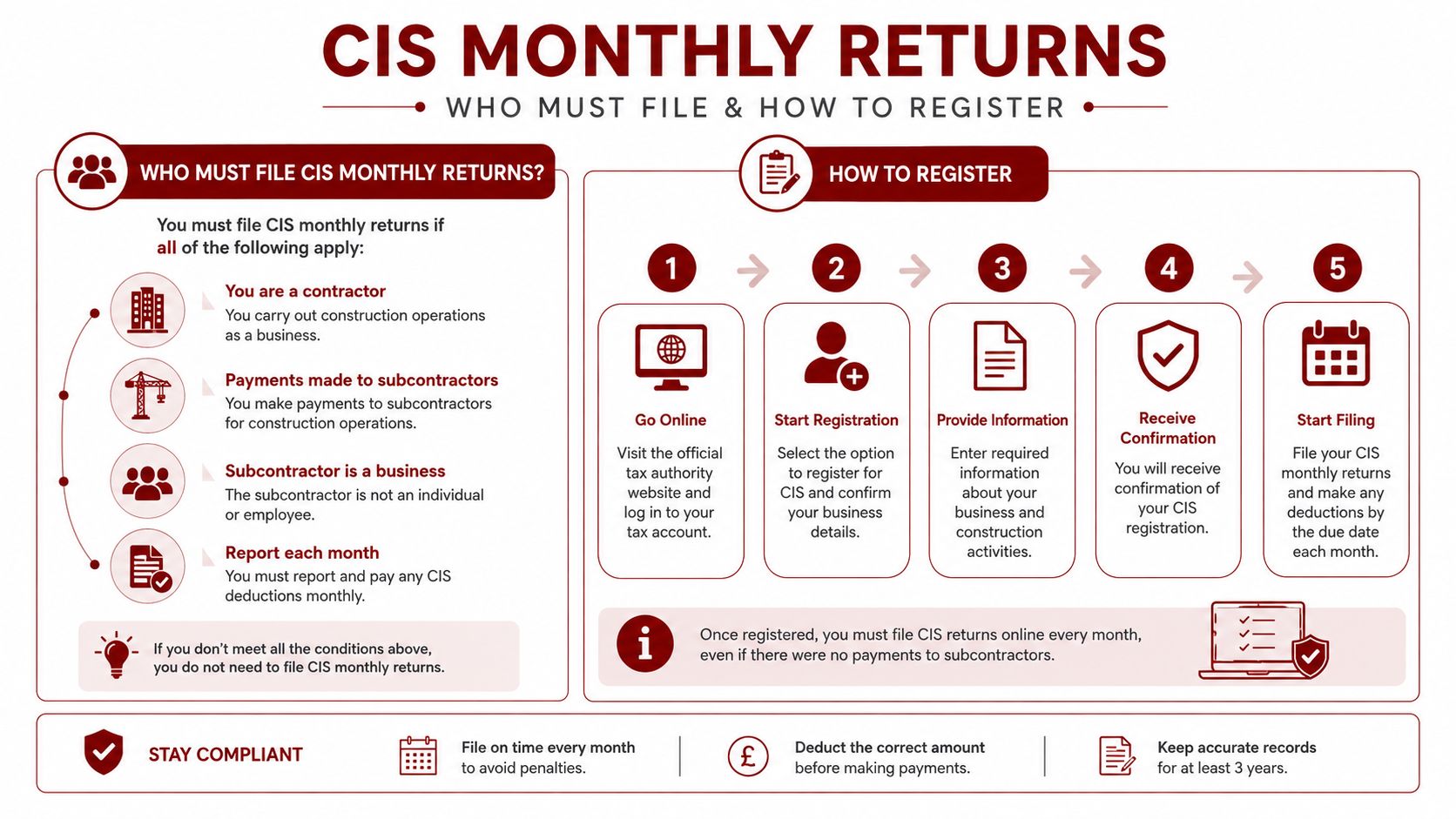
If you pay subcontractors for construction work, you are almost certainly a contractor under CIS. That covers main contractors, subcontractors who pass labour work down the chain, and some landlords or property businesses that use subcontractors for construction work. The title on your business card is irrelevant, the payment flow decides the obligation.
Get the contractor registration right first
Registering as a CIS contractor is the first step. HMRC expects you to do this through the Government Gateway, and once you are set up you will have the identifiers you need to run the scheme properly. Do not leave this until the first subcontractor starts work. By then, you are already behind. If you want a straightforward registration walkthrough, this CIS registration guide from Action Accountants gives you a practical check against the HMRC process.
Subcontractors need their own registration too, because their status determines the deduction rate applied to their payments. If you cannot verify a subcontractor's registration status, the deduction rises to 30%. If they are properly registered, the standard rate is 20%. If they hold gross payment status, no deduction is taken. Those rates matter because they are the rules that control what you should deduct on each payment.
Check status before you pay, not after
Contractors lose control by making the payment, filing later, then discovering the subcontractor's status was never checked. That is backwards. Verification must happen before the payment goes out, because the deduction rate follows the verification result. If the subcontractor is not verified, you do not sort it next month. You deduct at the higher rate and keep the record straight.
Build verification into your purchase approval flow. No verification, no payment. That rule is plain, and it saves money. It also stops the office from arguing with site teams after the fact. If your subcontractor pipeline is messy, or you are juggling different statuses across multiple jobs, it is worth using systems that help streamline your UK workforce without turning the office into a paper chase.
Know the difference between contractor and subcontractor roles
Contractors file the monthly return. Subcontractors do not file that return, but they do need to be registered properly so the right deduction rate is applied. That distinction is basic, yet it is where a lot of confusion starts, especially in smaller firms where the same person might quote, buy materials, and arrange payments. If you are paying someone for construction operations, treat the role carefully and document it properly.
What Goes Into Your CIS Monthly Return
A proper CIS return is not a vague summary of “what went out this month”. It's a record of each subcontractor payment and the tax treatment attached to it. If your numbers are loose, your return is wrong. If your records are incomplete, your return is risky.
The fields that actually matter
Start with the gross payment to each subcontractor. Then record the deduction taken, the subcontractor's verification status, and the split between labour and materials where relevant. Materials matter because CIS deductions are not supposed to treat the whole invoice as labour when part of the charge is for materials. If you mix those up, you distort the deduction and the return no longer reflects what was paid.
The control question is simple. Can you reconstruct the payment from the invoice, the verification result, and the deduction calculation without guessing? If the answer is no, the return isn't ready.
Use a structure like this before you file:
| CIS Deduction Rates at a Glance | ||
|---|---|---|
| Subcontractor Status | Deduction Rate | When It Applies |
| Registered subcontractor | 20% | When the subcontractor is verified and registered under CIS |
| Not registered or not verified | 30% | When the subcontractor cannot be verified or isn't registered |
| Gross payment status | 0% | When the subcontractor holds gross payment status |
Those rates are the ones that should appear on the return where applicable, and they're the numbers that need checking before submission. This CIS deduction calculator from Action Accountants can help you sanity-check the figures before they go out.
Keep one rule in mind, if the status is wrong, the deduction is wrong.
Don't mis-handle mixed invoices
A mixed invoice with labour and materials is where sloppy bookkeeping gets exposed. If you deduct as though the whole invoice is labour, the subcontractor gets over-deducted and your return no longer matches the payment reality. That creates a correction problem later, and corrections are always slower than getting it right in the first place.
The clean approach is to separate the invoice properly at the point of entry. Store the labour element, the materials element, and the verification result together. If you do that, the return becomes a reporting step rather than a detective job.
Use the numbers you have, not the ones you wish you had
Do not pad the return with estimates because someone is chasing you for a deadline. Use the actual verified figures and the actual deduction rate. If a payment has changed because the subcontractor's status changed, the return needs to reflect that month, not a convenient average. The monthly scheme exists to track real payments, not your best guess.
Filing Deadlines, Payment Timing, and Common Pitfalls
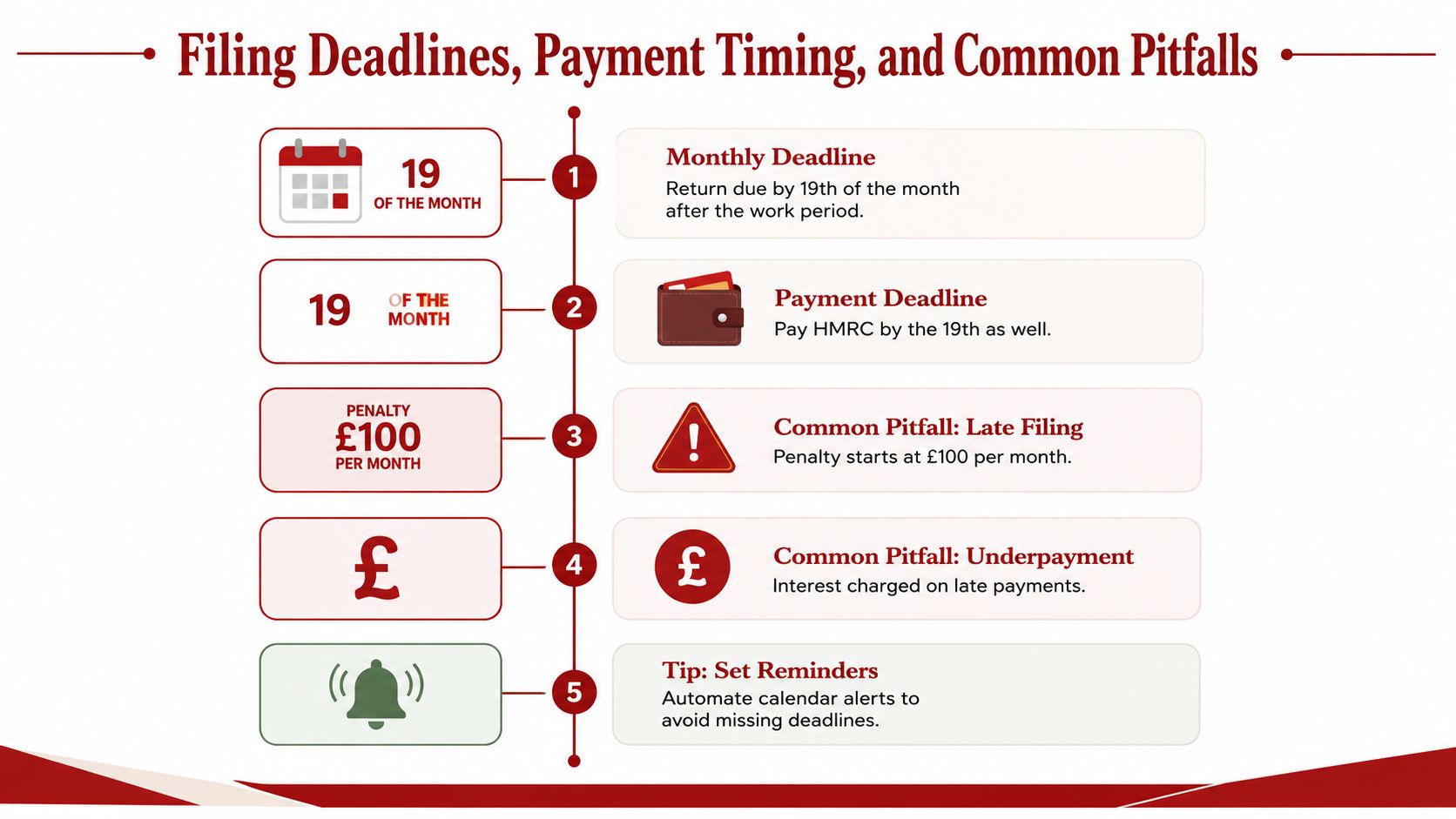
Contractors get into trouble when they blur the filing date and the payment date. They are separate jobs, and each one needs its own check. The return is due by the 19th of the month after the tax month ends, while payment is generally due by the 22nd if you pay electronically. Miss the filing date and you can trigger a penalty even if the money is on the way. Miss the payment date and interest can still build. HMRC's filing and payment guidance sets out the split clearly.
Build a deadline calendar, then enforce it
If your business runs on site diaries and reminders in someone's head, you are exposed. Put every monthly filing deadline into a shared calendar and set alerts before the 19th. If you have multiple schemes, each one should be visible, not buried in a spreadsheet only one person understands.
Do the month-end work early. Lock the figures, review them with whoever handles subcontractor payments, and file before the deadline day. Then pay HMRC electronically with time to spare. That gives you room for a bank delay or a missing approval without turning the month into a compliance mess.
The common traps are predictable
One of the worst mistakes is entering negative values when correcting over-deductions. HMRC's internal guidance says that if commercial CIS software produces negative values, they must be entered as 0. Contractors often get caught when they try to reverse a previous error the same way they would in a spreadsheet. HMRC's internal manual on CIS monthly returns is clear on the zero treatment.
Another trap is assuming the software will manage the timing for you. It will not. Software can calculate and submit, but it cannot decide whether your figures are complete, whether a subcontractor was verified, or whether the return has been reviewed by someone who understands the job costs. It is a tool, not a compliance brain.
If your month-end process depends on one tired person pressing “submit” at the last minute, you have already created the problem.
Keep the filing and paying jobs separate
Filing and paying are two different actions, and each one deserves its own check. The return confirms what was due. The payment settles what HMRC expects. If you treat them as one step, you create a false sense of completion. That is how contractors discover, too late, that a return went in but the cash never followed, or the cash went out before the record was properly filed.
A monthly checklist stops that. Verify the return, confirm the payment instruction, then mark both off only after each step is done. If you want to tighten the admin around that process, Receipt Router on FreeAgent automation is worth reading alongside your bookkeeping setup.
Recordkeeping, Corrections, and Real-World Scenarios
Good CIS work starts with records, not the return screen. If your paperwork is tidy, the submission is quick. If your paperwork is scattered across email, WhatsApp, and two old folders on a shared drive, the return becomes a reconstruction exercise and every mistake takes longer to fix.
Keep these records every month
- Subcontractor verification status, keep the evidence of whether they were registered and what rate applied.
- Gross payment figures, store the amount paid before deductions.
- Materials cost separation, keep invoices or cost support that show what part of the charge was materials.
- Deduction amounts, record what was withheld and why.
- Payment dates, note when the subcontractor was paid and when HMRC should be paid.
That checklist is not overkill. It's the minimum needed to rebuild the month if HMRC asks questions or your own figures don't tie back. A contractor who keeps this in order can fix a problem in minutes instead of spending an afternoon hunting through old files. For teams that want to automate part of that admin, Receipt Router's discussion of FreeAgent automation for builders is worth reading alongside your bookkeeping setup.
A contractor mistake and a subcontractor mismatch
A builder hires a new plumber on a rush job and forgets to verify him before paying the invoice. Three weeks later, he realises the return is due and the status was never checked. At that point, the right move is not to pretend the omission didn't happen. It's to correct the record, verify the subcontractor properly, and submit the return with the actual treatment the payment should have had.
Now look at it from the subcontractor's side. A limited company director checks his CIS statement and finds the deduction doesn't match his own invoice records. That's not just a bookkeeping annoyance. It's a sign that the contractor's return, statement, or payment split needs review. The subcontractor should raise it immediately with the contractor and keep his own records aligned for his Self Assessment.
Correct the error, don't improvise around it
If you under-deducted or over-deducted, the correction route is through your HMRC online account and the amended return process. Don't try to patch the problem with a made-up adjustment in the next month's figures. That only spreads the error forward and makes later reconciliation messier. If the correction would create a negative value in software, remember the zero rule from HMRC's guidance and process it correctly.
A practical working rule is this, if you can't explain the correction to another person in the office in plain English, you probably haven't fixed it properly. Use the source documents, update the records, and keep the amended trail clean. That saves you when the subcontractor challenges the figure or when HMRC wants the logic behind it.
When to Get Professional Help with CIS Compliance
DIY CIS works when the business is small, the subcontractor list is short, and someone in the office has time to review the month properly. It stops working when the compliance load grows faster than the systems around it. At that point, a single missed deadline or bad correction can cost more than a year of decent support.
The line where help starts paying for itself
Bring in a specialist if you're managing multiple sites, juggling different subcontractor statuses, or missing the filing rhythm because the numbers are always arriving late. You also want support if you're applying for gross payment status, untangling year-end reconciliation, or facing an HMRC enquiry into CIS records. Those are not jobs for guesswork. They need someone who knows where the scheme breaks down in practice.
The issue is not just filing. It's control. A construction-focused accountant can wire CIS into your bookkeeping, payroll, VAT, and cash flow process so you stop treating it as a monthly fire drill. That's where how to choose an accountant becomes a practical question, not a branding exercise.
Use support for the jobs that create risk
If you're still handling CIS manually while your job list keeps growing, you're spending time on the wrong task. A professional can take over the routine checks, flag inconsistent deductions, and help make sure the right figures land in the return before the deadline. That doesn't remove your responsibility, but it does reduce the chance of preventable mistakes.
Action Accountants Limited provides CIS and self-employed tax return support, along with construction accountancy experience covering CIS regulations, amounts due, and allowable expenses. That kind of service fits contractors who want the numbers handled properly rather than patched up after a reminder lands.
Pay for the help before the penalty lands. It's cheaper, cleaner, and less embarrassing.
Frequently Asked Questions About CIS Monthly Returns
Can I file CIS returns manually?
Yes, but manual filing is usually the wrong choice once your business has more than a handful of subcontractor payments to track. Software or an organised digital workflow reduces the risk of missing fields, mixing up statuses, or losing the trail behind a deduction. The question isn't whether you can file manually, it's whether manual filing helps you stay accurate when the month is messy. If you're unsure what other businesses ask when choosing a form or process, these common form API questions are a useful reminder of how often simple data entry gets complicated.
What if I stop contracting part-way through the year?
You don't just stop thinking about CIS because the jobs have dried up. If your scheme is still active, you need to deal with the remaining filing obligations properly and make sure HMRC has the right record for the months when subcontractors were paid. If no subcontractors were paid in a month, that still needs to be dealt with correctly rather than ignored. Keep the scheme status clean until you've confirmed the position is closed.
How does CIS affect my Self Assessment?
If you're a subcontractor, the deductions taken under CIS still matter to your Self Assessment because they form part of your tax picture for the year. That's why your own records must match the contractor's statements. If the deductions don't line up, your year-end figures won't either. Keep every statement and invoice in one place so your return isn't built on guesswork.
Can subcontractors claim back deductions at year-end?
Sometimes, yes, depending on their overall tax position. The point is that the deduction taken during the year is not the final story by itself. The annual tax return is where the wider calculation happens, so subcontractors need to hold onto the CIS statements and report them accurately. Don't wait until the last minute to chase missing paperwork from contractors, because that turns a simple claim into a scramble.
What should I do if I realise a return is wrong after submission?
Correct it through your HMRC online account and get the records aligned with what happened. Don't bury the mistake in the next month's figures and hope nobody notices. If the correction creates a negative value in software, apply HMRC's zero rule and process it properly. The sooner you fix it, the less damage it does to the rest of your monthly cycle.
If CIS is already slipping in your business, Action Accountants Limited can help you get the records straight, clean up the monthly rhythm, and stop the same mistakes from coming back. Visit Action Accountants Limited to speak with a team that understands construction compliance and can take CIS off your worry list before the next deadline lands.