

CIS Explained Simply: A Practical Guide for Contractors
Action Accountants •30 July 2026
You've done the work, sent the invoice, and then the payment lands short. Maybe you expected £1,000 and got £800, or something close enough to make you stare at the bank feed and wonder who took the missing money. That moment is where CIS explained starts to matter, because the deduction is usually not a mistake, it's part of how the Construction Industry Scheme works in UK construction.
For small subcontractors, the problem is rarely just the deduction itself. It's the knock-on effect on wages, materials, and whether you've got enough cash left to keep the next job moving. Add in the common confusion between CIS registration and employment status, and it's easy to see why so many contractors and subcontractors end up unclear on what they owe, what they receive, and what HMRC expects.
Table of Contents
- What the Construction Industry Scheme Actually Does
- Who Must Register Under CIS
- How Verification and Deductions Work
- CIS Registration Is Not the Same as Employment Status
- Why CIS Deductions Can Squeeze Your Cash Flow
- Staying Compliant with Returns and Recordkeeping
- A Worked Example and Next Steps for Your Business
What the Construction Industry Scheme Actually Does
A subcontractor finishes a week's work, sends an invoice, and the payment turns up smaller than expected. That usually triggers the same question, where did the rest go? Under CIS, the contractor takes tax from the labour payment before the money reaches the subcontractor, then passes it to HMRC as an advance towards that subcontractor's tax and National Insurance liabilities. The scheme was introduced in 1971 to tackle tax evasion in the sector, and the basic logic hasn't changed, even if the surrounding rules have become more complex. LITRG's CIS guidance sets out that history clearly.
The easiest way to think about CIS is this, it is not a separate tax. It is a collection system. HMRC gets part of the money up front instead of waiting until the subcontractor files a return later on. That is why the deduction often feels like money leaving your hands before you've had a chance to plan for it.
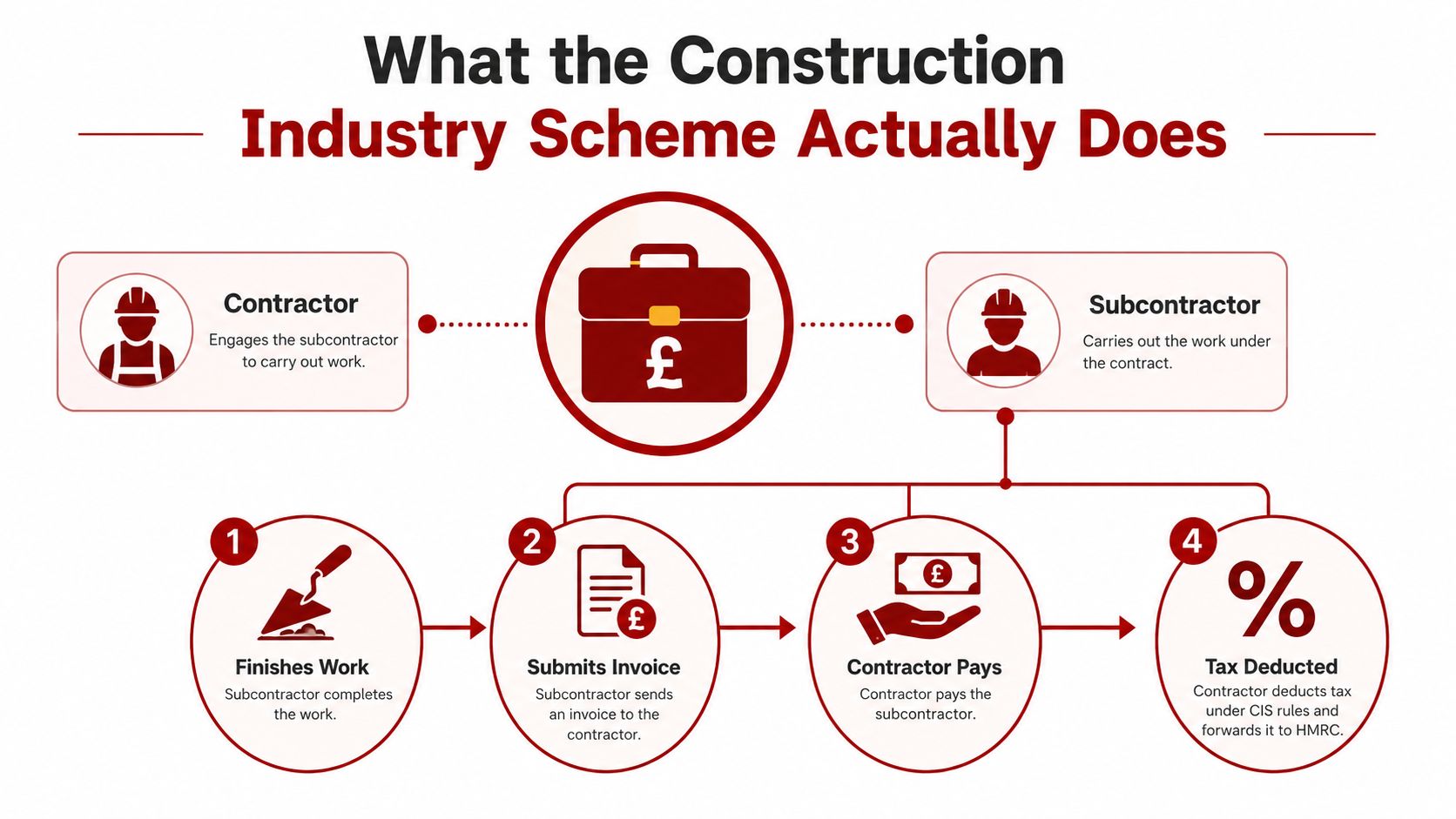
CIS matters because it applies to people working for a contractor in construction but not as an employee. That means it's relevant for sole traders, partnerships, and limited companies operating in the trade, not just one type of business structure. The practical takeaway is simple, CIS sits on top of the way you're paid, and it changes how much reaches your bank account on the day the invoice is settled.
Practical rule: if you're being paid for construction labour by a contractor, CIS is about tax collection at source, not whether your business is “properly set up”.
Who Must Register Under CIS
A small contractor often finds out about CIS at the same moment the first subcontractor invoice lands on the desk. The question is usually practical, because the deduction changes what leaves the bank account right away. Registration is the next step, but the issue is role, since CIS looks at what you do, not the title you use for yourself.
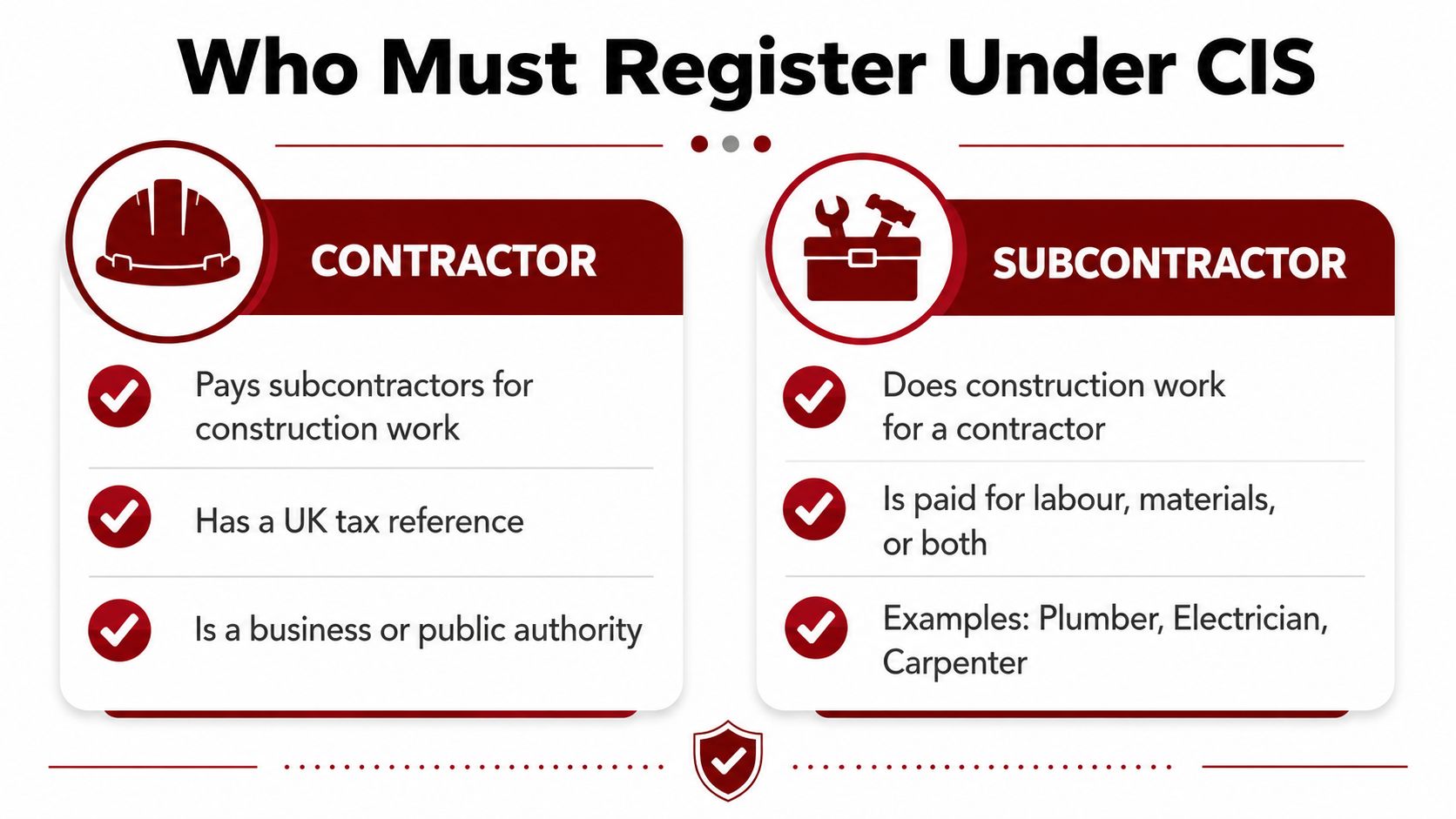
A contractor is anyone who pays subcontractors for construction work. A subcontractor is anyone who carries out construction work for a contractor. That can include a mainstream builder, a property developer, or a business that spends above the relevant construction threshold, and it can also include trades such as plumbers, electricians, scaffolders, and carpenters.
The two roles in plain English
A contractor should register with HMRC before starting to pay subcontractors. A subcontractor should register too, because registration affects the deduction rate and the cash they receive upfront. If you run a small trade business and you work on site for other firms, you are often in the subcontractor bucket, even if you invoice through a limited company.
The quickest way to work out your position is to ask one question, who is paying whom for construction labour? If you are paying others, you are likely acting as a contractor. If you are doing the work for someone else and invoicing them, you are likely a subcontractor. The business structure matters less than the payment chain.
For registration help, keep a direct route handy, such as how to register for CIS, because the practical steps are easier once you know which side of the relationship you are on.
Why VAT now sits in the same conversation
From 1 March 2021, VAT reverse charge rules changed how VAT is handled in many construction transactions, so CIS no longer sits alone in the bookkeeping process. That does not change what CIS is, but it does make accurate records and clean invoicing more important. Contractors and subcontractors now need to think about deduction handling and VAT treatment at the same time, and sloppy admin starts to cost real money.
For a subcontractor, that pressure shows up in cash flow first. A deduction can reduce what reaches the account on the day the invoice is paid, while the VAT treatment still has to be recorded correctly. The result is a tighter squeeze on working money, especially if you are buying materials, paying labour, or waiting on other jobs to be settled.
How Verification and Deductions Work
Once a contractor takes on a subcontractor, they don't just guess the deduction rate and hope for the best. They verify the subcontractor with HMRC first, so the payment can be handled at the right CIS rate. That verification step matters because the contractor needs to know whether the subcontractor is registered and what rate applies before making payment.
The rates that change the cash you take home
The standard deduction rate is 20% for subcontractors who are registered under CIS and 30% for subcontractors who are not registered, according to HMRC-backed CIS guidance used in the UK and the practical explanation in this CIS overview video. That difference is why registration status matters so much in practice. It changes the amount the subcontractor gets straight away, and it changes the pressure on day-to-day cash flow.
| CIS Deduction Rates at a Glance | |||
|---|---|---|---|
| Subcontractor Status | Deduction Rate | Applies To | Impact on Cash Flow |
| Registered under CIS | 20% | Labour payments made by the contractor | Less money held back at payment time |
| Not registered under CIS | 30% | Labour payments made by the contractor | More money held back at payment time |
The key detail many people miss is that CIS deductions are taken from the labour element, not from the whole job in a blanket way. That matters because materials are treated differently from labour in the payment calculation. If you price a job without separating those parts properly, your invoice won't match your expectation and your bank balance will feel smaller than it should.
Simple way to picture it: HMRC takes a slice before the money reaches you, then treats that slice as an advance payment toward your eventual tax and National Insurance bill.
If you want a practical breakdown of the numbers contractors apply, this guide to CIS deduction basics is a useful companion.
CIS Registration Is Not the Same as Employment Status
A lot of people hear “CIS registered” and assume that means “self-employed”. That's the trap. CIS is a tax deduction mechanism, employment status is a separate legal and tax question, and the two are not the same thing. UK specialist commentary on CIS and employment status keeps making the same point because firms still mix them up.
Why the distinction matters in practice
A worker can sit within CIS and still be an employee for tax purposes. That's the bit that catches contractors out. If a business assumes CIS registration settles the status question, it can end up applying the wrong payroll treatment and exposing itself to backdated liabilities. The risk is not theoretical, because status has to be assessed separately from how someone is paid.
That's why formal status checks matter before anyone is engaged under CIS. Contractors need to ask what the relationship looks like, who controls the work, how the person is engaged, and whether the arrangement fits the tax treatment being used. Registration alone won't answer those questions.
Important distinction: CIS can tell you how to deduct tax, but it can't tell you whether the worker is employed.
For agencies, builders, and labour-heavy contractors, this is one of the easiest ways to get into trouble. A subcontractor can be perfectly registered and still be misclassified. The paperwork may look tidy, but the underlying status can still be wrong. That's why a separate employment status review isn't admin for admin's sake, it's part of getting the tax treatment right before HMRC asks questions later.
Why CIS Deductions Can Squeeze Your Cash Flow
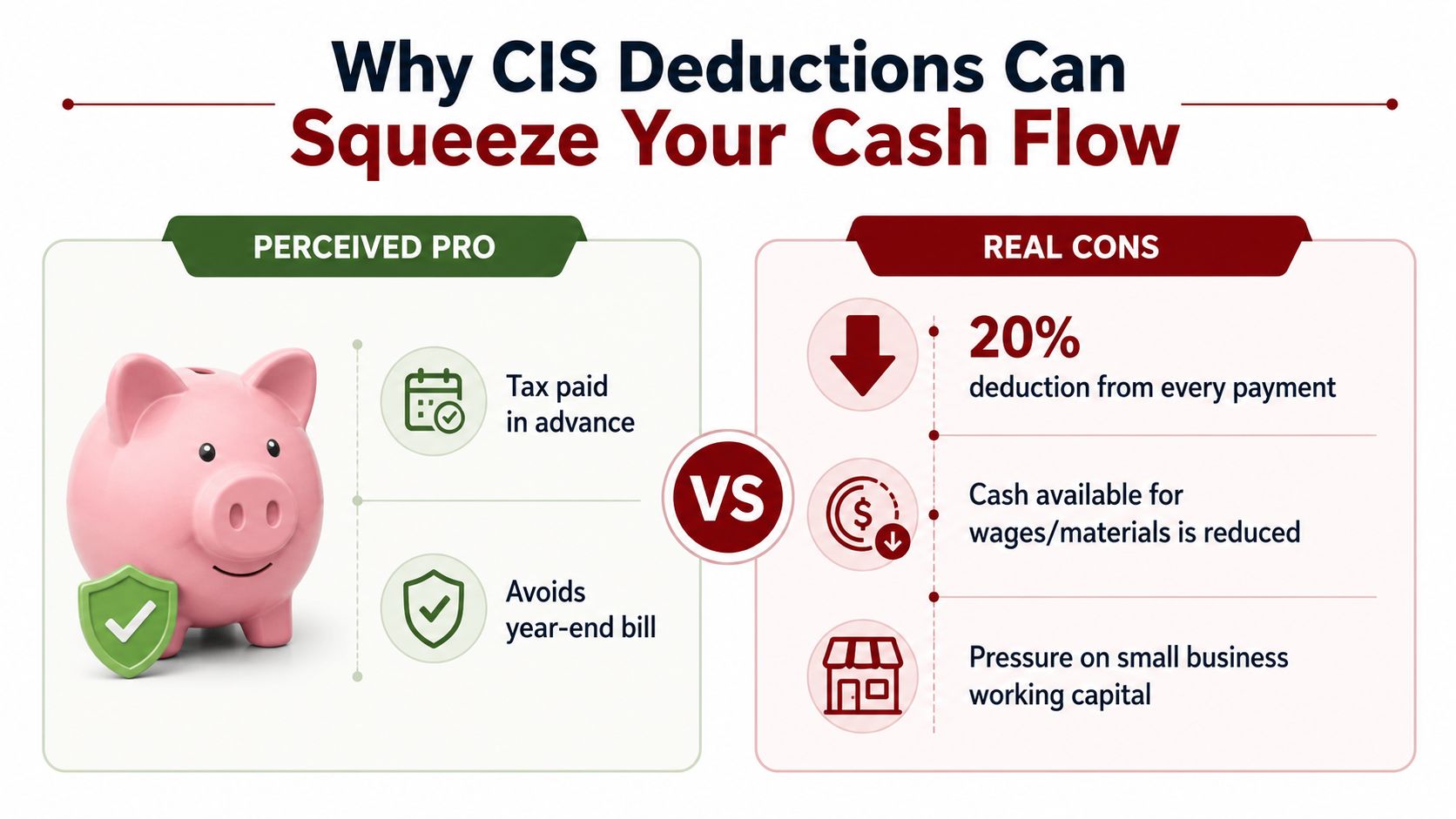
People often describe CIS as a simple 20% deduction, but that description misses the part that hurts most, the timing. The money is removed from your payment before it reaches you, which means you're financing part of your own tax position while still paying for fuel, tools, labour, and materials. That can be perfectly manageable on a strong-margin job, but it feels very different when you're running a small operation with tight weekly commitments.
The hidden strain on small subcontractors
CIS deductions are explicitly only an advance payment toward tax and National Insurance, not the final tax bill. That means the money is not lost, but it also doesn't stay in your bank account when you need it most. For low-margin trades, that creates short-term liquidity pressure even when everything is fully compliant.
That's why cash flow planning matters as much as registration. If you're invoicing on a CIS basis, you need to build the deduction into your pricing and your internal forecasting from day one. Otherwise, your profit on paper can look healthier than the cash available in your account.
A useful complement here is tax return cash flow insights, because the same tension shows up when businesses wait for tax positions to settle after money has already gone out. The pattern is familiar, the timing mismatch does the damage.
What to do before the shortfall becomes a problem
- Price with the deduction in mind: if you don't account for CIS at quotation stage, the net receipt can feel like a surprise even when the figures are correct.
- Separate materials cleanly: when labour and materials are mixed together in your head, your cash plan gets fuzzy fast.
- Watch your working capital weekly: if you leave CIS until quarter end or year end, you've already missed the point.
If the admin side is starting to eat into job time, the skip administrative tasks guide is a useful reminder that cleaner systems usually mean less cash pressure and fewer mistakes.
You can also explore gross payment status support if you want to understand one route that some subcontractors consider when they're trying to reduce the drag on cash flow.
Staying Compliant with Returns and Recordkeeping
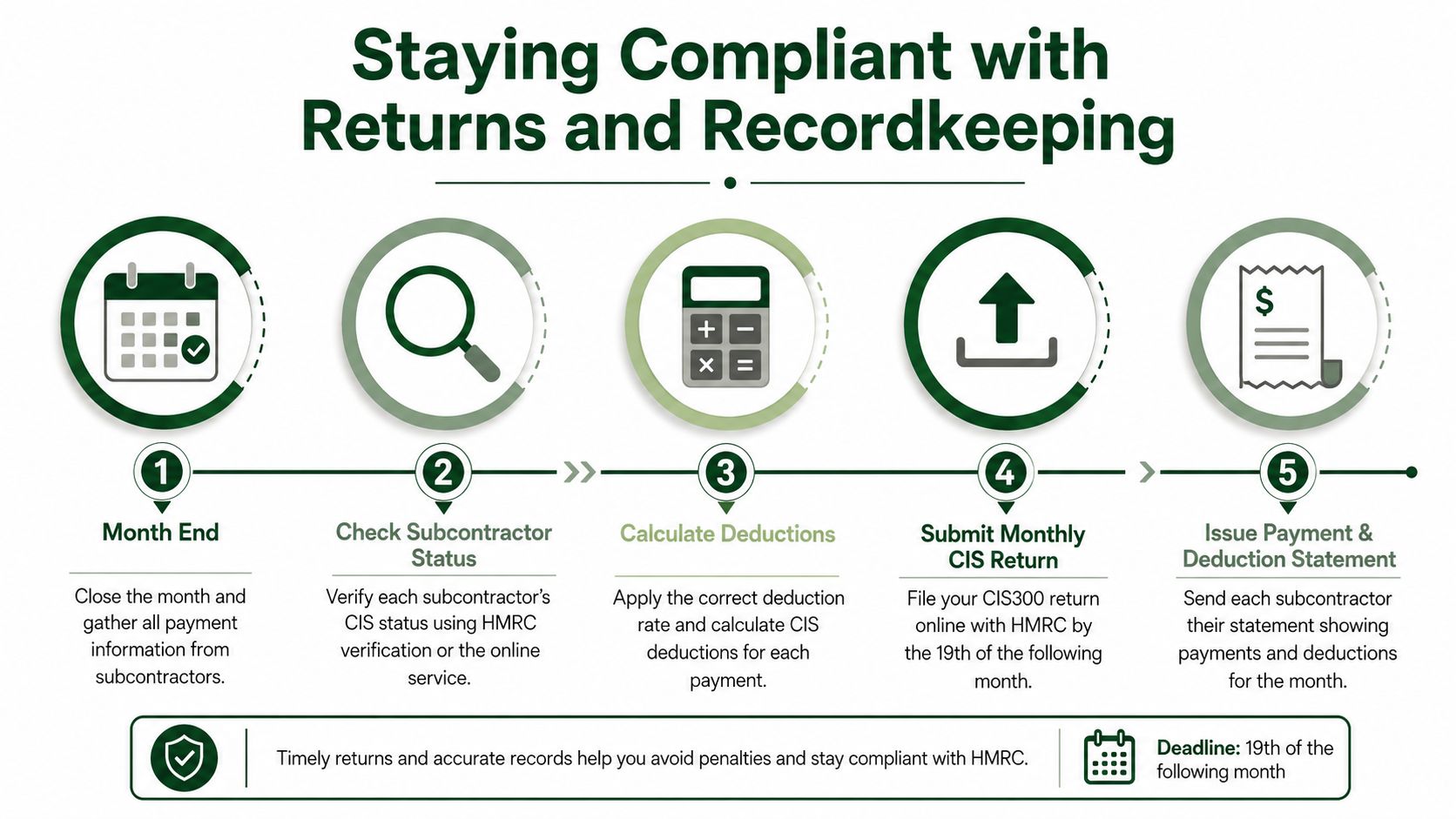
Contractors have a monthly job to do whether payments were large or small. They must file a monthly CIS return with HMRC that includes subcontractor details, the amounts paid, and the deductions made. That return is the backbone of CIS compliance, because it tells HMRC what was paid out and what tax was sent on.
The documents that keep you out of trouble
Contractors must keep records of payments and deductions for at least three years after the end of the tax year they relate to, according to HMRC-backed CIS guidance used in the UK. That record trail matters because if HMRC asks questions later, the contractor needs to show exactly who was paid, how much was paid, and how the deduction was calculated. For subcontractors, the monthly payment and deduction statement is equally important, because it should show the gross amount, the deduction, and the net payment.
Late returns and late payments can trigger penalties, so timing isn't optional. The safest habit is to treat CIS like payroll for construction work, because the discipline is similar even if the labels are different.
A simple monthly routine works better than a last-minute scramble:
- Check subcontractor details before paying.
- Confirm the deduction rate against the contractor's verification record.
- Keep the payment and deduction statement with the invoice.
- File the monthly return on time.
- Store records so they can be produced later without a hunt through old emails.
If you prefer a broader operational checklist, this contractor admin guide fits neatly alongside CIS compliance.
A Worked Example and Next Steps for Your Business
A subcontractor sends an invoice for £2,000 of labour and £500 of materials. The contractor checks the subcontractor, applies the 20% CIS deduction to the labour part only, and deducts £400 from that labour element. The contractor then pays £2,100 net, which is the materials plus the labour after deduction.
That is the bit that catches people out on a first CIS job. The deduction does not bite on the whole invoice in the same way, and the net payment does not match the headline invoice total. For a small subcontractor, that gap can put pressure on cash flow straight away, because money that looks due on paper does not always arrive in full. At year end, the £400 deduction is treated as an advance payment against the subcontractor's actual tax position when they file self-assessment, so it reduces part of the final bill rather than sitting there as a separate charge.
The practical next steps
A straightforward example helps here. If the work is construction-related and CIS applies, the first job is to make sure the business is registered properly with HMRC under the right status. CIS registration and employment status are different questions, and that distinction matters because a subcontractor can be within CIS without being an employee. If that point is unclear, the answer changes how deductions are handled and how the relationship should be recorded.
- Register properly with HMRC if you're working in the construction chain and CIS applies to you.
- Track deductions separately in bookkeeping so labour, materials, gross amounts, and net receipts don't get muddled.
- Review your cash flow before each job starts so CIS doesn't create a surprise gap when payroll or supplier payments fall due.
- Get support early if you're unsure whether your role is contractor, subcontractor, or something closer to an employment relationship.
For businesses that work across construction, clean records and correct returns make the difference between steady cash flow and repeated payment surprises. Action Accountants Limited can help you handle CIS with a clearer process and less stress, so you are not left untangling avoidable mistakes after HMRC gets involved.