

Tax Section 24 Explained for Landlords in 2026
Action Accountants •26 July 2026
You opened your self assessment, saw the rental figure, and the number looks wrong. Rent hasn't jumped enough to explain it, your mortgage has only got more expensive, and yet the tax bill still bites harder than last year. That's the moment tax section 24 stops being theory and starts feeling personal.
For a small landlord, this rule is brutal because it changes the way your mortgage interest is treated. The old instinct, that interest should come off the rental profit in full, no longer works for individuals in the same way. The result is simple enough to state and annoying enough to live with, the relief is capped at a basic-rate 20% tax credit, not a full deduction, and that matters most when your income already pushes you into a higher band as set out in the UK landlord tax guidance.
If you're also trying to keep your records clean, your return on time, and your portfolio compliant, the basics still matter. A useful starting point is UK rental laws for landlords, because tax problems usually grow out of messy compliance habits elsewhere in the file. If the return itself is what's causing the headache, self-assessment tax return help is where most landlords should start rather than guessing through it alone.
Table of Contents
- What Section 24 Means for Your Rental Property
- How the Calculation Changed
- Worked Examples by Tax Band
- Realistic Strategies to Reduce the Bill
- Why Incorporation Is Not Always the Answer
- Local Notes for North West London Landlords
- Planning Around an Uncertain Rule
What Section 24 Means for Your Rental Property
You open your self assessment, see a bigger bill than last year, and the rent has not changed enough to explain it. That is the Section 24 problem in real life. It hits small landlords who still expect mortgage interest to sit neatly inside rental expenses.
Section 24 is the rule that restricted residential landlords' mortgage-interest relief under the Finance (No. 2) Act 2015. The change was phased in and ended with a basic-rate 20% tax credit instead of a full deduction for individuals UK landlord tax overview. The result is simple. Your finance costs no longer reduce taxable rental profit pound-for-pound in the old way.
That shift changes the tax bill according to the rest of your income. A basic-rate landlord often absorbs it, although the return still feels tighter. A higher-rate or additional-rate landlord takes the hit much harder, because the credit stays at basic rate while the tax charge follows the higher band.
Practical rule: if your rental business is geared, Section 24 hits cash flow as well as tax.
It also changes how lenders view the numbers. A landlord with decent rent cover on paper can still look stretched once interest relief is restricted, and that affects affordability tests as well as the monthly surplus you keep. If your return is due and the figures no longer make sense, use self assessment tax return help before you file a guess.
The compliance side matters too. Clean records, clear ownership, and a proper paper trail make the return easier to complete and easier to defend, which is why UK rental laws for landlords and tax admin should sit together rather than as separate chores.
The core point is this. Tax section 24 changed the economics of geared landlord ownership, especially for smaller portfolios with heavy borrowing. The mortgage interest still goes out in cash, but the relief only arrives as a basic-rate credit, so geared landlords feel the squeeze first Parliamentary briefing on Section 24.
How the Calculation Changed
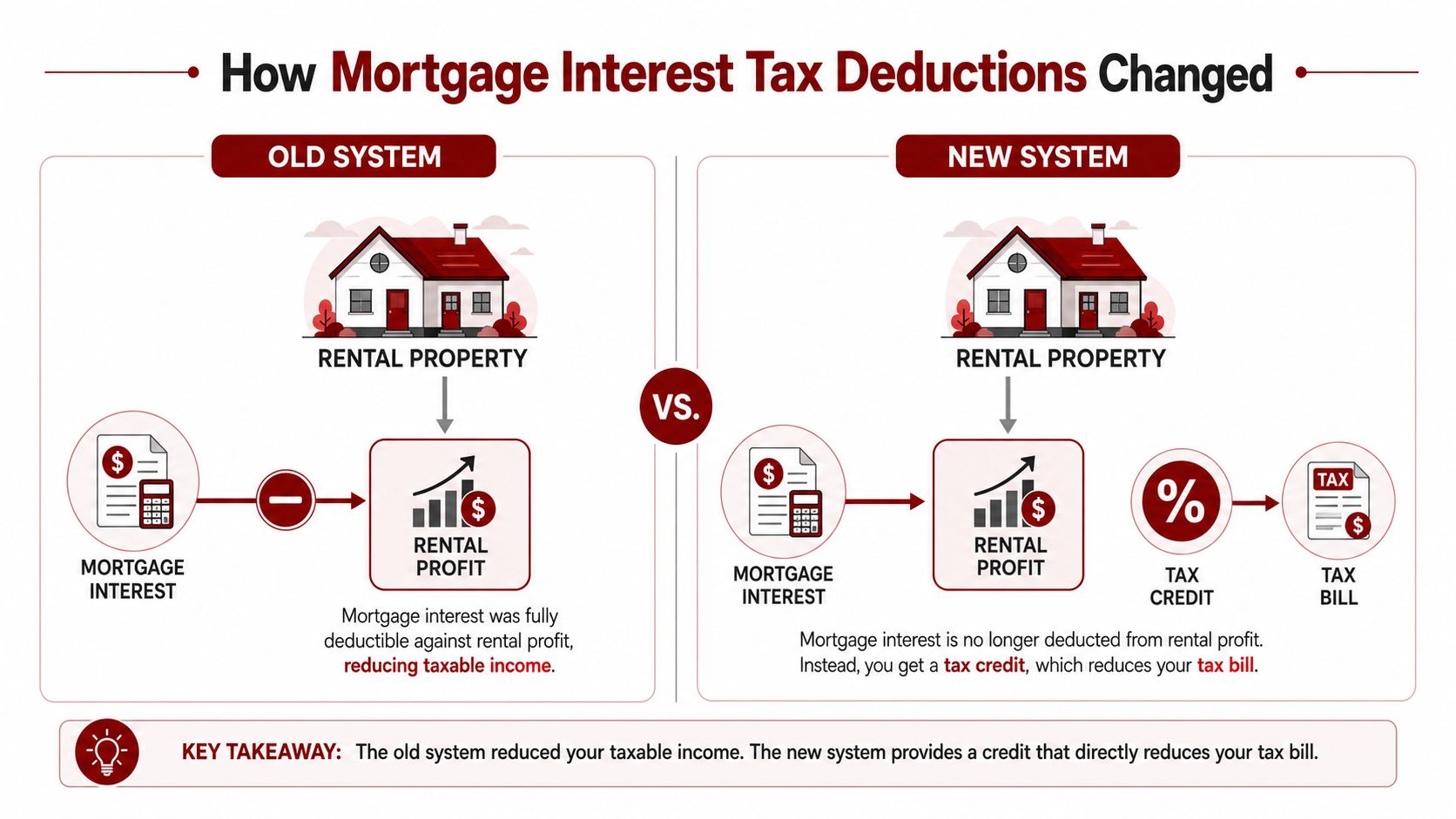
The old model was simple. Mortgage interest came off rental profit like any other finance cost, so the tax figure matched the property's economics more closely. Section 24 broke that link for individuals and replaced it with a credit system outside the normal deduction route.
Deduction versus credit
Under the old rule, interest reduced taxable rental profit in full. Under the current rule, you get a 20% credit on the finance cost instead. You still pay the interest in cash, but the tax system only offsets part of it.
The same property can produce the same rent and still give you a different tax bill.
HMRC's property income guidance says loan interest is no longer fully deductible in the traditional way for individuals, and a 20% tax credit applies to finance costs. That means your marginal band drives the final result. A higher-rate landlord can still face a tax charge even when the accounting profit looks thin.
Why the band matters
The tax credit stays fixed at basic rate, but your income tax liability does not. That gap is the problem. Once rental income moves into a higher band, the restricted relief leaves a clear gap between what the property produces on paper and what the return says you owe.
Landlords feel the rule more sharply than the headline suggests. It does not just push tax up in a vague way. It changes how the return flows through the bands, especially where finance costs are large compared with rent. The Parliament briefing on Section 24 describes the policy shift plainly, and that is what it did.
Heavy mortgage interest and repairs make the picture worse. The relief no longer behaves like an ordinary expense line, so the return can show weak taxable headroom even when the property still drains the same amount of cash each month. Stop treating Section 24 as a small technical detail. It changes the order in which your numbers hit.
Worked Examples by Tax Band
Take one flat in North West London, £12,000 annual rent and £9,000 mortgage interest. Keep the property the same and only change the landlord's tax band. That's where the difference becomes obvious, because Section 24 does not treat every owner the same way.
Under the old deduction system, the interest would have reduced rental profit directly. Under the current credit system, the landlord still gets a 20% credit on the interest, but the rest of the tax calculation depends on the person's marginal rate. The property hasn't changed. The owner's tax band has.
| Landlord band | Tax under old rules | Tax under Section 24 | Extra cash owed |
|---|---|---|---|
| Basic-rate | Lower, because interest reduces taxable profit in full | Higher, because only a 20% credit applies | More tax than before |
| Higher-rate | Lower, because the full interest deduction protects more of the profit | Higher, because the deduction is restricted to a credit | Noticeably more cash out of pocket |
| Additional-rate | Lower, because full relief used to shield more income | Higher, because the relief cap is still only 20% | The heaviest tax drag |
The point of the table is not that every landlord gets the same pound figure. It's that the same flat can look fine on paper and still produce a tax bill that feels too high once the interest restriction is applied. That's the trap landlords can run into, especially when rent is steady but rates and finance costs are doing the damage.
What this means in practice
If your return is already close to the threshold between bands, Section 24 can tip more of your property income into a bad place. The issue is not just the final tax bill, it's the way the credit interacts with the rest of your income and changes the tax band outcome. The higher your personal rate, the less forgiving the rule becomes.
That is why advisers keep warning landlords not to judge a property by gross yield alone. Yield can still look acceptable while the tax system strips away the margin. If you want a proper handle on the expense side, use rental income allowable expenses guidance and separate the expenses that still count in the normal way from the finance costs that do not.
Realistic Strategies to Reduce the Bill
There is no magic fix. Start with the property, the debt, the ownership split, and the cost of changing course. Then choose the option that leaves the cleanest after-tax cash flow, not the one that sounds clever in a forum thread.
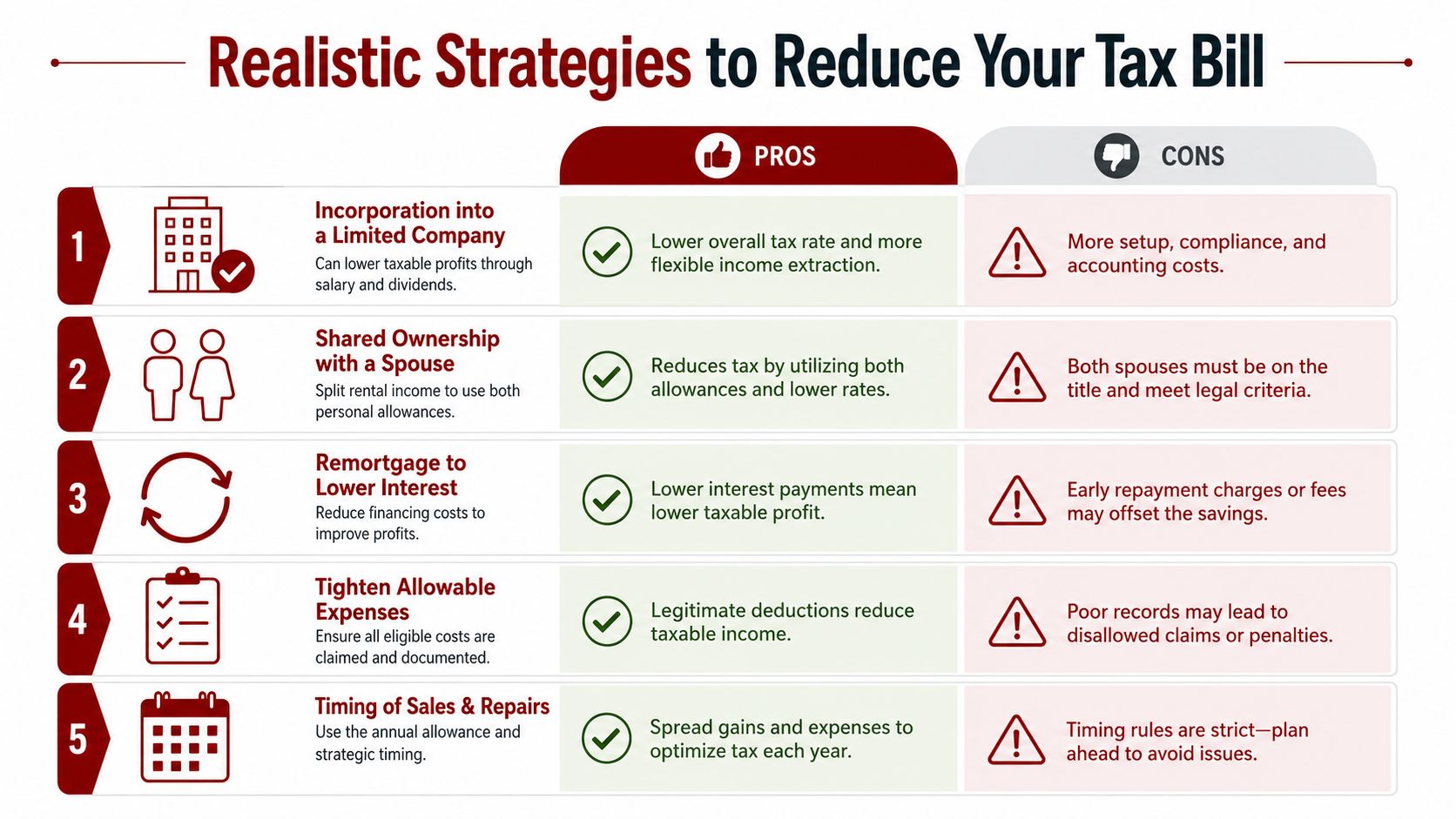
The main options landlords use in practice
Incorporation into a limited company can work because company structures are not hit in the same way as individual ownership, but the transfer is not free, and it is rarely tidy for a small landlord with existing equity.
Shared ownership with a spouse can help when the income split matches the ownership and profit split, because tax follows the facts, not a wishful paper exercise.
Refinancing to lower interest costs does not change Section 24, but it cuts the finance bill that gets restricted, so the cash drain eases.
Tightening allowable expenses matters because every genuine expense you record correctly is one less pound landing in the taxable figure. Use rental income allowable expenses guidance and keep the finance costs separate from the expenses that still get normal relief.
Timing sales and repairs carefully helps when several moving parts fall in the same tax year. A sale, a major repair, or a refinancing decision can push the tax result into a worse band if you leave the timing to chance.
Best advice: do not ask which strategy is fashionable. Ask which one leaves you with the cleanest after-tax cash flow.
The parliamentary briefing on Section 24 confirms the policy was built to restrict relief to the basic rate of income tax. That gap is why the numbers change so sharply for geared landlords, and why you should plan for uncertainty rather than assume the old treatment is coming back soon Parliament briefing on Section 24. Measure the damage first, then choose the least painful fix, then only change structure if the numbers still stack up.
For day-to-day expense control, keep your evidence tight and your categories consistent, especially for maintenance, professional fees, and void-related costs. Good records beat guesswork every time, and they matter more when the self assessment figure is already heading in the wrong direction.
If you are also weighing wider ownership changes, read navigating company accommodation before you rush into a transfer.
Why Incorporation Is Not Always the Answer
A lot of landlord chat jumps straight to one answer, move everything into a company. That advice is too lazy for real portfolios. It can work, but only when the full cost of moving is lower than the tax pain you are trying to escape.

The hidden friction
The first problem is the gain already sitting in the property. If you transfer it into a company, you may trigger a tax charge on the uplift to date. That alone can kill the headline benefit for a small landlord with modest equity and no appetite for a clean restructuring.
The second problem is the borrowing side. Companies often face different mortgage pricing and borrowing terms, and those costs can erase much of the expected saving. If the lender treats the move as a fresh business case, the numbers can deteriorate faster than the tax improves.
The third problem is extraction. Profits inside a company are not the same as money in your pocket. Once the income sits there, taking it out later adds another layer to the decision, which many landlords conveniently ignore when they compare an individual return with a company rate.
Practical rule: incorporation only helps if you've priced the move, the borrowing, and the exit, not just the tax line.
If you're still weighing that structure, navigating company accommodation is a useful read for understanding how company relationships work in the wider property world. Pair that with limited company vs sole trader guidance before you make a decision you'll be stuck with.
The bottom line is blunt. Incorporation is a tool, not a cure-all. For some landlords it is the right way to contain Section 24. For others it just turns one tax problem into three admin problems and a more expensive mortgage.
Local Notes for North West London Landlords
Colindale, Kingsbury, Edgware, and Finchley landlords all face the same Section 24 rule, but the outcome depends on the shape of the portfolio, the mortgage, and the personal tax band. A landlord with one heavily financed flat and a strong salary gets hit far harder than a landlord whose rental income sits mostly in the basic-rate band and whose borrowing costs are lighter. That is the part many owners miss when they stare at a higher self assessment figure and assume the tax office has got it wrong.
The basic-rate credit also distorts more than the tax bill itself. Once mortgage interest no longer reduces rental profit in full, taxable income stays higher, which can push a landlord closer to the next band and make the return look worse than the cash position at first glance. That gap matters for affordability tests too, because lenders do not just look at rent, they look at how tight the numbers become after tax and debt service.
What usually changes the result
Joint ownership helps only when the legal title, the mortgage, and the beneficial split all point in the same direction. Shifting rent onto the lower-rate spouse without matching the paperwork creates a dispute, not a saving. Get the ownership wrong and you end up arguing with HMRC instead of cutting the bill.
Remortgaging is the other place where North West London landlords get caught. A new deal can improve the headline rate, but Section 24 still leaves the interest relief restricted, so the after-tax cash flow is what decides whether the refinance helps. A lender may accept the property on paper and still tighten the stress test once the tax position is fed into the numbers.
If you are buying for the long term, stress test the deal as though the current treatment stays in place. A strong rental market does not fix a weak ownership structure. Model the ownership split, the mortgage terms, the likely tax band, and the post-tax cash flow before you commit.
Before you sign a purchase contract or a restructuring deed, get these points clear:
- Ownership split: check whose income will carry the rental profit and whether that matches the legal title.
- Borrowing terms: confirm how the lender prices the mortgage if the property is held personally or through a company.
- Tax band exposure: work out whether the income sits near a band edge, because that is where Section 24 bites hardest.
- Cash flow buffer: keep room for tax bills that do not move in step with rent collection.
This is the reality for many North West London landlords. They are often asset-rich and cash-sensitive. That mix makes Section 24 hurt more, because the property can look strong while the tax bill keeps draining liquidity.
If you want practical solutions, speak to a property tax adviser who can check the ownership, the lending, and the self assessment together. For advisers who need material they can use with clients, the regulatory content for financial advisors resource is a useful reference.
Planning Around an Uncertain Rule
The current trap is not just the rule itself, it's the uncertainty around it. An October 2024 parliamentary amendment proposed that restricted deductions for residential finance costs be removed from the 2023–24 tax year onward, which leaves a real practical question hanging over returns, amendments, and ongoing planning parliamentary amendment document. Don't plan as if the old position is settled forever.

What to do now
Start with the return in front of you, not the rumour mill. Review the numbers, keep the mortgage statements, and make sure every finance cost and rental expense is recorded cleanly. If the return is wrong, fix the return. If the structure is wrong, fix the structure. Don't confuse those two jobs.
If you're making payments on account, check the cash impact before you move money elsewhere. payments on account guidance matters because Section 24 can make a tax bill feel larger than your reserves expected.
For advisers and landlords alike, the smart response is to treat the rule as active but not immune to change. That means keeping your planning flexible, avoiding knee-jerk restructures, and documenting the assumptions behind any return you file. A tax decision made in panic is usually the expensive one.
For readers asking the obvious questions:
- Could the rule be reversed? Yes, the legislative position has already shown movement, so you should not assume the current treatment is permanent.
- How do I treat the credit on my return? Treat it as a restricted finance-cost credit, not as a full deduction, unless a current change specifically overrides that treatment.
- What records should I keep? Keep mortgage interest statements, rent schedules, ownership documents, and every expense receipt that supports the rental calculation.
If you want clean planning while the position keeps moving, use regulatory content for financial advisors as a reminder that tax content needs regular review, not one-off assumptions. That is especially true here, because tax section 24 is exactly the sort of rule that catches landlords who file on old habits.
If Section 24 has pushed your rental tax bill higher, stop guessing and get the numbers checked properly. Action Accountants Limited helps landlords review self assessment returns, property income, and ownership structures so you can see what the rule is really costing you and what can still be done about it. Visit the team in Colindale for straight advice on your return, your finance costs, and the next move for your portfolio.