

You issue an invoice in March, submit your VAT Return in April, and set aside money for VAT even though your customer won't pay until June. Your business has earned the revenue on paper, but the cash is still missing from the bank account. That gap can force a small business owner to delay supplier payments, draw more from an overdraft, or spend time chasing a customer instead of running the business.
The VAT Cash Accounting Scheme is designed around that timing problem. It lets eligible businesses account for VAT when money changes hands, rather than when sales and purchase invoices are issued. The result isn't a reduction in VAT. It's a change in when VAT enters your cash-flow calculation.
This guide explains the scheme in plain English, starting with the basic pay-when-paid principle and moving through eligibility, worked examples, VAT Return boxes, records, sector issues, and the practical process of joining or leaving. If you're comparing VAT cash accounting with other ways to manage working capital, invoice discounting is another financing option to understand, although it works differently from changing your VAT accounting method.
The important question isn't whether you're allowed to join. It's whether your customer payment cycle, supplier terms, and bookkeeping systems make the timing change worthwhile. Used carefully, cash accounting can help your VAT payments follow your bank balance more closely and make working capital easier to manage.
Table of Contents
- Introduction Why Paying VAT Before You Are Paid
- How the VAT Cash Accounting Scheme Really Works
- Are You Eligible and When You Must Leave the Scheme
- Cash Flow Benefits and Drawbacks in Plain Numbers
- Joining Leaving and Keeping Records Without Mistakes
- Sector Notes for Contractors Subcontractors and Landlords
- Next Steps and How Action Accountants Can Help
Introduction Why Paying VAT Before You Are Paid
Under standard VAT accounting, the invoice date can determine when VAT enters your return. That creates pressure for businesses that give customers credit. You may have completed the work, issued the invoice, and recognised the sale, while the customer retains the cash for several weeks.
A contractor provides a useful example. Suppose the contractor completes a project and invoices the customer in March. The customer has agreed to pay later, but the contractor's VAT liability is connected to the sale before the money arrives. The business owner must then find cash for HMRC from money that hasn't yet been collected.
That is the frustration behind many searches for the VAT Cash Accounting Scheme. The scheme doesn't make late-paying customers more reliable, and it doesn't remove the need to submit returns on time. It changes the VAT timing rule so that customer receipts and supplier payments become central to the calculation.
The cash-flow question behind the scheme
Ask yourself what happens in a normal trading cycle:
- You invoice customers: Revenue appears in your bookkeeping, but payment may remain outstanding.
- You pay suppliers: You may settle bills quickly to keep projects moving.
- You prepare the VAT Return: VAT timing can create a liability before your sales cash arrives.
- You manage the gap: The business funds the difference through reserves, delayed spending, or borrowing.
The VAT Cash Accounting Scheme can reduce that mismatch where your customers generally pay after you invoice them. It may be less attractive if customers pay you promptly but you make substantial purchases and would benefit from reclaiming input VAT earlier.
The rest of this guide keeps those trade-offs visible. You'll see how the rules work, how HMRC's thresholds affect eligibility, how contractor and landlord scenarios differ, and which records your bookkeeping system must capture. By the end, you should be able to discuss the choice with your accountant using practical cash-flow questions rather than relying on the scheme name alone.
How the VAT Cash Accounting Scheme Really Works
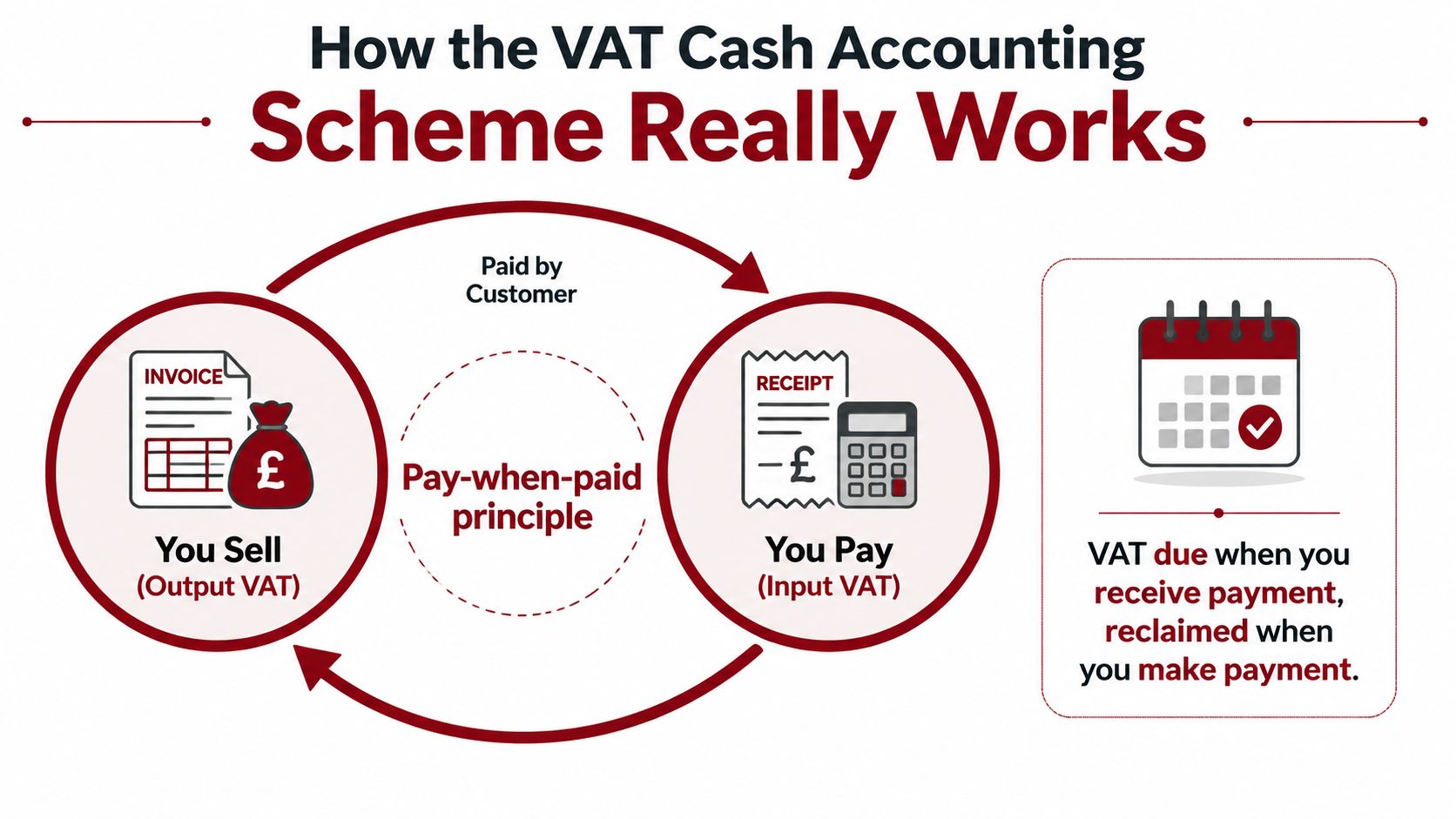
Think of the scheme as a pay-when-paid system for VAT. When a customer pays you, you account for the output VAT connected with that payment. When you pay a supplier, you reclaim the input VAT connected with that payment.
The UK introduced the scheme on 1 October 1987 as a deregulatory measure intended to ease the burden on small businesses, particularly those that extend credit to customers, as explained in HMRC's history and technical explanation of the VAT Cash Accounting Scheme. HMRC also notes that the scheme provides automatic bad debt relief because unpaid sales haven't yet triggered output VAT under the cash method.
Sales and purchases follow different cash events
For sales, the relevant event is the customer's payment. An invoice can remain unpaid without creating the same immediate output VAT timing under the scheme. Once the customer pays, you include the relevant VAT in the return according to the payment received.
For purchases, the relevant event is your payment to the supplier. Receiving a VAT invoice isn't enough on its own for recovery under the scheme. You need a reliable record showing when money left your business account or was otherwise paid.
Core principle: Output VAT follows customer receipts, while input VAT follows supplier payments.
That differs from standard invoice accounting, where VAT is generally linked to the invoice date. Cash accounting therefore shifts the focus from what your invoices say was due to what your bank and payment records show happened.
What the change means in practice
The benefit is strongest when you issue invoices before customers pay. You can avoid funding output VAT from your own working capital during the collection period. The counterweight is that input VAT recovery waits until you pay suppliers, so businesses that purchase heavily or pay suppliers quickly need to model both sides.
The return itself still needs accurate reporting. HMRC requires special treatment under the scheme for VAT Return boxes 1, 4, 6 and 7, as set out in its guidance on completing and submitting a VAT Return. If you're reviewing the wider treatment of VAT on labour, materials, or professional work, this guide to VAT on services can provide useful context.
Cash accounting should also sit within a broader financial control process. Businesses planning expansion may want to consider tax planning for growing companies alongside VAT timing, because a scheme decision affects records, forecasts, and working capital rather than operating as an isolated compliance choice.
Are You Eligible and When You Must Leave the Scheme
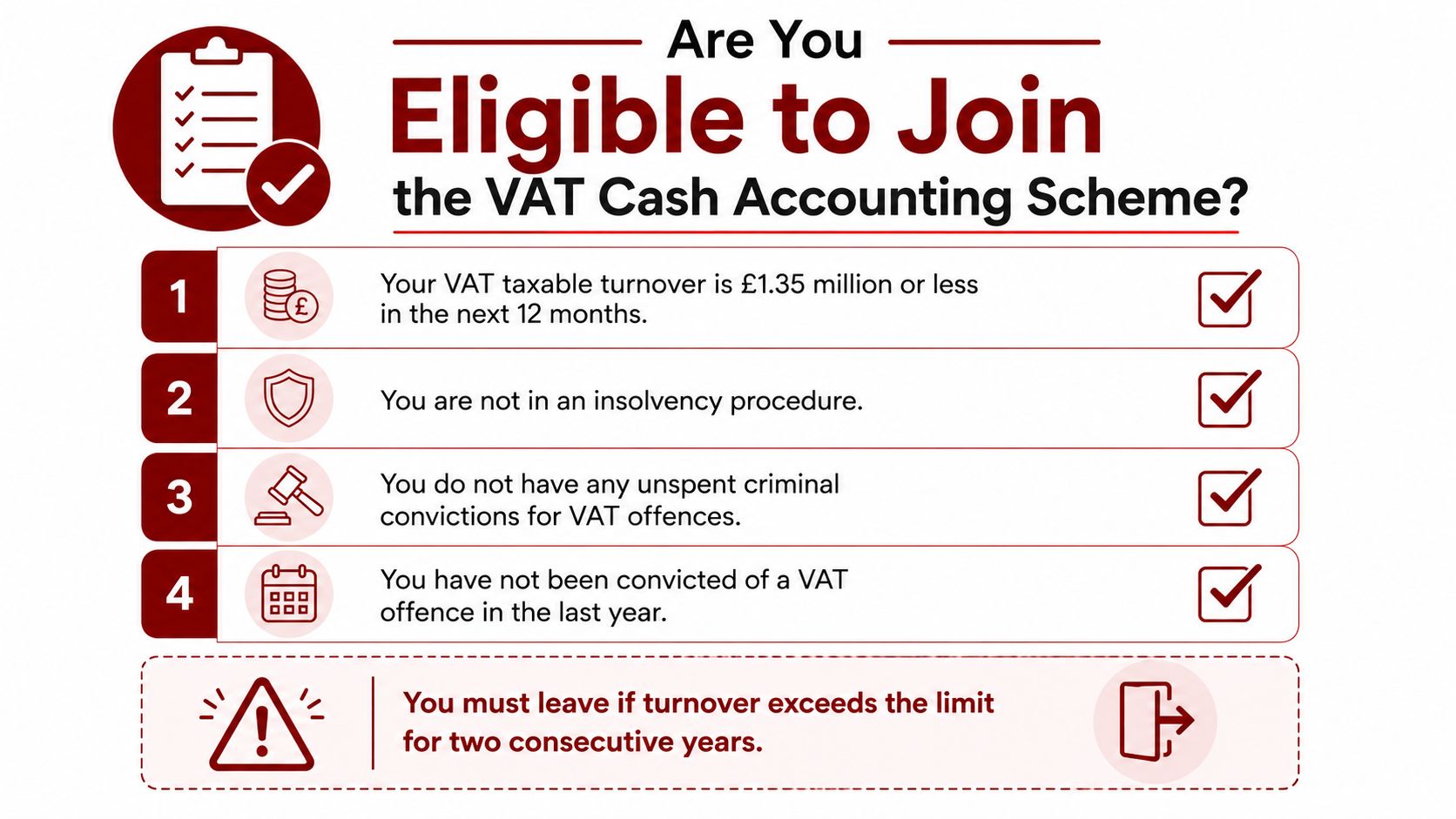
A growing contractor can qualify today and still need to leave after winning several large projects. Eligibility depends on the turnover you expect, while continued use depends on keeping that forecast under review. HMRC allows entry when estimated VAT taxable turnover is £1.35 million or less in the next 12 months, as explained in the official eligibility guidance for the VAT Cash Accounting Scheme. Last year's sales alone are not enough. Your forecast should reflect signed work, likely orders, and the timing of taxable income.
The turnover test is only one part of the check. Your business status and transaction types also matter, and some arrangements do not follow the scheme's normal cash-payment treatment.
Check the rules against your records
Review the following before you change your VAT method:
- Forecast taxable turnover: Base the estimate on expected taxable sales for the next 12 months.
- Confirm business status: Check whether insolvency or VAT-offence issues affect your ability to join.
- Separate excluded transactions: Identify sales that HMRC does not allow under cash accounting.
- Test your records: Make sure your bookkeeping can connect receipts and payments with the right invoices.
- Set a review routine: Revisit the forecast when new contracts, orders, or major projects are agreed.
HMRC lists exclusions such as hire purchase, conditional sale, and certain invoices issued more than six months before payment is due. A business can therefore qualify overall while particular transactions require different VAT treatment. That distinction matters for contractors with mixed contract terms and landlords handling varied arrangements.
Understand the exit point
A business must leave when its turnover exceeds £1.6 million. Monitor that figure during the year rather than waiting for the accounts to close. A rapid increase in contracts can take a business beyond the limit while its bookkeeping software remains configured for cash accounting.
The entry and exit figures answer different questions. The entry test asks whether your forecast supports joining. The exit limit determines when continued use is no longer permitted. If you are checking how registration fits with the scheme, this guide to the VAT registration threshold in the UK provides relevant context. Reviewing both limits helps you choose a VAT method that supports cash-flow planning without leaving the business exposed to an incorrect return.
Cash Flow Benefits and Drawbacks in Plain Numbers
A simple example shows why payment timing matters. A consultant issues an invoice for £10,000 plus VAT with 60-day payment terms. Under standard invoice accounting, the VAT connected with the invoice can enter the relevant return before the consultant receives the customer's money. Under cash accounting, output VAT follows the customer's payment, so the consultant doesn't fund that VAT from cash that hasn't arrived.
That doesn't mean the VAT disappears or that the customer can delay the consultant's filing obligations. It means the VAT event moves from the invoice stage to the receipt stage. The consultant still needs to match the later payment to the correct invoice and record any part payment accurately.
Now reverse the pressure. A retailer pays suppliers immediately but gives customers short terms. Cash accounting may delay input VAT recovery until the retailer pays suppliers, while customer receipts arrive soon enough that the output VAT deferral offers little practical benefit. In that pattern, the scheme may create an administrative trade-off without materially improving the bank balance.
Standard and cash accounting side by side
| Feature | Standard VAT Accounting | VAT Cash Accounting Scheme |
|---|---|---|
| Sales timing | VAT generally follows the invoice date | Output VAT follows customer payment |
| Purchase timing | Input VAT generally follows the purchase invoice rules | Input VAT follows payment to the supplier |
| Unpaid sales | VAT may arise before cash collection | Unpaid sales haven't yet triggered output VAT under the scheme |
| Working capital | The business may fund VAT during credit terms | VAT timing can align more closely with receipts |
| Control requirement | Invoice records drive much of the calculation | Payment dates and invoice matching become critical |
| Growth suitability | Familiar for businesses with stable collections | Useful where customer credit creates a persistent cash gap |
The practical drawbacks deserve equal weight. Delayed input VAT recovery can hurt a business with significant upfront purchases. Weak debtor controls can also create a false sense of security, because unpaid invoices don't immediately create output VAT but still represent money the business needs to collect.
Cash accounting improves timing. It doesn't improve a customer's creditworthiness.
Use a cash-flow forecasting tool and process to test both sides of the decision. Map when customers normally pay, when suppliers require settlement, and whether delayed input VAT would create a new funding pressure. The right choice depends on the shape of those movements, not just on whether the business passes the eligibility test.
Joining Leaving and Keeping Records Without Mistakes
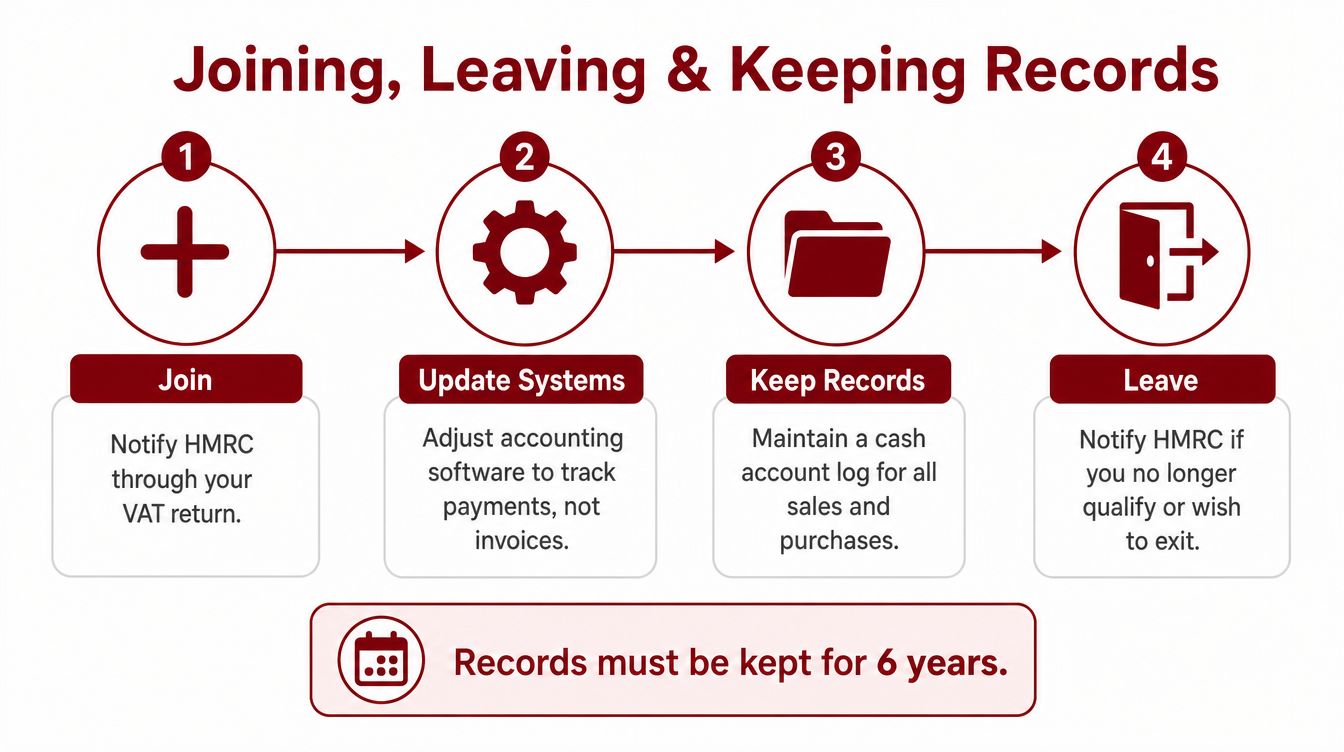
Treat the switch as an accounting-system project, not a tick box. Before joining, confirm your turnover estimate, review excluded transactions, and choose the start of a VAT accounting period that allows your records to be cleanly separated.
A controlled joining process
Confirm the decision. Compare expected customer receipts with supplier payments and consider whether the timing benefit outweighs delayed input VAT recovery.
Set the start date. Start from the beginning of an appropriate VAT accounting period. Keep a clear note of the date and the reason for the change.
Update the bookkeeping software. Configure the VAT method so the system uses payment dates rather than treating every invoice date as the VAT trigger. The exact menu depends on the software, so check its VAT cash accounting settings before posting transactions.
Review open invoices. Identify unpaid sales and purchase invoices at the changeover. Mark which transactions belong to the old method and which belong to the new one, so the same VAT isn't omitted or counted twice.
Reconcile the first return. Compare the VAT report with bank receipts, supplier payments, credit notes, and outstanding balances. A clean reconciliation is more valuable than a quick submission.
A business using SME invoicing automation software may find it easier to issue consistent invoices and follow up overdue balances, but automation doesn't replace the need to verify payment dates. Your VAT records must show what happened, not merely what the system expected to happen.
Returns and evidence
Under the scheme, pay close attention to boxes 1, 4, 6 and 7. HMRC's return guidance explains the special treatment, so your software report and accountant's working papers should agree with the figures submitted. Keep sales invoices, purchase invoices, bank statements, payment confirmations, credit notes, and a clear record linking each receipt or payment to the relevant transaction.
Common mistakes include:
- Reclaiming input VAT early: Don't claim purchase VAT merely because the supplier issued an invoice. Confirm that payment has been made.
- Applying the method universally: Check hire purchase, conditional sale, and other excluded arrangements separately.
- Ignoring part payments: Allocate receipts consistently and record the VAT accounted for at each payment stage.
- Losing the audit trail: Keep bank references and payment dates where a single payment covers several invoices.
- Forgetting debtor control: Review aged receivables regularly, because deferred VAT doesn't remove the need to collect the underlying debt.
If you leave voluntarily or must leave because you no longer qualify, plan the transition rather than switching settings without review. Outstanding debtors and creditors may require adjustment so VAT connected with earlier supplies is brought into the correct accounting treatment. Ask your accountant to prepare a transition schedule and reconcile it to the final cash-accounting return.
Sector Notes for Contractors Subcontractors and Landlords
A construction subcontractor may complete work for a main contractor, submit an application for payment, and wait while the commercial team checks the valuation. The subcontractor might also deal with CIS deductions, retentions, staged payments, and material costs. In that environment, cash accounting can help because output VAT follows money received rather than sitting as a cash requirement while the payment process continues.

The subcontractor still needs precise records. An application for payment isn't necessarily the same thing as a receipt, and a CIS deduction doesn't automatically answer the VAT question. The bookkeeping file should distinguish the gross invoice, amounts withheld or deducted, actual cash received, supplier payments, and any retention that remains outstanding.
A contractor with frequent upfront materials purchases may experience the opposite pressure. Cash accounting can postpone input VAT recovery until those suppliers are paid, so the owner should compare the delayed output liability with the delayed input claim rather than assuming the scheme always improves liquidity.
A landlord's timing can look different
Consider a landlord receiving regular rent while paying for repairs, management services, and professional fees. If rental receipts arrive promptly but repair invoices are settled under agreed supplier terms, the output-side timing advantage may be modest. The landlord should test whether delayed input VAT recovery affects the business more than the receipt timing helps it.
Property records also need careful classification. Rental arrangements, repairs, agent charges, and property-related supplies may not all have identical VAT treatment. Cash accounting changes the timing for eligible transactions, but it doesn't turn an otherwise non-recoverable or differently treated cost into recoverable input VAT.
The same decision works differently for each sector because the cash cycle differs. Contractors should track retentions and staged receipts. Landlords should match rent collections with repair and agent payments. Both need a clear list of excluded transactions and a monthly review of outstanding balances.
This short video provides another practical visual explanation of the scheme's timing and operating process:
Next Steps and How Action Accountants Can Help
The decision becomes clearer when you reduce it to three questions.
First, do you extend credit to customers? If invoices commonly remain unpaid while VAT would otherwise enter a return, cash accounting deserves serious consideration. If customers pay at once, the sales-side benefit may be limited.
Second, is your expected taxable turnover within HMRC's entry rules? Use a forward-looking forecast, not a casual glance at historic sales. Then put a recurring review in place so growth doesn't leave the business operating a scheme it can no longer use.
Third, will delayed input VAT recovery create a problem? List major purchases, supplier terms, equipment spending, and recurring costs. A business that pays suppliers after receiving customer cash may benefit from the timing. A business that pays substantial costs upfront may need a different answer.
A practical review checklist
- Export your aged receivables: Identify how long customers take to pay and which balances create the largest funding gaps.
- Review supplier terms: Compare the date you receive purchase invoices with the date you settle them.
- Check your software: Confirm that payment-based VAT reporting is available, enabled, and reconciled to bank transactions.
- List exclusions: Isolate hire purchase, conditional sale, and invoices with payment terms that fall outside the scheme.
- Set a turnover warning: Ask who will review projected taxable turnover and what action follows if the business approaches the exit point.
- Prepare questions for your accountant: Bring recent VAT returns, a customer ageing report, supplier balances, and your cash-flow forecast.
Action Accountants Limited can help businesses assess scheme choice, prepare VAT returns, maintain bookkeeping records, and connect VAT treatment with wider cash-flow planning. Its construction-focused support also considers CIS records and contractor payment cycles, while its accounting services can support landlords, sole traders, and growing companies across North West London and the wider UK.
You don't need to choose cash accounting because it sounds simpler. Choose it when the timing fits how your business collects money, pays suppliers, and controls its records. A short VAT health check can reveal whether the scheme would release working capital, delay useful input claims, or add controls your current system isn't ready to handle.
Speak with Action Accountants Limited about a VAT Cash Accounting Scheme review, payment-based bookkeeping setup, and VAT Return support suited to your customer and supplier cycles. Visit Action Accountants Limited to arrange practical guidance before you change your VAT method.