


Only 31% of construction projects came within 10% of their original budgets in the KPMG benchmark cited by Autodesk, which means roughly 69% missed that threshold. In practice, that's not a one-off failure rate, it's proof that construction cost management in the UK has to be treated as a live control system, not a once-a-month spreadsheet exercise. When materials, labour, change orders, and site conditions all move at different speeds, the contractor who waits for month-end is usually the one explaining the overrun.
Table of Contents
- Why Most UK Construction Projects Miss Their Budgets
- Building Accurate Cost Estimates and Realistic Budgets
- Job Costing and Daily Cost Tracking Systems
- Managing Variations and Change Orders Without Losing Margin
- Forecasting and Cash Flow Management for UK Projects
- CIS Compliance and Tax Considerations for Cost Management
- Key Performance Indicators and Reporting for Better Decisions
Why Most UK Construction Projects Miss Their Budgets
The budget problem starts long before the first lorry arrives on site. A tender can look tight on paper, then unravel as soon as the actual sequence of work, subcontractor availability, and lead times collide with real conditions. The historic UK inflation spike in 2021 to 2022 made that gap impossible to ignore, because construction output price inflation reached double digits at the peak according to the Office for National Statistics data referenced in the research brief, forcing contractors to reprice, renegotiate, and reforecast far more often than they were used to.

The structural reasons budgets drift
In the field, budget drift usually comes from a stack of small misses rather than one dramatic mistake. A quote is based on a price book that's already stale. A package is assumed to be straightforward, then site access changes, a subcontractor works out of sequence, or a design detail gets revised after procurement has already started.
That's why the best projects don't treat cost control as a finance department task. They tie estimating, procurement, valuation, and site reporting into one closed loop, so the team can see whether the budget is still alive or just being repeated from last month. A useful practical resource on this problem is stop cost overruns in construction, because it points contractors back to the operational habits that usually fail first.
Practical rule: if a cost issue can only be spotted in the monthly valuation pack, it's already too late to fix cheaply.
Why monthly reporting alone falls short
Monthly valuation is still common in UK project controls, but it's a lagging view. The ICONDA/CIB study in the brief says conventional monthly valuation analysis is used by 70% of respondents, which tells you how dominant the habit is, not how complete it is. A contractor who relies on month-end alone can miss rapid drift between reporting dates, especially when plant, labour, and subcontractor costs are moving independently.
The better operating model is simpler than most software vendors make it sound. Measure progress at fixed intervals, compare earned progress against actual cost, and force corrective action while there's still money left to protect. That approach fits the closed control cycle identified in the UK-based review, plan, implement, monitor, report variance, then correct, with cost estimating and budgeting strongest at the start, the Gantt chart most useful in execution, and final audits most valuable at close-out as summarised in the UK review.
Building Accurate Cost Estimates and Realistic Budgets
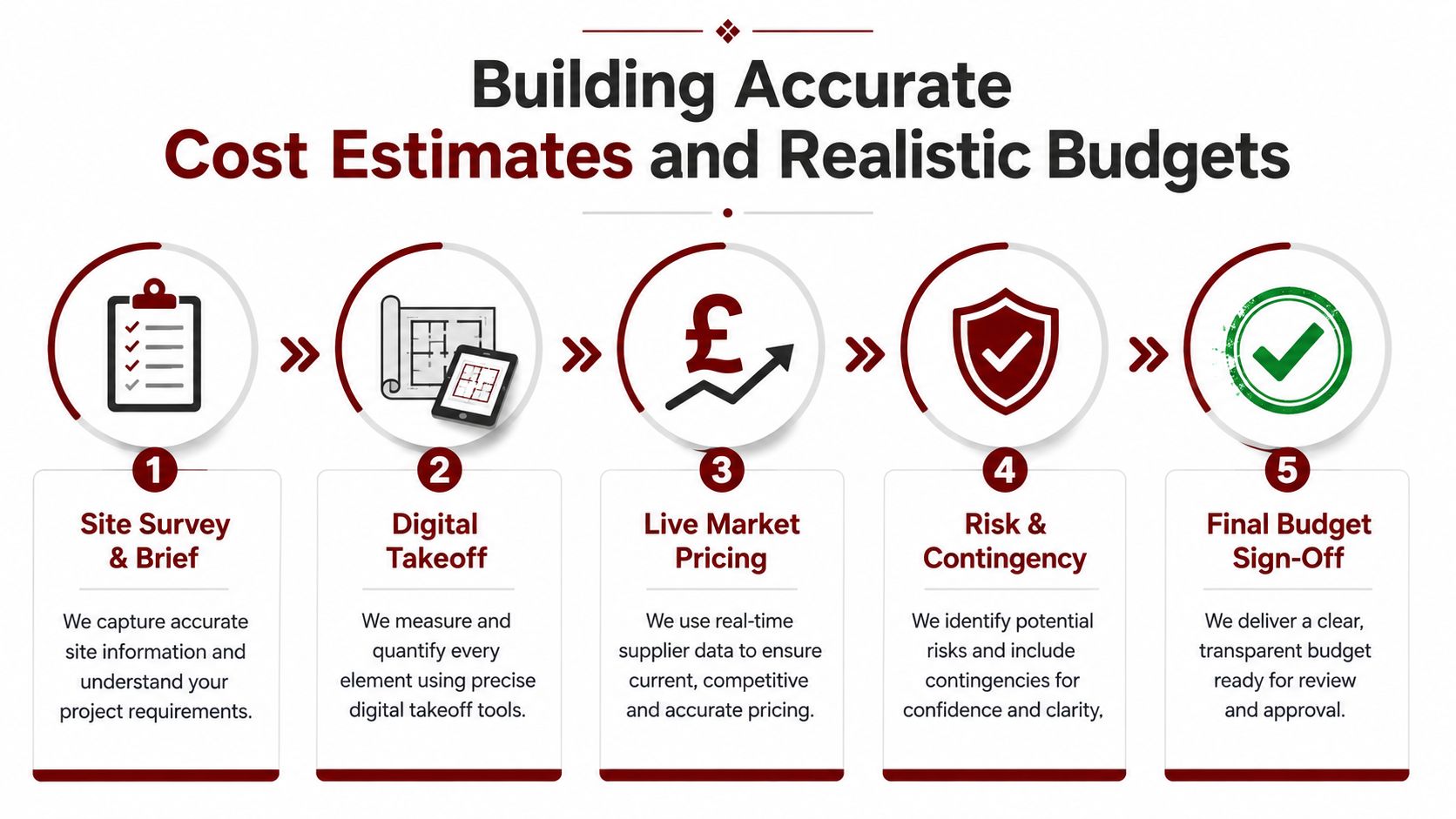
A budget that misses reality usually starts with guesswork at tender stage. In UK construction, the estimate has to reflect live supplier pricing, current subcontract quotations, labour availability, and whether the programme is deliverable with the resources on hand. A spreadsheet can look tidy and still fail on site.
Build the estimate from the site upwards
Start with the brief, the site survey, and the constraints that will affect labour and plant before you price a single item. Then move into digital takeoff, because manual quantity checks are where a lot of avoidable leakage starts. Once quantities are locked, test the numbers against live market pricing, not generic historic rates.
That sequence matters because it keeps the estimate tied to what can be built. A London contractor pricing façade access, waste removal, or night work on a constrained city-centre scheme will see quickly that the client's preferred programme can change the cost picture as much as the design itself. If the schedule is ambitious, say so early and price the consequence transparently rather than burying the risk in a thin contingency.
Use contingency as risk pricing, not decoration
Contingency works best when it is linked to specific risks, not applied as a flat padding exercise. Academic work on contingency management argues for sizing contingency by risk category, package, and design stage, which is much more useful than a generic allowance pasted onto every job as discussed in the contingency literature. That view matches what experienced UK contractors already see in practice, because the risk profile of groundworks, fit-out, and envelope packages is not the same.
A budget that hides uncertainty inside one lump sum is hard to defend, hard to track, and easy to exhaust.
The most practical budget structure is one that can be tracked from day one. Break the estimate into codes that match your site reporting, valuation structure, and management accounts. If the budget cannot be compared cleanly to actual spend later, it is not a control document, it is just an estimate.
For a useful reminder on how digital finance systems keep budgeting connected to live project data, see cloud accounting benefits. That matters because the budget only helps if the numbers can flow through the job quickly enough to inform decisions.
Make the client part of the realism check
A budget holds up better when the client understands the trade-offs. If lead times are uncertain or escalation clauses are needed, those issues should be agreed before the order is placed, not after procurement has exposed the gap. I have seen too many decent estimates damaged by optimism in the programme and silence in the pre-construction meeting.
If the client wants a fixed finish date and the market is volatile, you can still agree the job, but the commercial terms need to reflect that reality. A realistic budget is the one that can survive contact with procurement and the site team.
For contractors working across different markets, the same discipline applies. A practical comparison with forecasting success in Dubai shows the same principle at work, budget for the conditions you are likely to face, then test the assumptions against how the job will be delivered.
Job Costing and Daily Cost Tracking Systems
Daily cost tracking is where construction cost management stops being theory. If labour, materials, plant, and subcontractor spend aren't captured while the work is happening, the month-end close turns into archaeology. By then, the site team is guessing, the commercial team is reconciling, and the margin has already moved.
The most effective setup I've seen is one where site reporting and cost coding match each other exactly. That way, the foreman's daily diary, the buyer's order, the invoice, and the valuation all point to the same job code instead of three different versions of the truth. That sounds basic, but it's usually where weak systems fall apart.
What to track every day
Track labour hours against the right cost code, not just against the job as a whole. Record materials when they land, because deliveries often arrive before they're installed and the cash has already left the account. Keep plant usage visible, especially hired plant, because extension costs creep in when jobs slip.
A useful reference on construction accounting basics is construction accounting explained, particularly if your team still treats job costing as separate from bookkeeping. It isn't separate in practice. If the accounting entry and the site report don't match, your margin analysis is already contaminated.
Essential Job Costing Categories for UK Contractors
| Cost Category | Tracking Frequency | CIS Treatment | Common Pitfalls |
|---|---|---|---|
| Labour | Daily | Usually outside CIS for PAYE labour, but check worker status carefully | Time booked to the wrong job, unrecorded overtime |
| Materials | On delivery | No CIS deduction on materials alone | Deliveries accepted without matching the order |
| Plant and equipment | Daily or weekly | Usually no CIS on hire, but contract structure matters | Hire extensions hidden in admin codes |
| Subcontractors | Per application and payment | CIS deduction often applies, subject to verification and status | Paying before verification, poor gross payment checks |
| Variations | At instruction and approval | Same treatment as the underlying package | Scope changes added later and never re-coded |
Keep the field and office on the same clock
Daily site reports matter because they turn memory into evidence. The report should show what was completed, what was delivered, what changed, and what still needs pricing. Monthly reconciling is fine for statutory reporting, but it's a poor substitute for real control.
Field rule: if a subcontractor is about to leave site and the extra work isn't logged, priced, and coded that day, recoverability drops sharply.
If your team is still fighting duplicate entry, the operational fix is to integrate the systems rather than ask people to retype the same data twice. A practical starting point is accounting software integration, because the less friction there is between site, accounts, and valuations, the better the data quality becomes.
Managing Variations and Change Orders Without Losing Margin
Variations don't destroy margin by existing. They destroy margin when they're done first and priced later, or worse, priced never. On UK jobs, that usually happens when site teams try to keep the client happy by “just getting on with it”, then discover the commercial paper trail is too weak to recover the cost.
The contractor's position should be simple. No approved scope change, no silent extra work. If the instruction affects time, cost, or sequence, it needs to be logged before the team commits labour or orders materials.
Price the change before the work starts
A proper variation process asks three questions. What exactly changed, what does it cost in labour, material, plant, and preliminaries, and what is the schedule impact? If you can't answer all three, the variation isn't ready for approval.
A lot of margin erosion happens on “small” client requests, because they feel low-risk and get handled informally. Extra sockets, upgraded finishes, revised access arrangements, or late compliance changes all look manageable in isolation. Together, they can consume the contingency and distort the programme.
Treat scope creep as a commercial event
Unforeseen site conditions need the same discipline. If the ground is worse than expected, if existing services are different from the record drawings, or if a regulatory requirement changes the installation method, the team should stop and document the implication. The site manager doesn't need to write a legal letter, but they do need enough evidence to support a fair price and a time extension.
A variation log should hold the instruction date, description, quotation status, approval status, and the job code it sits against. Without that structure, people start relying on emails and memory, and both are unreliable when the final account arrives.
Commercial reality: the cheapest variation is the one agreed before anyone opens a bag of materials.
Contractors who protect margin usually do one thing differently. They negotiate time and money together, not separately. If a change affects access, sequencing, or procurement, the time consequence belongs in the same conversation as the price.
Forecasting and Cash Flow Management for UK Projects
Forecasting is where project cost control becomes bank balance control. A job can look profitable on paper and still strain cash if valuation timing, retention, CIS deductions, VAT, and payment terms are not modelled properly. That gap matters because cash flow failures often arrive before the final account does.
Forecast beyond the valuation date
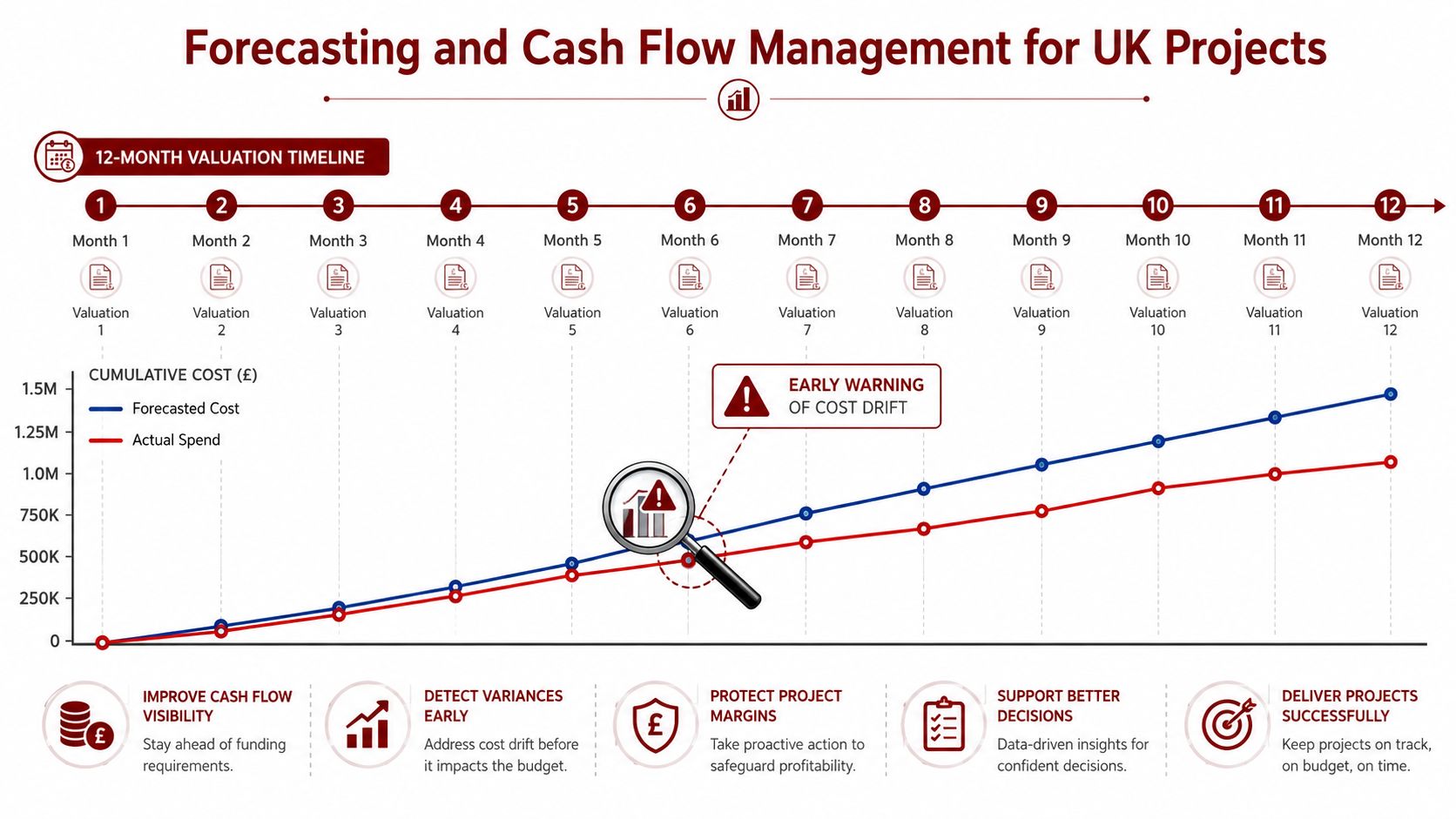
Monthly valuations remain useful, but they're not enough on their own. The ICONDA/CIB data in the brief shows monthly valuation is widely used, yet the same practical pattern also creates a blind spot between reporting points. The answer is not to abandon valuations, it's to supplement them with more frequent internal reviews tied to the work breakdown structure.
That means comparing earned progress against actual cost at fixed intervals, even if the external valuation date hasn't arrived. If a package is moving faster than planned, or a supplier price has shifted, the forecast should change immediately. Waiting until the formal month-end pack turns a manageable drift into a surprise.
Build the cash view the way the money actually moves
Retention, CIS deductions, VAT timing, and client payment terms all change the shape of cash. If you only forecast billed value and ignore the deductions and timing differences, your project P&L and your bank position will never quite line up. On UK jobs, that mismatch is one of the most common reasons owners feel profitable on paper but tight in practice.
Forecast the cash, not just the invoice.
The most useful forecast is rolling, not static. It should update for programme slips, late approvals, unpriced variations, and any material cost movement that changes the remaining work. That sounds like extra admin, but it's cheaper than funding a surprise from overdraft pressure.
For a deeper operational look at this discipline, cash flow forecasting is worth reviewing because the task is not just predicting receipts, it's understanding when the project becomes cash negative and why.
CIS Compliance and Tax Considerations for Cost Management
CIS, VAT, and cost control shouldn't live in different systems. If the commercial team tracks spend one way and the accounts team processes subcontractors another way, you'll end up with avoidable errors, weak audit trails, and a valuation pack that doesn't agree with HMRC records. In construction, compliance is part of cost management, not a separate back-office chore.
Build CIS checks into the payment workflow
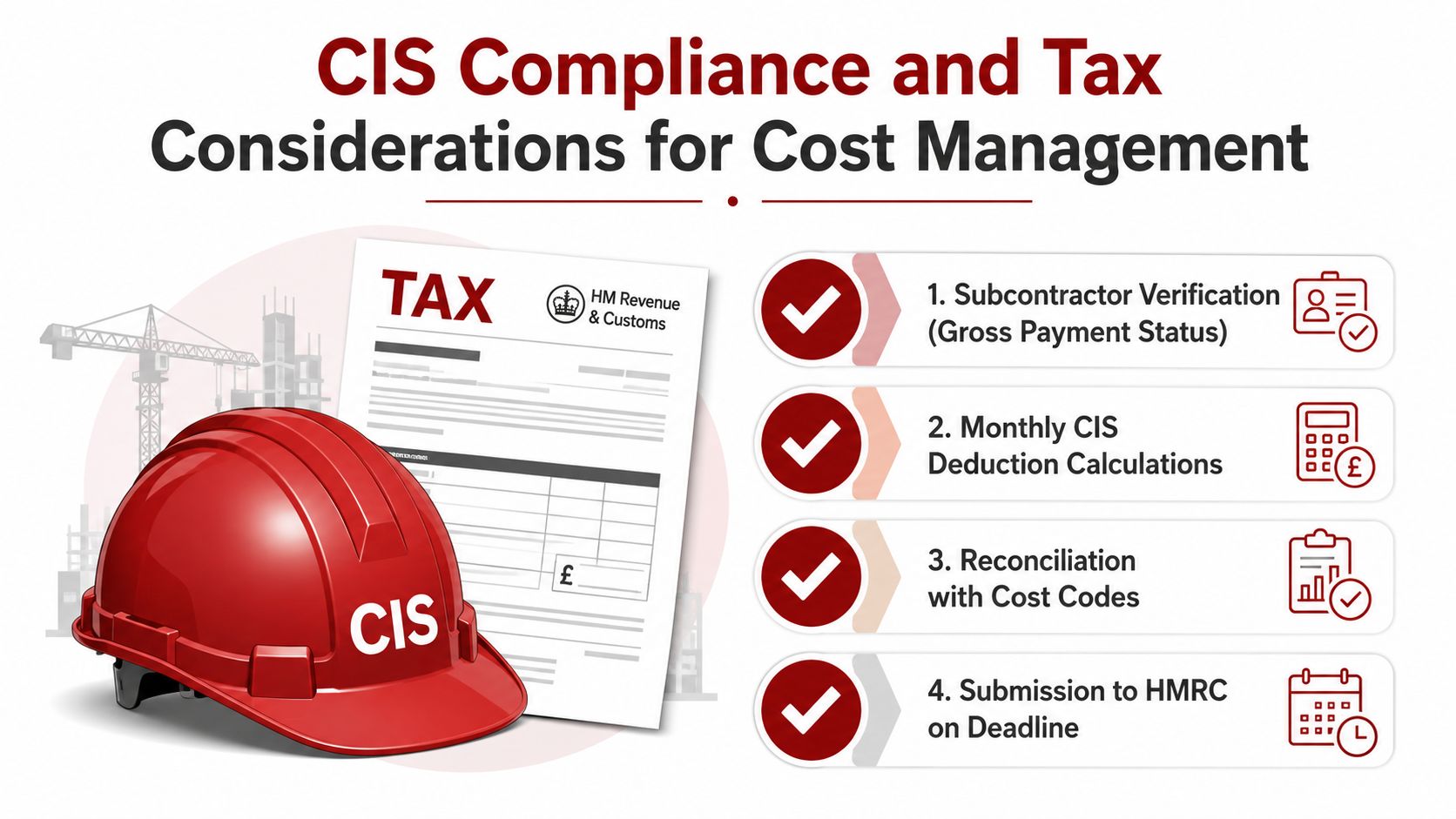
The cleanest system verifies subcontractors before payment, calculates deductions correctly, reconciles the deduction back to the cost code, and submits the return on time. If verification is done later, the payment run is already at risk. If the deduction isn't linked back to the job code, margin reporting becomes messy and the CIS trail is harder to defend.
That's why the payment process should never be detached from the job cost ledger. The person approving the invoice needs to know whether the labour element is deductible, whether materials are separated properly, and whether the subcontractor status has been checked. If those steps happen in different places, errors multiply fast.
VAT reverse charge needs to be forecasted, not guessed
The VAT reverse charge changes how cash moves, so it has to be part of the forecast from the start. Mixed-supply contracts can make that harder, because labour, materials, and subcontracted elements may not all sit in the same treatment bucket. The practical fix is to code the work clearly at the point of commitment, not after the invoice lands.
For monthly administration, CIS monthly returns is the relevant operational checkpoint because the return, deduction, and reconciliation all need to line up before the period closes. That discipline protects both the numbers and the compliance position.
CIS and tax checklist for contractors
- Verify subcontractors early. Do this before the first payment, not after the invoice run.
- Separate materials from labour. Mixed invoices need clear breakdowns if you want the deduction and the margin to be right.
- Reconcile deductions to job codes. If CIS sits in a suspense account for too long, your project figures become unreliable.
- Review payment timing. Tax processes affect cash flow, so the forecast should reflect the actual deduction and remittance cycle.
The contractors who stay out of trouble usually share one habit. They treat every subcontractor payment as both a commercial event and a compliance event. That dual view saves time later, especially when HMRC asks for records and the job file already tells the same story as the ledger.
Key Performance Indicators and Reporting for Better Decisions
Good reporting doesn't flood people with data, it tells them where the money is leaking. The key is to use a small set of KPIs that match the decision each audience needs to make. Site teams need speed, commercial teams need accuracy, and clients need clear valuation commentary without the internal noise.
Pick KPIs that force action
Cost variance tells you whether the job is drifting. Earned value tells you whether progress has been converted into value efficiently. Labour productivity and subcontractor performance tell you where the site is losing time or paying for underperformance.
The reporting pack should also show whether the problem is isolated or systemic. One bad package can be managed. Repeated variance across several packages usually means the estimate, procurement, or site control process needs attention.
Match the reporting cadence to the risk
Daily reports suit live site control, weekly reviews suit internal commercial oversight, and monthly packs suit valuation and stakeholder communication. The mistake is using one cadence for everything. That's how teams either drown in reports or discover issues too late to recover them.
The best dashboard is the one the project manager actually opens before the damage spreads.
Keep the dashboard short. Show the current budget, committed cost, actual cost, forecast final cost, and the few exception items that need a decision. If a dashboard looks impressive but no one can tell what to do next, it's decoration, not management.
For contractors in the UK, that last mile matters because the reporting must satisfy both the project team and the compliance trail. The numbers need to support the valuation, the CIS record, and the forecast at the same time, otherwise the system will work in fragments instead of as a control loop.
Action Accountants Limited helps construction contractors build accounting and compliance systems that keep the commercial numbers and the HMRC trail aligned. If you want clearer job costing, tighter CIS controls, and better cash flow visibility on real projects, visit Action Accountants Limited to see how their team can support your next job.