
Business Exit Plan: A UK SME’s Guide to a Profitable Exit
Action Accountants •12 June 2026
You might be at that awkward point where the business looks healthy from the outside, but a hard question keeps surfacing in quiet moments. If you stepped back in a year, could someone else buy it, run it, or inherit it without you holding the whole thing together?
That question catches more owners than they expect. Contractors often realise the client relationships sit with them personally. Startup founders discover the product roadmap is in their head, not in board papers or documented processes. Family business owners know the company has value, but not whether that value can be transferred cleanly. A proper business exit plan deals with that now, not when a buyer appears or retirement suddenly feels close.
Done properly, exit planning sharpens how you run the company today. It pushes you to organise financial records, tighten compliance, reduce owner dependency, and choose a structure that supports your eventual route out. If you want a practical companion piece on the money side, this guide to financial strategies for business exit is a useful place to compare funding, tax, and transition considerations alongside your operational planning.
Table of Contents
- Why Your Exit Plan Is Your Most Important Business Strategy
- Mapping Your Four Main Exit Routes in the UK
- How to Value Your Business and Maximise Its Worth
- Navigating Critical UK Tax and Legal Hurdles
- Your Playbook for Due Diligence and Negotiation
- A Business Exit Plan Checklist and Action Timeline
Why Your Exit Plan Is Your Most Important Business Strategy
A business exit plan isn't a retirement memo. It's one of the clearest tests of whether you are building a business or merely carrying a demanding role with overheads attached.
That distinction matters in the UK because founder-led and family-led firms dominate the business sector. The Institute for Family Business estimated that around 4.8 million family businesses operated in the UK in 2018, accounting for roughly 88% of all private-sector firms, according to this business exit planning overview. Exit planning therefore isn't a niche exercise for larger corporates. It's a live issue for ordinary owner-managers across London and the rest of the UK.
The business you can exit is usually the better business to run
When an owner starts planning for an eventual handover, several useful things happen at once. Reporting gets cleaner. Decision-making becomes less dependent on one person. Contracts, payroll, VAT, and company records get reviewed with more discipline. Those are not just sale-preparation tasks. They improve control, reduce risk, and make the company easier to finance, manage, and grow.
A landlord with a small property company needs records and tax clarity if shares are ever transferred. A construction firm needs CIS processes that stand up to scrutiny if a buyer reviews historic compliance. A startup aiming for acquisition needs its cap table, IP ownership, and incentive arrangements in order well before conversations begin.
Practical rule: If the business can't function for a few weeks without you solving every major issue, it probably isn't exit-ready.
An exit plan forces better choices earlier
Owners often think the exit comes later, after the core work is done. In practice, the exit route influences today's structure. If you're still deciding between trading personally or through a company, the legal and tax consequences can shape future transfer options, so it helps to understand the difference between limited company and sole trader arrangements before the business becomes more complex.
A sound business exit plan usually answers these questions early:
- What does success look like: Maximum cash on sale, family continuity, staff handover, or a gradual step-back with income retained.
- Who could realistically take over: A trade buyer, management team, family member, investor, or no one.
- What would a buyer dislike today: Owner dependency, weak margins, messy records, unresolved tax points, or poor contracts.
- What needs fixing first: Governance, recurring revenue, cash conversion, and compliance.
An owner who plans for transferability tends to build a stronger company long before any sale. That's why exit planning belongs in strategy meetings, not in a drawer marked “later”.
Mapping Your Four Main Exit Routes in the UK
The right route depends less on what sounds attractive and more on what fits your business, your personal goals, and your tax position. UK guidance for owners stresses that valuation, tax exposure, and successor selection must be addressed early, with decisions made before leadership change or sale discussions begin, as explained in this exit planning guidance for business owners.
A profitable software company, a contractor-led consultancy, and a family trading company can all be good businesses. They just don't exit in the same way.
| Exit Route | Best For | Value Potential | Speed | Tax Efficiency |
|---|---|---|---|---|
| Trade Sale | Startups, niche firms, scalable SMEs | Often strongest where there is strategic fit | Moderate | Depends on structure and reliefs |
| Management Buyout | Stable companies with capable leadership below owner level | Often solid, though funding can constrain price | Moderate to slower | Depends on funding and share structure |
| Family Succession | Family-led firms with willing next-generation successors | Can preserve legacy more than maximise headline price | Usually slower | Depends on succession and estate planning |
| Members Voluntary Liquidation | Solvent companies where closure is the chosen route | Realisation of remaining value, not a premium sale | Often structured and orderly | Can be efficient if planned correctly |
Trade sale
A trade sale means selling to another company. This suits businesses with something a buyer can use immediately. That might be a client base, specialist team, software product, route to market, regulated capability, or regional presence.
For startups, this route can be attractive when a larger acquirer values the technology or customer relationships more than a financial buyer would. For SMEs, trade buyers often care about integration risk. If your systems are messy, contracts are inconsistent, or the owner controls every commercial relationship, enthusiasm fades quickly.
Trade sale works well when:
- The business has strategic value: Strong niche, protected know-how, or reliable clients.
- The owner can demonstrate continuity: The company should continue after the founder steps back.
- Confidentiality is managed carefully: Staff and customers don't need sale rumours before terms are mature.
Management buyout
An MBO involves the management team buying the company, usually with some combination of personal commitment, staged payments, or external finance. It often suits service businesses where trusted managers already run day-to-day operations.
This route can preserve culture and client relationships. It can also be more realistic than a trade sale if the company is closely tied to specialist know-how but already has internal leadership depth. The downside is price tension. Managers know the risks because they live them. Funding can also limit how much can be paid upfront.
Management buyouts work best when the owner has genuinely delegated authority before the process starts.
Family succession
Family succession isn't just gifting shares and hoping things settle. It only works where the successor wants the role, can carry the responsibility, and is accepted by staff, customers, and suppliers.
For many family firms, this route protects continuity and identity. It can also reduce disruption compared with selling externally. But it often creates difficult conversations about fairness between family members, control versus ownership, and the difference between inheritance and earned leadership.
Watch for these pressure points:
- Role clarity: Ownership and management don't have to pass to the same person.
- Documentation: Shareholder arrangements, wills, and authority limits need to line up.
- Capability: Good intentions don't replace leadership readiness.
Members voluntary liquidation
A Members' Voluntary Liquidation is not a sale. It's a planned closure of a solvent company. This route can make sense where the owner wants to wind down on their terms, extract remaining value, and stop trading cleanly.
It's often relevant for consultants, contractors, or founders whose company has cash reserves but no obvious buyer. It can also suit businesses where the owner has decided not to pursue succession or sale because the company depends too heavily on them personally.
The common mistake is assuming every profitable company should be sold. Some shouldn't. A realistic business exit plan includes the possibility that an orderly close produces a better outcome than an overstretched attempt to market an unsellable business.
How to Value Your Business and Maximise Its Worth
Valuation isn't just a formula. It's a judgment about future earnings, risk, and how easy the business will be to transfer.
Buyers do use recognised methods. They may look at earnings multiples, future cash flow, asset backing, or a blend of methods. But the headline method matters less than the evidence underneath it. In UK exits, the stronger outcomes tend to come from structured preparation around valuation and due diligence, with financial statements, tax returns, and forecasts ready in advance, as noted in this practical guide to exit preparation.
What buyers are really valuing
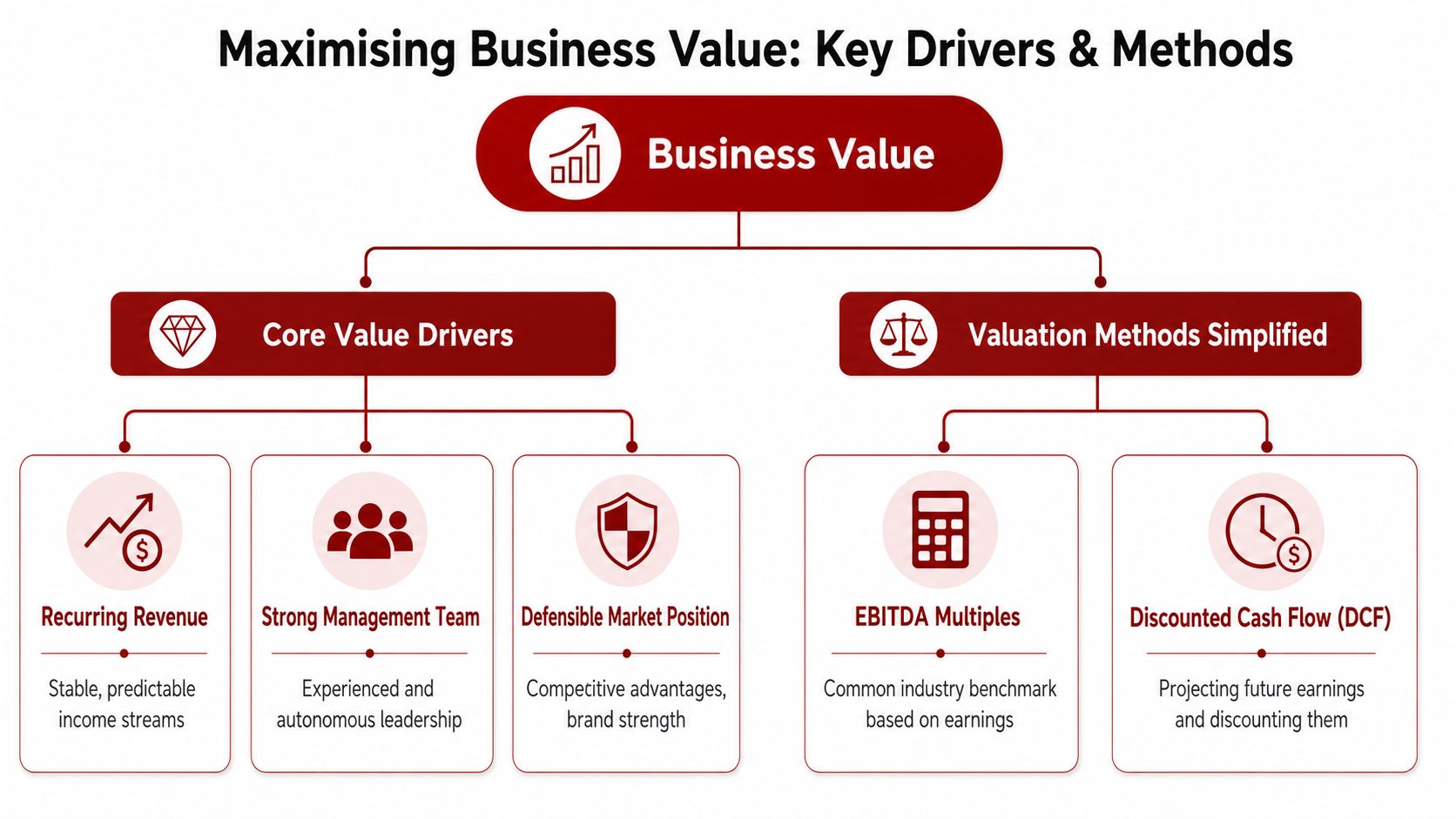
A buyer isn't purchasing your past effort. They are purchasing a stream of future benefit with manageable risk.
That is why two companies with similar turnover can attract very different interest. One has tidy monthly reporting, customer contracts that renew, a trained team, and stable margins. The other relies on the founder, invoices irregularly, and has weak records for VAT, payroll, and debtor control. They are not worth the same in the market.
The value drivers that come up repeatedly are practical:
- Recurring income: Service agreements, retainers, subscriptions, or repeatable contracts reduce uncertainty.
- Owner independence: Buyers pay more comfortably when delivery and sales don't collapse without the founder.
- Defensible position: IP ownership, technical expertise, accreditations, or a strong reputation can protect margins.
- Clean records: If your numbers don't reconcile, buyers assume risk and reduce price.
- Working capital discipline: Late billing, disputed debtors, and stock problems often surface late and hurt negotiations.
For many smaller firms, a good accountant adds value here long before the sale. Work such as management accounts, cash flow forecasting, tax planning, and system discipline often makes the business easier to value. This overview of ways an accountant can help your small business is a fair reminder that value is built in routine decisions, not just in the sale process.
Practical ways to improve value before a sale
The fastest way to depress value is to leave obvious gaps. Buyers notice inconsistency quickly.
A contractor who lives on one-off projects should try to secure longer-term maintenance or support agreements where commercially sensible. A startup should document who owns the IP, who wrote the code, and what licence terms apply. A family business should separate personal expenses from company expenses well before any valuation exercise.
Buyers rarely object to normal business imperfections. They object to uncertainty they cannot price.
A useful pre-sale discipline is to review the business as if you were buying it yourself:
- Open the accounts file first: Are the numbers clear, current, and explained?
- Check dependency risk: Which customers, suppliers, or staff create concentration risk?
- Review contracts: Are terms signed, current, and transferable?
- Test reporting quality: Can you show trends in revenue, margin, and cash with confidence?
- List unresolved issues: Tax queries, legal disputes, payroll corrections, and compliance gaps need action, not wishful thinking.
Owners often wait for a buyer to “see the potential”. Serious buyers don't pay for vague potential. They pay for documented performance, lower risk, and a business they can take over without unpleasant surprises.
Navigating Critical UK Tax and Legal Hurdles
A business can be commercially attractive and still produce a disappointing personal outcome if tax planning starts too late. This is the part owners often underestimate.
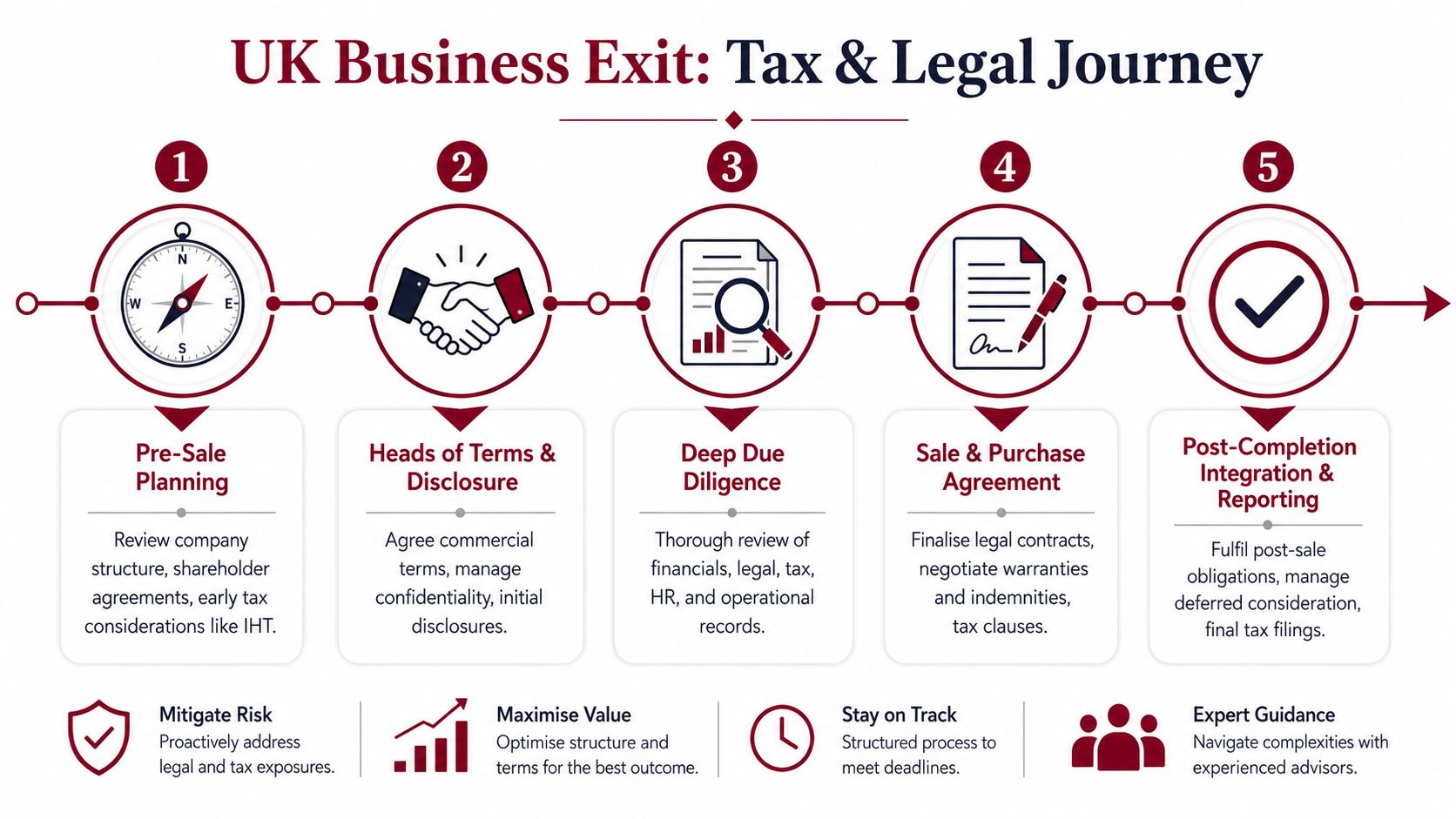
In the UK, one major milestone is Business Asset Disposal Relief, which replaced Entrepreneurs' Relief in April 2020 and reduced the capital gains tax rate on qualifying disposals to 10%, capped at £1 million of lifetime qualifying gains, according to this BADR summary for owner-managers. That makes structure and timing central to a profitable exit.
BADR and why timing matters
BADR can materially improve the tax result on a qualifying disposal, but owners get into trouble when they assume it applies automatically. It doesn't. Eligibility depends on the facts, the legal structure, and whether the relevant conditions are met.
That is why a late-stage rush is risky. If shares are held in the wrong way, if the trading status is not straightforward, or if the disposal route changes mid-process, the tax position can shift. Founders often need to decide well in advance whether a future sale is likely to be a share sale, business asset sale, succession arrangement, or wind-down.
A further complication is the changing rate environment. One UK-focused guide notes that the CGT rate on eligible BADR disposals is set to rise from 10% to 14% in April 2025 and is scheduled to rise to 18% in April 2026, while HMRC reports BADR cost the Exchequer about £1.6 billion in 2023-24, as outlined in this discussion of business sale tax strategies. If you're considering a staged exit or sale timetable, future changes like that affect planning.
The deal structure can change the outcome
Owners often focus on price and ignore structure until solicitors get involved. That's backwards.
A share sale and an asset sale can lead to very different tax and practical results. Buyers may prefer assets if they want to avoid historic liabilities. Sellers often prefer shares if the tax treatment is more favourable and the transfer is cleaner. The right answer depends on the company, its history, and what risks a buyer is inheriting.
There are also legal and tax details that need checking early:
- Shareholder position: Who owns what, and are there any restrictions or informal promises?
- Directors' loan account: An unresolved balance can become a sticking point in diligence, and many owners only realise late how sensitive this is. It helps to understand what a directors' loan account is before terms are negotiated.
- Employee incentives: For startups, an Enterprise Management Incentive plan can be useful, but only if it has been set up and documented properly before exit discussions intensify.
- Estate and succession consequences: A family transfer may satisfy personal aims but produce complexity if ownership, control, and tax planning are not aligned.
The tax answer is rarely “sell and sort it out later”. By that point, most of the meaningful choices have already been made.
Compliance problems buyers spot quickly
Tax efficiency doesn't rescue weak compliance. Buyers look for signs that the business has been run in a disciplined way.
For construction companies, CIS records matter because they show whether subcontractor reporting and deductions have been handled properly. For startups, buyers usually want to see consistent payroll treatment, option documentation, and evidence that the company owns the key assets it claims to own. For contractors and consultants, a company that mixes personal and business expenditure without clear treatment will attract uncomfortable questions.
A practical legal review should include:
- Company records: Statutory books, share allotments, PSC entries, and board approvals.
- Tax files: Corporation tax, VAT, PAYE, and any open queries.
- Customer and supplier contracts: Transfer provisions, termination rights, and change-of-control clauses.
- Employment records: Contracts, restrictive covenants, and incentive arrangements.
- Regulatory or sector files: CIS, licences, permissions, accreditations, or landlord obligations where relevant.
The earlier you identify these issues, the more choices you keep. Leave them until heads of terms are signed, and they stop being planning matters. They become negotiating weaknesses.
Your Playbook for Due Diligence and Negotiation
Due diligence feels intimidating mainly when owners meet it for the first time under time pressure. In reality, it is just a structured request for proof.
A buyer wants evidence that the business they are buying matches the story they have been told. If your business exit plan is credible, much of this work should already be underway. Some owners also find it useful to review newer tools that can accelerate document review and issue spotting. This guide to explore AI due diligence with OdysseyGPT gives a practical look at that side of the process.

Build the data room before anyone asks
A data room is an organised place where sale documents are stored and shared securely. It should not be assembled in a panic after buyer interest arrives.
The basic contents usually include accounts, tax returns, management information, contracts, employee records, company documents, and key commercial information. For smaller owner-managed businesses, the issue isn't usually lack of documents. It's that they are scattered across inboxes, old folders, and advisers' files.
Use a simple checklist:
- Financial records: Statutory accounts, management accounts, forecasts, bank information, and working capital detail.
- Tax documents: VAT returns, PAYE records, corporation tax filings, and correspondence on any unresolved points.
- Legal papers: Incorporation records, shareholder agreements, leases, loan documents, and insurance.
- Commercial evidence: Customer agreements, supplier contracts, pipeline information, and renewal patterns.
- People records: Employment contracts, payroll schedules, and incentive documents.
If core customer contracts are weak or outdated, that needs fixing before diligence starts. This practical guide to creating business contracts is worth reviewing because contract quality affects both buyer confidence and enforceability.
Negotiate from evidence not optimism
Owners lose advantage when they improvise answers. Good preparation gives you options.
Know your essential terms before heads of terms move forward. That may include minimum cash at completion, limits on earn-out exposure, the scope of warranties, or how long you stay involved post-sale. Buyers will press on uncertainty. If margins fluctuate, explain why with records. If a major customer is concentrated, show contract tenure and mitigation.
A few rules consistently help:
- Answer carefully: Fast but inaccurate responses create more problems than a short delay.
- Use advisers as a buffer: Let your accountant and solicitor handle technical pushback where needed.
- Keep a live issues list: Track what has been requested, answered, and still needs support.
- Separate price from terms: A strong headline number can be weakened by deferred payments or broad indemnities.
A smooth diligence process doesn't just reduce stress. It protects value because buyers have less room to argue that the risk is greater than first expected.
A Business Exit Plan Checklist and Action Timeline
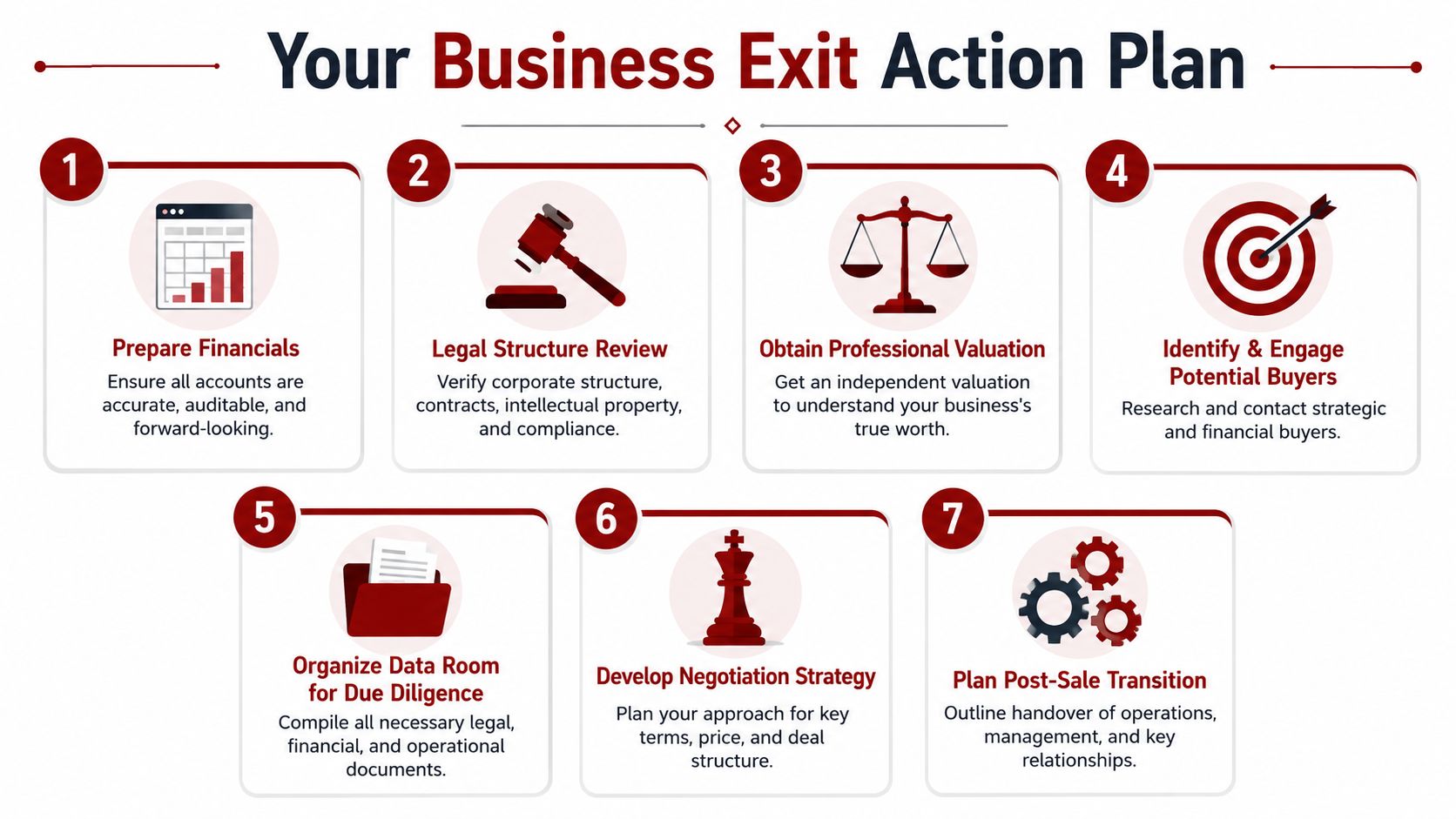
Most owners don't need a perfect plan on day one. They need a timeline that turns a vague ambition into decisions, documents, and deadlines.
This visual checklist is a useful way to think about the sequence.
Five years out and earlier
- Define the personal outcome: Decide whether you want a sale, succession, phased withdrawal, or solvent close.
- Reduce owner dependency: Hand off operational responsibility and document recurring decisions.
- Clean up records: Separate personal items from business accounts and tighten routine reporting.
Three to five years out
- Review tax structure: Test whether your intended route still fits the company and shareholder position.
- Build transferable value: Improve contract quality, recurring revenue, governance, and team depth.
- Prepare successors: If management or family will take over, make that transition visible in practice.
A healthy business can still become difficult to transfer if these years are wasted. This is often where value is either built properly or eroded.
One to two years out
- Get a realistic valuation: Use it to identify weak points, not just to chase a flattering number.
- Appoint advisers early: Accountants and solicitors need time to fix issues before a buyer sees them.
- Start assembling the data room: Don't wait until exclusivity.
This short video gives a helpful overview of the planning mindset:
The final year
- Approach the right buyers or route: Be selective and keep confidentiality tight.
- Control negotiation scope: Focus on net outcome, not headline price alone.
- Plan the handover: Customer introductions, staff communication, and post-sale obligations should be agreed before completion.
A business exit plan works best when it stays live. Review it after structural changes, major hires, funding rounds, acquisitions, or shifts in personal goals.
If you're planning a sale, succession, contractor wind-down, or want to determine whether your business is exit-ready, Action Accountants Limited can help you review the numbers, structure, tax position, and compliance risks before they become costly problems. They support businesses across North West London and the wider UK with practical accounting, tax, and advisory work that helps owners exit on better terms.