
What Is Directors Loan Account
Action Accountants •10 June 2026
A director's loan account (DLA) is a record of all money you, as a director, have taken from or loaned to your limited company, excluding salary and dividends. If that account is overdrawn and not cleared within 9 months and 1 day after your accounting period, the company can face Section 455 tax at 33.75%, and once the balance goes over £10,000 it can also create a benefit-in-kind issue.
If you're running a small limited company, you've probably already used a DLA without calling it that. You paid for something personally because the company bank balance was tight. Or you moved money from the business account to your personal account and told yourself you'd sort it later. Or the company paid for something that wasn't really a business cost.
That is exactly where directors get into trouble. Not because these movements always break the rules, but because casual money movements become formal tax and company law issues very quickly. Used properly, a DLA gives owner-managed businesses flexibility. Used badly, it creates avoidable tax bills, messy accounts, and pressure right when cash flow is already stretched.
Table of Contents
- The Everyday Transactions That Create a Directors Loan
- Defining the Directors Loan Account
- How a Directors Loan Becomes Overdrawn
- The Tax Consequences You Cannot Ignore
- Common DLA Mistakes and How to Avoid Them
- Smart DLA Management for Your Business Type
- When to Partner with an Accountant
The Everyday Transactions That Create a Directors Loan
A founder uses the company card to pay for a family meal. Another pays a supplier from a personal card because the business account is short that week. A third transfers money from the company account to cover rent and plans to “put it back next month”. Those are the everyday movements that create a DLA.
The point isn't that every mixed transaction is wrong. The point is that every one of them needs to land somewhere in the records. HMRC expects companies to keep a ledger of money moving between the company and each director, including cash withdrawals, personal bills paid by the company, expenses reimbursed, and loans made by the director to the company, as set out in the UK guidance on directors' loans.
For new business owners, the DLA often starts innocently. The company is young, cash is uneven, and the director is wearing every hat. Personal and company spending begin to blur, especially if bookkeeping is done after the event.
Keep this rule in mind. If the payment isn't clearly salary, dividend, or expense repayment, ask whether it belongs in the DLA.
That is why the discipline to separate business and personal expenses matters so much. It is not just tidy bookkeeping. It protects the company from misstatements and protects the director from a surprise tax problem later.
In practice, the businesses that stay in control treat the DLA like a live management tool, not a year-end clean-up job. They review it regularly, question unusual entries early, and avoid using the company bank account as a substitute personal account. That approach supports better financial habits across the board, especially if you're also thinking seriously about spending smart to grow fast.
Defining the Directors Loan Account
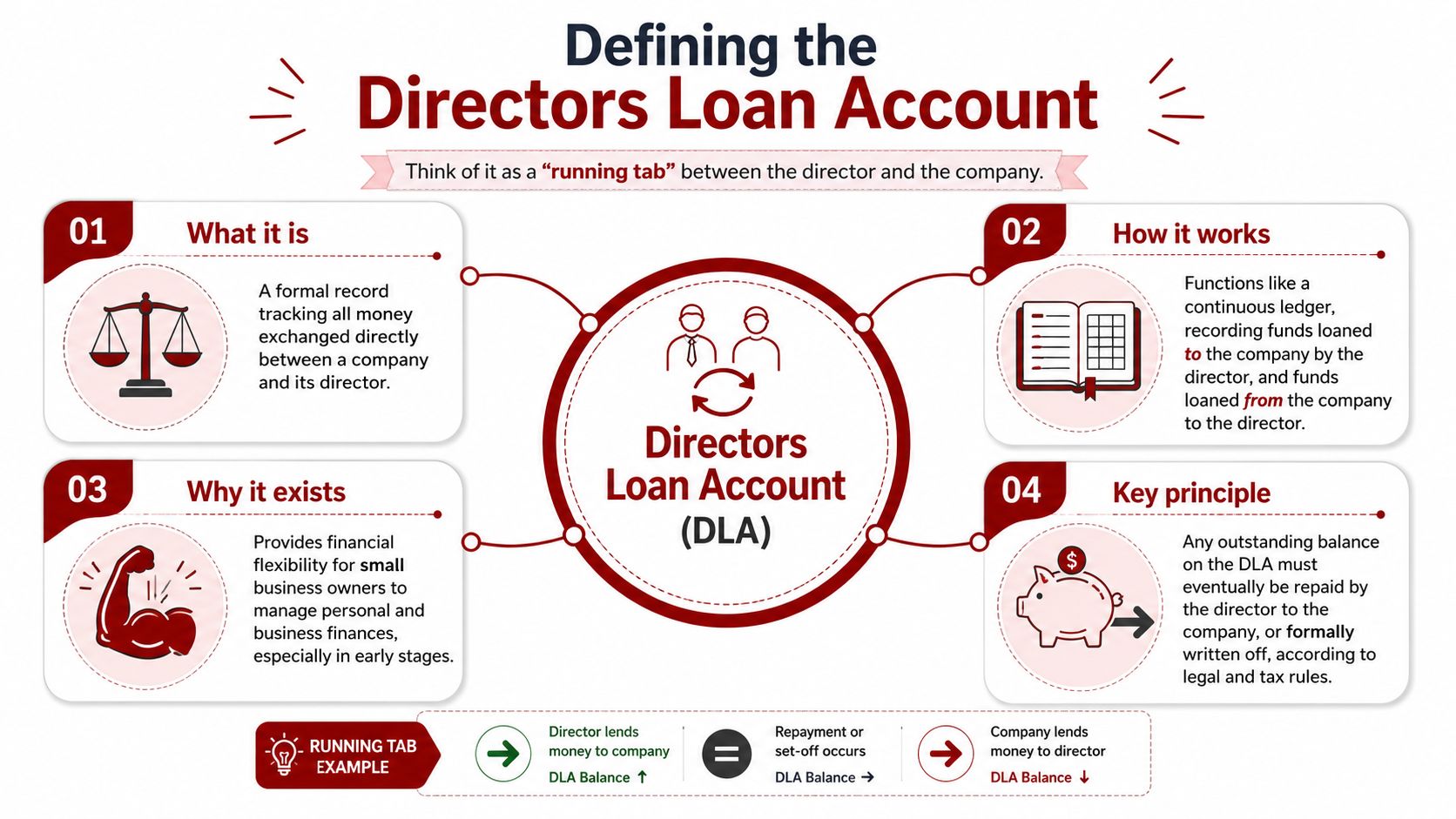
A DLA is not a tax trick, and it is not a spare bucket where uncertain transactions disappear. It is a formal record.
Under the UK rules, a director's loan account tracks money a director takes from or puts into a company that is not salary, dividend, or expense repayment. The government fact sheet also makes clear that each director should have their own separate account showing cash withdrawals and personal expenses paid with company money, and notes the historical shift that before the Companies Act 2006 overdrawn DLAs were described as illegal, whereas the current framework allows them but under strict reporting and repayment rules, with £10,000 being a key compliance threshold in practice, as explained in the government fact sheet on directors' loan accounts.
Think of it as a running tab
The easiest way to understand what is directors loan account is to think of it as a running tab between you and your company.
If you put your own money into the business, the company owes you. If you take money out that isn't salary or dividends, you owe the company. The DLA records that movement and shows the position at any point in time.
That matters for more than bookkeeping. The year-end balance affects compliance, tax treatment, and how credible your records look if anyone ever asks how a transaction was classified.
What belongs in the DLA and what does not
These are the entries that usually belong in the DLA:
- Money you lend to the company. This often happens at start-up when the business needs working capital before sales are steady.
- Cash you take out for personal use. If there is no payroll or dividend paperwork behind it, it usually belongs here.
- Personal bills the company pays. That includes private spending that accidentally goes through the company card or account.
- Business costs you paid personally. If the company owes you and it isn't being processed as a standard expense repayment entry, it may pass through the DLA depending on the bookkeeping setup.
These usually do not belong in the DLA:
| Transaction type | Normal treatment |
|---|---|
| Salary | Payroll |
| Dividend | Dividend paperwork and company records |
| Proper expense reimbursement | Expense claim and repayment record |
Working rule: The DLA should explain informal money movements formally. If it cannot, the records are already weak.
A good DLA gives a director flexibility. A bad DLA becomes a dumping ground for uncoded transactions. That difference is where most later problems begin.
How a Directors Loan Becomes Overdrawn
An overdrawn DLA means the director owes the company money. It usually does not happen in one dramatic move. It builds through ordinary transactions that looked harmless at the time.
Three common ways it happens
The first is the direct withdrawal. You transfer money from the company account into your personal account to cover mortgage, rent, school fees, or a short-term personal gap. If there is no matching salary or dividend paperwork, that withdrawal pushes the DLA towards debit.
The second is private spending on the company card. That could be groceries, travel for a family member, a streaming subscription, or a household bill. Even small items matter because repeated personal payments can create a material balance over time.
The third is the undocumented transfer. Directors sometimes move money and intend to “sort it as dividends later”. That doesn't work by intention alone. If the paperwork and profits do not support a dividend, the amount taken is still just money owed back to the company.
Why founders drift into trouble
The founder mindset is often the problem. You know the company is yours, you are carrying risk personally, and the business may have been funded from your own savings in the first place. That makes it feel natural to move money both ways.
Company law and tax do not look at it emotionally. They look at records.
Here is what usually doesn't work:
- Backfilling explanations months later. Memory is poor evidence.
- Calling everything “director drawings”. That phrase doesn't solve the tax treatment.
- Assuming future dividends will tidy it up. Dividends need proper support.
What works is much simpler:
- Record each mixed transaction immediately in your bookkeeping software or with a clear note to your bookkeeper.
- Review the DLA monthly alongside the bank reconciliation.
- Flag anything personal fast so it is coded correctly while the facts are still obvious.
A healthy owner-managed company treats the DLA like stock control. If you don't monitor movement as it happens, the problem only becomes visible after the loss has already occurred.
The Tax Consequences You Cannot Ignore
Once a DLA is overdrawn, the issue stops being administrative. It becomes expensive.
Early in the conversation with a new director, I usually focus on two risks only. They are the ones that cause the most confusion and the most avoidable cost.
Section 455 tax when repayment is late
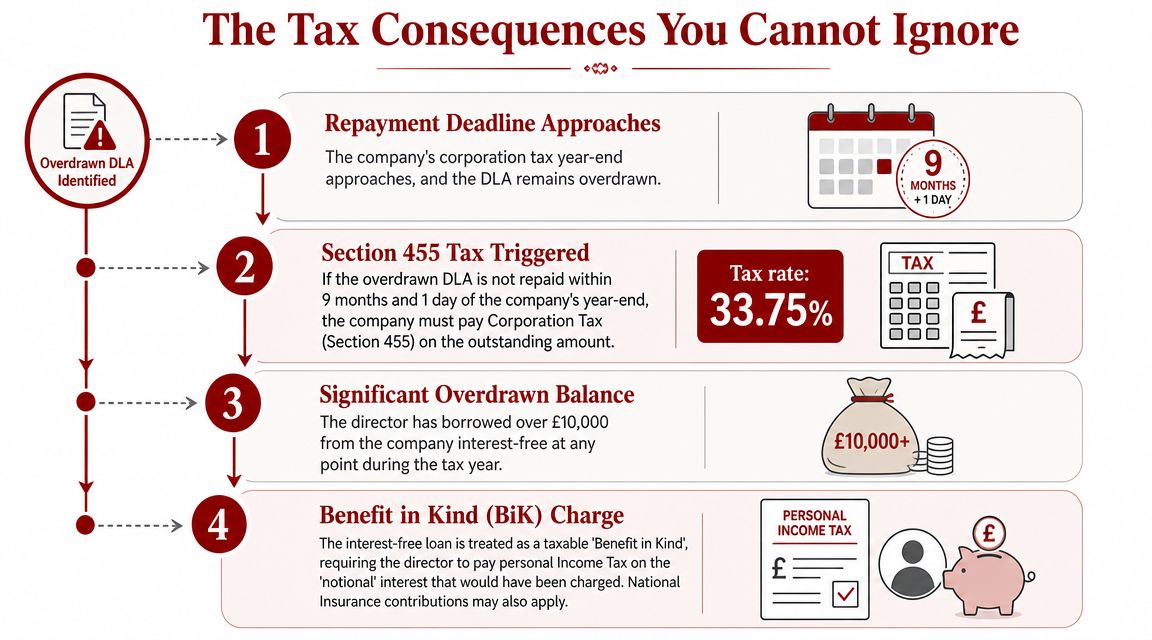
If an overdrawn DLA is not cleared within 9 months and 1 day after the end of the company's accounting period, the company can face Section 455 corporation tax at 33.75% of the outstanding balance, as described in Wellers' explanation of what a director's loan account is and how it is taxed.
That catches directors out because the company can be profitable on paper and still short of cash in reality. A balance sits there, year-end passes, and suddenly there is a corporation tax-style charge tied to a loan that was meant to be temporary.
This is one reason dividend planning matters. If part of your repayment strategy depends on declaring dividends, you need to know what the business can support and document properly. A practical primer on how business owners calculate investment dividends can help you understand the mechanics before you treat dividends as a clean-up tool.
A short explanation is often easier to follow on video, especially if you are seeing these rules for the first time.
An overdrawn DLA is not just “money to sort later”. Once the deadline passes, it carries a defined tax cost.
When the loan becomes a benefit in kind
A separate issue appears if the balance goes over £10,000. At that point, the loan is also treated as a benefit in kind. The amount must be reported on the director's Self Assessment, and the company can have Class 1A NIC exposure on the benefit value, according to the same Wellers guidance linked above.
This catches many small company owners because they think only unpaid year-end balances matter. In practice, a larger balance can create a second layer of consequences even before you think about long-term repayment.
Two things matter here:
- The size of the balance
- How long it stays unresolved
If your DLA is drifting near that threshold, passive bookkeeping is no longer enough. You need an active plan.
A simple comparison
| Issue | What triggers it | What it means |
|---|---|---|
| Section 455 tax | Overdrawn DLA not cleared within 9 months and 1 day after the accounting period | Company can face 33.75% tax on the outstanding balance |
| Benefit in kind | Loan balance exceeds £10,000 | Director reports it on Self Assessment and the company may face Class 1A NIC exposure |
The strategic point is this. A DLA is not only a compliance risk. It is also a cash flow signal. If you are repeatedly borrowing from the company to support personal living costs, the remuneration structure may be wrong, the profit extraction plan may be weak, or the business may be undercapitalised.
Common DLA Mistakes and How to Avoid Them
Most DLA problems are self-inflicted. Not because directors are careless, but because they assume intent matters more than process. It doesn't.
The mistakes that cost directors money
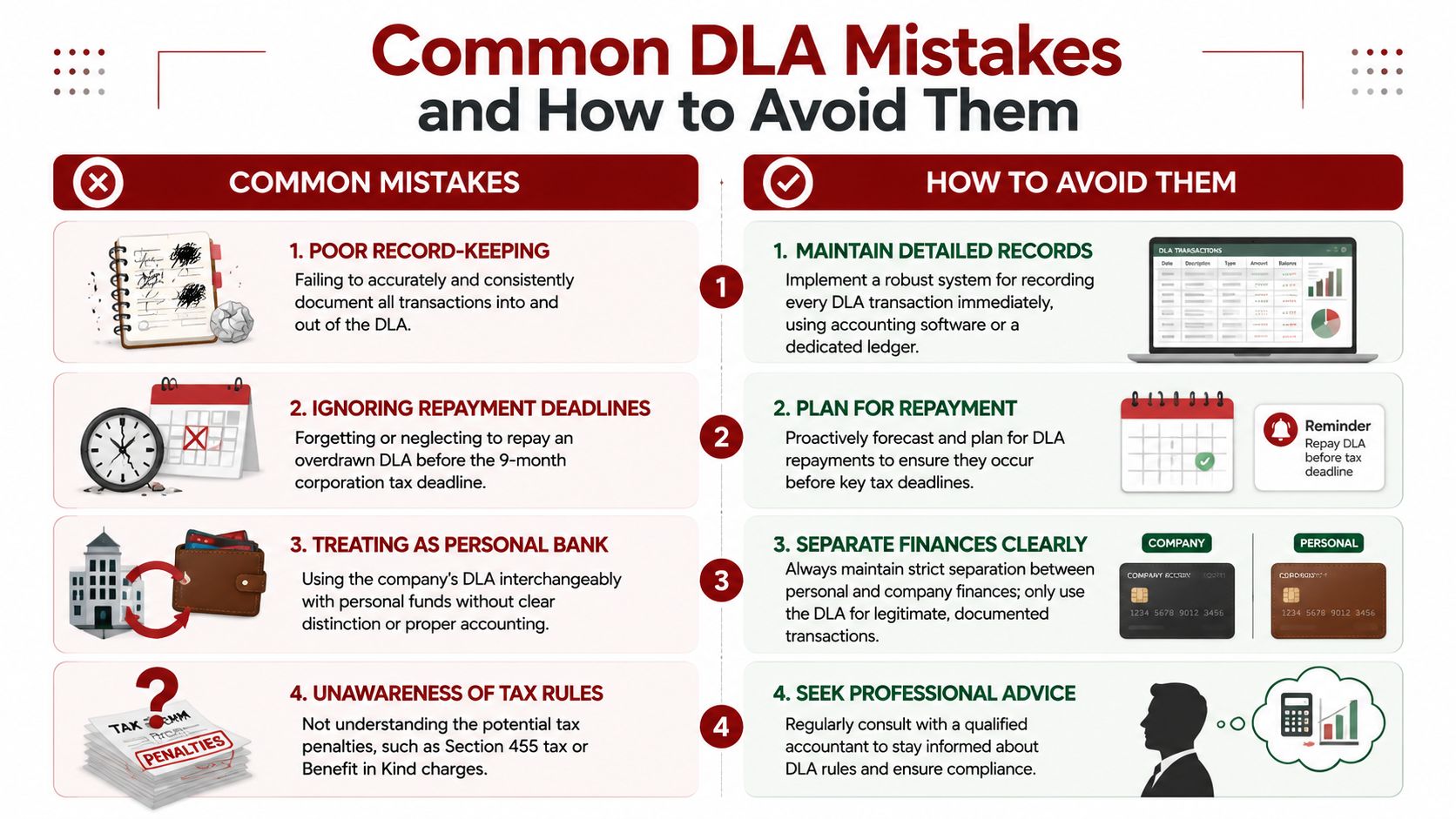
The first mistake is poor record-keeping. Transactions sit in suspense accounts, personal spending is mixed into software subscriptions or travel, and the DLA only gets reviewed when year-end accounts are prepared. By then, fixing the trail is harder and more expensive.
The second is ignoring connected-person transactions. DLA records can include transactions made not just by directors but also by their close family members, so payments involving a spouse, child, or other close associate can still affect the same account and tax treatment, as discussed in DS Burge's guide to director's loan accounts and family-related transactions.
The third is treating the company bank account as if it were an extension of personal cash flow. That habit rarely stays small. It usually sits alongside weak budgeting, weak bookkeeping, and other issues that gradually accumulate, much like the broader financial traps that undermine small business owners.
What good control looks like
You do not need complex systems to manage a DLA well. You need discipline.
- Use separate cards and accounts. The fewer mixed transactions you create, the fewer judgement calls you need later.
- Review family-linked spending. If the company pays something that benefits a close family member, do not assume it can be ignored.
- Document decisions early. If money is meant to be salary, dividend, or a repayment to the director, process it correctly at the time.
- Check the balance before year-end planning. Do not wait until accounts are drafted to discover what happened.
Small DLA errors rarely stay small. They spill into tax returns, payroll, dividends, and year-end accounts.
What doesn't work is trying to repair a bad pattern with one rushed entry near the deadline. What works is a monthly habit, clear separation, and someone thoroughly reviewing the ledger with scepticism.
Smart DLA Management for Your Business Type
The DLA should fit the way your business operates. A startup has different pressure points from a contractor or a property company.

Startups
Startups often use the DLA positively at the beginning. Founders pay incorporation costs, software, travel, and early supplier bills personally before revenue settles down. That can be perfectly workable if the record is clean.
The danger comes when startup informality becomes a habit. Founders should decide early whether the business model suits a limited company structure, because that choice affects how money moves between owner and company over time. If you are still weighing that up, this comparison of limited company vs sole trader is a useful place to start.
Contractors and CIS businesses
Contractors often deal with uneven payment timing. One month looks strong, the next is thin, and personal drawings start filling the gaps. In a CIS-aware business, that can create extra friction because cash flow discipline is already important for staying organised.
The practical answer is to stop using the DLA as a shock absorber for weak forecasting. If cash is tight, look at budgeting, reserves, and payment timing first. Broader guidance on solutions for small business cash flow issues can help frame the operational side of the problem.
Landlords and property companies
Property companies often produce messy DLAs because directors pay for repairs personally, fund deposits, cover mortgage-related costs, or move money quickly around completions and refurbishments. That creates a lot of entries, and each one needs a clear business or personal classification.
For landlords, the best approach is simple:
- Keep a separate property company bank account
- Avoid paying property costs from personal cards unless necessary
- Record director funding as it happens
- Review the DLA before any refinance, purchase, or major extraction of cash
A DLA can support growth if it reflects deliberate funding decisions. It becomes a drag when it is just the residue of messy money movement.
When to Partner with an Accountant
There is a point where DIY stops being efficient. With a DLA, that point often arrives earlier than directors think.
You should get help if the balance is above £10,000, if you are approaching the 9 months and 1 day repayment point, if your bookkeeping is unclear, or if family-related transactions have gone through the company. You should also get advice before using company funds in a way you hope to tidy up later with salary or dividends.
An accountant is not just there to process the year-end result. A good one helps you decide what the transaction should be before it creates the problem. That includes reviewing whether drawings are sustainable, whether dividends are properly supported, and whether your bookkeeping is strong enough to defend the treatment.
If you are still seeing the DLA as a technical side issue, you are underestimating it. For many owner-managed businesses, it is one of the clearest signals of whether the company is being run with control.
A practical overview of ways an accountant can help your small business often makes that clearer. The value is not just compliance. It is better decisions, earlier warnings, and fewer expensive surprises.
If you want clear advice on managing a director's loan account, structuring drawings properly, and keeping your company compliant as it grows, speak to Action Accountants Limited. They support startups, contractors, landlords, and owner-managed businesses with practical accounting, tax, bookkeeping, and advisory support that helps you stay in control before small DLA issues turn into costly ones.