

Service Charge Accounting: A UK Landlord’s Guide for 2026
Action Accountants •7 June 2026
You're often pushed into service charge accounting at the worst possible moment. A block changes managing agent. A director resigns. Invoices sit in email folders, reserve fund records don't tie back to the bank, and leaseholders want answers before the next demand goes out.
That's when many landlords and new agents realise the same thing. Service charge accounting isn't ordinary bookkeeping. If the records are weak, the problem isn't just admin. It affects recoverability, challenge risk, timing, and trust.
A clean ledger won't solve every dispute, but poor records almost always make one worse. Good service charge accounting does the opposite. It gives you a structure for collecting money, allocating costs to the right period, protecting reserve funds, reconciling the bank properly, and producing year-end statements that stand up to scrutiny.
If you're acquiring a block, self-managing for the first time, or taking over a badly organised scheme, the practical task is the same. Build a system that ties the legal position to the accounting process. If you want a broader view of how disciplined finance supports property growth, this piece on the BRRRR blueprint for real estate investment success gives useful context from the investment side.
Table of Contents
- The Hidden Risks of Poor Service Charge Management
- What Is Service Charge Accounting
- Navigating the UK Legal and Regulatory Framework
- Core Accounting Principles and Treatment
- Bookkeeping in Action with Sample Journal Entries
- Annual Reporting and Reconciliation
- Common Pitfalls and Best Practices Checklist
The Hidden Risks of Poor Service Charge Management
A shoebox of receipts is still surprisingly common. So is the spreadsheet with one tab for “bills paid” and another for “money in”, with no proper year-end accruals, no reserve analysis, and no clear split between one scheme and another.
That setup usually survives until someone asks a hard question. Why has the cleaning line overspent? Where did the reserve fund go? Why has this invoice only just appeared? Why doesn't the bank match the statements sent to leaseholders?
The immediate risk is obvious. People stop trusting the figures. The less obvious risk is more expensive. If your accounting doesn't show what was incurred, when it was incurred, and which fund paid for it, you make it harder to defend demands and easier for disputes to drag on.
Where things usually go wrong
In practice, the breakdown isn't caused by one dramatic error. It's usually a cluster of smaller failures:
- Costs are posted late. Invoices sit unentered until year-end, so the service charge account tells a distorted story.
- Cash is mistaken for performance. A bank balance looks healthy, but unpaid liabilities are hiding underneath it.
- Reserve movements aren't tracked clearly. Leaseholders then assume reserve money has been spent casually or twice.
- Documents can't be retrieved quickly. When someone challenges a cost, the accounts team spends days hunting for support.
Poor service charge management turns ordinary questions into formal disputes because nobody can evidence the answer quickly.
The financial consequences aren't always immediate, but they build. A weak process can delay demands, complicate handovers, and leave agents defending numbers they can't fully support.
Why this needs an accounting system, not a tidy spreadsheet
A spreadsheet can help with budgeting. It rarely gives enough control on its own. Service charge accounting needs a repeatable process for coding costs, separating schemes, handling reserves, and producing reports that match the bank and the supporting paperwork.
That's the difference between records that merely exist and records you can rely on. New landlords and managing agents don't need a more complicated process. They need one that is properly organised from the start, so legal duties and accounting outputs line up.
What Is Service Charge Accounting
A new managing agent takes over a block in April. By June, a leaseholder wants to know why the lift repairs were charged to the current year when the work was ordered months earlier, and whether reserve money has been used to plug a shortfall. If the records only show cash in and cash out, that query turns into a dispute. Service charge accounting exists to stop that happening.
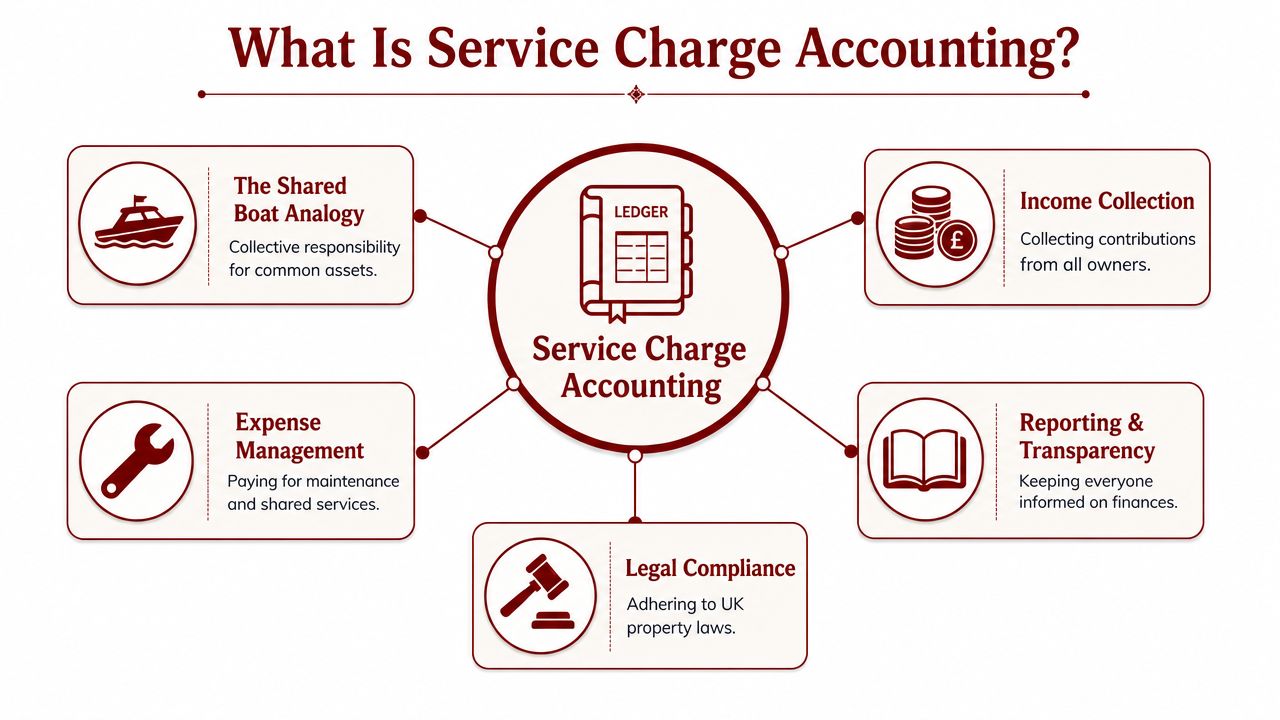
Service charge accounting is the discipline of recording, allocating, and reporting money collected for the shared costs of a building in a way that matches the lease, supports statutory obligations, and stands up to challenge. The funds are collected for the scheme. They are not the landlord's trading income, and they should not be mixed into ordinary business results.
What makes it different from ordinary bookkeeping
Standard bookkeeping asks whether income and costs have been recorded correctly for a business. Service charge accounting asks a narrower and more demanding question. Has each cost been charged to the right scheme, in the right period, under the right lease authority, with a clear trail back to the demand, invoice, bank entry, and year-end statement?
That difference affects the whole setup. A contractor invoice is not just an expense to post. It needs the correct property code, the correct cost heading, the right accounting period, and a record of whether it is recoverable under the lease. If you miss one of those points, the arithmetic may still balance while the account remains hard to defend.
The same discipline matters long before year-end. Agents who want fewer arguments should set up supplier terms carefully, because weak contract wording often creates coding disputes, delayed approvals, and costs that are difficult to recover. Clear business contract drafting for supplier and service arrangements helps prevent those problems at source.
What the accounts need to show
Useful service charge accounts let a landlord, agent, accountant, or leaseholder answer a small set of practical questions without digging through emails for three days:
- What was demanded for the period
- What was received and what remains in arrears
- What costs relate to the period, whether paid yet or not
- What has been charged to reserves or sinking funds
- What balance is still held for the scheme at year-end
That is why cash reporting on its own is weak. A healthy bank balance can sit alongside unpaid supplier invoices, unposted accruals, or reserve transactions that have been coded wrongly. I see this often on handovers. The bank reconciles, but the service charge position is still unclear because nobody has tied the ledger back to lease categories and supporting documents.
The practical aim
Good service charge accounting gives you two things at once. It gives management information during the year, and it gives evidence if a leaseholder asks questions later.
That link between legal duty and accounting process is where many landlords get caught out. For example, if costs are posted late or supporting invoices are hard to retrieve, it becomes much harder to issue clear summaries, explain variances, or support demands within the relevant time limits. The accounting system needs to help you meet those deadlines, not create extra risk.
Landlords who are still getting comfortable with the wider compliance picture should also read this guide to navigating UK landlord laws. It gives useful context for the duties sitting around the numbers.
A sound service charge process is therefore more than bookkeeping. It is a control system for recoverability, timing, evidence, and trust.
Navigating the UK Legal and Regulatory Framework
Most problems in service charge accounting start when people treat the legal position and the bookkeeping as separate jobs. They aren't. The accounting records are what allow you to prove you've complied with the lease and handled the fund properly.
The first document to read is always the lease. That tells you what can be recovered, how costs are apportioned, whether there are reserve fund provisions, and what the demand mechanics look like. The law then sits around that framework and gives leaseholders rights to information, challenge, and scrutiny.

The lease comes first
A managing agent can have immaculate nominal codes and still fail if they charge for something the lease doesn't permit. Equally, a recoverable cost can still become hard to collect if the evidence is late, incomplete, or badly presented.
For landlords who are still getting comfortable with the wider compliance picture, this primer on navigating UK landlord laws is a useful companion read because it frames legal duties in plain English before you get into scheme-specific accounting detail. The same applies to supplier arrangements and management contracts. If your appointment terms are vague, disagreements over scope and authority often spill into the service charge records, which is why clear engagement documents matter, much like the principles discussed in this guide to creating business contracts.
Where accounting becomes evidence
The practical test is simple. Can you support the numbers with underlying documents, and can you do it fast?
For properties with more than four dwellings, UK case law and guidance note that a leaseholder can require a certified summary of service charge costs, and that summary must be supported by accounts, receipts, and other documents. That makes certification a real control point because, without it, liability to pay can be disputed or delayed (KDL Law on certified service charge accounts).
That requirement changes how you should run the ledger during the year. It isn't enough to know the total for repairs. You need the invoice, the coding, the payment trail, and the explanation for why the cost belongs to that scheme and that period.
A practical framework looks like this:
- Lease review first. Confirm the charging basis before demands are raised.
- Document retention by scheme. Store invoices, receipts, contracts, and approvals in a way that mirrors the accounts.
- Certification planning. Don't wait until challenge stage to discover records are incomplete.
- Clear scheme separation. Mixed ledgers and pooled paperwork create avoidable risk.
If the accounts are challenged, the ledger is only the start. The supporting file is what gives the figures weight.
Core Accounting Principles and Treatment
A service charge year can look tidy in the bank and still be wrong in the accounts. That is usually where disputes start. The practical fix is to account on an accruals basis from the start of the year, not as a last-minute year-end exercise.
Service charge accounts need to show what the scheme incurred in the period, what leaseholders were charged, and what remains payable or recoverable. Cash movement on its own does not do that. If the lift contract covers March but the invoice arrives in April, March still carries that cost. If you miss that adjustment, the year-end statement understates expenditure, the following year gets distorted, and any challenge becomes harder to answer.
That timing discipline is familiar to anyone who has worked in business accounting. The detail is different, but the logic behind Resolut's guide on recognizing revenue is relevant here. Accounts should reflect the period the transaction belongs to, not only the date cash moved.
Treatments that need consistent handling
The technical issues are usually straightforward. The risk sits in inconsistent posting, weak lease review, or leaving decisions until the accounts are being drafted.
- Budgets and demands. Set the budget from the lease, not from last year's nominal codes. Then raise demands in the format and frequency the lease allows, and post them to the correct scheme and leaseholder accounts.
- Expenditure recognition. Code each invoice to the right property, heading, and accounting period. If a contractor covers several blocks, split the bill on a documented basis at the time of posting. Do not leave it sitting in a holding code.
- Accruals and prepayments. Accrue costs for work done before the year end where the liability exists but the invoice has not arrived. Prepay costs that relate to the next accounting period. Insurance is a common example.
- Surpluses and deficits. The lease decides the treatment. Some balances carry forward. Some must be credited. Some may require a balancing charge. Assumptions here create expensive mistakes.
- Reserve funds. Keep reserve contributions, reserve expenditure, and any transfers clearly separate from day-to-day service charge costs. If major works are funded from reserve, the entries should show that movement plainly.
- VAT. In many residential settings, the gross cost is what matters for service charge reporting because VAT recovery is limited or unavailable. If you need background on how recoverability changes the accounting outcome, see our guide on when you can claim VAT back.
One point is often missed. Legal deadlines should drive accounting routines. If a cost risks falling outside the period for recovery or support, the ledger needs enough detail to identify it early, chase the invoice, and post the adjustment before the year-end file is assembled. Good service charge accounting is not just tidy bookkeeping. It is a control system that links lease terms, demand timing, accruals, and supporting records so costs are both recorded correctly and recoverable.
A practical month-end close usually includes five checks:
- Post all supplier invoices received to the correct scheme and heading.
- Review contracts and recurring costs for missing invoices or accrued liabilities.
- Match demands, receipts, and arrears by leaseholder.
- Reconcile each scheme bank account and reserve fund movement.
- Review unusual balances, especially suspense codes, old credits, and negative expense lines.
Teams get into trouble when year-end adjustments are treated as optional tidy-up work. They are part of the core accounting process, and they protect both the figures and the landlord's position if a leaseholder asks questions later.
Bookkeeping in Action with Sample Journal Entries
Most new landlords don't struggle with the idea of service charge accounting. They struggle with what to post on Monday morning.
The easiest way to stay organised is to build a chart of accounts that separates each scheme's service charge debtors, current year expenditure, reserve fund balance, bank account, and year-end accruals. If you also keep a leaseholder-by-leaseholder record, you'll have a cleaner route from the nominal ledger to arrears reporting. A tenant-style ledger is a vital landlord financial tool because it shows how individual balances move over time, even though service charge records need the extra scheme and legal context.
How to post the routine transactions
Use simple, repeatable logic.
When you issue a service charge demand, you recognise that the leaseholder owes the scheme money. When they pay, you clear that debtor and increase the scheme bank balance. When the scheme pays a supplier, you record the expense against the relevant heading and reduce cash. When a cost belongs to the year but the invoice hasn't arrived, you accrue it.
If you're new to posting journals consistently, strong bookkeeping habits matter more than software brand. This guide to bookkeeping for sole traders is aimed at a different audience, but the discipline it describes around regular posting and reconciliation still applies.
Sample Service Charge Journal Entries
| Transaction | Account to Debit | Account to Credit | Amount |
|---|---|---|---|
| Service charge demand issued to leaseholder | Leaseholder debtor account | Service charge income or demand account for the scheme | Per demand |
| Leaseholder pays the demand | Service charge bank account | Leaseholder debtor account | Per receipt |
| Gardening invoice received | Grounds maintenance expense | Trade creditors or service charge bank account | Per invoice |
| Gardening invoice paid later | Trade creditors | Service charge bank account | Per payment |
| Electricity cost incurred but invoice not yet received at year-end | Utilities expense | Accruals | Estimated amount based on invoice or usage evidence |
| Opening reserve fund contribution transferred into reserve balance | Service charge bank account or reserve bank account | Reserve fund liability or reserve balance account | Per transfer |
| Major works paid from reserve fund | Major works expense or relevant cost code | Service charge bank account | Per payment |
| Reclassification of reserve funding used for those works | Reserve fund liability or reserve balance account | Transfer from reserve or reserve contribution line | Matching funded amount |
A few practical points make these entries usable:
- Name accounts clearly. “Block A reserve fund” is better than “reserves”.
- Avoid mixed postings. Don't combine current service costs and reserve-funded major works in one journal if you want clean reporting.
- Attach the evidence. The journal alone won't help much during a challenge if the invoice or working paper is missing.
Annual Reporting and Reconciliation
The annual statement is where your work becomes visible. Leaseholders rarely see your month-end checks, coding decisions, or accrual workings. They see the final report and decide whether it looks coherent.
That's why presentation matters, but substance matters more. A tidy annual pack with weak reconciliations will still collapse under scrutiny. A sound pack shows what the scheme budgeted, what it spent, what it still owes, what happened to reserves, and what balance remains held for the block.
What a proper annual statement needs to do
The Property Institute says all leaseholders paying variable service charges should receive an annual statement within six months of the end of the accounting year, and that statement should include an income and expenditure account, a balance sheet, and a schedule of reserve movements, with funds held in designated bank accounts with “client” or “trust” in the title (The Property Institute advice note on service charge accounting best practice).
That guidance reflects how these funds should be handled in practice. They aren't ordinary trading balances. The annual statement needs to identify the scheme's financial position clearly enough for leaseholders to follow the movement of money through the year.
A useful reporting pack typically includes:
- Income and expenditure account. This shows budget against actual spend by category.
- Balance sheet. This shows cash held, debtors, creditors, accruals, and fund balances.
- Reserve movement schedule. This explains additions, use of funds, and closing reserve position.
- Supporting notes. These help explain material variances, unusual works, or lease-specific treatments.
Why reconciliation is the control that matters
Bank reconciliation is an essential step. If the bank doesn't reconcile, the annual statement is already suspect.
The same applies to leaseholder balances and supplier liabilities. A service charge account should not contain unexplained suspense items, old uncleared balances, or reserve totals that don't tie back to actual cash and supporting schedules. Those are the small defects that create big credibility problems later.
A year-end statement should read like a clean financial story. If the balance sheet and the income and expenditure account don't connect, the story won't hold.
Timeliness matters here as much as format. Late reporting often means teams are still reconstructing basic records long after the year has ended. That's usually a sign the bookkeeping process needs fixing, not just the year-end file.
Common Pitfalls and Best Practices Checklist
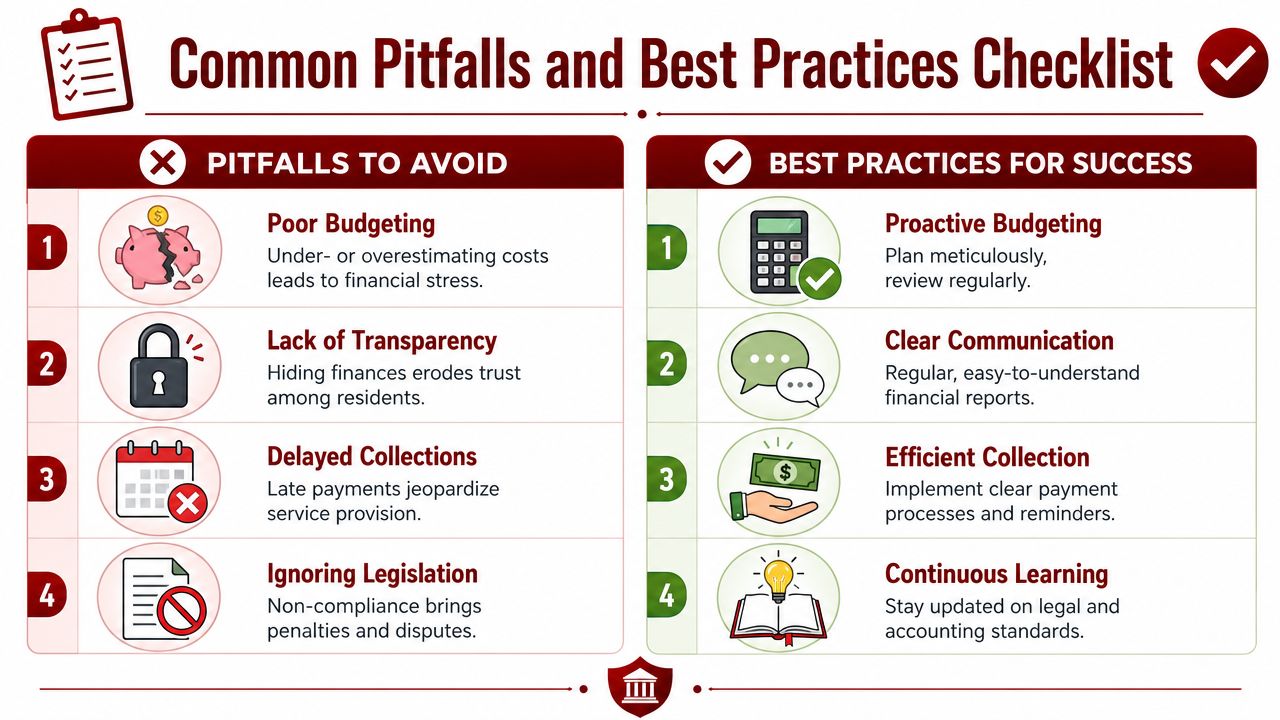
The most expensive service charge problems aren't usually dramatic fraud cases. They're ordinary management failures left to drift. Costs are posted late. Demands go out without full support. Reserve movements are vague. By the time somebody asks for the detail, the accounting team is trying to recreate a year from bank statements and inbox searches.
The mistakes that create avoidable losses
One of the biggest financial risks is timing. The Property Institute notes that section 20B of the Landlord and Tenant Act 1985 can bar recovery of service charge costs if they are not notified to leaseholders within 18 months of being incurred, which makes timely accounting and demand issuance a financial control rather than a paperwork exercise (The Property Institute guidance on section 20B timing and service charge accounting).
That single rule should shape your process design. If invoice capture is slow, approval chains are messy, or year-end work is left too late, recoverability risk increases. It is at this point that legal deadlines and accounting execution meet.
Other recurring problems include:
- Commingled funds. When multiple schemes share one uncontrolled bank position, tracing balances becomes difficult.
- Weak reserve records. Leaseholders often focus on reserves first because that's where long-term trust sits.
- Overreliance on cash reporting. A healthy bank balance can hide unpaid liabilities and understate the actual cost of the year.
- Poor document retrieval. If support for a charge can't be produced quickly, disputes harden.
This short video gives a useful additional view on handling the practical side of service charge processes.
A practical checklist that works
Use this as an operating checklist rather than a one-off clean-up list:
- Read the lease before posting anything unusual. The accounting should follow the charging rights, not the other way round.
- Open designated bank accounts for scheme money. Keep client funds visibly separate and traceable.
- Post invoices promptly. Don't leave routine costs sitting outside the ledger until quarter-end or year-end.
- Accrue known liabilities. If the cost belongs to the period, reflect it even when the invoice arrives later.
- Track reserve movements separately. Show contributions, spending, and closing balances clearly.
- Reconcile every month. Bank, debtors, creditors, and reserves should all tie back to supporting records.
- Prepare certification support as you go. Waiting for a challenge is too late.
- Monitor recoverability deadlines. The accounting calendar should flag costs that need notification and demand action.
- Produce the annual statement promptly. A late report often signals a broken process underneath it.
Good service charge accounting protects income, reduces friction, and gives you a stronger answer when leaseholders ask difficult but fair questions. That's what an effective system is for.
If you need help setting up or repairing your service charge accounting process, Action Accountants Limited can support landlords, property investors, and managing agents with practical bookkeeping, reconciliations, year-end reporting, and wider compliance support. The firm works with clients across North West London and the wider UK, with a focus on clear advice, reliable turnaround, and accounting systems that hold up when the pressure is on.