
Bookkeeping for Sole Traders a Practical UK Guide 2026
Action Accountants •4 June 2026
You've done the work to get trading. You've found clients, sent a few invoices, and money is starting to move. Then the admin starts piling up. Receipts are in your van, your inbox, your wallet, and your camera roll. One customer has paid late. Another has paid without a clear reference. You know bookkeeping matters, but you're not sure what matters now and what can wait.
That's the point where many sole traders either build a clean system or drift into a yearly scramble. Good bookkeeping for sole traders isn't about producing fancy reports. It's about keeping control of cash, knowing what you've earned, knowing what you've spent, and having the records to back it up when tax deadlines come round.
If you're new to self-employment, keep this simple. Start with a routine you can stick to. Then make sure that routine is strong enough to cope with real UK compliance, including CIS if you work in construction and digital record-keeping changes linked to Making Tax Digital.
Table of Contents
- Laying Your Bookkeeping Foundation
- Choosing Your Bookkeeping System
- Mastering Day-to-Day Record Keeping
- Navigating Tax Compliance and Deadlines
- Critical Bookkeeping Mistakes to Avoid
- When to Partner with a Professional Accountant
- Frequently Asked Questions
- Do I need a business bank account if I'm a sole trader
- Can I still use spreadsheets
- What records should I keep for expenses
- What's the difference between drawings and expenses
- How often should I update my books
- What if I work under CIS
- When should I think about VAT
- What if I'm already behind
- What's the simplest bookkeeping setup for a new sole trader
- Should I keep paper copies of everything
- What if a customer pays late
- How do I know if my bookkeeping system is working
Laying Your Bookkeeping Foundation
You do a few jobs, send a few invoices, buy materials, and promise yourself you'll sort the paperwork later. A few months pass, January gets closer, and now you're trying to remember which card paid for fuel, whether that transfer was personal or business, and where the missing receipt went.
That is how bookkeeping problems usually start for sole traders. Not with a tax rule, but with a messy setup.
A good foundation makes everything else easier later, especially if you may end up dealing with CIS deductions, VAT registration, or Making Tax Digital changes. The aim at this stage is simple. Make sure every pound in and out can be identified, explained, and backed up.
Start with separation, not admin overload
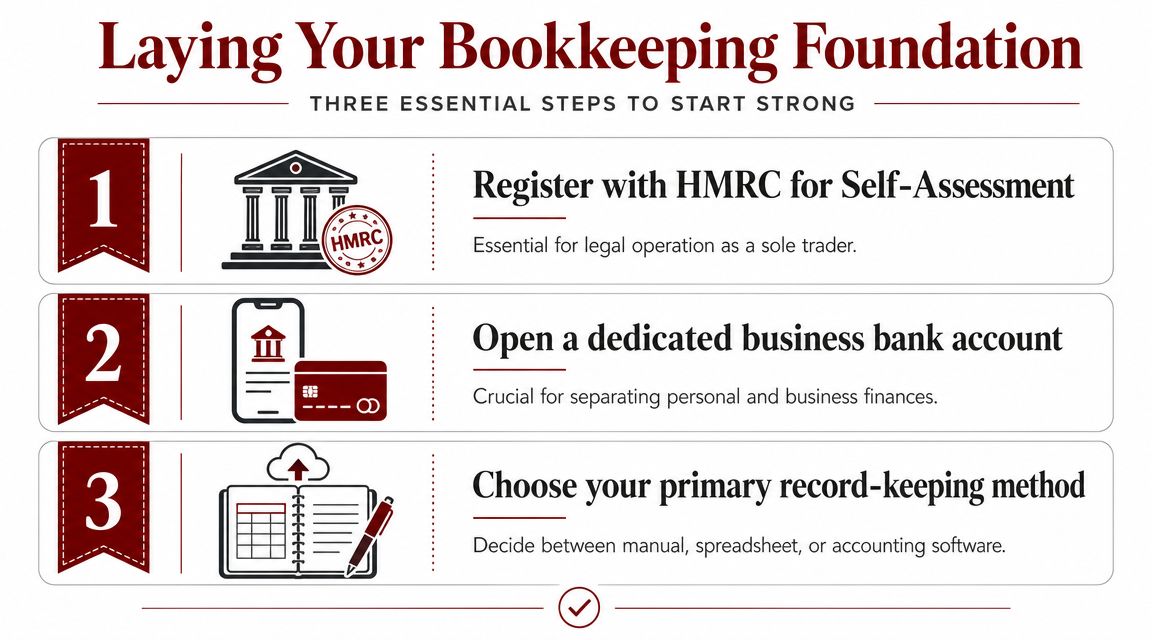
Three setup steps solve a lot of future problems.
-
Register with HMRC at the right time.
Your records need to match the way you report your income. If you leave registration late, bookkeeping often gets rebuilt from memory, and that is where errors creep in. -
Use a dedicated business bank account.
Sole traders are not legally separate from the owner in the way limited companies are, but separate banking still makes a big difference. It speeds up reviews, makes business costs easier to spot, and cuts down the usual confusion over drawings versus expenses. -
Choose one system and keep all records in it.
That might be a spreadsheet, software, or a process supported by a bookkeeper. A basic system used every week is far better than a clever system abandoned after a month. If you want a broader comparison before deciding, this guide to accounting software for small businesses is a useful place to start.
Practical rule: if money relates to the business, record it once, store the evidence once, and make sure both can be found quickly.
Know which records do the heavy lifting
Good bookkeeping is built on a small number of documents used properly. For most sole traders, these are the records that matter most.
| Document | What it proves | Why you need it |
|---|---|---|
| Sales invoice | What you charged a customer | Supports your income record and helps track unpaid work |
| Purchase receipt or supplier bill | What you bought and when | Supports expense claims and cost tracking |
| Bank statement | What actually moved in or out of the account | Lets you match your records to real cash movement |
| CIS statement, if applicable | Tax deducted by contractors | Needed to claim the deduction correctly on your tax return |
If you are in construction, that last line matters more than many sole traders realise. I often see subcontractors keeping invoices but misplacing monthly CIS statements, then struggling to prove deductions already taken from their payments. Keep those statements together from day one.
Build a record trail that still works a few years from now
Bookkeeping is not only about knowing this month's profit. It is also about having a clear history if HMRC asks questions later, if you apply for a mortgage, or if you need to catch up on a return quickly.
That is why I advise sole traders to store records as they go, not in a pile at year end. Paper can work if you are disciplined. For many people, a phone scan saved on the same day is more reliable than a glovebox full of faded receipts.
The fix is rarely “work harder in January”. It is usually setting up a simple routine now, while the business is still easy to track.
Choosing Your Bookkeeping System
A sole trader usually picks a bookkeeping system on a rushed evening after a long job. You open a spreadsheet, tell yourself you will tidy it up later, and a few busy months on, later never quite arrives.
The best system is the one you can keep using in a normal working week, not only when business is quiet. It needs to cope with invoices, expenses, bank movements, and, for some trades, CIS deductions without turning year end into a rescue job.
A quick comparison that reflects real life
Here is the practical trade-off.
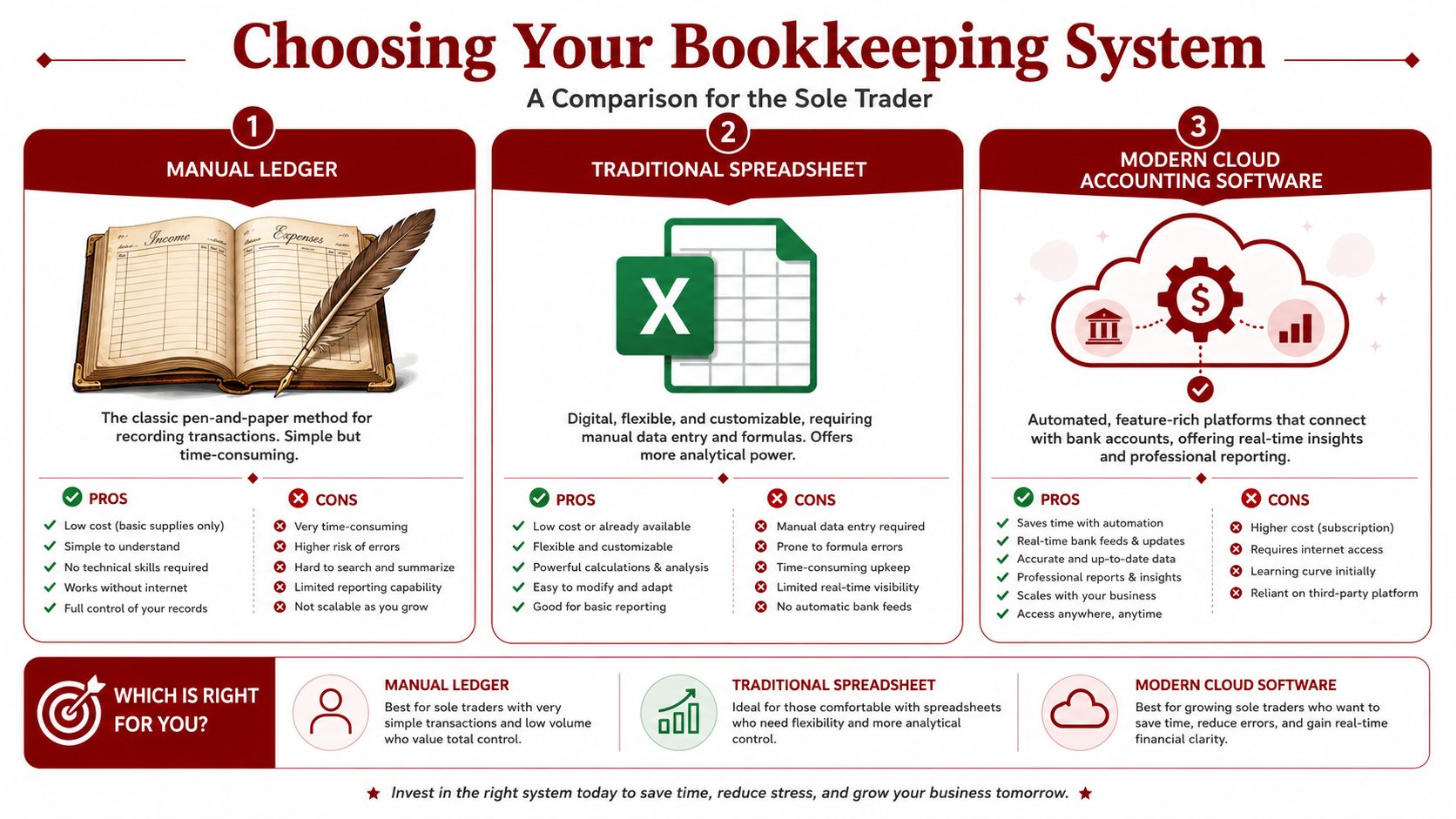
| System | What works | What doesn't |
|---|---|---|
| Manual ledger | Cheap, straightforward, no software to learn | Slow to maintain, harder to search, easy to miss patterns or errors |
| Spreadsheet | Flexible, familiar, low starting cost | Relies on manual entry, formula mistakes happen, receipts and supporting records can end up stored separately |
| Cloud accounting software | Bank feeds, receipt capture, easier reporting, clearer audit trail | Monthly subscription, setup matters, categories still need checking |
| Outsourced support | Saves admin time, adds oversight, useful for CIS and VAT | You still need to send records promptly and answer questions |
If you want a broader look at software options, this guide to accounting software for small businesses is a useful starting point because it compares tools in a practical way.
For a new sole trader, spreadsheets can be fine at the beginning if volume is low and you are disciplined. I would not call them a long-term answer for many people. Once the business has regular supplier costs, a steady flow of customer payments, or construction industry deductions to track, manual systems start to fray.
Here's a helpful explainer on the shift towards digital accounting tools:
What I'd choose if you want fewer problems later
The strongest reason to adopt software early is future compliance. Wise notes that Making Tax Digital for Income Tax Self Assessment starts in April 2026 for self-employed people and landlords with qualifying income above £50,000, and is scheduled to expand in April 2027 to those above £30,000. The same source says spreadsheets on their own are unlikely to be a future-proof approach.
That matters now. Leaving the change until the rules apply means learning a new system while trying to file correctly under pressure.
Cloud software suits many sole traders because it joins up the work you already have to do. You can raise invoices, match payments, store receipts, review bank feeds, and keep expense categories consistent in one place. That gives you cleaner records now and a better starting point for MTD later.
CIS adds another reason to choose carefully. If you are a subcontractor, your system needs to show gross income, deductions suffered, and the monthly statements that back those figures up. A basic spreadsheet can do that, but only if it is set up properly and kept current. For many construction clients, software plus regular review is a safer option. If you want a clearer explanation of what to keep and how deductions are treated, our guide to CIS for self-employed subcontractors covers the practical points.
Tools like Xero and QuickBooks are popular because they reduce rekeying and make it easier to spot missing items before they become tax problems. If you want support rather than handling everything yourself, Action Accountants Limited can manage bookkeeping alongside VAT returns and tax compliance. That is often the point where bookkeeping stops being an admin chore and starts giving you usable numbers.
Mastering Day-to-Day Record Keeping
Bookkeeping for sole traders should feel repetitive in a good way. The less you rely on memory, the better your records will be. You do not need a heroic monthly catch-up session. You need a short routine that keeps things moving.
A weekly workflow that works
A simple weekly process usually beats an ambitious monthly one. For most sole traders, this is enough:
- Check money received: Match customer payments to the invoices you issued. If someone has paid without a reference, fix it while the job is still fresh in your mind.
- Capture every expense: Photograph or upload receipts the same day if possible. Fuel, parking, tools, software subscriptions, materials, and small site purchases are the ones people forget.
- Review bank transactions: Categorise what came in and what went out. Don't leave mystery items uncoded.
- Raise missing invoices: If you've finished the work, bill it. Delayed invoicing causes cash flow problems that look like bookkeeping problems.
- Separate owner withdrawals: Money you take for yourself isn't the same as a business expense. Record it clearly as drawings.
If you're trying to tighten your invoice process, this invoice automation guide is useful for thinking through how documents move from issue to payment and where delays creep in.
A CIS example from the real world
Take a subcontractor working in construction. On Monday, he buys materials and pays for parking. On Wednesday, he receives payment from a contractor. On Friday, he transfers money to his personal account for home spending.
Those three events shouldn't all be treated the same way.
- Materials and parking may be business costs if they relate to the work.
- The contractor payment is business income that needs to match the job and paperwork.
- The personal transfer is drawings, not a deductible expense.
Where CIS applies, the paperwork needs extra care because deductions and statements can affect how you prepare your records. If you're unsure how to treat those entries, this guide to CIS for the self-employed is worth reading before bad habits settle in.
The cleanest books usually come from one habit. Record the transaction when it happens, not when you finally remember it.
A smartphone is often your best bookkeeping tool. Use it to snap receipts, forward supplier emails into your records, and store job notes while the detail is still clear. A shoebox full of faded receipts isn't a system. It's a delayed argument with your future self.
Navigating Tax Compliance and Deadlines
A lot of sole traders only feel the pressure when January arrives and the numbers still are not ready. By that point, bookkeeping has turned into damage control. The better approach is simpler. Keep your records usable month by month, so tax deadlines become a filing job, not a reconstruction exercise.
Your compliance calendar in plain English
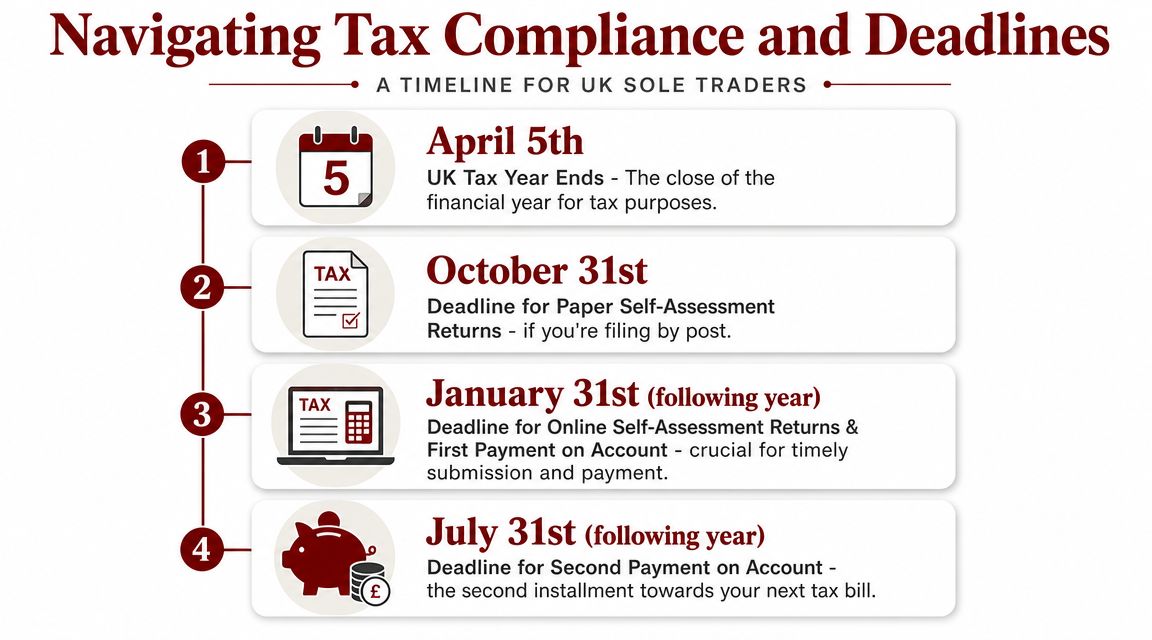
For many sole traders, four dates shape the year:
| Date | What it usually means |
|---|---|
| 5 April | Tax year ends |
| 31 October | Paper Self Assessment deadline |
| 31 January | Online Self Assessment deadline and first payment on account |
| 31 July | Second payment on account |
These dates matter because they expose weak bookkeeping fast. Missing paperwork, uncategorised transactions, and unclear transfers all surface at once when a return is due.
One change has caught many people out recently. The rules around Class 2 National Insurance changed from 6 April 2024, and the VAT registration threshold also increased from April 2024. If your process is based on old habits, it is worth checking that it still fits the current rules rather than relying on advice passed around on site or in trade groups.
Where VAT, MTD, and CIS add extra pressure
VAT is often the point where a basic bookkeeping routine stops being enough. Once turnover approaches the registration threshold, records need to be cleaner, transaction coding needs to be more consistent, and reviews need to happen more often. Voluntary VAT registration can still be sensible in some cases, especially if you have regular VATable costs, but it brings extra filing and record-keeping work. If you want the practical side explained clearly, this guide on how to claim VAT back covers what traders usually trip over.
MTD also belongs in this conversation, even if it feels like a future problem. For sole traders, the practical question is not just when the rules apply. It is whether your records are being kept in a way that will be easy to adapt when digital filing becomes part of your routine. In practice, that means keeping income and costs up to date, using software consistently, and avoiding a year-end pile of fixes.
CIS makes compliance more technical. A subcontractor can have the right money in the bank and still have poor records if deduction statements are missing, income is posted to the wrong period, or materials are lumped into vague expense categories. Those errors cause delays when it is time to prepare the return and can affect whether the figures make sense against the paperwork.
Messy admin usually starts with document handling. If your records arrive as PDFs, scans, emailed statements, and phone photos, tools that automate tax document processing can help sort the paperwork before it reaches your bookkeeping file.
When tax dates feel overwhelming, the fix is rarely “work harder in January”. It's keeping records ready for review throughout the year.
Critical Bookkeeping Mistakes to Avoid
Most sole trader bookkeeping errors aren't dramatic. They're small, repeated, and expensive in time. The danger is that they often feel harmless when they happen.
The mistakes that create the most clean-up work
The first is mixing personal and business spending. One account, one card, and a vague plan to “sort it later” creates hours of untangling. It also weakens your evidence when you're trying to support expense claims.
The second is forgetting the small purchases. Traders often remember major costs and miss the steady stream of lower-value items. Parking, consumables, software renewals, small tools, and travel-related spending are common examples.
The third is misclassifying transactions. A payment to yourself is not the same as a business cost. A customer payment isn't “miscellaneous income” just because you can't remember the job offhand. Classification matters because your books need to tell a believable story.
What to do instead
Use these warning signs as a prompt:
- If your bank feed is full of uncategorised items: Stop adding new entries and clear the backlog first.
- If you can't explain a transfer quickly: Check whether it was drawings, a supplier payment, or a movement between accounts.
- If receipts are scattered across pockets, vans, and inboxes: Move to one capture method and use it every day.
- If year-end always feels like reconstruction: Reconcile your records to the bank regularly, not just before filing.
One more mistake deserves special mention. Some sole traders think messy books are normal in the early years. They aren't. Early habits become permanent habits, and they get harder to fix once turnover rises or VAT and CIS obligations become part of the routine.
If you've recognised a few of these patterns, this article on financial traps that quietly undermine small business owners is a useful next read because the bookkeeping issues usually connect to wider cash flow and decision-making problems.
When to Partner with a Professional Accountant
Doing your own records is possible. Doing everything yourself forever usually isn't the best use of your time.

The tipping points that matter
A few moments usually signal that outside help is worth considering:
- You're approaching the VAT threshold.
- CIS deductions or contractor paperwork are becoming routine.
- Your bookkeeping backlog keeps returning.
- You no longer trust your own numbers.
- Admin is eating hours you should be using to earn.
At that point, an accountant isn't just there to file forms. A good one helps you keep records in a usable state, spot issues earlier, and build a system that still works when the business gets busier.
For a lot of sole traders, the right move is a hybrid approach. You keep the day-to-day capture of receipts and invoices. Your accountant reviews the records, corrects treatment where needed, and handles the compliance edge. If you're weighing that step, this guide on ways an accountant can help your small business gives a clear picture of what support should look like in practice.
Frequently Asked Questions
Do I need a business bank account if I'm a sole trader
You're not under the same separation rules as a limited company, but in practice you should still have a dedicated account for business activity. It makes bookkeeping cleaner, reduces misposted items, and gives you a much clearer view of what the business is doing.
Can I still use spreadsheets
You can, but they have limits. They rely on manual entry, they're easy to break, and they don't cope well with growing transaction volume or document management. If your business is likely to fall within future digital tax reporting rules, software is the more sensible long-term choice.
What records should I keep for expenses
Keep the document that proves what you bought, when you bought it, and that it relates to the business. That often means receipts, supplier invoices, and the bank transaction that shows payment. The clearer your evidence, the easier it is to support the treatment in your books.
What's the difference between drawings and expenses
An expense is a business cost. Drawings are money you take out of the business for yourself. Confusing the two is one of the most common sole trader errors, especially when money is moved quickly through one bank account.
How often should I update my books
Weekly is a good rhythm for most sole traders. It's frequent enough to stop backlogs building and light enough to be realistic. Daily capture of receipts is even better if you're on the move.
What if I work under CIS
Then your bookkeeping needs to be more disciplined than a generic self-employed setup. Keep payment records, invoices, and any CIS-related paperwork together and review them regularly. Construction bookkeeping gets messy quickly when site purchases, deductions, and customer payments aren't matched properly.
When should I think about VAT
Before you hit the registration point, not after. If your turnover is rising, watch it carefully. VAT changes how you record sales and purchases, so it's much easier to prepare early than to retrofit order onto messy records.
What if I'm already behind
Start with the bank. Work through transactions in date order, gather the missing paperwork, and sort income, expenses, and drawings into the right categories. Don't try to build a perfect system while also fixing months of backlog. Clear the outstanding records first, then put a routine in place.
What's the simplest bookkeeping setup for a new sole trader
A dedicated bank account, one method for recording transactions, one place for storing receipts and invoices, and a weekly review slot in your diary. Simple is good if it's consistent.
Should I keep paper copies of everything
You can, but paper alone is awkward. It gets lost, fades, and is harder to search. Digital copies are generally easier to organise and review, especially when you need to find something quickly.
What if a customer pays late
Your books should still show that the invoice was raised and remains unpaid until payment arrives. Don't let overdue debts disappear just because cash hasn't landed yet. Good bookkeeping helps you chase payment from a clear position.
How do I know if my bookkeeping system is working
A good test is whether you can answer basic questions without guessing. What have you invoiced? What have you been paid? What do you owe? What have you spent? If those answers take too long to find, the system needs tightening.
If you're a sole trader and want practical help getting your records under control, Action Accountants Limited supports self-employed people, contractors, and growing businesses with bookkeeping, VAT, tax returns, CIS-aware support, and day-to-day accounting guidance. If the admin is starting to distract you from the work that brings in income, it may be time to get proper support in place.