
Your 2026 Guide to Cis Self Employed UK Tax
Action Accountants •1 June 2026
You've finished a job in North London, sent the invoice, and the contractor pays you less than the figure you billed. There's a deduction on the remittance advice, and now you're wondering whether that means you're employed, self-employed, taxed twice, or heading for trouble at tax return time.
That confusion is common with CIS self employed work. Plumbers, electricians, decorators, general builders, and fit-out trades often hear “you're on CIS” so often that it starts to sound like a legal status in its own right. It isn't. CIS changes how tax is collected from certain construction payments. It doesn't automatically decide whether you're self-employed.
If you get that distinction right early, everything else becomes easier. You'll invoice properly, protect cash flow, keep the records HMRC expects, and avoid the nasty shock of missing out on a refund because paperwork has gone missing.
Table of Contents
- Is a CIS Worker Self-Employed? Understanding the Basics
- Registering for CIS as a Subcontractor
- How CIS Deductions Work on Your Payments
- Qualifying for Gross Payment Status
- Filing Your Tax Return with CIS Deductions
- Your CIS Compliance Checklist and Expert Support
Is a CIS Worker Self-Employed? Understanding the Basics
The short answer is usually yes, but the important answer is more precise.
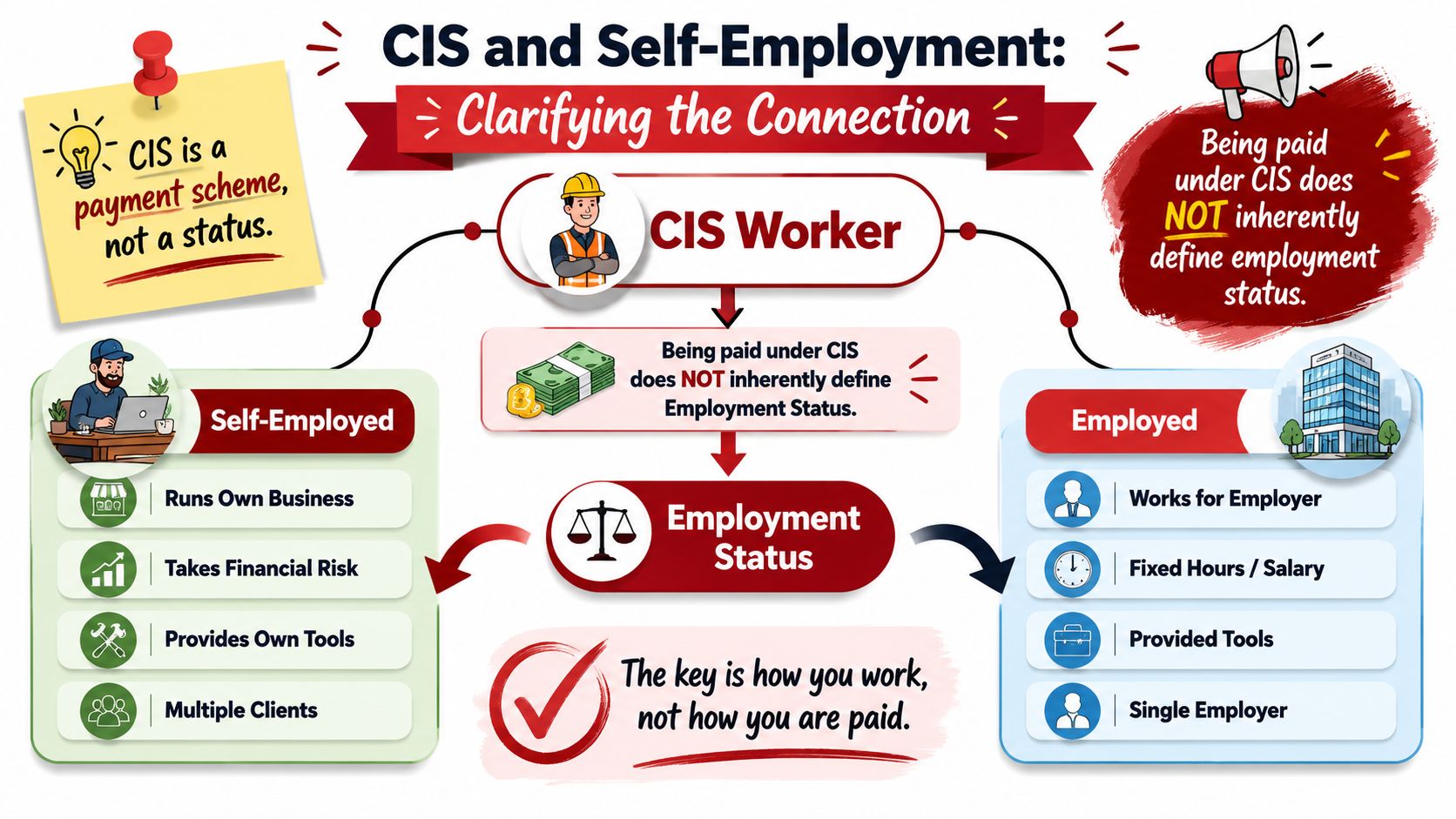
A worker paid under CIS is often self-employed, but CIS itself is not your employment status. HMRC's own subcontractor guidance makes that distinction clear. A CIS subcontractor can be a sole trader, company owner, partnership or trust, and a person can still be paid under CIS even if the working arrangement points to employment status. That's the trap many basic guides miss. You can read HMRC's subcontractor guidance here: HMRC guidance for CIS subcontractors.
Why people mix up CIS and employment
Most subcontractors see deductions coming off their pay and assume that means they're being treated like an employee. That's understandable, but it's the wrong conclusion.
A better way to think about CIS is this. It's a down payment on your tax bill. The contractor withholds part of the labour payment and sends it to HMRC on your behalf. That feels similar to PAYE, but the legal position is different. If you're self-employed, you still run your own business, carry your own costs, and remain responsible for sorting your final tax position through Self Assessment.
Practical rule: CIS tells you how money is withheld. It does not, by itself, tell you what you are.
The status trap that catches good tradespeople
The key indicator is how you work in practice. If you control your own jobs, take financial risk, quote for work, supply your own tools, and work for more than one client, that points towards self-employment. If one firm controls your hours, directs the work like an employer, provides what you need, and treats you like staff in all but name, the position can look very different.
That matters for more than tax. Employment status affects rights and obligations as well. It also affects who carries the tax risk if HMRC later says the arrangement was wrong.
Here's the point most subcontractors need to hear clearly. Being “on CIS” is not enough evidence on its own.
What this means in real life
If you're self-employed, you still need to:
- Keep business records: Save invoices, payment statements, receipts, and job records.
- Track your deductions: CIS suffered during the year needs to be carried through properly.
- File Self Assessment: That's where the year gets reconciled.
- Review working arrangements: If one contractor relationship looks too much like employment, get advice before it turns into a bigger issue.
If you need support from someone who understands construction work in London, a specialist contractor accountant in London can help you check the practical reality, not just the label on the remittance.
Registering for CIS as a Subcontractor
If you're working as a subcontractor and haven't registered for CIS, sorting that out should move near the top of your list. It's one of the quickest admin jobs that can make an immediate difference to cash flow.
According to Dearne Accountancy's CIS and self-employed guide, CIS workers are still classed as self-employed, and contractors usually deduct 20% from registered subcontractors' payments or 30% if the subcontractor is not registered. The same guidance also highlights that you still need to file a Self Assessment return at year-end.
Why registration matters
That deduction gap is not small when you're buying materials, paying van costs, covering fuel, and waiting on late payers. If you're unregistered, more money gets held back from every qualifying payment. For a trade business, that can squeeze working capital fast.
Registration won't remove all CIS deductions by itself, but it usually moves you onto the standard rate rather than the higher one. For many subcontractors, that's the difference between staying comfortable and constantly topping up the business from personal funds.
Register early. Waiting until several jobs have already been paid under the higher deduction rate makes the year harder than it needs to be.
What you'll usually need ready
Before you start, have your basics organised. The smoother your records are at this stage, the easier the rest of the year tends to be.
- UTR details: Your Unique Taxpayer Reference is central to CIS and Self Assessment.
- National Insurance information: Contractors and HMRC will use this to verify you.
- Business details: Name, trading style, address, and contact details should match your records.
- Trading setup clarity: Know whether you're operating as a sole trader or through another structure.
The practical registration approach
Use the HMRC route for registering as a subcontractor and make sure the details you provide are consistent across your tax records. Mismatched names, old addresses, and half-finished setups are what tend to slow things down.
Once you're registered, tell each contractor promptly and give them the details they need to verify you. Don't assume they'll “already have it from last year”. CIS admin often breaks down because one side assumes the other has done the legwork.
A simple habit helps here. Keep a folder, whether that's in Dropbox, Google Drive, or a paper file in the van office, with:
- registration confirmation
- your UTR
- your National Insurance details
- copies of contracts
- onboarding forms from contractors
If you're also signing agreements with firms you work for, make sure the paperwork reflects a genuine subcontractor relationship. This guide on creating business contracts is useful if you want to tighten up how your terms are documented.
How CIS Deductions Work on Your Payments
The point where CIS causes the most frustration is not the tax return. It's the invoice stage.
Most subcontractors don't lose sleep over the theory. They lose sleep when money lands short, materials weren't separated properly, and nobody can explain why the deduction looks too high. That usually comes down to how the invoice was prepared and how the contractor processed it.
What happens between invoice and payment
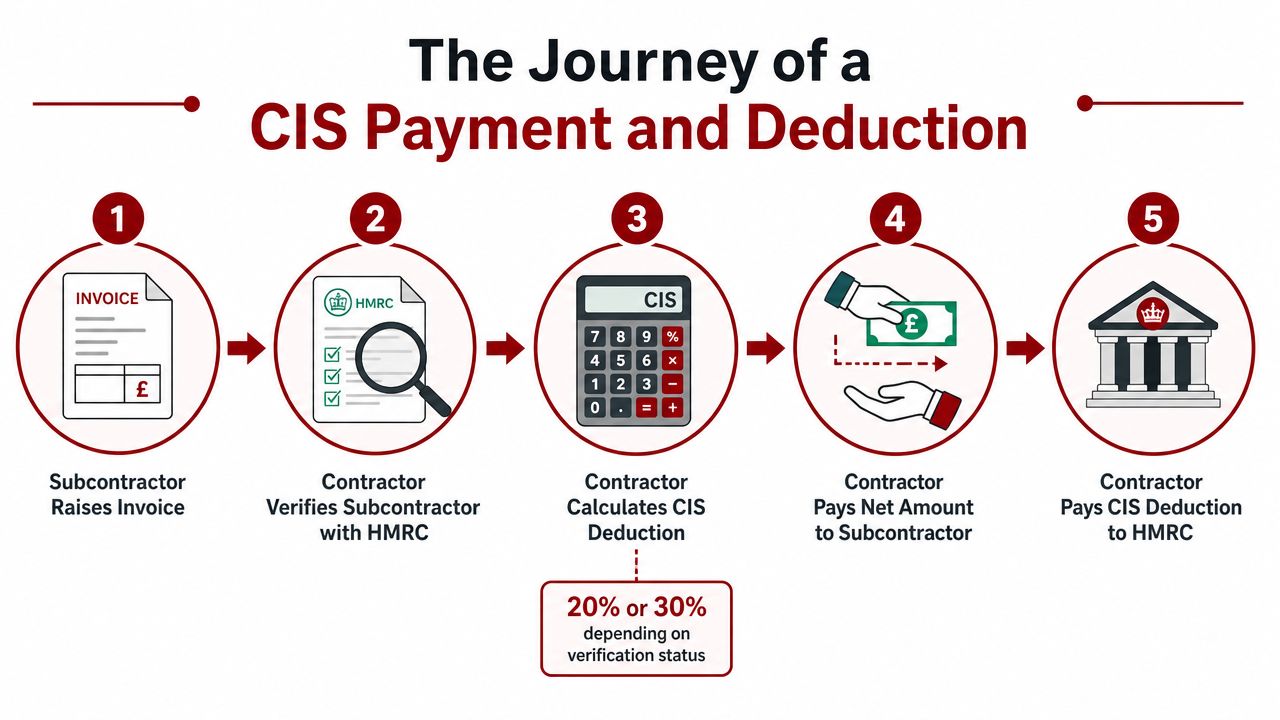
The contractor should verify you with HMRC, then apply the correct deduction status to the payment. Under CIS, a registered self-employed subcontractor normally has 20% deducted, while an unregistered subcontractor faces 30%. These deductions are advance payments towards tax and National Insurance, and they hit cash flow immediately. Artema's explanation also highlights a key practical point. Invoices must separate labour from materials and VAT, because CIS should only apply to the labour element: CIS for self-employed subcontractors explained.
A clean payment process usually looks like this:
- You raise the invoice: It should clearly show labour and non-labour items separately.
- The contractor verifies you: They check your status with HMRC.
- The deduction is calculated: CIS should apply to the labour part only.
- You receive the net payment: This is the invoice amount less the CIS deduction on labour.
- You receive a deduction statement: Keep it. Don't rely on memory later.
Here's a useful visual summary of that payment journey.
A simple invoicing example
Say you bill for a job with two clear lines:
| Item | Treatment under CIS |
|---|---|
| Labour | CIS deduction applies |
| Materials | CIS deduction should not apply |
| VAT | CIS should not be applied to VAT |
If you send a vague invoice with one total and no breakdown, you make it easier for the contractor to process it badly. If materials are buried inside labour, the deduction can end up being taken on costs that shouldn't have been caught.
That's why good invoicing isn't admin for admin's sake. It protects your cash.
A poor invoice doesn't just look untidy. It can lead to over-deduction and a tighter month than you expected.
What works and what doesn't
What works:
- Separate labour clearly: Put it on its own line.
- List materials properly: Don't roll them into labour.
- Match invoice wording to the job: Clear descriptions help avoid disputes.
- Save every payment statement: Rebuilding the year from bank entries alone is painful.
What doesn't work:
- One-line invoices: They create confusion.
- Text message billing: Fine for a reminder, not for record keeping.
- Ignoring software: Even simple tools help. If you're choosing systems, this review of builder finance management tools is worth a look because it compares options with construction workflows in mind.
- Assuming the contractor got it right: Always check the remittance.
Qualifying for Gross Payment Status
For an established subcontractor, Gross Payment Status is worth aiming for because it changes the rhythm of the business. Instead of having CIS deducted before the money reaches you, you're paid in full and deal with your tax through the normal year-end process.
That doesn't mean it's right for everyone immediately. It suits tradespeople who are organised, consistently compliant, and able to keep money aside for tax rather than treating every pound received as spendable cash.
Why it matters for cash flow
When deductions stop coming off each payment, the business feels less restricted month to month. That can make it easier to cover wages, buy stock, replace tools, and smooth out the gap between jobs.
But there's a trade-off. Some subcontractors are better disciplined when CIS is deducted upfront because it forces part of the tax provision out of the account. Gross Payment Status gives you flexibility, but it also demands stronger habits.
A good test is simple. If you already set aside tax regularly, keep records up to date, and don't wait until deadlines are looming, you're the sort of business owner who usually handles gross payment better.
The three tests in plain English
HMRC applies specific qualifying tests for Gross Payment Status. The language can sound technical, but the commercial meaning is straightforward.
The business test
You must be operating in the UK construction sector in a way that fits the scheme. In practical terms, your business activity has to sit properly within the construction world rather than just touching it occasionally.
The turnover test
There's a minimum turnover requirement. The principle matters more than memorising labels. HMRC wants to see that this is a real trading business with enough scale to justify gross treatment.
The compliance test
Many otherwise capable subcontractors often come unstuck in this area. HMRC expects a strong filing and payment record. If your tax admin is patchy, returns are late, or records are inconsistent, that weakens the application.
Gross Payment Status rewards businesses that behave like businesses, not businesses that only tidy up when HMRC comes knocking.
Should you apply now or later
Not every self-employed plumber or electrician should rush into it. A newer business may be better served by getting the basics stable first:
- regular invoicing
- reliable bookkeeping
- clean CIS statements
- timely tax returns
- sensible tax reserves
Once those habits are in place, Gross Payment Status becomes a strategic next step rather than an administrative headache.
The strongest applications usually come from subcontractors who can already answer basic questions quickly. What was invoiced, what was deducted, what was paid, what's still owed, and what's set aside for tax. If those answers take too long to produce, focus there first.
Filing Your Tax Return with CIS Deductions
This is the stage where many subcontractors finally see how CIS fits together.
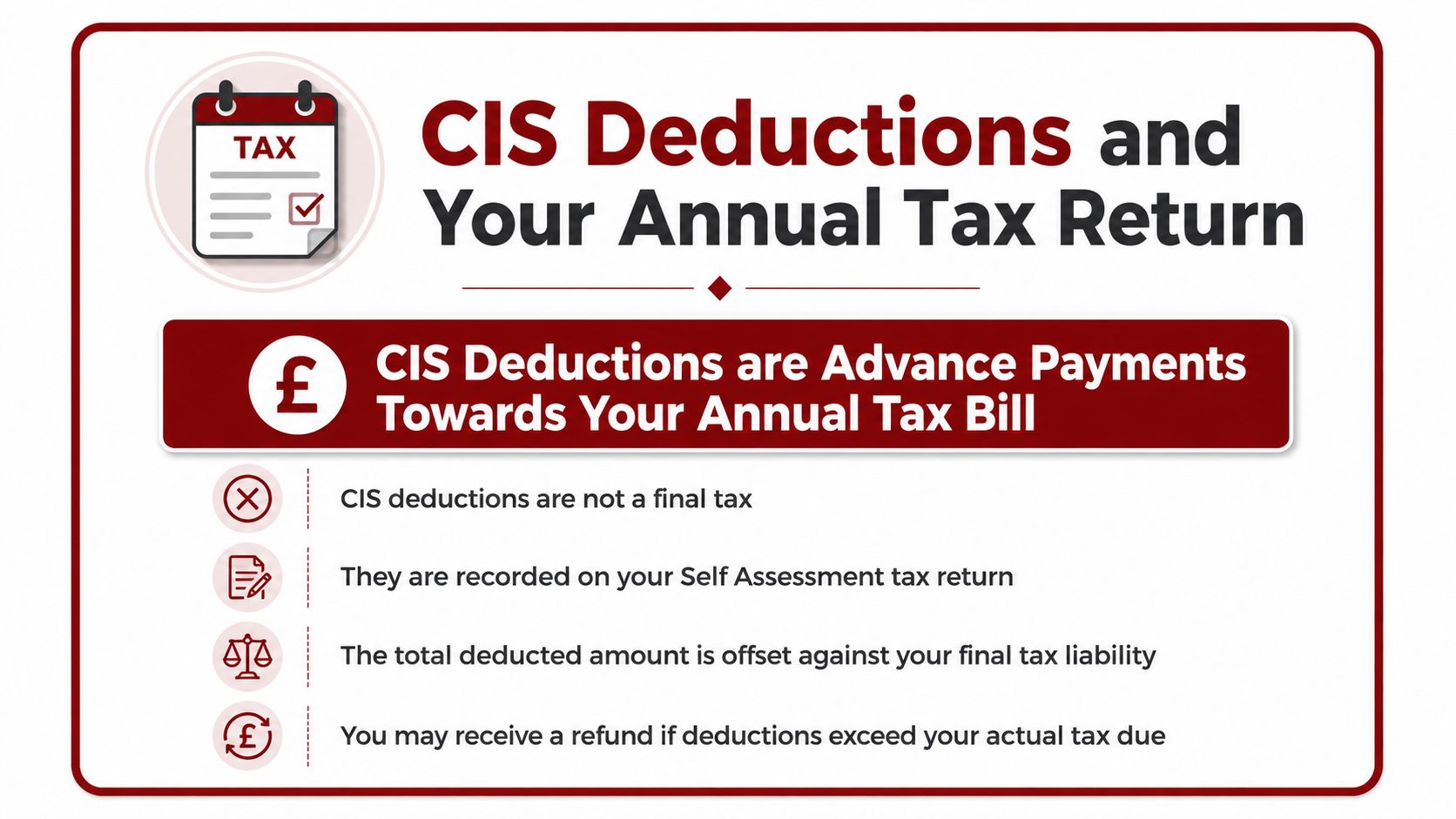
During the year, money has been withheld from your payments. At Self Assessment time, those deductions are brought into the tax return and set against the tax and National Insurance due on your business profits. That's why CIS should be viewed as advance tax, not as money that has vanished forever.
How the year-end calculation works
Think of the process like this. Your tax return totals up what your business earned and deducts allowable business expenses to arrive at profit. Then the CIS tax already suffered during the year is entered in the correct place and credited against what's due.
If the deductions already made are more than the final liability, you may be due a refund. If they're less, there may still be tax to pay. Either way, the return is where the numbers are reconciled properly.
That's why missing CIS statements cause such trouble. Without accurate deduction records, the return can be wrong, and refunds can be delayed or understated.
The records that make the return smoother
A strong CIS tax return is built from ordinary discipline, not heroics in January.
- Monthly deduction statements: These are essential.
- Sales invoices: They support your turnover figure.
- Purchase and expense records: Materials, tools, travel and other allowable costs need evidence.
- Bank records: They help confirm what was received.
- VAT records where relevant: If you're VAT-registered, your invoicing and bookkeeping need to reflect that clearly.
The tax return is only as good as the paperwork behind it.
If you want a broader view of how an accountant supports record keeping, compliance, and year-end claims, this overview of ways an accountant can help your small business is a useful read.
A detail worth understanding about contractors
Some businesses don't think of themselves as construction contractors at first, but HMRC can still treat them as deemed contractors if their expenditure on construction operations exceeds £3 million in any rolling 12-month period. Once that threshold is crossed, they fall into CIS obligations. HMRC's CIS guide also states that the CIS tax month runs from the 6th to the 5th, with returns due by the 19th of the following month: HMRC CIS 340 contractor and subcontractor guide.
That matters to subcontractors because the payer's systems affect your paperwork. If you work for property businesses, developers, or organisations that have crossed into deemed contractor territory, make sure their remittance and statement process is consistent.
Where VAT fits in
VAT and CIS often get muddled together on invoices. They are different systems.
The clean rule for subcontractors is practical. Keep the invoice structure clear so labour, materials, and VAT are easy to identify. That reduces disputes and makes it easier for your records, your accountant, and the contractor's accounts team to treat the payment correctly.
Your CIS Compliance Checklist and Expert Support
Most CIS problems aren't caused by one dramatic mistake. They come from a string of small avoidable ones. A missing statement here, a rushed invoice there, a late return, a contractor using old details, and by year-end the numbers no longer tie up cleanly.
The safest approach is a repeatable checklist. If you use one, CIS becomes manageable. If you wing it, it stays stressful.
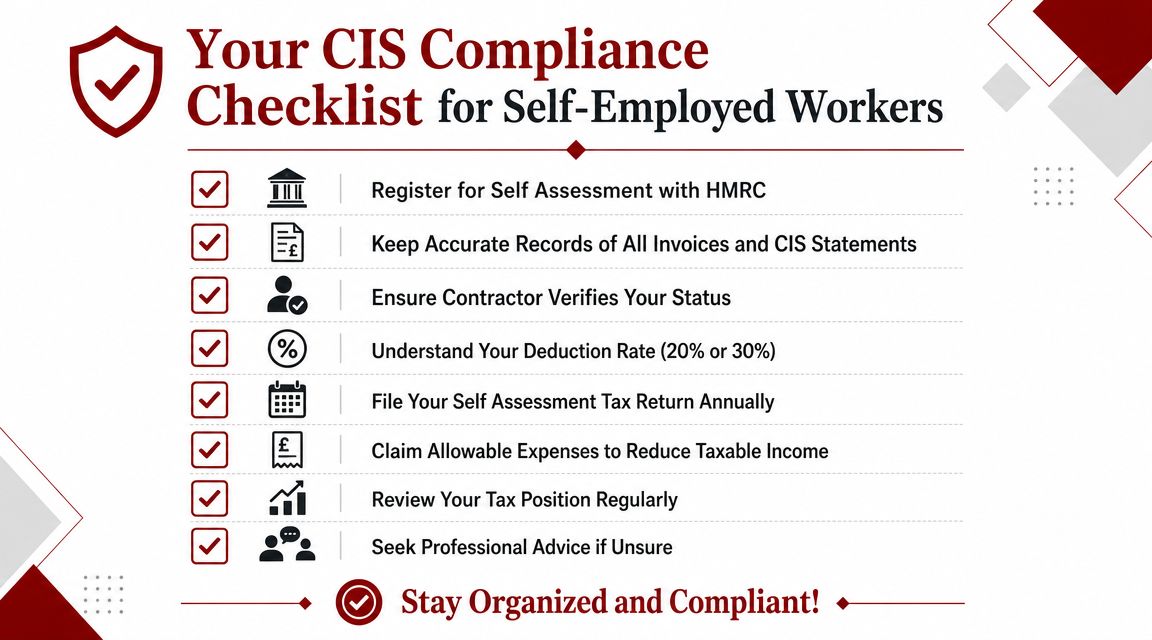
The checklist that keeps you out of trouble
Use this as your working routine through the year.
- Register properly: If you haven't sorted CIS registration and Self Assessment, do that first. A bad start tends to echo through the whole year.
- Give contractors accurate details: Old addresses, wrong names, and missing UTR information create verification problems.
- Issue proper invoices: Separate labour, materials, and VAT clearly every time.
- Check remittances as they arrive: Don't leave discrepancies until months later.
- Keep every CIS deduction statement: Save a copy in cloud storage and another in your accounts file if possible.
- Track expenses as you go: Waiting until year-end means lost receipts and missed claims.
- Review your tax position regularly: Don't assume CIS deductions cover everything automatically.
- File your return on time: Refunds are much easier to secure when the return is accurate and prompt.
For a plain-English refresher on the annual filing side, this self assessment tax return guide is a helpful companion resource.
Common mistakes that cost subcontractors money
Some mistakes come up repeatedly with self-employed trades.
Losing CIS statements
This is one of the biggest avoidable problems. If the contractor issued the statement but you didn't keep it, the year-end claim becomes slower and harder to support.
Treating the bank feed as full bookkeeping
A bank transaction tells you money moved. It doesn't tell you whether part of the invoice was materials, whether VAT was involved, or whether the deduction posted correctly. Software helps, but it still needs proper input.
Forgetting the employment status question
Some workers spend years on one site, under one business, under tight control, then assume CIS must be correct because that's how they've always been paid. That assumption is risky. Labels don't override the facts of the relationship.
If one contractor relationship feels less like a business-to-business arrangement and more like a job, review it before HMRC does.
Letting admin drift until refund season
Many subcontractors only start searching for paperwork when they want a rebate. By then, emails are missing, statements are buried, and the rush creates errors. The better route is to maintain a monthly habit.
A straightforward system that works
You don't need a complicated finance department to stay compliant. You need a system you'll put to use.
A practical setup for many tradespeople is:
| Record type | Best habit |
|---|---|
| Invoices | Create and send from one app or template |
| CIS statements | Save as PDFs in one dedicated folder |
| Receipts | Capture immediately with a phone app |
| Bank review | Reconcile regularly, not once a year |
| Tax return prep | Keep a running file for accountant queries |
If you want a local firm's perspective on broader accountancy support in North West London, have a look at this trusted accountancy practice in London page.
The main thing is consistency. A modest system followed every month beats a “perfect” system you never keep up with.
If you're a subcontractor, plumber, electrician, or builder who wants CIS handled properly without the usual confusion, Action Accountants Limited can help. The team supports self-employed workers and construction businesses across Colindale, North West London, and the wider UK with CIS-aware bookkeeping, Self Assessment, VAT, and practical tax advice. If you want clear answers, organised records, and a smoother route to compliance and refunds, they're well placed to help you get it sorted.