
Contractor Accountant London: Your 2026 Guide to IR35 & CIS
Action Accountants •31 May 2026
You're probably dealing with this right now. A client payment is late, a subcontractor invoice needs checking, CIS deductions are hitting cash flow, and your bookkeeping is sitting behind because site work came first again. On top of that, someone has asked whether the contract is inside or outside IR35, and your current accountant replies three days later with a generic answer that doesn't really answer anything.
That's the point where most London contractors realise they don't need a basic bookkeeper. They need a contractor accountant who understands how construction businesses run in London. Not just year-end filings. Not just software feeds. Pressure points include timing, compliance, contract risk, and making sure cash doesn't disappear through avoidable errors.
If you're weighing up a contractor accountant in London, the right question isn't “who's cheapest?” It's “who will keep this business stable when payments slow, CIS gets messy, and HMRC deadlines keep moving closer?”
Table of Contents
- The Modern Challenge for London Contractors
- Essential Services Beyond Basic Bookkeeping
- Decoding Contractor Accountant Fees in London
- Your Selection Checklist for the Right Partner
- Spotting Red Flags Before You Sign
- Making the Hire and Onboarding Smoothly
- Frequently Asked Questions
The Modern Challenge for London Contractors
London contractors rarely struggle because they don't work hard enough. They struggle because the admin risk builds faster than the paperwork gets cleared. A typical week can mean chasing a valuation, approving wages, checking whether a subcontractor has been verified properly, and trying to work out if a client's contract wording creates an IR35 problem.

A good contractor accountant in London now does a different job from the one many contractors expected a few years ago. Since HMRC's off-payroll working reforms shifted tax-status risk to many medium and large private-sector clients, the value of a specialist accountant has moved away from simple take-home-pay optimisation and towards compliance, contract review, and protecting the business in a stricter environment, as discussed by Accounting People's overview of contractor accountants.
That shift matters in construction because the pressure isn't theoretical. If paperwork slips, cash slips. If contract wording is weak, status risk lands in the wrong place. If CIS records don't match what was paid, the correction usually arrives when cash is already tight.
Practical rule:If your accountant mostly talks about “saving tax” and rarely talks about process, documentation, reserves, and contract terms, you're probably getting old advice for a newer problem.
Plenty of contractors still look first at company structure, which is sensible. If you want a plain-English refresher on the commercial side of incorporation, this guide to UK limited company benefits for 2026 is a useful starting point. But once the company exists, the primary challenge is operational discipline.
The firms that cope well in London usually have one thing in common. Their accountant isn't just filing returns after the fact. They're helping the contractor stay organised before mistakes become expensive.
Essential Services Beyond Basic Bookkeeping
Generic accounting support misses the problems that hurt contractors most. For London construction businesses, the must-have services sit around CIS, cash flow, invoice checking, payroll timing, VAT treatment, and contract risk. If those aren't front and centre, the service is too general.
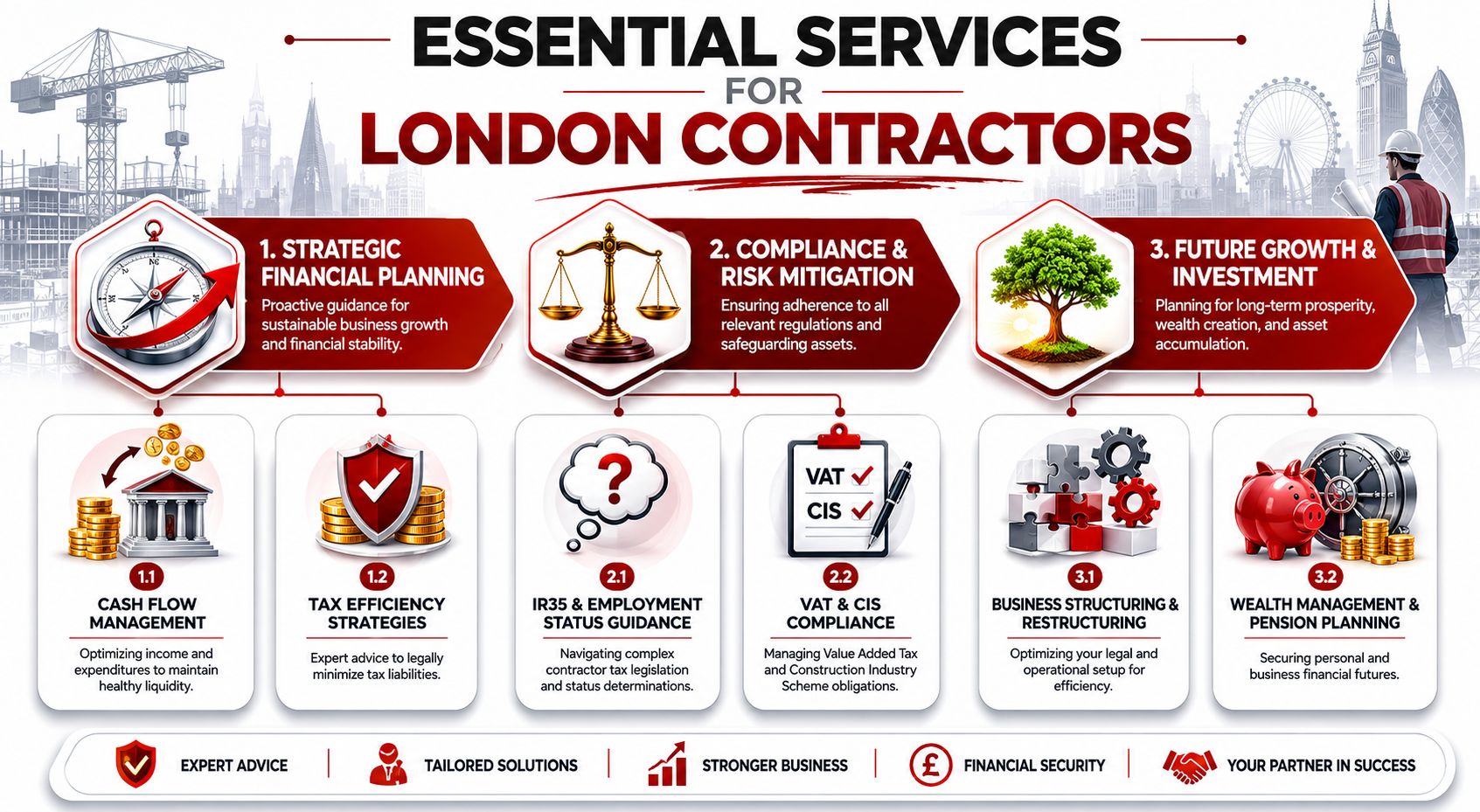
Many contractors don't need more reports. They need better control over what leaves the bank, what gets deducted under CIS, and what should have been queried before payment. That's why specialist firms focus less on broad bookkeeping language and more on practical issues such as CIS cash-flow management, invoice verification, and reserve planning, which is highlighted in Howlader & Co's contractor accounting page for London.
CIS control comes first
If you're in construction, CIS is not an add-on task. It's one of the first things to test when you assess an accountant.
The work should include:
- Subcontractor verification before payment: If status checks happen late or inconsistently, deductions can be wrong from the start.
- Monthly CIS return handling: The accountant should know what was paid, what was deducted, and whether the return agrees to the underlying records.
- Invoice verification: This sounds simple, but it prevents paying the wrong amount, paying too early, or paying against incomplete support.
- Reserve planning: When receipts are irregular, setting aside funds for tax, VAT, and timing gaps stops one late payment from causing three separate problems.
For contractors trying to model deductions and payment effects, a practical CIS calculator for contractors and subcontractors can help sense-check figures before they feed into payroll and cash planning.
The right accountant doesn't wait until month end to ask what happened. They help you build a system where the answer is already documented.
IR35, VAT and payroll need active management
IR35 still matters, but not in the simplistic way many marketing pages suggest. A useful contractor accountant in London should look at the actual contract, the working practices, and who carries status responsibility. If they only repeat generic “inside versus outside” language, that's not enough.
VAT support also needs more than filing. Construction businesses often run into timing issues. An accountant should explain the trade-off of schemes such as cash accounting in practical terms. It can help with payment timing, but it won't fix poor invoicing discipline or weak debtor control.
Director payroll is another area where bad advice creates avoidable mess. A clean payroll setup should tie into the broader company records and not sit as a disconnected monthly chore.
Look for a service line-up that covers:
- Contract review for IR35 risk
- VAT return preparation with attention to real cash timing
- Director payroll run correctly and consistently
- Year-end accounts and corporation tax
- Self Assessment where needed
- Software support that matches how you run jobs
One useful sign of a serious provider is whether they separate everyday data capture from strategic guidance. Action Accountants Limited, for example, provides accounting, bookkeeping, taxation, and construction-aware support for businesses that need CIS-focused controls, rather than generic retail-style bookkeeping.
If a firm can't explain how they handle invoice approvals, subcontractor checks, and month-by-month reserve planning, keep looking.
Decoding Contractor Accountant Fees in London
A London subcontractor can look at a quote for £79 a month and think the problem is solved. Three months later, they are paying extra for VAT, extra for payroll, extra for Self Assessment, and still chasing answers on CIS deductions that should have been dealt with from the start. That is how a cheap package turns expensive.
Fees only make sense once you know what work your business needs. For construction contractors in London, the pressure points are usually CIS compliance, uneven payment timing, VAT, payroll, and year-end filing. A low monthly fee has little value if it leaves gaps in those areas.
Why fixed fees are common
Most contractor accountants charge a fixed monthly fee because the work repeats through the year. Accounts, corporation tax, payroll, software, VAT returns, and personal tax do not arrive once and disappear. A monthly package spreads the cost and makes cash planning easier when one contractor pays in 14 days and another takes 60.
Published market guidance still puts many contractor packages in a broad range of £60 to £150 + VAT per month, with higher pricing once advice and tax support become more involved, according to Sleek's guide to contractor accounting costs.
London pricing often sits above the cheapest national offers for a simple reason. Construction contractors here tend to have more moving parts. More subcontractors, tighter margins, bigger VAT exposures, and more frequent questions around CIS and payment timing all create work that a generic bookkeeping package does not cover well.
If you want a benchmark for what firms include at different price points, review a clear contractor accountant pricing page before you compare quotes line by line.
For another angle on how limited-company accounting fees are structured, Umbrella Company's guide to accountant fees is a useful comparison point.
What each package level usually includes
The practical way to compare firms is to put every quote into the same table. Otherwise, one accountant includes payroll and VAT, while another strips them out and looks cheaper on paper.
| Feature | Basic Package (~£60-£100/mo) | Standard Package (~£100-£140/mo) | Premium Package (~£140+/mo) |
|---|---|---|---|
| Year-end statutory accounts | Usually included | Included | Included |
| Corporation Tax return | Usually included | Included | Included |
| Accounting software access | Often included | Included | Included |
| Bookkeeping support | Limited | More hands-on | More detailed review and correction |
| VAT returns | Often extra | Commonly included | Included |
| Director payroll | Often extra | Commonly included | Included |
| Self Assessment | Often extra | Sometimes included | Commonly included |
| IR35 support | Rare | Sometimes limited | Commonly included |
| Day-to-day advisory input | Minimal | Moderate | Broader access |
The main difference is rarely the filing itself. It is the amount of review, advice, and correction included before the filing goes in.
A construction contractor with CIS deductions, reverse charge VAT issues, and subcontractor payments usually needs more than the cheapest package. Paying a little more each month is often cheaper than fixing a year of coding errors, missed deductions, or badly timed VAT payments.
Where firms add extras
A common issue arises with many quotes. The headline fee looks tidy, but the firm bills separately for the questions that matter most.
Check these points before you agree terms:
- VAT work: Ask whether returns are included and whether the price covers review, not just submission.
- Payroll: Confirm how many payroll runs are covered and what happens if you add staff or subcontractors.
- Self Assessment: Many firms treat this as separate, even where the director assumes it is part of the package.
- CIS support: Ask whether subcontractor verification, deduction reporting, and corrections are covered.
- Ad hoc advice: Clarify what happens when you need answers on a contract, cash extraction, or a filing problem.
- Onboarding and catch-up fees: Late records and prior-year cleanup often cost extra.
One blunt test helps. Ask the accountant to list every likely additional charge for a typical London construction contractor over the next 12 months. If the answer is vague, expect the invoice to grow later.
The best fee arrangement matches the complexity of the business and the cost of getting things wrong. For London contractors working under CIS, accuracy and timely advice usually matter more than shaving £20 off the monthly fee.
Your Selection Checklist for the Right Partner
Most contractors shortlist accountants by price, location, and whether the website mentions IR35. That misses the biggest differentiator. In construction, specialisation changes the quality of the work.
Why construction specialisation matters most
A construction-aware accountant doesn't just process transactions. They understand that one job can look profitable in the bank account while leaking margin in the records.
A key differentiator is the ability to manage job costing separately from statutory bookkeeping. Construction cost-estimation research identifies 13 influencing factors in contingent-cost judgments, with the most critical including stakeholder communication, prior project experience, risk attitude, and perceived tender-document quality. In practice, that supports a method where labour, materials, plant, subcontractor spend, and overhead are tracked by project and then reconciled against CIS deductions and VAT records, as explained in this construction accounting and cost-estimation research paper.
That matters because a generalist may file compliant accounts but still miss the operational issue. The contractor sees turnover. The specialist sees where margin is being lost.
A strong shortlist should include firms that can answer questions like these without hesitation:
- How do you separate project costing from statutory accounts?
- How do you track labour, materials, and subcontractor costs by job?
- How do you deal with CIS deductions when reconciling project profitability?
- What do you want from me weekly, not just at year end?
If you're comparing support options in North West London, compliance services in Colindale and North West London can give you a practical sense of the compliance scope a local firm should be ready to handle.
Here's a useful discussion point to consider while you assess providers:
The shortlist test that saves time
You don't need twenty calls. You need a disciplined filter.
What works: An accountant who asks about your contracts, payment timing, subcontractor setup, VAT position, and software process before quoting.
What doesn't work is a smooth sales call with no technical depth. If they spend most of the time talking about being approachable, but never ask how you approve invoices or record job costs, they're selling comfort rather than capability.
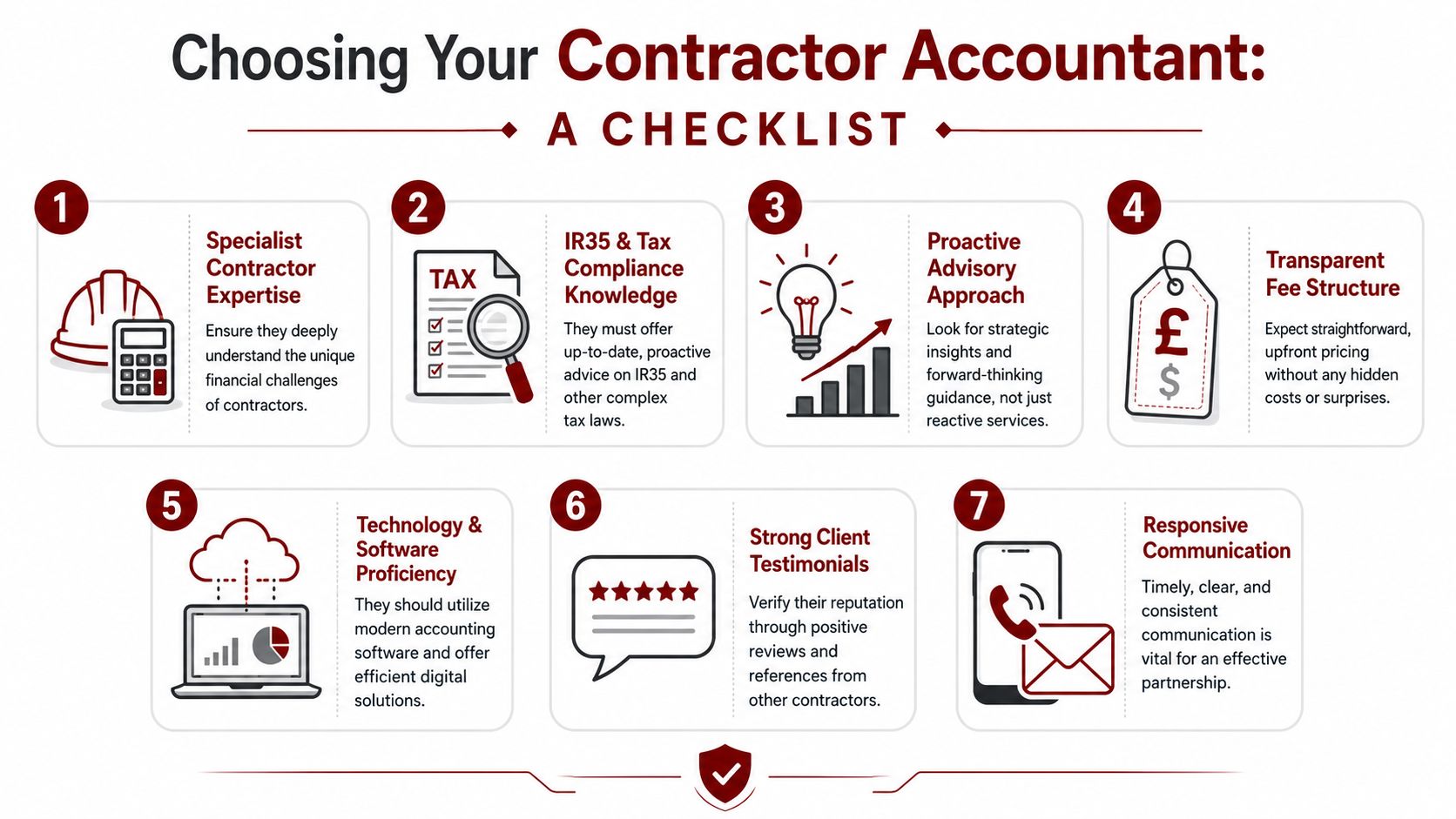
Use this checklist:
- Construction fluency: They should understand CIS timing, subcontractor verification, and project-led records.
- Software competence: Xero and QuickBooks are common, but the key issue is whether they can build a usable process around them.
- Proactive communication: Good firms tell you what they need before the deadline becomes urgent.
- Clarity under pressure: Ask a messy question. The quality of the answer usually tells you more than the brochure.
The best choice is rarely the accountant who promises the most. It's the one who spots the problems you haven't spotted yet.
Spotting Red Flags Before You Sign
The danger signs often show up before the engagement letter does. Contractors ignore them because the fee looks decent or because they're in a rush to get someone in place. That's how they end up with a firm that files eventually but doesn't control the risk.

Promises that usually age badly
One common red flag is vague pricing. If the proposal says “from” a low number but avoids specifics on VAT returns, payroll, personal tax, or contract reviews, expect add-on charges and friction later.
Another is outdated process. If a firm still relies on sporadic document dumps, manual chasing, and no clear approval flow, errors become more likely when workload rises. That matters because Gartner research found 59% of accountants make several errors every month during busy periods, a point covered in CFO Dive's report on the Gartner findings. In contractor accounting, those errors don't stay small for long. CIS coding mistakes, incorrect VAT treatment, and payroll misclassification can create penalties and distort cash flow.
Watch for these warning signs:
- Heavy “tax savings” language: If compliance barely gets mentioned, the priorities are off.
- Slow, fuzzy replies: Delayed answers before you sign usually become worse after you sign.
- No CIS detail: A firm that talks about bookkeeping in broad terms may not understand construction pressure points.
- No documented workflow: If they can't describe how data moves from invoice to return, they probably rely on memory and firefighting.
A polished website doesn't protect you from weak processes. A documented workflow does.
Questions worth asking before you commit
The best interview questions are slightly awkward. They force the firm to explain how work is done.
Ask them:
- How do you prevent CIS errors before returns are filed?
- Who reviews VAT treatment when something unusual comes in?
- How quickly do you respond during payroll week or month end?
- What software do you use, and what happens if records are incomplete?
- What is billed separately?
- What do you need from me every week to keep things accurate?
Listen for direct answers. Strong firms give you a sequence. Weak firms give you reassurance.
Another red flag is overpromising on turnaround without asking how organised your records are. Good accountants know that clean reporting depends on clean inputs. They won't pretend otherwise.
If you feel rushed into signing before scope, communication, and pricing are clear, walk away. Replacing a bad accountant later is always more disruptive than taking a little longer now.
Making the Hire and Onboarding Smoothly
Choosing the firm is only half the job. The handover needs to be clean, otherwise the first few months become a scramble.
The handover steps that matter
Start with the engagement letter. Read the scope carefully. Make sure it states what's included, what's extra, who handles payroll, who files VAT, and whether Self Assessment or contract review sits inside the package.
If you're switching from another accountant, ask for professional clearance early. That usually matters more than people expect because delays tend to sit around missing records, incomplete prior-year files, or confusion over software access.
Then get the systems in place:
- Bank feeds and software access: These should be connected at the start, not weeks later.
- Company and ID documents: Send them in one organised batch.
- Tax registrations and references: Keep them easy to retrieve.
- Payroll setup: If you pay yourself or staff, lock this down early. If you need a reference point for service scope, review practical payroll services in Colindale and North West London.
Set communication rules from day one. Decide whether queries go by email, portal, or call. Agree how often management figures will be reviewed. Monthly check-ins work well for many contractors because they catch drift before quarter-end problems pile up.
Onboarding rule: The first month should focus on building a repeatable routine, not solving every historical problem at once.
The smoothest relationships start with a disciplined document flow and realistic expectations on both sides.
Frequently Asked Questions
When should a new contractor hire an accountant?
As early as possible. Ideally before the first contract is signed or the company starts trading. Early setup affects payroll, VAT handling, software structure, and how you keep records from day one.
Can I just use accounting software instead of hiring an accountant?
Software helps, but it doesn't replace judgement. Xero or QuickBooks can record transactions well if you use them properly. They won't review contract risk, sense-check CIS treatment, or warn you when your records are technically complete but commercially misleading.
Is it difficult to switch accountants if I'm unhappy?
Usually not, provided your records are reasonably organised. The practical issues are getting professional clearance, retrieving prior records, confirming who still has software access, and making sure no filing deadlines are missed during the changeover.
What matters most for construction contractors?
Sector knowledge. A contractor accountant in London should understand CIS deductions, irregular payment cycles, invoice verification, and job costing discipline. If they don't, you may still get filed accounts, but you won't get much operational protection.
If you need a contractor accountant in London who understands construction workflows, CIS compliance, payroll, bookkeeping, and day-to-day business controls, Action Accountants Limited provides accounting and advisory support from North West London for contractors, subcontractors, and growing businesses that need practical, organised financial oversight.