

You've hired your first employee, taken on more subcontractors, or bought another rental property. The bank feed is full of transactions, invoices are waiting to be chased, and someone still needs to be paid correctly. The spreadsheet that once felt manageable now depends on memory, late-night calculations, and crossed fingers.
That's where payroll and bookkeeping services stop being optional admin support. Payroll keeps employees, contractors, HMRC and pension obligations aligned. Bookkeeping creates the reliable financial record behind VAT, tax returns, cash-flow decisions and year-end accounts. For a London startup, construction contractor or landlord, the cost of getting either function wrong is rarely the advertised service fee. It's the missed deadline, incorrect deduction, confused employee, avoidable penalty and time taken away from running the business.
Table of Contents
- The Day the Spreadsheet Breaks
- What Payroll and Bookkeeping Services Actually Cover
- The Monthly Rhythm of UK Payroll and Bookkeeping Tasks
- Compliance Demystified from PAYE to VAT and CIS
- Why Outsourcing Still Beats the Software Only Setup
- The CIS Trap That Catches Construction Contractors
- How to Choose the Right Payroll and Bookkeeping Provider
- Your Next Step with Action Accountants in North West London
The Day the Spreadsheet Breaks
A North West London founder may start with one employee and a simple spreadsheet. They record hours, calculate pay, copy figures into payroll software and promise themselves they'll reconcile the bank at the weekend. A contractor working across several sites faces a different version of the same problem: subcontractor invoices, CIS deductions, materials, mileage and payment dates all sit in separate folders.
A landlord with a growing portfolio often has the same issue disguised as property administration. Rent arrives on different dates, repairs are paid from mixed accounts, mortgage interest needs careful treatment, and personal spending can become entangled with property costs. None of these tasks is impossible in isolation. The problem is that they interact.

What usually goes wrong first
The first failure is often timing. The owner knows payroll must run, but variable hours arrive late. A new starter's details are incomplete. A subcontractor's status hasn't been verified. A bank reconciliation is postponed because the business is busy, then forgotten.
The second failure is classification. A payment is posted to the wrong expense category, a director's personal withdrawal is treated as a business cost, or a CIS deduction is recorded without matching it to the relevant payroll claim. The accounts may still look plausible, which makes the error harder to spot.
Practical rule: If your records depend on one person remembering every deadline and exception, you don't have a process. You have a vulnerability.
Cloud accounting can reduce manual entry and make records easier to access, but software doesn't decide whether a transaction is correct or whether a payroll submission is ready. Understanding the benefits of cloud accounting is useful, but the system still needs disciplined input, review and reconciliation.
The rescue plan is straightforward. Separate payroll from bookkeeping conceptually, connect them operationally, set a monthly rhythm, and decide which work belongs with you. The aim isn't to outsource every decision. It's to stop routine compliance from consuming the attention you need for sales, delivery and growth.
What Payroll and Bookkeeping Services Actually Cover
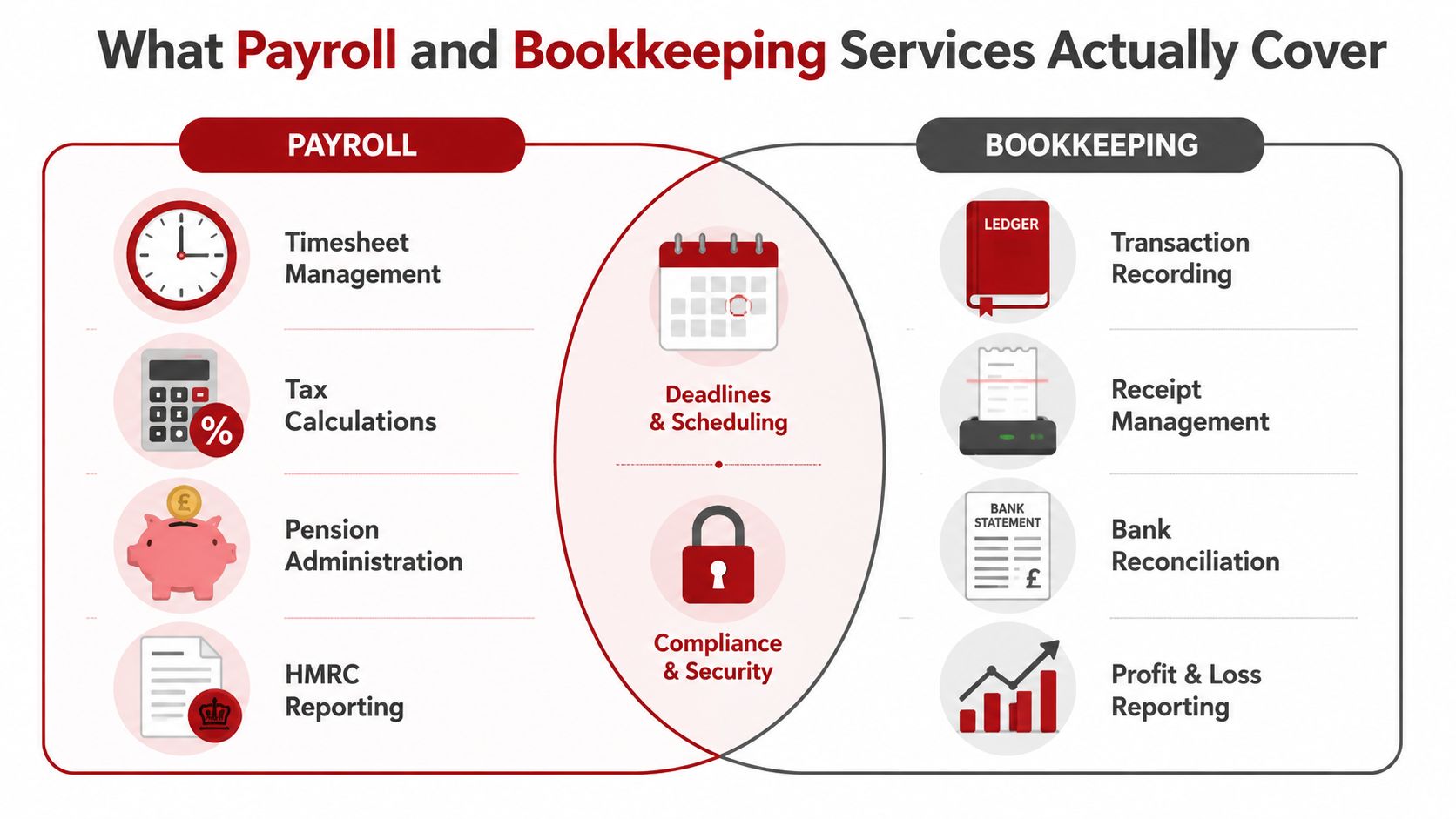
Payroll is the process of paying people and reporting that payment. It includes collecting timesheets, calculating gross pay, deductions and net pay, issuing payslips, handling statutory payments, administering workplace pensions and sending the required payroll information to HMRC.
Bookkeeping is the financial record of the business. It captures sales invoices, supplier bills, receipts, bank transactions, payroll journals, loan movements and owner drawings. Good bookkeeping also reconciles the bank, tracks unpaid invoices and prepares information for VAT returns, management reporting and annual accounts.
A useful way to remember the distinction is this:
- Payroll is the heartbeat: It runs to a regular timetable and affects employees directly.
- Bookkeeping is the memory: It records what happened and preserves the evidence needed to explain the business's financial position.
- The ledger is the connecting tissue: Payroll costs, PAYE liabilities, pension deductions and net wages must be posted accurately into the accounts.
Where the two services overlap
Suppose a café pays staff wages from its business bank account, but the payroll journal isn't posted correctly. The bank may reconcile while the nominal ledger shows the wrong wage expense or an unexplained PAYE balance. A contractor might record a subcontractor payment but fail to match the CIS deduction to the correct return and payroll records. The cash has left the bank, yet the compliance trail is incomplete.
That's why you shouldn't choose a provider based only on whether they can produce payslips or enter receipts. Ask how they connect:
- Payroll journals to the general ledger.
- PAYE and pension liabilities to payment records.
- Supplier invoices to bank transactions.
- VAT coding to supporting documents.
- CIS deductions to subcontractor statements and payroll claims.
Software can help, but each platform handles workflows differently. If you're comparing QuickBooks, Xero, Sage or another system, use a practical guide to compare accounting software against your actual needs, including payroll integration, bank reconciliation and reporting.
The strongest arrangement gives you one clear ownership map. Someone approves hours and expenses. Someone checks the payroll. Someone reconciles the bank. Someone monitors HMRC correspondence. If those responsibilities remain vague, even good software will produce tidy-looking records that nobody has properly reviewed.
The Monthly Rhythm of UK Payroll and Bookkeeping Tasks
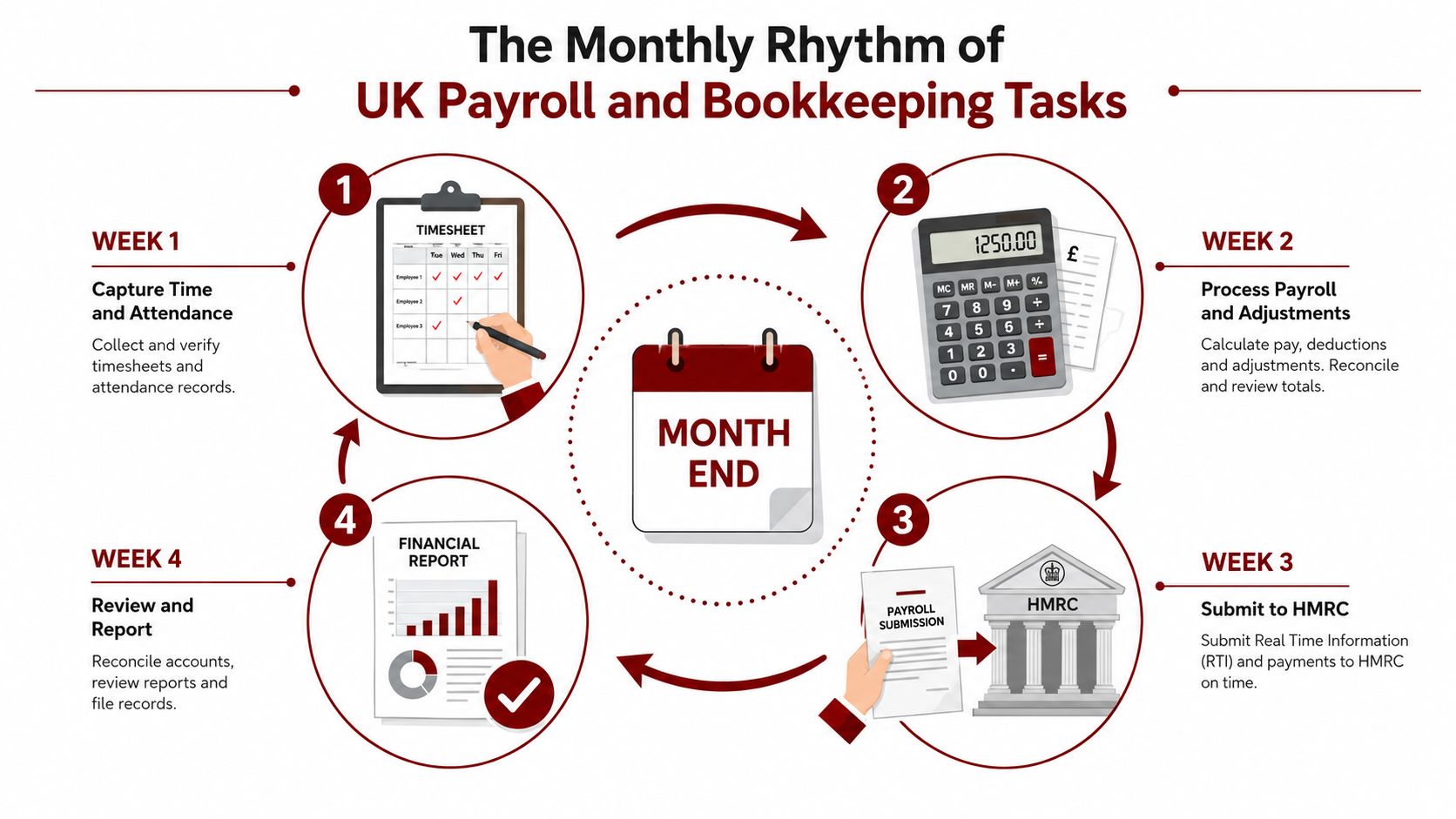
A small London café provides a useful example. During the first part of the month, the owner gathers timesheets, holiday information, new-starter details and any changes to hours or pay. The bookkeeper also collects supplier invoices, checks receipts and reviews transactions imported from the bank.
The payroll preparer then calculates pay, checks deductions and produces payslips. Before submission, the owner or authorised reviewer should confirm that starters, leavers, variable hours and statutory payments have been handled correctly. A payroll file shouldn't be approved just because the software accepts it.
A month that leaves an audit trail
Once payroll is approved, the employer sends the Full Payment Submission, or FPS, to HMRC. Employees receive their payslips, payroll liabilities are recorded in the books, and the business prepares to pay the amounts due for PAYE and National Insurance.
The bookkeeping work continues after payday:
- Post the payroll journal: Record wages, employer costs, deductions and liabilities in the correct accounts.
- Reconcile the bank: Match wages, PAYE payments, supplier payments and customer receipts to the bank statement.
- Review unpaid invoices: Identify overdue customer balances and decide who will chase them.
- Check VAT coding: Make sure transactions have the right VAT treatment and supporting evidence.
- Prepare CIS information: For construction businesses, match subcontractor payments, deductions, verification details and statements.
- Review exceptions: Investigate unreconciled items, unusual expenses, duplicate invoices and unexplained transfers.
A contractor with several active sites needs an even tighter rhythm. Site managers must provide accurate information, subcontractors must submit usable records, and the accounts must distinguish labour, materials and other costs. If the bookkeeping is left until year end, the contractor loses the chance to identify cash-flow pressure while there's still time to respond.
Your provider should be able to explain this workflow in plain English. A useful overview of payroll for small businesses can help you understand the expected tasks, but the important question is operational: who collects the information, who reviews it, who submits it and who confirms that the books agree with the bank?
Good monthly work produces more than compliance. It gives the owner a current view of money owed, money available and costs that are still to come. That's the information you need before agreeing another project, hiring another employee or committing to a property expense.
Compliance Demystified from PAYE to VAT and CIS
UK compliance becomes manageable when each obligation has an owner, a timetable and a checking process. The danger comes from treating all submissions as one large year-end task. Payroll and CIS, in particular, operate through recurring reporting cycles, while bookkeeping supplies the evidence that makes VAT and tax reporting defensible.
PAYE and RTI
HMRC moved UK payroll to Real Time Information, or RTI, in April 2013. Employers now report payroll information each time employees are paid rather than relying on the former annual PAYE workflow. The FPS is the main payroll filing, and HMRC's rules allow an FPS for the previous tax year only until 19 April of the current year. HMRC's PAYE payment deadline guidance should sit alongside your payroll calendar, not in a folder opened after a deadline has passed.
Late filing creates a direct headcount-related exposure. Under HMRC's compliance rules, a missed submission can trigger a monthly penalty of:
- £100 for 1 to 9 employees.
- £200 for 10 to 49 employees.
- £300 for 50 to 249 employees.
- £400 for 250 or more employees.
If the failure continues beyond 3 months, HMRC can apply an additional 5% penalty on the amount that should have been reported. These amounts and conditions are set out in the HMRC compliance handbook. The sensible response is a controlled calendar, an accountable reviewer and a documented process for late or corrected information.
Pensions, VAT and Corporation Tax
Workplace pension duties require employers to assess workers, communicate with eligible staff and administer contributions through the chosen scheme. The exact treatment depends on the workforce and scheme, so your payroll process should capture pension status and deductions rather than treating them as an afterthought.
VAT requires accurate transaction coding and a complete audit trail. The return itself is only as reliable as the invoices, receipts and bank records behind it. Corporation Tax also depends on clean accounts, particularly where the business has loans, director transactions, capital purchases or mixed personal and business spending.
CIS for construction businesses
CIS adds a separate layer of control. Contractors must register before taking on subcontractors, verify subcontractor status, retain full records and file monthly returns. If a contractor gives the wrong employment status on a monthly return, HMRC can charge a penalty of up to £3,000, as stated in the CIS monthly return requirements.
Compliance isn't an abstract finance function. It's a cost-of-control equation. Every reconciled transaction and checked status reduces the chance that a small administrative shortcut becomes a cash cost or a difficult HMRC conversation.
Why Outsourcing Still Beats the Software Only Setup
Software is useful. It isn't a substitute for judgement, review or accountability.
The UK market has moved towards keeping more payroll work in-house. A 2025 payroll survey reports that outsourcing to a provider decreased by 22% in 2025, while wider trend reporting from the same source says over half of UK businesses hadn't implemented new salary measures since COVID-19. Those findings are available in the Moorepay annual payroll survey. The trend doesn't prove that in-house payroll is the right choice. It shows that many businesses are making a deliberate trade-off, often because software appears cheaper.
Three operating models
Pure DIY: The owner runs the software, reconciles the bank and handles HMRC submissions. This can work for a very simple business with stable transactions and a financially confident owner. It becomes fragile when payroll changes, CIS, pension administration, VAT issues or director transactions enter the picture.
Software plus part-time support: A bookkeeper maintains the ledger while the owner retains responsibility for payroll decisions and approvals. This is often a sensible middle ground, provided the engagement clearly covers payroll journals, reconciliations and exception handling.
Fully outsourced payroll and bookkeeping: A provider runs the recurring processes, maintains records, prepares submissions and gives the owner a defined review point. You still approve key decisions, but you're not personally carrying every deadline and technical exception.
The cheapest monthly arrangement is rarely the cheapest arrangement after a payroll correction, missed return or unexplained tax balance.
The right comparison isn't software fee versus service fee. Compare owner time, error exposure, continuity, review quality and complexity. Software-only setups tend to struggle at the edges, for example with benefits in kind, director's loans, irregular pay, CIS claims or incomplete records. An experienced provider can identify when a transaction needs clarification before it becomes embedded in the accounts.
A sound month-end process also improves your ability to improve cash flow close process, because the business can see which balances are real, which invoices remain outstanding and which liabilities are approaching payment.
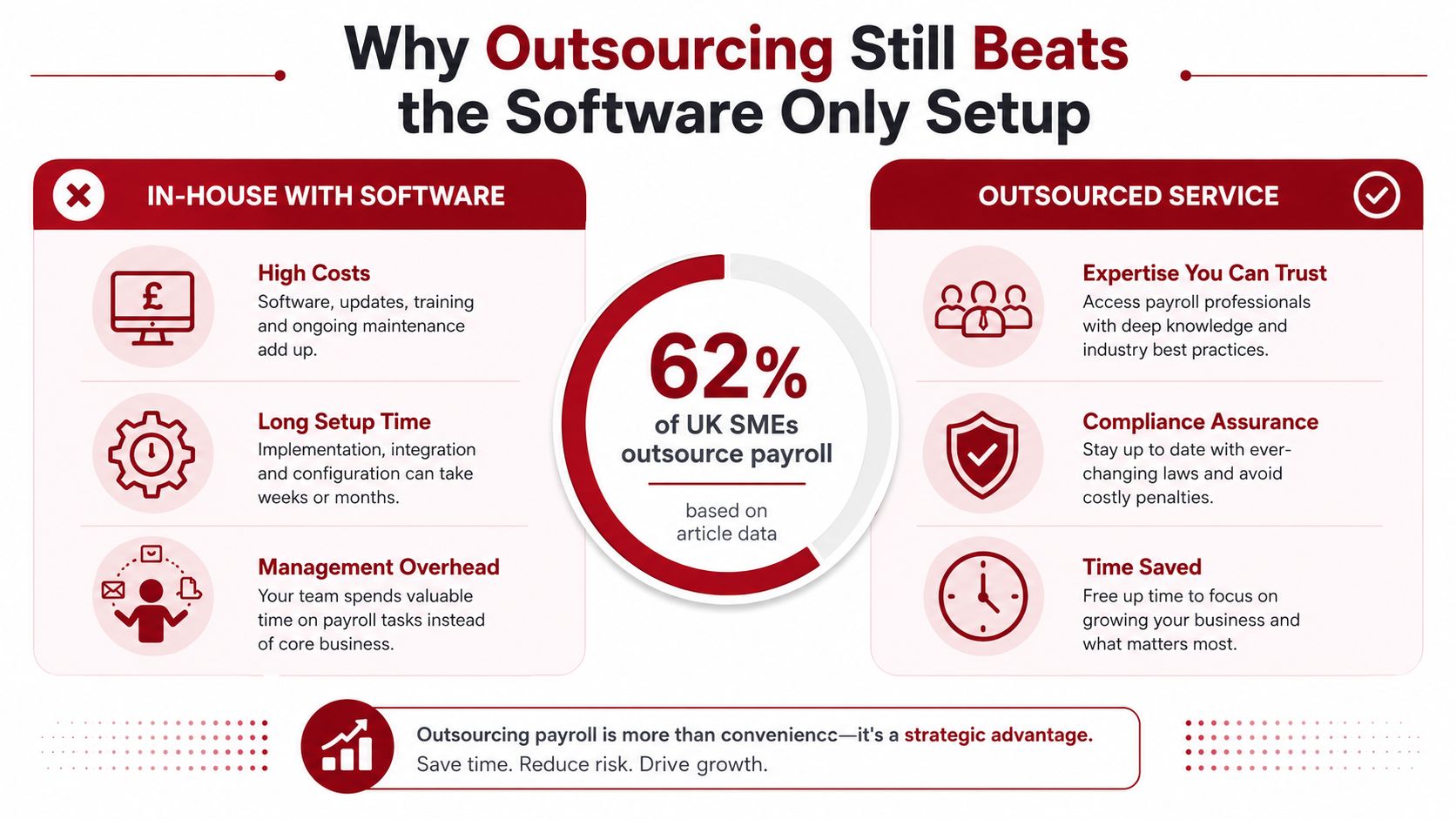
My recommendation is blunt. Keep approval of pay, expenses and business decisions in-house. Outsource the repetitive processing, reconciliations, filings and technical checks once those tasks are distracting you from delivering work or selling the next project.
The CIS Trap That Catches Construction Contractors
CIS bookkeeping fails most often at the point where construction deductions meet payroll. Contractors frequently understand that they must deduct CIS from subcontractor payments, yet miss the separate step required to reclaim those deductions. A company that pays CIS deductions must reclaim them through its monthly payroll scheme, not through Corporation Tax.
The contractor must send both an FPS and an EPS. The FPS reports the payroll information, while the EPS is used to claim CIS deductions against the employer's liabilities. If the deductions can't be fully used in one period, they can be carried forward within the same tax year. HMRC sets out the process in its CIS tax and deduction guidance.
The reconciliation that matters
For each payment cycle, match:
- The subcontractor's invoice and payment date.
- Verification status and the applicable deduction.
- The contractor's CIS statement.
- The CIS amount recorded in the bookkeeping ledger.
- The amount included in the EPS.
- Any balance carried forward within the same tax year.
Registered subcontractors are typically subject to a 20% deduction, while an unregistered or unverifiable subcontractor is typically subject to 30%. Those rates are not bookkeeping labels. They affect the subcontractor's cash received, the contractor's liability records and the accuracy of the monthly return.
A contractor who stops trading mid-project needs to deal with more than the final invoice. The business must establish what has been paid, what deductions were made, what statements are missing and whether outstanding CIS amounts have been claimed correctly. If records are incomplete, don't guess. Reconstruct the ledger from bank payments, invoices, statements and submitted returns, then document the assumptions.
The wrong employment status on a monthly return can lead to a penalty of up to £3,000, so clean verification records are a practical defence, not administrative decoration. Contractors should also avoid relying on a subcontractor's verbal description of their work. Keep the evidence used to support the status and deduction treatment.
For businesses working across London sites, a specialist workflow for CIS monthly returns can prevent the common mistake of treating CIS as an isolated contractor report. It belongs in the monthly payroll and bookkeeping cycle.
How to Choose the Right Payroll and Bookkeeping Provider
Start with the handover, not the sales pitch. Ask a prospective provider to describe exactly what happens from the moment you send timesheets or invoices to the moment the return is submitted and the ledger is reconciled.
Questions worth asking
- Who reviews the work? Find out whether another person checks payroll, CIS calculations and bank reconciliations before submission.
- What is included? Confirm whether the fee covers payslips, FPS and EPS submissions, pension administration, payroll journals, VAT support, CIS returns and year-end information.
- How are corrections handled? Ask who pays for provider errors, how quickly corrections are made and how you'll be informed.
- Which software connects? Check compatibility with your accounting platform, payroll system, bank feeds, invoice tools and pension provider.
- What happens when information is late? A credible provider should have a cut-off time, escalation route and written process for missing timesheets or statements.
- Can they handle your sector? A generic bookkeeper may not understand CIS deduction claims, property income records or startup director transactions.
Pricing needs the same scrutiny. A fixed monthly fee gives predictability, but check its limits. A per-employee model may suit a stable team, while per-transaction pricing can become difficult to forecast for a busy contractor or ecommerce business.
| Pricing Model | What It Usually Covers | Watch Out For |
|---|---|---|
| Fixed monthly fee | Agreed payroll runs, bookkeeping tasks and routine reports | Limits on transaction volume, payroll changes or year-end work |
| Per employee | Payroll processing linked to the number of workers | Extra charges for starters, leavers, pensions or corrections |
| Per transaction | Bookkeeping based on entries, invoices or bank items | Bills can rise sharply in busy months |
| Tiered package | A defined service level with optional add-ons | Important compliance tasks may sit in a higher tier |
Request a written service-level agreement. It should state submission responsibilities, information deadlines, response times, data security arrangements, software ownership, backup procedures and the process for HMRC letters. If a provider can't explain who owns a missed deadline, the price is not the main problem.
Your Next Step with Action Accountants in North West London
You don't need to redesign your entire finance function this week. Start with evidence.
First, book a discovery call and explain how payroll, bookkeeping, VAT, CIS or property records currently work. Second, send the last three months of payroll and bookkeeping records so the adviser can see unreconciled items, late submissions, missing documents and recurring pressure points. Third, ask for a fixed-fee plan that matches your business stage, transaction volume and sector.
Action Accountants Limited is based in Colindale and works with startups, SMEs, contractors, subcontractors, landlords and self-employed professionals across North West London and the wider UK. The firm provides payroll, bookkeeping, VAT, tax and compliance support, with construction-aware processes for CIS records and monthly reporting.
You should also treat your website as part of the same trust system. Clear service explanations and practical accountant content strategy tips can help prospective clients understand what your firm handles before they make contact. But your internal records still come first. A polished website won't repair an unreconciled payroll liability.
Take the records you already have, identify the deadlines and balances you're least confident about, and put those questions in front of an adviser. That conversation will tell you whether you need a tidy-up, ongoing support or a complete handover.
Action Accountants Limited provides practical payroll and bookkeeping support for North West London startups, SMEs, contractors, subcontractors and landlords, including payroll processing, reconciliations, VAT and CIS-aware compliance work. Visit Action Accountants Limited to arrange a discovery call and discuss a clear, fixed-fee plan for bringing your records and reporting under control.