

You're a freelancer with invoices going out, a few regular clients, and that nagging feeling that VAT is no longer optional in the practical sense. Or you're a startup owner who's just crossed the line where tax stops being a background admin task and becomes part of every quote, every booking flow, and every receipt you issue. Get it wrong, and you create cash-flow problems, messy returns, and avoidable questions from HMRC.
The UK's modern VAT system has been part of business life since 1 April 1973, when it came in under the Finance Act 1972 with a 10% standard rate and quickly became a core revenue source for the state, contributing 6% of central government revenues in its first year, according to the House of Lords Library's historical review of VAT at 50. That history matters because VAT on services was built as a broad consumption tax from the start, not something limited to retail goods. If you're selling advice, design, software, maintenance, training, or property-related services, you're inside the system whether you feel ready or not.
The good news is that VAT on services is manageable when you run it like an operating process, not a loose memory test. Get the place of supply, the tax point, and your evidence trail right, and the rest becomes routine. For a practical systems view on invoicing logic and checkout design, see compliant SaaS checkout flows, because the same discipline that protects a software seller helps any service business avoid bad VAT decisions.
Table of Contents
- Why Getting VAT on Services Right Is Non-Negotiable
- The Core Rule Determining Where VAT is Charged
- UK VAT Rates and Service Exemptions Explained
- Navigating Cross-Border and Digital Services
- VAT Registration Filing and Keeping Records
- Common Pitfalls for Startups Contractors and Landlords
- Your VAT Action Plan for Growth
Why Getting VAT on Services Right Is Non-Negotiable
A London consultant sends out a quote on Monday and gets the reply every growing business wants, “Let's go ahead.” The challenge emerges when the client base is split between UK companies, overseas businesses, and one-off consumers, and the invoice template hasn't been designed for any of them. This is when VAT transitions from theory to a direct impact on whether the deal is profitable, compliant, and easy to defend.
VAT on services is not just about adding tax to an invoice. It affects what you charge, when you charge it, whether you can reclaim input tax, and which tax authority gets the return. If you build the process properly, you protect your cash flow and your reputation at the same time.
Practical rule: treat VAT as part of your delivery workflow, not an afterthought at month-end.
For a small firm, that means the sales team, the accountant, and the booking system all need to agree on one thing, whether the supply is taxable, exempt, outside the scope, or subject to a reverse charge. If those decisions are left to whoever raises the invoice that day, you'll eventually send the wrong document to the wrong customer.
Why this becomes a growth signal
Businesses often panic when they get close to VAT registration because they assume it means more admin with no upside. That's the wrong lens. Hitting the VAT system usually means your business is moving from survival mode to proper scale, where process matters more than guesswork.
The challenge is simple. Service businesses don't sell one thing to one market. A contractor may bill a UK client one week, a foreign client the next, and a digital platform customer after that. A landlord may deal with exempt property income, but then make a commercial decision that changes the VAT position on the same building.
The right response is to stop relying on memory and start using a decision rule for each service line. If you do that, VAT becomes a control system rather than a crisis. That's the mindset that keeps founders calm when turnover rises, contracts diversify, and HMRC starts to matter more than it did at launch.
The Core Rule Determining Where VAT is Charged
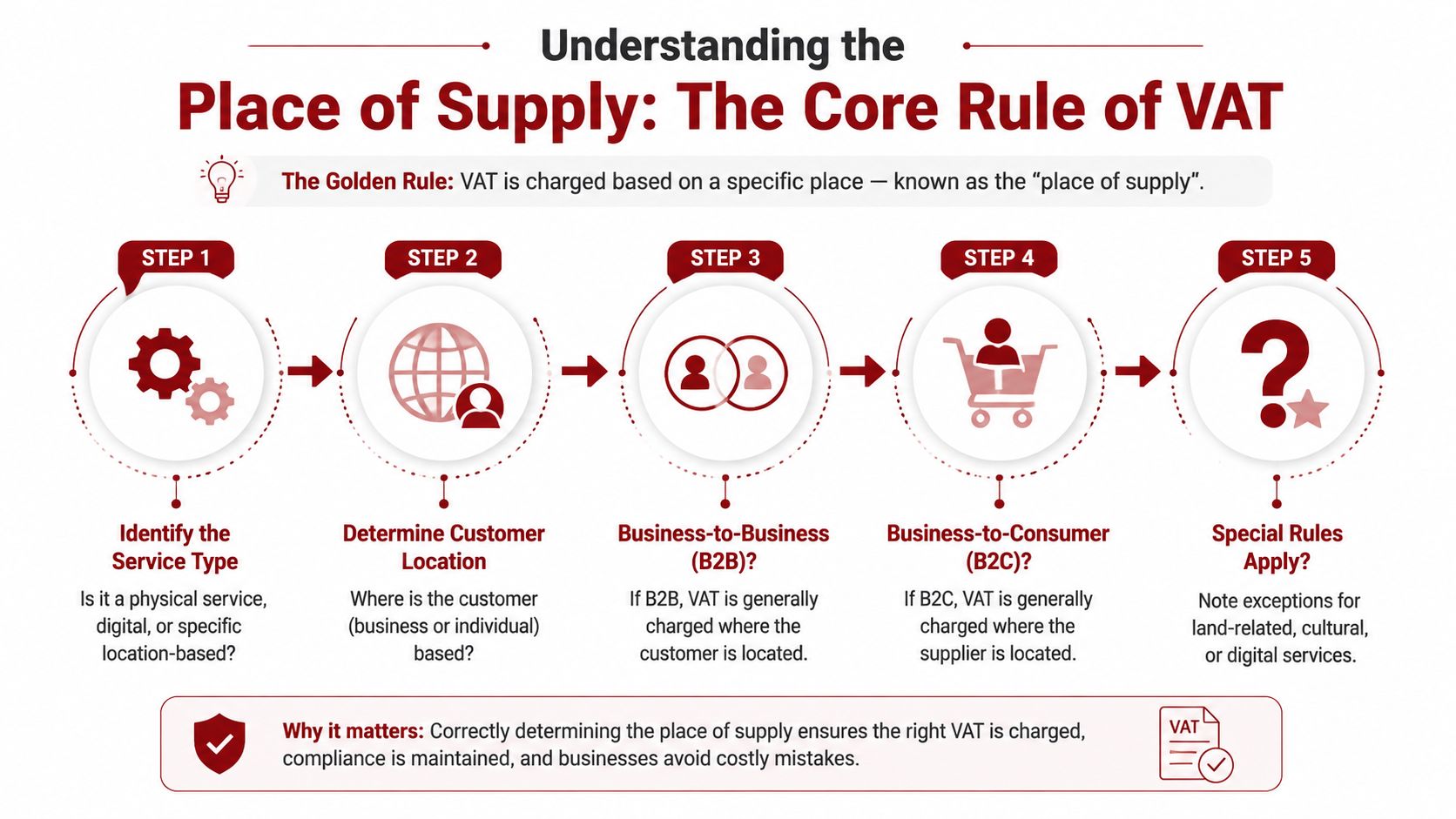
VAT follows the customer, but not in a vague way, in a rule-based way. For services, the first question is always where the supply belongs for VAT purposes, because that decides which country taxes it and who accounts for it. If you get this wrong, the invoice can look fine while the VAT treatment is completely off.
B2B and B2C are not the same question
For Business-to-Business services, the customer's location usually drives the VAT outcome. For Business-to-Consumer services, the supplier's position often matters more, unless a special rule changes the result. That distinction is the backbone of every sensible VAT decision.
If you're unsure who your customer is, stop and verify it before you invoice. Don't guess from an email signature or a trading name. A proper business status check is worth more than a fast invoice, because it can decide whether you charge UK VAT or leave it off and let the customer account for tax elsewhere.
Quick guide to place of supply for services
| Customer Type | Customer Location | Place of Supply Rule | Who Accounts for VAT |
|---|---|---|---|
| B2B | UK | UK supply rules usually apply | UK supplier normally accounts for VAT |
| B2B | Overseas | Customer location usually drives the outcome | Overseas customer may account under local rules |
| B2C | UK | Supplier location usually drives the outcome | UK supplier normally accounts for VAT |
| B2C | Overseas | Special rules can move the supply to the consumer's location | Supplier or local system may account, depending on the service |
That table is a starting point, not a substitute for judgement. HMRC also treats certain electronically supplied services to private consumers as supplied where the consumer lives, and it requires two pieces of evidence such as billing address, IP address, bank details, SIM country code, or fixed-line location to support that position, according to HMRC's guidance on digital services to private consumers. Use that rule when your service is remote, automated, or sold through a platform.
Keep a habit of asking two questions on every service invoice. Who is the customer, and where is the supply treated as taking place?
Once those answers are documented, the rest of the VAT treatment gets much easier to defend.
UK VAT Rates and Service Exemptions Explained
Most service businesses don't need a wall of rates, they need a clean filter. Start with the default assumption that many professional services are taxable, then check whether a specific service is relieved, exempt, or outside the scope. That's the only sensible way to avoid undercharging tax or reclaiming input tax you were never entitled to use.
Standard-rated, exempt, and outside the scope
A standard-rated service is taxed at the normal VAT rate. For consultants, agencies, contractors, and most fee-based service providers, that's usually where the work lands unless a specific relief applies. In practical terms, if you're selling expertise, labour, or access, assume VAT is in play until you prove otherwise.
An exempt service is different. Exempt supplies sit inside the VAT system but don't carry output VAT in the same way, and that can restrict input tax recovery. Landlords often run into this with property income, especially where the supply is residential or otherwise exempt by nature.
Outside the scope is a separate category again. That's where the transaction falls outside UK VAT rules altogether because the service is not treated as a UK taxable supply. Don't confuse that with zero-rated. Zero-rated supplies are still taxable supplies for VAT purposes, they're just taxed at 0%.
How to handle mixed service businesses
A mixed business needs clean separation. A digital agency might have taxable design services, recoverable business purchases, and a separate line for something that's exempt or outside the scope. If you mix them together in the ledger, you blur input VAT recovery and make your return weaker.
Use your accounting software to tag service lines by VAT treatment, not just by customer name. If your systems are weak, fix the chart of accounts before you worry about fancy tax planning. I'd rather see a simple structure that's accurate than an elaborate one that no one updates.
For a practical finance-side checklist on reclaiming VAT correctly, review VAT reclaim guidance for UK businesses. It's the right mindset for service firms that buy software, subcontract labour, or incur launch costs and need to know what can come back.
Best practice: classify the service before you raise the invoice, not after the quarter ends.
That one habit prevents a lot of awkward adjustments later.
Navigating Cross-Border and Digital Services
Cross-border service work is where good businesses get sloppy. A UK consultant may invoice a business in another country, sell a digital course to a consumer abroad, or deliver remote work through a platform and assume the software will sort the VAT out. It won't. The tax treatment depends on the type of customer, the location rule, and the evidence you can produce.
B2B cross-border services and the reverse charge
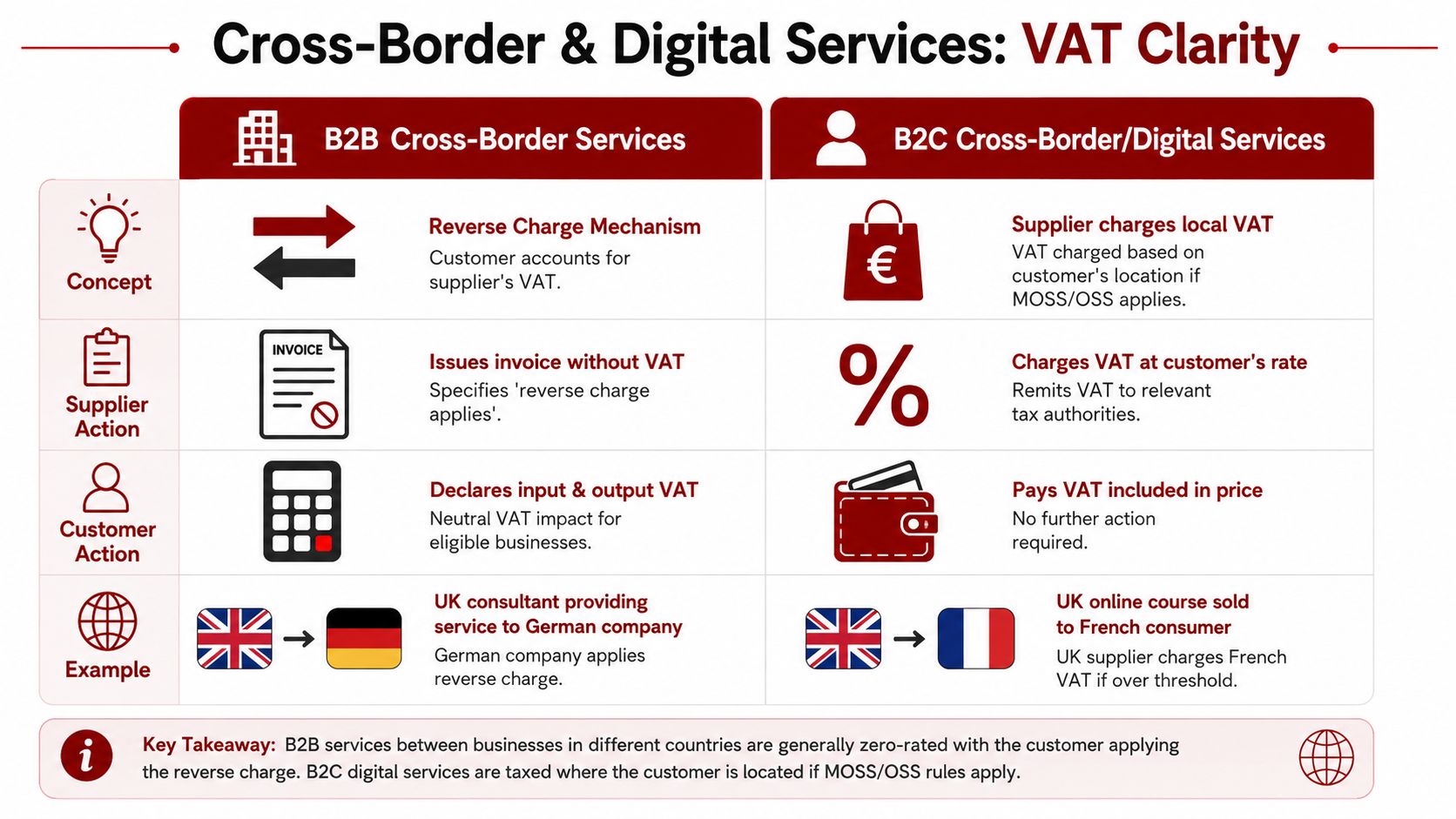
For many B2B overseas supplies, the reverse charge shifts the VAT responsibility away from the UK supplier and onto the business customer in the other jurisdiction. That means your invoice shouldn't be built like a domestic sale. It needs to reflect that the customer is responsible for accounting for VAT under their local rules.
Sloppy customer verification causes trouble. If you treat a consumer like a business customer, or the other way round, you can end up issuing the wrong invoice and creating a compliance issue in both places. A proper sales process should collect the customer status up front and store it with the order record.
Digital services to consumers need evidence, not assumptions
HMRC is clear that when UK businesses supply digital services to non-business consumers, they must keep two pieces of non-contradictory evidence proving where the consumer normally lives. HMRC accepts evidence such as billing address, IP address, bank details, SIM country code, or fixed-line location in its guidance on digital services to private consumers. That matters because the place of supply can shift the VAT result into another jurisdiction.
If you sell software, downloads, online courses, or similar services, don't rely on the checkout country field alone. Build a system that captures and stores evidence at the point of sale, then keep it in a format you can show if HMRC asks.
How to make the process audit-ready
Your controls need to be boring and consistent. Use a sales workflow that asks for customer type, location, and supporting evidence before invoice creation. If you work through a website or booking engine, your checkout design needs to match the VAT logic, not fight it.
If the location evidence is weak, the VAT position is weak.
For UK service businesses that need a clear operational explanation of the reverse charge, this reverse charge guide is a useful companion when you're dealing with overseas business customers and want the invoice wording right the first time.
VAT Registration Filing and Keeping Records
Registration is where many owners start cutting corners. They wait too long, register late, or forget that the VAT system also changes how they document purchases, track tax points, and file returns. That creates avoidable strain on the first return, which is exactly when you want clean numbers and no surprises.
Get registration and software set up early
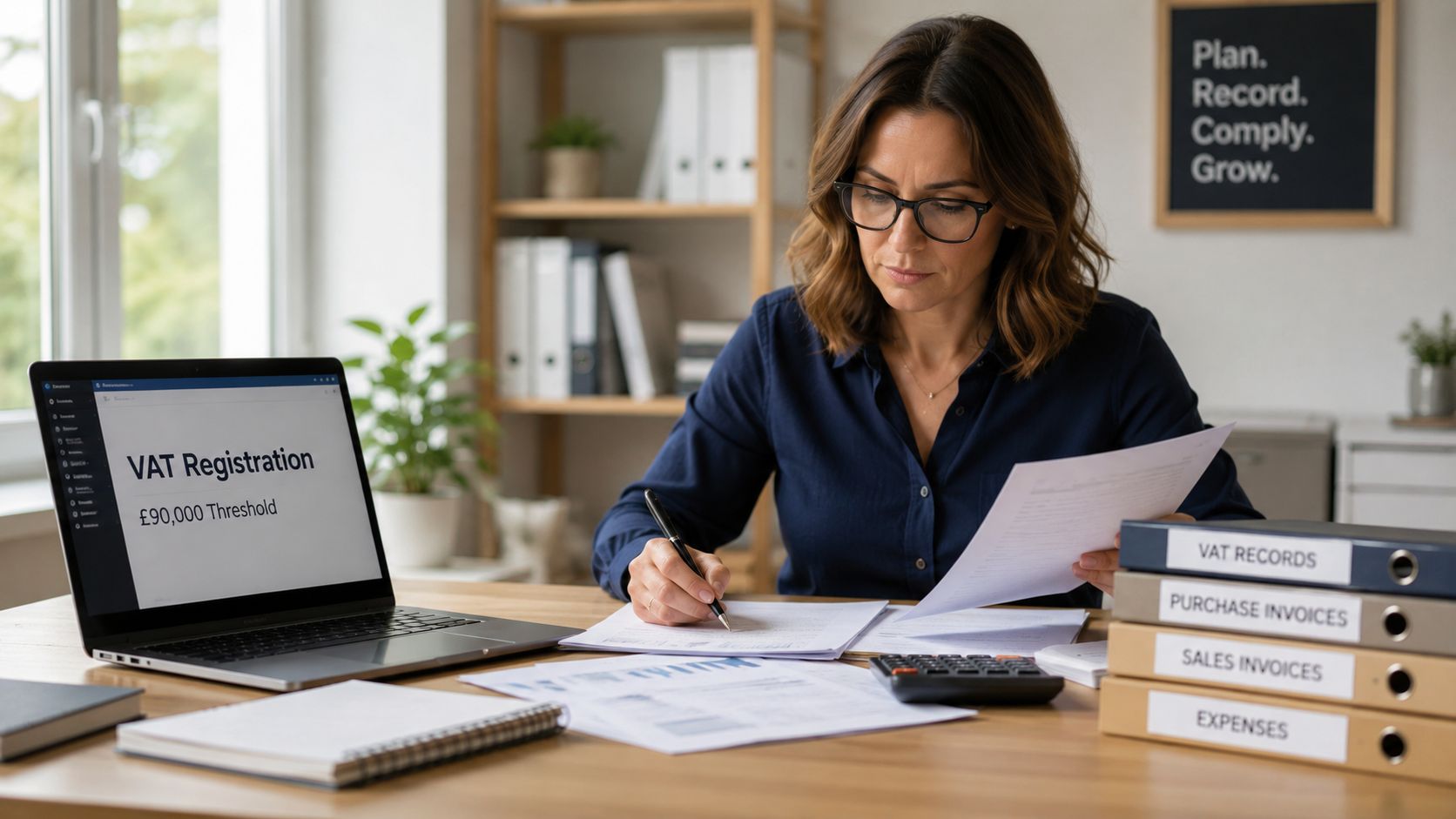
The current VAT registration threshold is £90,000, and discretionary service payments don't count towards that figure according to the guidance on service charges. That means you need to know exactly what counts as taxable turnover, not just what lands in the bank. If you're close to the threshold, don't wait for panic to tell you what to do.
For service firms, voluntary registration can make sense before the threshold if you're buying a lot of taxable inputs or working mainly with VAT-registered customers. But it also adds filing discipline, so don't register early just because it sounds impressive. Register when the numbers and your customer mix justify it.
If you need a systems-focused overview, this Making Tax Digital VAT guide is useful for understanding the software side of compliance and the pressure it puts on record quality.
Record tax points and pre-registration costs properly
HMRC says a single supply of services is normally taxable at the date the service is completed, or earlier if payment is received. Continuous supplies are handled by billing period or payment date. If your invoice dates and service dates don't match your tax point logic, your return will drift out of accuracy.
Pre-registration service costs can also be reclaimed as input tax if they were received within 6 months before registration, used for the newly registered business, and linked to taxable activities, according to HMRC's VAT Notice 700 guidance. That's not a nice-to-have. It can protect real cash that would otherwise be left on the table.
Keep your evidence trail tidy
A valid VAT record set should show what was sold, to whom, when the tax point arose, and why the chosen VAT treatment is correct. That means contracts, invoices, checkout logs, customer status checks, and location evidence all belong in the same file structure. If your records are scattered across email threads and spreadsheets, you're making the return harder than it needs to be.
Good VAT records don't just satisfy HMRC, they make management accounts more reliable too.
Common Pitfalls for Startups Contractors and Landlords
The biggest VAT errors don't come from complicated law, they come from ordinary business habits. A founder thinks an invoice note is enough. A contractor assumes every client is a business. A landlord copies last year's treatment without checking whether the supply still fits. Those mistakes are predictable, which means they're preventable.
Startups get caught by service charge wording
A common issue in hospitality, salons, bookings, and client services is whether a service charge is compulsory or genuinely optional. HMRC's position, as summarised in the THP guidance, is that a service charge is VATable if it is compulsory, but it falls outside the scope of VAT if the customer has a genuine choice to pay it. Those discretionary payments also do not count towards the £90,000 taxable turnover threshold for VAT registration, according to the same guidance.
That means the wording on your menu, invoice, or booking page matters. If your checkout flow makes the charge look automatic, you've probably made it compulsory in practice. If you want it treated as discretionary, the customer must have a real choice and your records need to support that.
Contractors should not improvise VAT treatment
Construction contractors often split their attention between CIS, invoicing, and cash flow, so VAT gets reduced to a template issue. That's a mistake. The correct VAT treatment depends on the service, the customer, and whether any reverse charge logic applies, so copying the previous invoice is not enough.
If you work in this space, standardise the invoice wording and train whoever raises invoices. One inconsistent description can create a chain of corrections that takes longer to fix than to prevent. I've seen too many small firms lose time because no one owned the tax wording.
Landlords need to respect the property line
Landlords are often dealing with exempt property supplies, but the tax position changes fast when commercial property elections, repairs, management services, and ancillary charges enter the picture. The danger is assuming the entire property file sits in one VAT bucket. It doesn't.
Use separate treatment for rent, recoverable costs, and optional charges. If you're handling commercial property or mixed-use buildings, the documentation around each supply needs to be explicit, because the line between exempt and taxable can be narrow in practice.
The safest treatment is the one you can explain clearly to HMRC six months later.
If you're a landlord, contractor, or startup owner, don't let the software decide by default. Set the rule first, then make the system follow it.
Your VAT Action Plan for Growth
The businesses that stay out of VAT trouble don't have better luck, they have tighter routines. Review every service line, confirm who the customer is, and decide whether the supply is domestic, cross-border, digital, exempt, or subject to a reverse charge before the invoice is issued. Then make sure your software, checkout, and record storage reflect those choices.
Use cloud accounting to keep the evidence in one place, not scattered across inboxes and phone photos. Cloud accounting benefits matter here because VAT compliance is mostly about clean data, timely posting, and consistent review. If your system can't show who was billed, what was supplied, and why VAT was handled that way, it's not good enough.
A simple control list works:
- Check customer status first. Know whether you're dealing with a business or consumer before you decide on VAT.
- Verify location evidence. Keep the documents that support place of supply, especially for digital and overseas sales.
- Review tax points monthly. Match service completion, payment timing, and invoice dates.
- Track pre-registration costs. Recover eligible input VAT where the rules allow it.
- Separate compulsory and optional charges. Don't let service wording create the wrong tax result.
If you do those five things consistently, VAT stops being a scramble and becomes a routine part of growth.
Action Accountants Limited helps new businesses, contractors, and landlords set up VAT systems that hold up in real life, not just on paper. If you want straightforward support with VAT registration, service charge treatment, reverse charge invoicing, and return filing, visit Action Accountants Limited and get practical help before the next invoice goes out.