

More than half of executives in McKinsey's post-2008 survey said their companies had already cut up to 10% of overall costs, nearly one-third had reduced costs by 11% to 20%, and 9% had cut 20% or more. That history matters in the UK, because it shows cost reduction strategies are rarely a one-time tidy-up. They're a management reflex when pressure hits margins, and the businesses that do it well protect cash without wrecking delivery, compliance, or growth. For UK SMEs and construction contractors, that means being disciplined about payroll, CIS, supplier spend, and working capital, not just trimming the obvious overheads.
Reactive cuts are usually blunt, short-lived, and expensive in the wrong places. Freezing hiring can leave jobs undone, slashing marketing can starve the pipeline, and cutting training can push error rates up. The smarter operators in 2026 are using structured cost reduction strategies that target waste, tighten controls, and improve cash timing. They're also looking hard at where a qualified accountant or management consultant can prevent a false economy.

Table of Contents
- 1. Outsourcing and Business Process Outsourcing
- 2. Automation of Routine Accounting and Payroll Processes
- 3. Supplier Cost Negotiation and Vendor Consolidation
- 4. Lean Operations and Waste Elimination
- 5. Tax Planning and Optimisation
- 6. Working Capital Optimisation and Cash Flow Management
- 7. Digital Transformation and Cloud Migration
- 8. Headcount and Payroll Optimisation
- 9. Facility and Real Estate Cost Management
- 10. Strategic Pricing and Revenue Optimisation
- Top 10 Cost Reduction Strategies Comparison
- When to Call in an Accountant or Management Consultant
1. Outsourcing and Business Process Outsourcing
For a lot of UK SMEs, the first sensible saving isn't a dramatic restructure, it's removing the cost of doing low-value work in-house. Accounting, payroll, HR admin, and CIS compliance are all areas where a specialist firm can often do the job faster and more cleanly than a stretched internal generalist. You're not just buying labour, you're buying process, systems, and a team that already knows the traps.
Construction businesses get this. A contractor with irregular project flow doesn't need a full internal back office for every stage of the cycle. A specialist accountant can handle bookkeeping, payroll, CIS returns, and reporting on a fixed retainer, which is usually easier to control than a patchwork of salaries, software, and holiday cover.
Start with the least risky functions first
The cleanest move is to outsource the pieces that don't define your brand. Accounting and payroll are usually the best starting points, then HR admin, then maybe customer support if the service model allows it. That staged approach protects continuity while you test responsiveness, turnaround times, and data handling.
Practical rule: If a function can be specified clearly, measured clearly, and checked independently, it's a strong outsourcing candidate.
Before you switch, insist on proper service levels, GDPR checks, and a live pricing breakdown. I've seen firms lose the expected saving because they signed a vague agreement and ended up paying extra for every exception. If the provider can't explain what's included, walk away.
A good outsourced setup should also be reviewed annually. If your volumes change, your supplier should be able to explain where the saving is still holding up and where the model needs reshaping. That's where specialist firms such as Action Accountants' accounting software integration support can matter, because the value comes from cleaner process handoffs, not just cheaper labour.
2. Automation of Routine Accounting and Payroll Processes
Manual bookkeeping still eats time in businesses that should know better. Every invoice typed twice, every bank reconciliation done by hand, and every payroll adjustment keyed into three different places creates cost, error risk, and frustration. Automation doesn't fix bad processes, but it does expose them quickly and usually pays back in staff hours you can redeploy.
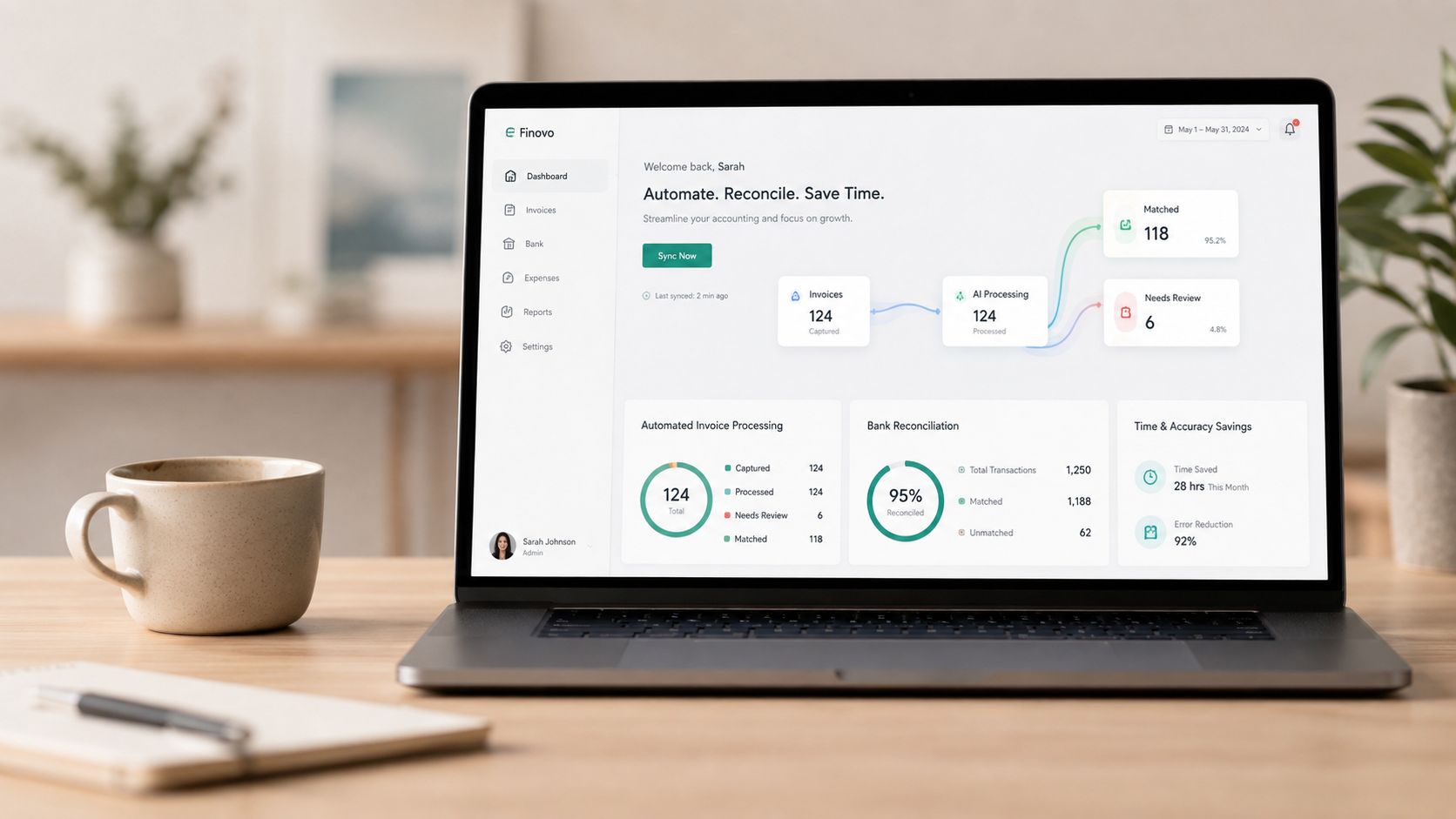
Construction contractors see the biggest gain when CIS calculations are automated instead of being manually checked every pay run. The same applies to SMEs that still rely on weekly spreadsheet reconciliation or month-end firefighting. If the process is repetitive and rules-based, software should be doing most of the heavy lifting.
Automate the messy middle, not just the front end
The best candidates are the tasks that are high-volume and error-prone. Invoice processing, bank-feed matching, expense coding, and payroll calculation are obvious examples. Cloud accounting platforms and API integrations can pull data across systems so staff spend less time rekeying and more time checking exceptions.
Automation works best after the source data has been cleaned up. Bad setup in, bad output out.
That's why I always recommend a phased rollout. Start with one process, measure the manual time it removes, then extend it once the team trusts the output. For a construction firm, that might mean automating CIS deductions first, then payroll, then purchase invoice capture. If you jump straight into everything, you usually buy confusion instead of savings.
The business case is stronger when volume is high, but don't ignore the control angle. Automation improves consistency, which matters when HMRC reporting, subcontractor payments, or month-end accounts need to land on time. Action Accountants' guide to accounting software integration is relevant here because software only reduces cost when it's joined up properly. A siloed app stack just creates a faster mess.
3. Supplier Cost Negotiation and Vendor Consolidation
Supplier reviews are one of the few cost reduction strategies where the upside is often visible within a single renewal cycle. Too many firms keep the same accountant, insurer, software supplier, or tool vendor on autopilot, then wonder why costs drift. You don't need to haggle every penny. You do need to know what you're buying, what it should cost, and whether you still need three suppliers doing the work of one.
Construction firms are often the quickest to see this because tool, plant, PPE, and materials supply chains are easy to fragment. If you're buying from five vendors when two would do, you're probably paying for duplicated admin as well as the goods themselves. The same applies to software licences, where overlap is common and forgotten subscriptions are an easy bleed.
Use spend data before you negotiate
A hard-nosed conversation only works if you know the numbers behind it. Build a full view of spend, review contract terms, and ask for quotes even from suppliers you already use. The goal isn't just a lower invoice. It's a cleaner supplier base, fewer exceptions, and better bargaining power next time.
Suppliers respect firms that track usage. They ignore firms that just ask for a discount.
For software and technology purchases, the risk of paying for unused or overlapping services is high. For market-data style entitlement control, industry guidance recommends a full inventory of users, vendors, and spend, with centralised contract ownership and usage monitoring so licence true-ups are evidence-based rather than reactive. That same logic applies to many SMEs, even if they never touch market data.
A practical compromise is to consolidate only where the service quality stays high. Don't squeeze out a good supplier just to save a small amount if the replacement is unreliable. The right move is usually fewer suppliers, clearer performance review, and annual renegotiation backed by evidence. TruTec's supplier relationship management guidance is worth a look if you want a structured way to keep that discipline going.
4. Lean Operations and Waste Elimination
Lean is not about turning your business into a factory spreadsheet. It's about seeing where work gets duplicated, delayed, rechecked, or made more complicated than it needs to be. In SMEs, that usually means admin people chasing missing information, site teams repeating reports, or finance staff fixing avoidable errors that should never have happened.
The biggest mistake is trying to “go lean” everywhere at once. Pick one process that annoys people, eats time, and has clear handoffs. Financial close, subcontractor onboarding, tenant maintenance requests, or site reporting all make good starting points because the waste is easy to see once you map the process properly.
Cut the steps that add no value
Frontline staff usually know where the drag is. They know which forms get ignored, which approvals sit in inboxes, and which reports nobody reads. When you involve them early, you get better ideas and less resistance.
A useful approach is to map the current workflow, then strip out every step that doesn't change the outcome, improve control, or satisfy a legal requirement. If a job is being checked three times by three different people, something has gone wrong with the design. That duplication is cost, even if it doesn't show up neatly in a spreadsheet.
If you're running payroll or construction admin, lean can shorten month-end without buying new software. A finance team that batches similar work, removes duplicate checks, and clarifies ownership can often do more with the same headcount. The savings come from fewer interruptions, fewer corrections, and fewer emergencies. That's the kind of improvement that sticks because it makes the work easier, not just cheaper.
5. Tax Planning and Optimisation
Tax planning isn't a year-end panic exercise. It's a cash and structure decision that should be live from the start of the financial year. For UK SMEs and contractors, that means looking at entity structure, salary and dividend mix, pensions, expense capture, and CIS treatment before the numbers get locked in.
This is also one of the easiest places to create expensive mistakes. A poor decision here can drag on cash flow for months, and the fix often costs more than the original problem. That's why the tax side should never be handled in isolation from payroll, working capital, and business structure.
Make tax a planning conversation, not a filing event
Good tax planning starts with the basics. Are you trading through the right structure? Are all legitimate expenses being captured? Are quarterly forecasts in place so you're not ambushed later? Those are the questions that matter before more advanced choices are even on the table.
For contractors, CIS-aware planning matters because deductions, payments, and reporting all interact with cash flow and corporation tax. For owner-managed businesses, the salary and dividend mix needs regular review, not annual guesswork. If you're unsure whether your structure is still right, that's the point where a qualified accountant earns their fee quickly.
Use the right support early, not after the deadline. Action Accountants' corporation tax guidance is the kind of practical resource that helps owners think ahead rather than react late. And if the business is changing, through growth, restructuring, or a planned sale, tax planning should be part of that conversation from day one.
The worst tax advice is the advice that arrives after the numbers are final.
6. Working Capital Optimisation and Cash Flow Management
Cash flow is where many supposedly profitable SMEs still get hurt. The issue isn't always margin, it's timing. Money goes out before it comes back in, and once that cycle starts to slip, the business ends up financing its own operations with overdrafts, supplier credit, or late payment stress.
A better grip on working capital often beats a blunt overhead cut. You can improve liquidity by billing faster, collecting faster, and paying on terms that match your own cash inflows. In construction, that means watching subcontractor timing, applications for payment, retention, and supplier calendars with more discipline.
Manage timing before you chase scale
Start by looking at when cash moves, not just when the invoice is raised. If VAT, PAYE, CIS, and supplier runs all fall badly together, the pressure on liquidity can be worse than the profit and loss account suggests. That's why payment calendars matter.
Action Accountants' cash flow planning support is relevant here because a good cash flow fix is usually a timing fix, not a heroics fix. I've seen businesses improve their position by tightening invoice issuance, chasing aged debt weekly, and renegotiating payment terms with key suppliers.
A few practical moves usually make the difference:
- Invoice same day: Don't let billing wait until the end of the week if the work is already signed off.
- Review overdue debt weekly: Monthly credit control is too slow for most small firms.
- Align payment runs: Don't pay every invoice the minute it lands if the contract gives you room to manage timing.
- Use early payment selectively: Small discounts can make sense if they enable faster customer cash.
The trick is not to squeeze suppliers blindly. It's to build a payment cycle that keeps the business liquid without upsetting the relationships that keep work moving. Good working capital management is boring, but it's one of the few areas where a modest operational tweak can free up real cash without changing headcount or service quality.
7. Digital Transformation and Cloud Migration
Legacy systems often cost more than owners realise. There's the subscription or licence, the maintenance, the time spent fixing broken processes, and the staff hours wasted working around limitations. Cloud migration can reduce those burdens, but only if the move is planned with the business process in mind, not just the software.
For SMEs, this usually means moving accounting, payroll, document management, and project tracking onto platforms that talk to each other. Construction firms need CIS-friendly systems, property businesses need rent and tenant tracking, and service businesses need clean access from anywhere. The technology choice should follow the operating model, not the other way round.
Don't buy cloud for the label, buy it for the control
A proper migration starts with a full technology audit. List what you pay for, what breaks often, what needs manual intervention, and where your team is working around system limitations. Then compare that with the cost and effort of moving to a cleaner setup.
Cloud only reduces cost when it removes duplication, old hardware, or avoidable admin. If it just relocates the mess, the bill keeps coming.
For some businesses, the wins come from retiring an old desktop package and replacing it with a cloud accounting system that updates automatically and improves access. For others, it's about reducing maintenance headaches and improving collaboration between site, office, and field staff. The important part is parallel running long enough to prove the data is accurate before switching over.
That's also where licensing mistakes get expensive. This note on avoiding DIY Microsoft 365 licensing mistakes is a useful reminder that software stacks need active management, not passive renewal. If nobody is checking usage, cloud can become a more expensive form of sprawl.
8. Headcount and Payroll Optimisation
Labour is the area most businesses are nervous to touch, and for good reason. Cut it badly and you create burnout, errors, and turnover. But ignore it completely and you end up carrying roles that no longer fit the workload, especially in firms that have grown by habit rather than design.
The right question isn't “How many people can we cut?” It's “Which tasks really need to be done in-house, at this cost, by this level of skill?” That question matters in construction, where workload can swing sharply, and in SMEs where admin roles often expand without much review.
Match labour to demand, not to history
A lot of payroll waste comes from fixed staffing where the work is variable. Part-time, flexible, or contractor support can be a better fit for seasonal or project-based demand, provided control stays tight. Equally, some specialist jobs are cheaper outsourced than hired permanently.
If you're carrying expensive staff who are underused, the answer isn't always a redundancy round. Sometimes it's cross-training, process redesign, or moving tasks to automation first. If the role still doesn't justify its cost after that, then you've got a clearer case for change.
Don't cut the people who create capacity if the business still needs that capacity elsewhere.
Salary structures also matter. Owner-managers often leave money on the table by not reviewing how pay, dividends, and pension contributions interact. That should be done carefully and with proper advice, because the wrong move can create tax and compliance issues. The saving only counts if it survives the year and doesn't blow up retention or delivery.
9. Facility and Real Estate Cost Management
Office space is one of the easiest costs to overpay for because it feels fixed. In reality, many SMEs have more space than they need, especially if hybrid work, field-based teams, or remote admin have changed how the business operates. The rent may be contractual, but the footprint often isn't as rigid as people assume.
The same is true of support costs around the building. Cleaning, utilities, security, parking, and maintenance all follow the size and usage of the premises. If desk occupancy is low, the whole cost stack is probably too high.
Treat space like a resource, not a status symbol
Start with utilisation. If a room is empty most days, it's not a benefit, it's overhead. That doesn't automatically mean moving offices, but it does mean testing whether hot-desking, shared rooms, or a smaller lease would fit the actual way the team works.
For some professional services firms, a smaller office with hybrid attendance is enough. For contractors and property businesses, a central base may still be needed, but the support footprint can often be reduced. The aim is to pay for collaboration and control, not for empty chairs.
Renegotiating at renewal is usually the best time to act, because you've got the upper hand and time to plan. Bring usage data, challenge the assumptions behind the current layout, and review support contracts alongside the lease. If the building no longer serves the business model, staying put is often the expensive choice.
10. Strategic Pricing and Revenue Optimisation
Cutting costs helps, but pricing mistakes can undo the work fast. If you're undercharging, you're subsidising customers while trying to trim the supply side. Strategic pricing is one of the most underused cost reduction strategies because it raises profitability without demanding a proportional increase in labour or overhead.
This matters in accountancy practices, consulting firms, property management, and construction-related advisory services where service levels vary widely by client. Some customers are profitable. Others are only busy. If you don't know which is which, you can end up chasing revenue that looks good and behaves badly.
Price the work, not just the time
Hourly billing often obscures the underlying economics of a relationship. It rewards effort, not outcome, and can make it hard to recover the cost of expertise, urgency, or complexity. Tiered packages, value-based pricing, and selective re-pricing of low-margin clients usually provide better control.
The first step is customer profitability analysis. Which clients demand the most revisions, the most calls, the most out-of-hours work, or the most bespoke reporting? Those costs matter, even if they never show up as a line item. Once you can see that clearly, pricing changes become a business decision rather than an emotional one.
If a customer only makes sense at last year's price, the pricing is the problem.
Don't try to reprice everyone at once unless you're ready for pushback. New clients are often the easiest place to test improved pricing structures, because the market tells you quickly whether the offer still works. For existing clients, communicate the value properly and be prepared to walk away from work that never paid its way.
Top 10 Cost Reduction Strategies Comparison
| Strategy | Implementation Complexity 🔄 | Resource Requirements ⚡ | Expected Outcomes 📊 | Ideal Use Cases 💡 | Key Advantages ⭐ |
|---|---|---|---|---|---|
| Outsourcing and Business Process Outsourcing (BPO) | Medium–High 🔄, vendor selection, transition (3–6 months) | Provider fees / low internal headcount; onboarding & security audits ⚡ | 30–50% function cost reduction; 40–60% payroll savings; consistent delivery 📊 | Startups & SMEs avoiding fixed overhead; compliance-heavy sectors 💡 | Access to specialist expertise, scalability, lower overhead ⭐ |
| Automation of Routine Accounting & Payroll | Moderate 🔄, integrations, RPA setup (2–3 months) | Software subscriptions (£500–£5k+), IT support, staff training ⚡ | Cuts manual work 50–70%; fewer errors; faster reporting 📊 | High‑transaction SMEs, payroll‑heavy businesses, construction 💡 | Immediate ROI, scalable processing, frees staff for analysis ⭐ |
| Supplier Cost Negotiation & Vendor Consolidation | High 🔄, audits, negotiations, transition risks | Procurement time, negotiation expertise, possible consultant fees ⚡ | 10–25% supplier cost savings; fewer vendors; better terms 📊 | Established SMEs with many suppliers; construction & property 💡 | Lower unit costs, simpler vendor management, stronger leverage ⭐ |
| Lean Operations & Waste Elimination | High 🔄, process mapping, cultural change | Time, lean training, CI teams and measurement tools ⚡ | 15–40% operational cost reduction; faster cycle times; fewer errors 📊 | Professional services and repetitive‑process businesses 💡 | Sustainable efficiency, quality improvement, employee engagement ⭐ |
| Tax Planning & Optimization | Moderate 🔄, ongoing advisory, possible restructure | Ongoing accountant/tax adviser fees; detailed record‑keeping ⚡ | 20–40% reduction in tax liability (legally achieved); improved cash flow 📊 | Owner‑managed businesses, contractors, property investors 💡 | Significant tax savings, compliant strategies, better cash timing ⭐ |
| Working Capital Optimization & Cash Flow Mgmt | Moderate 🔄, policy changes, forecasting discipline | Finance time, forecasting tools, AR/AP process changes ⚡ | Frees cash (inventory/receivables), reduces borrowing, stabilizes liquidity 📊 | Seasonal/growth businesses, inventory‑based, construction 💡 | Improved liquidity, lower financing costs, supports growth ⭐ |
| Digital Transformation & Cloud Migration | High 🔄, migration complexity, data validation | Subscriptions, implementation partners, training, connectivity ⚡ | 40–60% IT infra cost reduction; better reliability & scalability 📊 | SMEs on legacy systems, remote‑work organizations 💡 | Lower IT overhead, automatic updates, improved disaster recovery ⭐ |
| Headcount & Payroll Optimization | High 🔄, restructuring, legal & morale risks | HR/advisory costs, possible severance; change management ⚡ | 15–35% payroll cost reduction; improved flexibility & alignment 📊 | Mature SMEs with excess headcount; high labor‑cost orgs 💡 | Reduced fixed costs, reallocation to value roles, tax efficiencies ⭐ |
| Facility & Real Estate Cost Management | Moderate 🔄, lease renegotiation, relocation logistics | Real estate advisors, relocation/IT setup, remote work tools ⚡ | 20–40% facility cost reduction; lower utilities & maintenance 📊 | Admin‑heavy firms, large‑footprint SMEs, hybrid workplaces 💡 | Lower occupancy costs, improved flexibility, reduced footprint ⭐ |
| Strategic Pricing & Revenue Optimization | Moderate 🔄, analysis, testing, customer communication | Pricing analysts, market research, sales enablement ⚡ | 5–15% profitability improvement without proportional cost cuts 📊 | Service firms, professional practices, subscription businesses 💡 | Higher margins, better customer mix, defensible pricing ⭐ |
When to Call in an Accountant or Management Consultant
DIY cost reduction strategies work best for the first stretch of savings, especially on supplier spend, software subscriptions, and basic process fixes. Once you get into CIS, VAT, corporation tax, payroll, pensions, dividends, and contract structure, the risk of making a bad move rises fast. A small error in those areas can wipe out the savings from several “quick wins” and leave you with a compliance headache on top.
That's the point where a qualified accountant or management consultant pays for themselves. They can spot where savings are real, where they're temporary, and where they'll create a bigger problem later. In practice, the best advice often comes from looking at the business as a system, not as disconnected cost lines.
A sensible 30-day action plan is simple. Pull the last 12 months of supplier invoices and rank them by spend, run a bank-feed automation pilot in your accounting software, and book a tax planning review before your year-end. Then look at labour timing, subcontractor administration, and payment cycles, because that's where many UK SMEs lose cash without noticing.
If you're a construction contractor, landlord, or growing SME in North West London, Action Accountants Limited combines bookkeeping, CIS-aware tax support, payroll, VAT, and management consulting under one roof. That matters because cost reduction works best when compliance, cash flow, and operational change all move together, not in conflict. Pick one strategy, give it an owner, and measure the pounds saved over 30 days. If it doesn't save cash, it doesn't count.
If you want a straight-talking review of where your money is leaking, speak to Action Accountants Limited and ask for practical support on bookkeeping, CIS, payroll, tax planning, and management consulting. Their team works with SMEs, contractors, landlords, and growing businesses across North West London and the wider UK, so you get advice that's built around real operations, not generic theory.