

You've just agreed to be a director, the business is moving fast, and someone is already asking you to sign off a contract, approve payroll, and “sort the accounts later”. That's the moment when the roles and responsibility of board of directors stops being theory and becomes your problem. In a UK company, the board isn't a ceremonial group that meets when the paperwork piles up, it's the legal control layer that decides what the company can commit to, what risks it can take, and who carries the consequences when things go wrong.
Table of Contents
- Why Board Responsibility Matters for a UK Founder-Director
- The Statutory Duties Codified in UK Law
- Strategic Direction and Oversight in Practice
- Board Committees and How to Scale Them Down
- Risk, Compliance and the Audit Loop
- Sector Snapshots for Construction, Property and Startups
- How an Outsourced Advisor Strengthens the Board
- A Founder's Board Checklist and Common Pitfalls
Why Board Responsibility Matters for a UK Founder-Director
Monday morning. Your co-founder has already agreed a supplier deal, the finance inbox is full, and you have just discovered the company is tied to a commitment neither of you discussed properly. That is a board problem. Directors are the people who authorise the company to act, and the people who are expected to stop it when it is drifting into bad territory.
For a small UK company, board responsibility shows up in ordinary tasks that feel routine until they go wrong. You sign accounts, approve bank payments, decide whether to borrow, review HMRC correspondence, and keep an eye on whether the company can meet what it has promised. If a founder treats the board as a formality, the law does not suddenly become informal with it.
The board is your control function
The board is there to keep the company inside its legal powers, within its risk appetite, and aligned with long-term success. Under the Companies Act 2006, directors' duties are codified in sections 171 to 177, and the Act came into force in 2007.
Practical rule: if a decision can bind the company, move cash, create liability, or affect governance, treat it as a board issue until you have proved it is not.
That is why this matters to founders, not just to listed-company chairs. The same legal floor applies whether you run a two-person limited company or a much larger group. The difference is scale, not principle.
The three lenses that matter are statutory duties, practical governance, and the way those duties land in your sector. Get those right and the company is far easier to run, and far less likely to drift into avoidable problems. For a founder who wants the legal basics set out plainly, this section on Section 172 of the Companies Act 2006 is a useful starting point.
The Statutory Duties Codified in UK Law
The Companies Act 2006 is the starting point for any UK director, whether you run a startup, an SME, or a larger group. Sections 171 to 177 set out the duties every director owes the company, and they are the legal floor, not a box-ticking exercise.
The seven duties, in plain English
Act within powers. You must follow the company's constitution and use only the authority the company has given you. If the articles require board approval before borrowing, a founder cannot sign debt paperwork alone and assume it will stand.
Promote the success of the company. Your job is to act for the company's benefit, not for your own convenience. In a small business, that means turning down vanity projects that flatter the founder but weaken cash or distract the board from the core responsibilities.
Exercise independent judgment. You can listen to advisers, investors, or a dominant co-founder, but you must still make up your own mind. If a director signs because everyone else was comfortable with it, that is not judgment.
Exercise reasonable care, skill and diligence. Read the papers. Ask questions. Understand what you are approving. If the board is looking at a lease, a fundraise, or a tax position, you need enough detail to challenge it properly instead of nodding it through.
Avoid conflicts of interest. If you own the supplier, work for the buyer, or stand to benefit personally from the deal, say so. In small companies, conflicts are often informal and messy, which is exactly why they need to be brought into the open early.
Not accept benefits from third parties. Directors should not take side payments, gifts, or favours that distort judgment. If a supplier offers hospitality linked to a contract decision, decline it or disclose it.
Declare interests in proposed transactions. If you, your spouse, or your connected business stands to benefit, declare it before the company acts. Silence is how a manageable issue becomes a governance problem.
For a practical companion to the statute, this section 172 guide is a sensible place to start.
A bad board minute often starts with a missing disclosure. A good one records the interest, the challenge, and the reason the company still proceeded.
Breach of these duties is not academic. It can create personal exposure, internal disputes, and, in serious cases, wider claims. The safe habit is simple, document authority, document conflicts, document the decision.
Strategic Direction and Oversight in Practice
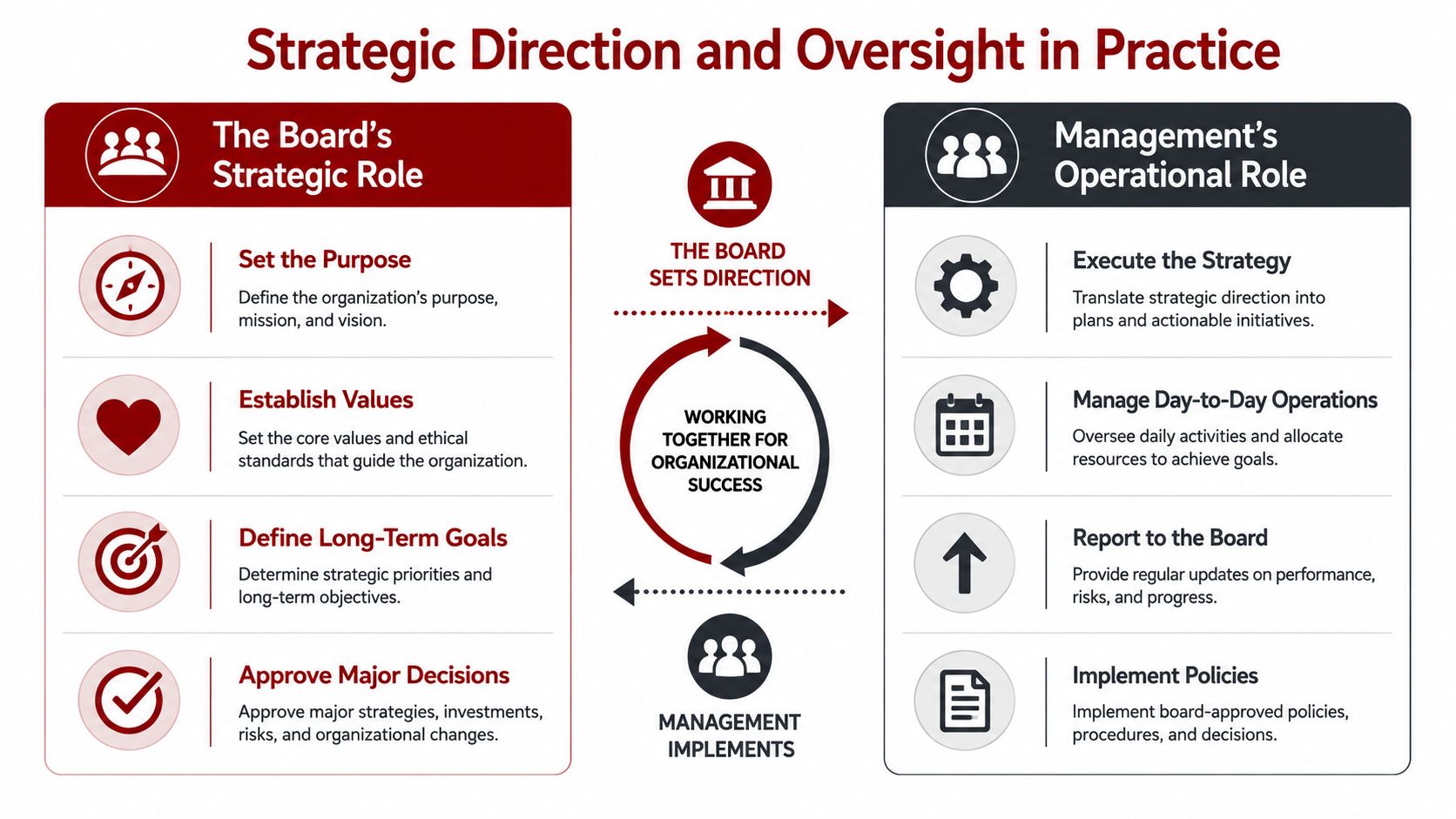
A board earns its keep by deciding what the company is trying to become, and what it will not do to get there. That's the strategic role. The oversight role is different. It's the discipline of checking whether management is delivering what the board approved, without losing control of risk, cash, or standards.
Where the board owns the decision
The board should own the destination, the guardrails, and the big commitments. That means approving budgets, debt, major contracts, acquisitions, dividend policy, and senior appointments or removals. It also means setting risk appetite, especially where one wrong move can damage cash flow or reputation fast.
Management handles the daily engine room. Hiring below board level, selecting routine suppliers, running campaigns, and executing operational plans are management tasks. If the board starts approving every supplier invoice and every marketing tweak, it hasn't become “hands-on”, it's become a bottleneck.
A clean rule helps founders who wear both hats. When you're acting as management, you execute. When you're acting as a director, you challenge, document, and decide in the company's best interests. If you don't switch consciously, you end up approving your own work without proper scrutiny.
Ownership versus influence
A useful way to separate the two roles is this. Ownership sits with the board on matters that bind the company. Influence sits with management on matters that shape delivery but don't need formal approval. The grey area is where founders make mistakes, especially in private companies where one person can dominate both sides of the table.
| Board territory | Management territory |
|---|---|
| Approving budgets and material borrowing | Setting team schedules and campaign timing |
| Hiring or dismissing senior executives | Hiring day-to-day staff within agreed headcount |
| Signing off major contracts | Choosing routine suppliers within policy |
| Deciding dividend policy | Running operations against the approved plan |
| Reviewing strategic risk | Executing controls and reporting exceptions |
The UK Corporate Governance Code makes the board's strategic job explicit. It asks boards to establish purpose, values, and strategy, and to keep culture aligned with those objectives (OECD summary of the UK Code). For a founder-led SME, the point is not to copy a listed company. It's to stop major decisions being made informally and then rationalised afterwards.
Board Committees and How to Scale Them Down
Large-company governance loves committees because they create focus. SMEs need judgment, not ceremony. The mistake is assuming a smaller business must either copy a FTSE structure or have no structure at all. That's false. You can scale committees down without watering down control.
Start with the function, not the title
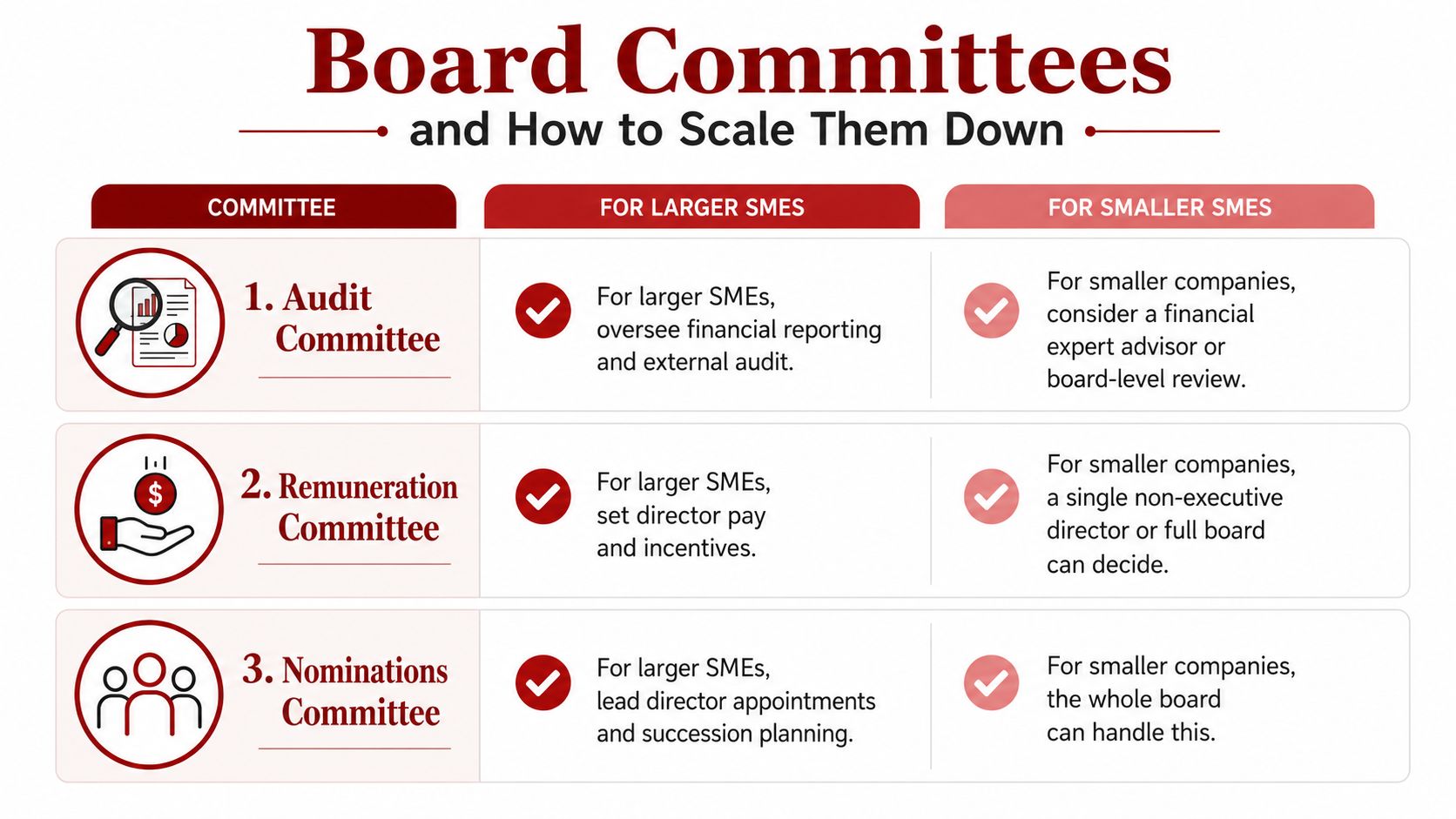
An audit committee exists to scrutinise financial reporting, controls, and the quality of the numbers. In a smaller company, that often means the full board reviews management accounts, cash flow, and statutory accounts together, with one director taking a harder finance lead where appropriate. You do not need committee theatre if one disciplined agenda item does the job.
A remuneration committee is there to keep pay, incentives, and director benefits under control. In an SME, that can be a simple annual discussion, recorded properly, with the rationale for pay decisions written down. That's enough if the board is small and the pay structure is straightforward.
A nominations committee handles appointments, succession, and skills gaps. Smaller companies can do this at the full board level, as long as the discussion isn't rushed and conflicts are declared. If you are adding a non-executive director, don't appoint them because they're available. Appoint them because they bring a skill or challenge the board doesn't already have.
What about risk
Risk doesn't need its own glossy committee unless the business is complex enough to justify it. Most SMEs can fold risk into the main board agenda if they keep a live risk register and review it regularly. That is more honest than pretending a committee exists when nobody has time to staff it properly.
Good governance scales down by keeping the discipline, not the paperwork.
The UK Corporate Governance Code expects formal annual evaluation, and for FTSE 350 companies, externally facilitated reviews at least every three years (governance expectations summary). That listed-company standard is a useful benchmark, but a small company should apply it proportionately. The test is whether directors are honest about their own weaknesses and whether the board has enough independent challenge to stop drift.
For a smaller board, the right question is not “Do we have enough committees?”. It's “Do we have enough scrutiny, enough challenge, and enough evidence that decisions were thought through?”. If the answer is no, the issue isn't committee names. It's weak governance.
Risk, Compliance and the Audit Loop
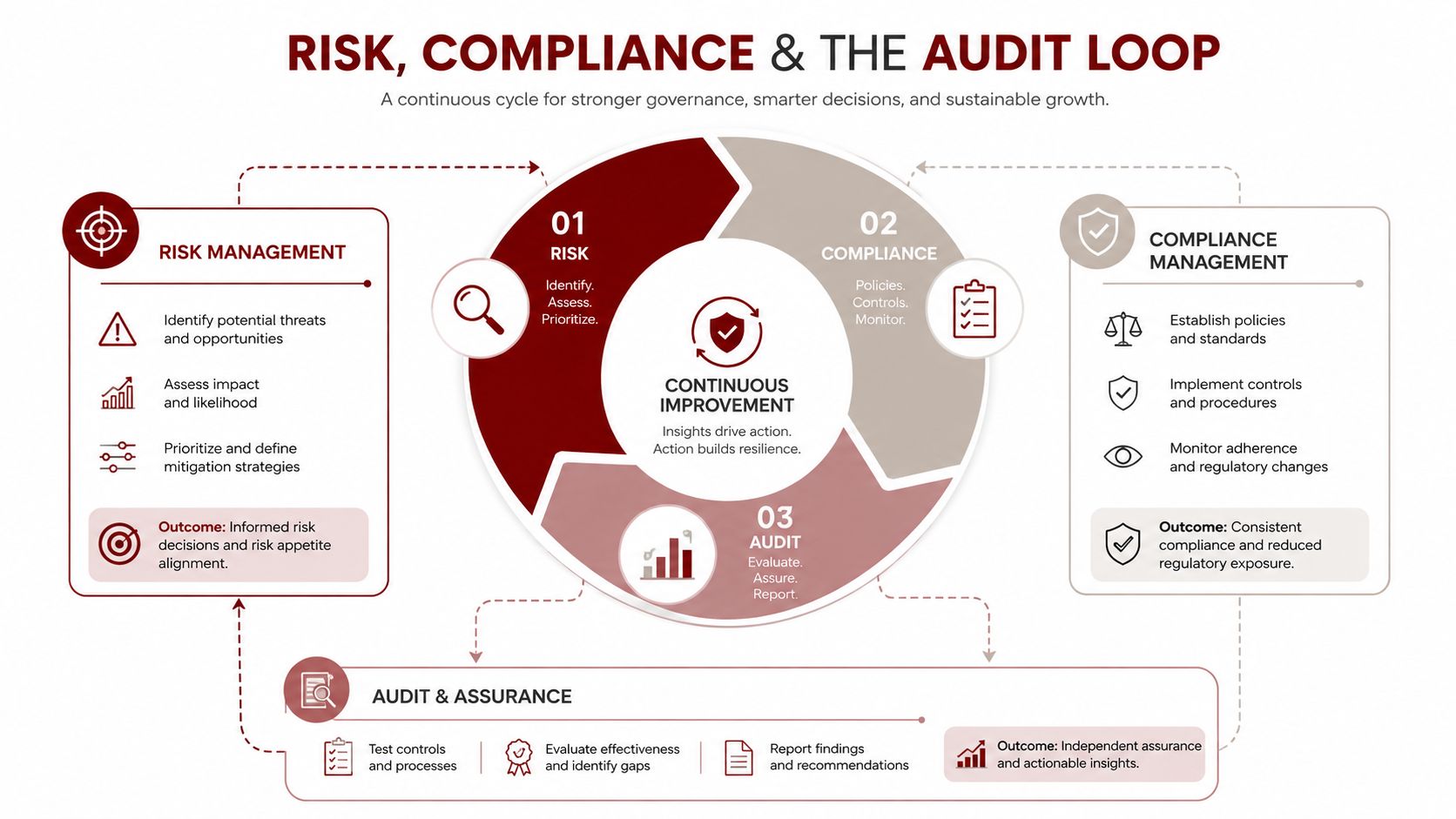
Boards don't manage risk by hoping for the best. They manage it by creating a loop, identify the risk, put controls around it, check whether those controls work, and improve the process when they don't. That loop is what separates real oversight from box-ticking.
The artefacts that prove the board has done its job
The risk register is not a bureaucratic spreadsheet. It's the board's memory of what could hurt the business, what controls exist, and who owns the action. If a risk is important enough to discuss, it's important enough to record.
Internal controls are the practical brakes and warning lights. Think bank payment approvals, segregation of duties, credit control, password governance, and documented authorisation thresholds. If one person can create, approve, and pay a transaction without review, the board has a control problem.
For compliance, the company needs more than good intentions. Anti-bribery and anti-money-laundering controls, data protection oversight, and clean statutory records all support the same point, that the directors can show how decisions were made and how the company was kept within the rules. The statutory accounts and any audit or audit exemption position are part of that evidence trail, not separate from it. If you're checking when an audit exemption may apply, this audit exemption threshold note is worth reading alongside your accountant's advice.
Why evidence matters when things go wrong
If a creditor, investor, or regulator asks what the board knew and when it knew it, your records matter more than your memory. That includes board minutes, conflicts declarations, approved policies, and the trail behind key filings. The Companies Act machinery around confirmation statements, PSC records, and statutory books exists for that reason. It gives directors proof that the company was kept properly, not just run informally.
The newer pressure point is ESG and climate risk oversight. UK guidance increasingly expects boards to evidence their oversight, not just say they care about it (Board Intelligence overview). For a small company, that doesn't mean writing a sustainability manifesto. It means knowing whether the business has material environmental, social, or supply-chain risks, and recording how the board reviewed them.
For a practical framing of governance, risk, and compliance as a connected system, the GRC guide by Logical Commander is a solid reference point. It's useful because it treats risk, compliance, and audit as one loop, which is exactly how directors should think about them.
The cadence should be boring and regular. Review risks monthly or quarterly, test controls before year-end, and make sure the final accounts sign-off isn't the first time the board has looked at the numbers properly.
Sector Snapshots for Construction, Property and Startups
The duties don't change by sector. The pressure points do. That's why a construction board, a property board, and a startup board can all be governed properly, but not identically. The trick is to watch for the place where one bad decision becomes a personal headache for a director.
Construction, property, and startup pressure points
In construction, the board's job often comes down to money flow, subcontractor verification, and tax compliance. A contractor who ignores CIS controls or leaves retention treatment vague is not being “efficient”, they're inviting disputes and avoidable risk. If that sounds familiar, the practical realities of starting a construction business show why board oversight has to be immediate, not theoretical.
In property, boards get caught in capital spending decisions, service charge treatment, and whether ownership structure still fits the tax and commercial picture. A landlord who treats major refurbishments as an operational afterthought can damage returns and create governance confusion between the company and the underlying asset. The right habit is to minute decisions on acquisitions, financing, and large works before the money moves.
In startups, the board usually gets tested at the exact moment growth becomes real. Equity issuance, investor reporting, founder vesting, and any bridge or convertible style funding need proper approval and documentation. A common failure is treating a fast deal as “too early for governance”. It isn't. It's exactly when governance matters most.
If the decision changes ownership, cash, or control, the board should see it.
The same duties land differently in each sector, but the fix is the same. Keep a short agenda, record conflicts cleanly, and don't let the founding team blur operational urgency with director authority. One clear board minute would have prevented most of the mess in these examples.
How an Outsourced Advisor Strengthens the Board
A small company doesn't need a bloated governance function. It needs reliable execution. That's where the right outsourced adviser earns its place, by making the board more disciplined without turning every decision into admin theatre.
What should be outsourced
Statutory registers, confirmation statements, board packs, minutes, filing calendars, and the audit liaison are all obvious candidates. So are controls testing, document chasing, and the quiet discipline of making sure the board is looking at the right papers before it signs anything. If nobody owns those tasks, directors end up improvising.
There's also a clear difference between a bookkeeper, a company secretarial service, and a strategic finance adviser. A bookkeeper records transactions. A company secretarial partner keeps the governance records and filing rhythm clean. A strategic adviser challenges whether the information itself is good enough for a board decision. If you want a useful lens on that third layer, it's worth comparing outsourced CFO options before you assume every finance adviser does the same job.
Why outsourcing doesn't dilute responsibility
Outsourcing execution does not outsource accountability. Directors still sign, still decide, and still carry the duty to act properly. What outsourcing does is reduce the chance that a board misses a filing, overlooks a conflict, or approves papers that don't tell the full story.
That matters most when the company is growing faster than its internal admin capability. A founder who waits until governance is broken before asking for help is usually paying for mistakes, not support. A better move is to build a simple cadence early, monthly numbers, quarterly risk review, annual statutory cycle, and properly written minutes for major decisions.
For practical selection, read how to choose an accountant with a governance lens, not just a price lens. The right partner should be able to produce a board minute template, a filing calendar, a conflicts register, a risk register, and a clean meeting rhythm that keeps directors honest.
A Founder's Board Checklist and Common Pitfalls
The most common mistakes are boring, which is exactly why they're dangerous. Founders skip minutes, sign after the fact, confuse shareholder wishes with director duties, ignore the PSC register, or treat the auditor as a checkbox. None of that is harmless admin. It's a sign that the board has stopped acting like a control function.
Use this checklist before your next board meeting
- Authority: Confirm the decision is within the board's powers and not just an operational habit.
- Conflicts: Ask every director to declare interests before discussing the item.
- Papers: Circulate the board pack early enough for proper reading, not last-minute scanning.
- Challenge: Record the key questions, not just the final approval.
- Decision: Minute the exact resolution, including any delegated authority.
- Follow-up: Assign owners, deadlines, and reporting dates.
- Records: Update statutory books, registers, and filings promptly after the meeting.
- Controls: Review whether the decision changes risk, cash, tax, or compliance obligations.
If you're a startup founder and want a broader finance view, AmbitionCFO for startup founders is a helpful comparison point for understanding the sort of finance support that pairs well with proper governance.
Keep the rhythm simple
For a small UK company, the board rhythm should be simple enough to sustain and strict enough to matter. Regular meetings, short but real agendas, clean minutes, and documented approvals will do more for you than a pile of unused committee terms. That's the practical standard.
The central truth is straightforward. A UK board is not a formality, it's the group that keeps the company lawful, deliberate, and defensible. With proportionate governance and the right support, that responsibility is entirely manageable for a small team.
If you want proper board support without the bureaucracy, Action Accountants Limited can help you put the right company-secretarial, accounting, and governance rhythm in place. They work with founders who need clean filings, sensible board packs, and practical oversight that stands up when decisions get tested. Visit them if you're ready to make your board more disciplined, not more complicated.