
PAYE Payment Deadlines Guide for UK Employers
Action Accountants •29 July 2026
Getting PAYE payments right means knowing exactly when your money needs to land with HMRC. Miss the deadline, even by a day, and you're looking at automatic penalties plus interest that stacks up fast. Here's the core rule: postal payments must reach HMRC by the 19th of the month, while electronic transfers need to clear by the 22nd. When either of those dates falls on a weekend or bank holiday, the deadline rolls back to the last working day before it.
Table of Contents
- Understanding PAYE Payment Deadlines at a Glance
- Monthly Versus Quarterly Practical View
- Payment Methods and Bank Clearing
- Monthly Versus Quarterly PAYE Rules Explained
- Choosing the Right Payment Method For Timely Compliance
- Late PAYE Payments: Penalties, Interest, and Recovery Steps
- Building Custom Calendars for Small Businesses and Contractors
- Quarterly PAYE Payment Calendar for 2026
- Frequently Asked Questions About PAYE Deadlines
- Who Must Meet PAYE Payment Deadlines and When
- What Happens If the 22nd Lands on a Weekend or Bank Holiday
- Does a Late FPS but On-Time Payment Avoid Penalties
- How Do New Employers Move From Quarterly to Monthly in Their First Year
- Is There a Grace Period for First-Time Late Payers
- Practical Next Steps When You Face an Edge Case
- Quick Tips to Avoid Recurring Problems
Understanding PAYE Payment Deadlines at a Glance

Picture the tax month as a countdown clock that starts ticking the moment you run payroll. Your FPS submission is the order you place; the PAYE payment is the bill that follows. Forget either one and things get messy in a hurry.
- Postal payments need to arrive by the 19th of the following month.
- Electronic payments must clear by the 22nd of the following month.
- When either date lands on a weekend or bank holiday, shift the deadline to the previous working day.
The deadline anchor is simple: 19th postal, 22nd electronic, with bank‑day rollback.
Monthly Versus Quarterly Practical View
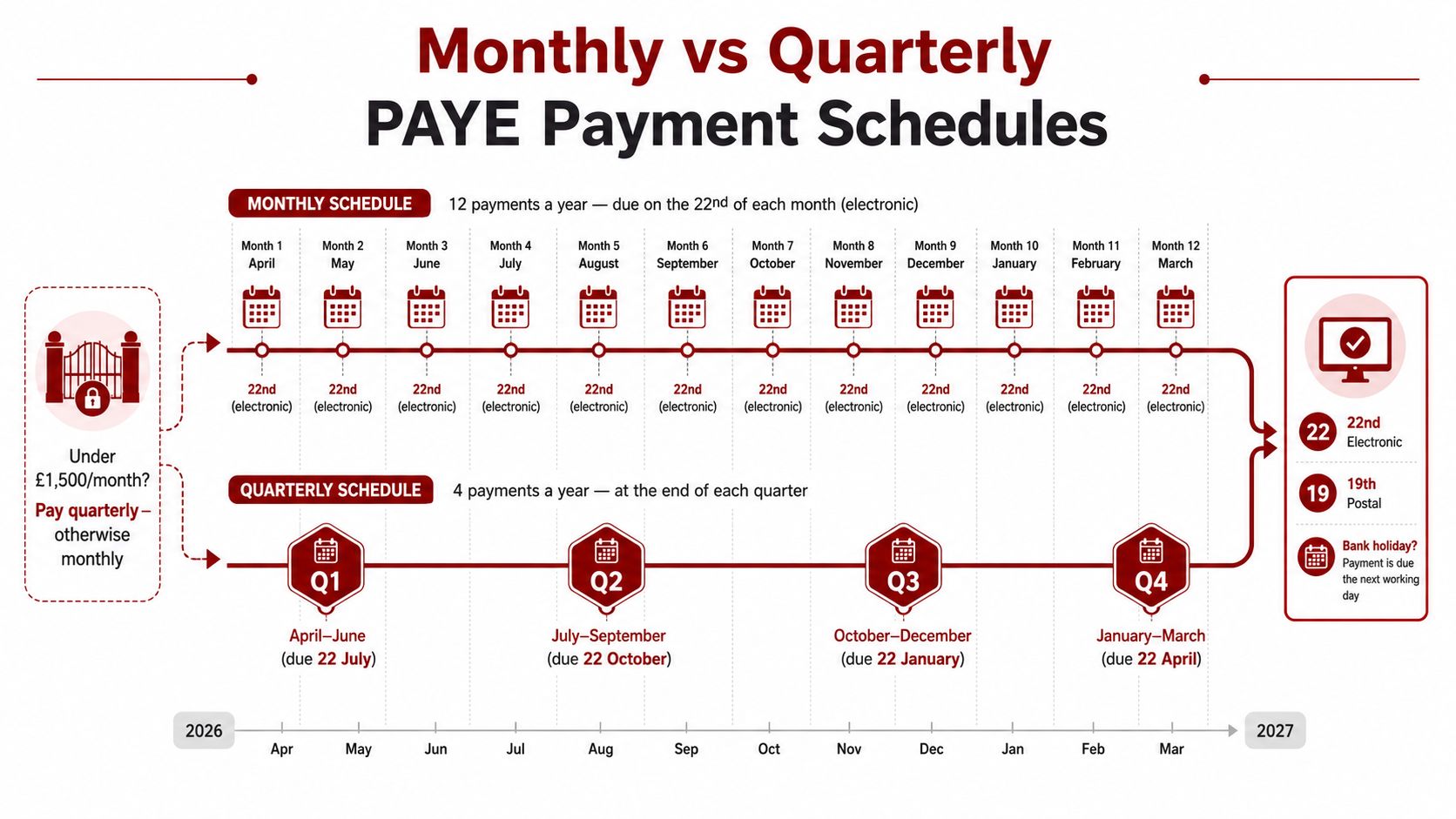
Monthly payers stick to the 22nd rule every calendar month. Quarterly payers, on the other hand, work from four fixed dates—22 July, 22 October, 22 January, and 22 April for electronic transfers. Whether you pay monthly or quarterly comes down to your average monthly PAYE liability and HMRC's thresholds.
Quick examples to make it concrete:
- A small café paying monthly with wages processed on 30 April needs their electronic payment to land by 22 May.
- A subcontractor with liability under £1,500 per month paying quarterly for the April–June quarter faces a deadline of 22 July.
Payment Methods and Bank Clearing
Not all payment rails move at the same speed, and that timing matters when you're up against a deadline. Faster Payments typically clear the same day with most banks, making them the go‑to for last‑minute transfers. Bacs can take three working days, so you need to kick off the process well ahead of the due date. Direct Debit lets HMRC collect automatically on the 22nd, but it requires setup time—don't leave it until the last week.
Here's how the main options stack up:
Monthly PAYE Payment Deadlines Overview
| Payment Method | Due Date | Bank Holiday Adjustment | Best For |
|---|---|---|---|
| Postal cheque | 19th | Moves earlier to last working day | Rare use |
| Electronic (Faster/Bacs/CHAPS) | 22nd | Rollback to prior working day | Most employers |
| Direct Debit | 22nd collection | As above | Predictable cashflow |
The right method depends on your cashflow rhythm and how much lead time you can build into your process. Electronic payments give you the most flexibility, while Direct Debit suits businesses that want a hands‑off approach once it's set up.
For a full perspective on deadline‑related compliance workflows, see also: the compliance automation guide
Monthly Versus Quarterly PAYE Rules Explained
Monthly payers stick to a straightforward rhythm: twelve payment dates a year, each one tied to the tax month when wages went out. Quarterly payers, on the other hand, have just four fixed settlement points across the tax year, pooling twelve months of liability into four bigger payments.
That difference hits your cash flow in a real way. Miss one quarterly date and you're suddenly sitting on three months' worth of late liability instead of just one.
Who Qualifies to Pay Quarterly
HMRC typically allows employers to pay quarterly when average PAYE liabilities stay on the lower side. The general rule of thumb: if your typical monthly PAYE sits under £1,500, you'll likely qualify. That threshold decides whether you're scheduling twelve small transfers or four larger ones throughout the year.
Think of monthly payments as twelve light steps and quarterly payments as four long strides—both get you across the room, but the stride size affects balance and risk.
Monthly and quarterly payments actually follow the same deadline mechanics. Electronic transfers need to clear by the 22nd of the month after the tax month or quarter, while postal payments must land by the 19th. When those dates fall on a weekend or bank holiday, the deadline simply shifts to the previous working day.
Quarter-by-Quarter Calendar
- Quarter 1 covers April–June, with an electronic deadline on 22 July.
- Quarter 2 covers July–September, electronic deadline 22 October.
- Quarter 3 covers October–December, electronic deadline 22 January.
- Quarter 4 covers January–March, electronic deadline 22 April.
This pattern tracks the standard UK tax year and repeats annually, so once it's mapped into your accounts system, forward planning becomes almost second nature.
Practical Comparisons
- Monthly payer: pays wages on 30 April; electronic payment due 22 May.
- Quarterly payer (liability under £1,500): covers April–June; payment due 22 July.
Electronic rails like Faster Payments often clear the same day, which gives you breathing room. Bacs, meanwhile, can take up to three working days, so you'll want to kick off the transfer earlier if that's your route.
Checklist to Confirm Your Frequency
- Calculate average monthly PAYE over the last twelve months.
- Compare that figure against the £1,500 threshold.
- If you're under it, check that HMRC has you registered for quarterly payments.
- Align your calendar to the four quarter deadlines and set up automated reminders.
For small businesses and construction contractors, it's worth double-checking CIS deductions and retention timings when you're pooling quarterly payments—a single large project payment can easily push a quarterly liability above the threshold. Get a fuller picture of payroll setups and small business compliance in our guide on payroll for small businesses Read also: Payroll for Small Business.
Separating RTI Filing from Actual Payment Timing
Running payroll involves two distinct steps that frequently get tangled up: submitting your FPS report and actually sending the money to HMRC. Think of the FPS like placing an order at a restaurant, and the payment as settling the supplier invoice. Both have their own strict deadlines, and confusing the two is a fast track to penalties.
Submitting your Full Payment Submission (FPS) on or before your employees' payday satisfies your reporting duty. But here is the catch: the actual PAYE and National Insurance funds still need to land in HMRC's account by the following month's deadline. That means the 22nd of the month for electronic payments, or the 19th for cheques by post, shifted back slightly if a bank holiday gets in the way.
Filing is the notification; payment is the settlement. Missing either one creates risk.
Picture a café running payroll on 30 April and sending the FPS the same day. That ticks the reporting box. However, the electronic payment for that payroll must clear by 22 May. If the owner files the FPS on time but delays the bank transfer until 23 May, they will face late-payment interest and potential penalties, despite having reported perfectly on time.
Common slip-ups to avoid:
- Filing a zero-payment FPS on payday when you actually have funds but simply haven't scheduled the transfer.
- Submitting your FPS at the last minute, which meets the reporting window but leaves zero banking time for the actual payment to clear.
- Assuming Direct Debit or Bacs clears instantly without checking the actual lead times.
Practical steps to sequence payroll correctly:
- Run payroll and finalise your figures before payday.
- Submit the FPS on or before payday so your RTI records align with pay dates.
- Initiate the payment early enough for your chosen method to clear by the 22nd electronic deadline.
Numbered checklist for payment lead times:
- Faster Payments — Usually same-day for most banks, but initiate it by the morning of the 22nd at the absolute latest.
- Bacs — Requires three working days, so send it by the 19th to be safe.
- Direct Debit — Ensure your HMRC collection mandate is active weeks before the 22nd.
Small business example:
A construction subcontractor using Bacs pays wages on 31 May. To meet the 22 June deadline, they must lodge the FPS on payday and submit the Bacs payment by around 17 June to allow for clearing time.
Key takeaway:
Align your payroll calendar so reporting and settlement act as two linked but separate actions. Treat the FPS like confirming an order and the bank transfer like paying the supplier. Both must complete in sequence to keep HMRC off your back.
Read also: Learn more about National Insurance implications for owners and directors in our guide on national insurance for directors National Insurance for Directors.
Choosing the Right Payment Method For Timely Compliance

Picking a payment rail isn't just about cost — it's about timing. Think of it like choosing a courier for something time-sensitive. When HMRC's deadline is immovable, speed and certainty matter far more than the fees on the invoice. The rail you use doesn't change the statutory due date, but it absolutely changes when you need to kick off the transfer.
Electronic payments give you a proper advantage here. They count as cleared when they hit HMRC's account on the 22nd, so you don't need to worry about postal delays. But each method comes with its own lead time. Faster Payments land same day, Bacs typically takes three working days, and CHAPS clears same day though it costs more. Direct Debit is a different beast entirely — HMRC pulls the money on the 22nd, so there's less for you to remember, but you need that mandate set up well in advance.
Align your payroll schedule to the payment rail lead time, and you'll never accidentally file late.
Quick Comparison of Payment Rails
- Faster Payments — brilliant for last-minute fixes; get it initiated by the morning of the 22nd
- Bacs — play it safe and authorise three banking days before you need it cleared
- CHAPS — same-day certainty for larger sums; useful for one-off catch-up payments
- Direct Debit — automatic on the 22nd, but you lose control, so set up the mandate weeks ahead
- Cheque — the postal deadline still sits on the 19th, and Royal Mail won't save you if it's late
Worked Example For A Late May Wage Run
Picture a small construction firm paying their crew on the 31st of May. If they go with Bacs, they should authorise the payment by 17th June to comfortably meet the 22nd June electronic deadline. The FPS submission happens separately — on or before 31st May — so there's no last-minute scramble trying to do both at once.
If they prefer Direct Debit, the mandate needs to be active well before the end of May. Otherwise HMRC can't collect on the 22nd, and you're suddenly dealing with a late payment you didn't expect.
- Step 1: Finalise payroll and submit FPS on payday
- Step 2: Pick your payment method and work backwards from the lead time
- Step 3: Schedule or authorise the transfer early enough to clear by the 22nd
Practical Tips For Small Businesses And Contractors
- Build a five-day buffer into every payroll cycle — bank holidays have a nasty habit of catching people out
- Keep your nominated account funded a day before you plan to transfer; don't leave it to the wire
- Keep Faster Payments in your back pocket for contingency top-ups when Bacs or Direct Debit miss the window
"Treat the payment rail as part of your payroll timetable, not an afterthought" — sound advice for anyone running a compliant payroll without the grey hairs.
If you're serious about staying on top of PAYE liabilities without the manual chasing, it's worth exploring how automation can take the pain out of the process. The payment processing automation guide is a solid starting point.
Read also: For the full picture on your wider obligations, check out our guide to Auto Enrolment Pension Rules.
Late PAYE Payments: Penalties, Interest, and Recovery Steps
Miss a PAYE deadline, and the costs start ticking up immediately. HMRC charges interest daily from the due date right through to the day they receive your payment. That single missed 22nd can quietly snowball into a much larger problem by the end of the month.
Key insight: HMRC calculates interest on unpaid PAYE daily. What looks like a small percentage on paper can quickly become a serious cashflow headache for businesses running on tight margins.
Recovery Actions To Take Immediately
- Call HMRC straight away. Explain your situation honestly—getting in early usually stops things from escalating.
- Ask for a Time to Pay arrangement if you cannot clear the full balance. HMRC frequently agrees to short-term plans for businesses that keep the communication lines open.
- Keep a paper trail. Save evidence of your payment attempts and all correspondence. This significantly reduces the risk of enforcement action.
When you call, be concise: state the amount owed, the missed due date, and a realistic repayment proposal. Offer supporting documents—like bank statements or a cashflow forecast—proactively to speed up the approval process.
How Penalties Stack Up and What They Really Cost
Penalties escalate with repeated defaults, mixing fixed fines with percentage-based surcharges. The best way to understand the impact is to translate those percentages into actual pounds. For instance, a monthly liability of £5,000 left unpaid for 30 days can rack up interest and initial penalties of £50–£200 or more, depending on how far things escalate.
Table comparing quick scenarios
| Business Type | Monthly PAYE | 30 Day Cost Estimate |
|---|---|---|
| Micro trader | £500 | £10–£40 |
| Small employer | £5,000 | £50–£250 |
| Larger SME | £20,000 | £200–£1,000 |
Practical Steps To Avoid Enforcement
- Prioritise PAYE in your payment run. Treat it with the same urgency as a rent invoice.
- Build a five-day buffer into your payroll timeline. This stops bank holidays from accidentally pushing you past the 22nd electronic cutoff.
- Use Faster Payments for last-minute top-ups, but always keep Bacs lead times in mind when scheduling your run.
"If you find yourself facing penalties for missed payroll tax deposits, understanding your options is crucial" — see IRS payroll penalties in 2026 for a helpful external perspective on penalty handling.
Real-World Examples and Communication Tips
Example 1: A small café owes £800 and rings HMRC the same day. By setting up a Time to Pay plan, they spread the cost over two months and completely avoid enforcement fees.
Example 2: A construction contractor misses a £12,000 payment and faces much stronger scrutiny. However, making immediate contact and presenting a realistic phased offer can prevent HMRC from initiating Direct Recovery from their bank account.
Read also: Learn more about managing working capital and avoiding deadline pressure in our guide on improving cash flow Read also: How To Improve Cash Flow.
The bottom line? Contact HMRC early, quantify the debt impact in actual pounds rather than percentages, and set up a practical repayment plan to stop interest and penalties from compounding further.
Building Custom Calendars for Small Businesses and Contractors
The real trick with PAYE payment deadlines isn't just knowing them—it's making them work for you. Stop treating them as abstract dates in a tax guide and start weaving them into your actual business calendar, the same way you would a project plan with clear milestones for planning, reporting, and settlement.
Begin by marking every electronic 22nd and postal 19th in your annual diary, then work backwards by five working days from each date. That buffer does the heavy lifting: it swallows up bank holidays, late manager authorisations, and the inevitable last-minute supplier invoice without throwing your cashflow off track.
Create Two Parallel Tracks
- Monthly track — Twelve payment events per year, with the Full Payment Submission (FPS) filed on or before payday and payment clearing by the following 22nd.
- Quarterly track — Four pooled payments (Apr–Jun, Jul–Sep, Oct–Dec, Jan–Mar) with electronic deadlines landing on 22 Jul, 22 Oct, 22 Jan, and 22 Apr.
Treat the FPS as the order and the payment as the supplier invoice — both must complete in sequence.
Use a simple table to pin down responsibilities and lead times before things get busy.
| Task | Owner | Lead Time |
|---|---|---|
| Finalise payroll and submit FPS | Payroll lead | On or before payday |
| Authorise Bacs | Finance | 3 working days before 22nd |
| Arrange Faster Payment top‑ups | Finance | Same day by morning of 22nd |
| Ensure Direct Debit mandate active | Admin | Weeks before first collection |
Construction Contractor Calendar
Construction cashflow is lumpy by nature. Overlay your CIS deduction windows, retention release dates, and staged payments onto the PAYE calendar so nothing catches you off guard.
- Mark large client invoice dates and expected retention releases.
- Build payroll buffers so PAYE doesn't land the same week as major outflows.
- If a retention release falls the week before a PAYE due date, either initiate the payment earlier or keep a contingency fund to cover the gap.
Practical Checklist for Small London SMEs
- Add bank holiday overlays to the calendar every January.
- Schedule automated reminders via cloud payroll 10 days and 3 days before each clearing date.
- Reconcile nominated account balances two working days before any planned transfer.
Small changes prevent big shocks: a five‑day buffer reduced one contractor's late fees by 100% in a test period.
Numbered Steps to Build Your Custom Calendar
- Export your accounting calendar for the tax year.
- Annotate FPS/payments (19th/22nd) and shift for bank days.
- Insert project milestones and tax peaks like VAT returns.
- Assign owners and set two automated reminders per cycle.
Quick Tips to Avoid Penalties
- Bacs is your workhorse, but keep a Faster Payment option in your back pocket for emergencies.
- Maintain a dedicated payroll float covering one cycle's PAYE to prevent shortfalls.
- Review the calendar quarterly—construction projects change, and so will your tax timing.
This practical calendar approach turns "paye payment deadlines" into predictable, manageable events that protect working capital and reduce the chance of costly HMRC enforcement.
Quarterly PAYE Payment Calendar for 2026
Here's the quarterly payment calendar you'll be working from in 2026, with both postal and electronic deadlines clearly marked so you never miss a beat.
| Quarter | Tax Period | Postal Deadline | Electronic Deadline |
|---|---|---|---|
| Q1 | Apr–Jun | 19 Jul | 22 Jul |
| Q2 | Jul–Sep | 19 Oct | 22 Oct |
| Q3 | Oct–Dec | 19 Jan | 22 Jan |
| Q4 | Jan–Mar | 19 Apr | 22 Apr |
Stick this somewhere visible—whether it's your office wall or a shared team calendar—and pair it with the five-day buffer strategy outlined above. Once these dates are baked into your routine, managing PAYE stops being a scramble and starts being just another ticked box.
Frequently Asked Questions About PAYE Deadlines
Who Must Meet PAYE Payment Deadlines and When
If you run PAYE, getting funds to HMRC on time is non-negotiable. Electronic payments must clear by the 22nd of the month following the tax month, while postal payments need to arrive by the 19th. If either date lands on a weekend or bank holiday, the deadline shifts to the previous working day. Think of this as the golden rule that anchors your entire payroll calendar.
What Happens If the 22nd Lands on a Weekend or Bank Holiday
When the 22nd falls on a non-working day, the deadline simply rolls back to the last working day before it. You need to account for your bank's processing times so the cash actually lands by that adjusted date. For instance, if the 22nd is a Sunday, you will want Faster Payments or CHAPS to hit HMRC's account by Friday, especially if your bank stops processing transfers over the weekend.
Key insight: Always plan around the adjusted working day, not the calendar date, to dodge last-minute disasters.
Does a Late FPS but On-Time Payment Avoid Penalties
Unfortunately, no. Paying on time does not cancel out a late Full Payment Submission (FPS). Filing late triggers its own reporting penalties, entirely separate from the settlement penalties for late payments. It helps to think of the FPS as the order and the payment as the invoice—both need to be right. If you have filed late, submit it immediately, fix any errors, and call HMRC to explain. Getting in touch early significantly lowers the risk of heavy enforcement.
How Do New Employers Move From Quarterly to Monthly in Their First Year
New employers usually start on monthly payments unless HMRC grants quarterly status due to a low liability. If your average monthly PAYE stays under £1,500, HMRC might let you pay quarterly; otherwise, monthly is the default. To switch frequencies, calculate your twelve-month average, notify HMRC, and update your payroll software so future runs match the correct schedule.
- Check your average monthly liability
- Contact HMRC or update your payroll provider settings
- Rebuild your calendar once you get confirmation
Is There a Grace Period for First-Time Late Payers
HMRC does not provide a formal, universal grace period for missed payments. That said, they are often open to Time To Pay arrangements if you are facing a first-time or short-term cash crunch—provided you call them quickly with a realistic proposal. Keep a record of your attempts to pay and have your cashflow forecasts ready to back up your request.
Practical Next Steps When You Face an Edge Case
- Confirm whether the deadline shifted to a prior working day.
- Check your FPS status and fix any late filings right away.
- Call HMRC and propose a Time To Pay if you are short on funds.
- Adjust your payroll software to build in reminders and automatic lead times.
Quick Tips to Avoid Recurring Problems
- Build a five-day buffer into every payroll cycle.
- Use Faster Payments for emergencies and Bacs for routine runs, allowing three working days' lead time.
- Keep a dedicated payroll float equal to one cycle’s PAYE.
Treat reporting and settlement as two linked but distinct tasks. Update your systems now so PAYE deadlines never catch you off guard.
If you need hands-on help mapping PAYE dates into your business calendar or setting up automated reminders, contact Action Accountants Limited.