
What Is a Confirmation Statement: UK Guide 2026
Action Accountants •27 July 2026
A confirmation statement is the annual Companies House snapshot that confirms a company's details are still accurate, filed at least every 12 months using Form CS01. It's a verification layer, not a financial return, so it confirms what Companies House already holds rather than reporting your trading results.
If you've got a first company anniversary creeping up, this is probably the filing you've heard mentioned in passing but never had to touch before. One minute you're thinking about bookkeeping, payroll, or your next client invoice, and the next you're staring at a Companies House reminder wondering whether this is the same thing as accounts or tax.
Table of Contents
- Why Every UK Director Needs to Know the Confirmation Statement
- The Core Definition and the Annual Cycle
- What the Statement Covers
- Confirmation Statement vs Annual Return and Statutory Accounts
- A Practical Filing Checklist for Directors
- Common Mistakes and the Consequences of Getting It Wrong
- Building the Annual Rhythm and When to Bring in Support
Why Every UK Director Needs to Know the Confirmation Statement
A founder in North West London often meets the confirmation statement for the first time when the company's first anniversary arrives and a filing deadline appears without much context. It can look like a tax form, an accounts filing, or just another Companies House admin task. It isn't any of those things.
A confirmation statement is the annual check-in that says the public record is still right. For many small companies, the practical cost is fixed at £50 online or £110 by paper CS01, so it's a small payment for a filing you can't ignore and shouldn't leave to the last minute (Companies House guidance).
Practical rule: if the company details on the register have changed, update those details first, then file the confirmation statement.
That simple order matters because the statement itself doesn't carry out the update. It only confirms the register after the actual changes have already been recorded.
What a first-time director usually needs to know
The rest of this guide focuses on the practical questions directors ask most often:
- What it is, in plain English.
- When it's due, and how the annual cycle works.
- What it covers, including the company details people confuse most.
- What it does not do, especially when details have changed.
- How to file it, online or on paper.
- What goes wrong when it's left too late.
- When it makes sense to get help instead of handling it alone.
If you've been trying to work out whether this belongs with your accounts, your tax return, or your company records, the answer is simple. It belongs in your annual Companies House compliance routine, and it's one of the few tasks a director can learn once and repeat reliably every year. If you also want a plain explanation of the wider role of a company secretary, this guide from Action Accountants is a useful companion read.
The Core Definition and the Annual Cycle
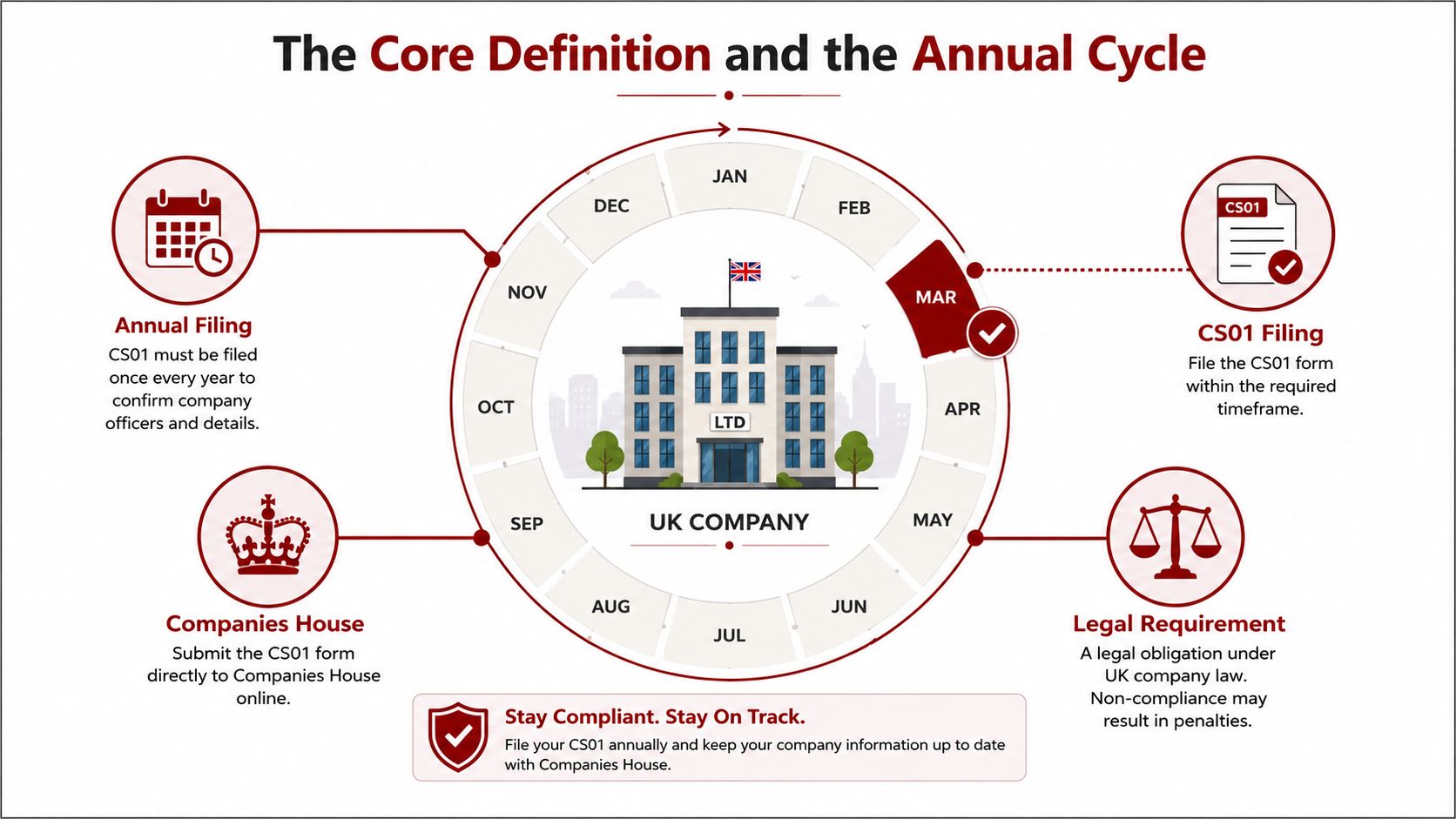
A confirmation statement is the annual check-in for a company's public record. It confirms that Companies House still holds the right information about the business, rather than reviewing the business itself. Every UK company, including dormant and non-trading companies, must file one at least once every 12 months (Companies House guidance).
The three timing points that matter
The filing cycle turns on three linked dates. The first is the confirmation date, usually the anniversary of incorporation or the last filed statement. The second is the review period, the stretch of time you are confirming. The third is the short 14-day window after that date when the statement has to be delivered to Companies House (Companies House guidance).
That 14-day period is where many first-time directors get caught. The date in the calendar can look far away, but the filing window becomes very tight once the review period ends. If you wait until the week after the anniversary to start thinking about it, your margin for error is already smaller.
A sensible compliance habit is to treat the confirmation date like a recurring diary event, not a background reminder.
The old annual return system disappeared on 30 June 2016, when the confirmation statement became the standard annual company-record check. Older directors still sometimes say “annual return”, but the filing you deal with now is the CS01 confirmation statement.
Why the distinction from accounts matters
This filing is about public-record accuracy, not financial performance. It is also not the form that updates changes for you. If the company's details have changed, those changes should be recorded first on the relevant Companies House register, then confirmed in the statement. A company director who expects the CS01 to fix the register is likely to miss the correct filing order.
That is why the confirmation statement can feel familiar to first-time directors and still cause confusion. The question it answers is simple, are the company details still right? Once that sits clearly in mind, the rest of the annual routine is easier to handle.
What the Statement Covers
A confirmation statement works like a yearly check on the company record. It tells Companies House that the details it already holds for the company or LLP still match what is on file. That includes officers, shareholders or members, the registered office, the SIC code, share capital, and PSC information. A plain guide to the filing explains the same point in simple terms through the FreeAgent glossary.
The key point is that the statement confirms what is already there. It does not rebuild the record from scratch, and it does not act as a catch-all update form.
The register data directors usually need to review
Before filing, directors usually check the parts of the public record that can change over time:
- Directors and secretaries, if the company has them.
- Shareholders or LLP members, depending on the business structure.
- Registered office address, which is the official Companies House address.
- SIC code, which is the code describing the company's business activity.
- Share capital, for companies limited by shares.
- PSC information, which relates to people with significant control.
If any of those details has changed, the change needs to be dealt with on the relevant register before the confirmation statement is filed. The CS01 then serves as the check that the record now reflects the position Companies House should hold. That point matters because first-time directors often expect one form to do both jobs, update the record and confirm it. The filing only does the second job.
A simple workflow example
A company moves its registered office, a new shareholder comes in, and a director changes home address. Each of those changes needs the correct filing route first, because the confirmation statement is not the form that makes the change itself. Once the register has been updated, the CS01 confirms that the public record is now in line with reality.
That order prevents a common misunderstanding. The annual statement is not the repair tool for the register, it is the final check after the repair has already been made. If you want a plain explanation of PSC registers and why they matter before filing, this Action Accountants guide is a useful next step.
Confirmation Statement vs Annual Return and Statutory Accounts
The easiest way to understand the confirmation statement is to compare it with the two filings directors most often confuse it with. One is its predecessor, the annual return. The other is statutory accounts, which live in a completely different compliance lane.
Old annual return and modern CS01
The confirmation statement replaced the old annual return on 30 June 2016 (Companies House guidance). Both filings served the same broad purpose, confirming company-record information, but the modern version is the CS01 and runs on the current annual cycle with the short filing window after the review period. If someone still says “annual return”, they usually mean the current confirmation statement, but the filing mechanics are now different.
Confirmation statement and statutory accounts
Statutory accounts are financial documents. They summarise the company's books for the year, so they deal with money, assets, liabilities, and trading performance. The confirmation statement contains none of that. It confirms company-record data only, and the fee is £50 online or £110 by paper CS01 (Companies House guidance).
| Dimension | Confirmation Statement (CS01) | Statutory Accounts |
|---|---|---|
| Purpose | Confirms public-record details are still correct | Reports the company's financial position |
| Contents | Officers, shareholders or members, registered office, SIC code, share capital, PSC information | Financial statements from the books and records |
| Filing trigger | At least once every 12 months | Financial year-end cycle |
| What it updates | Nothing directly, changes must be filed separately first | Financial reporting only |
| Fee | Fixed filing fee for the CS01 | Separate accounts filing rules apply |
The two filings often arrive in the same year, which is why directors mix them up. But they answer different questions. The confirmation statement tells Companies House the public record is still accurate, while the accounts tell the state of the business's finances.
If a filing contains financial figures, it's not the confirmation statement.
For a fuller look at the year-end accounting side, Action Accountants' year-end accounts checklist is a practical companion reference.
A Practical Filing Checklist for Directors
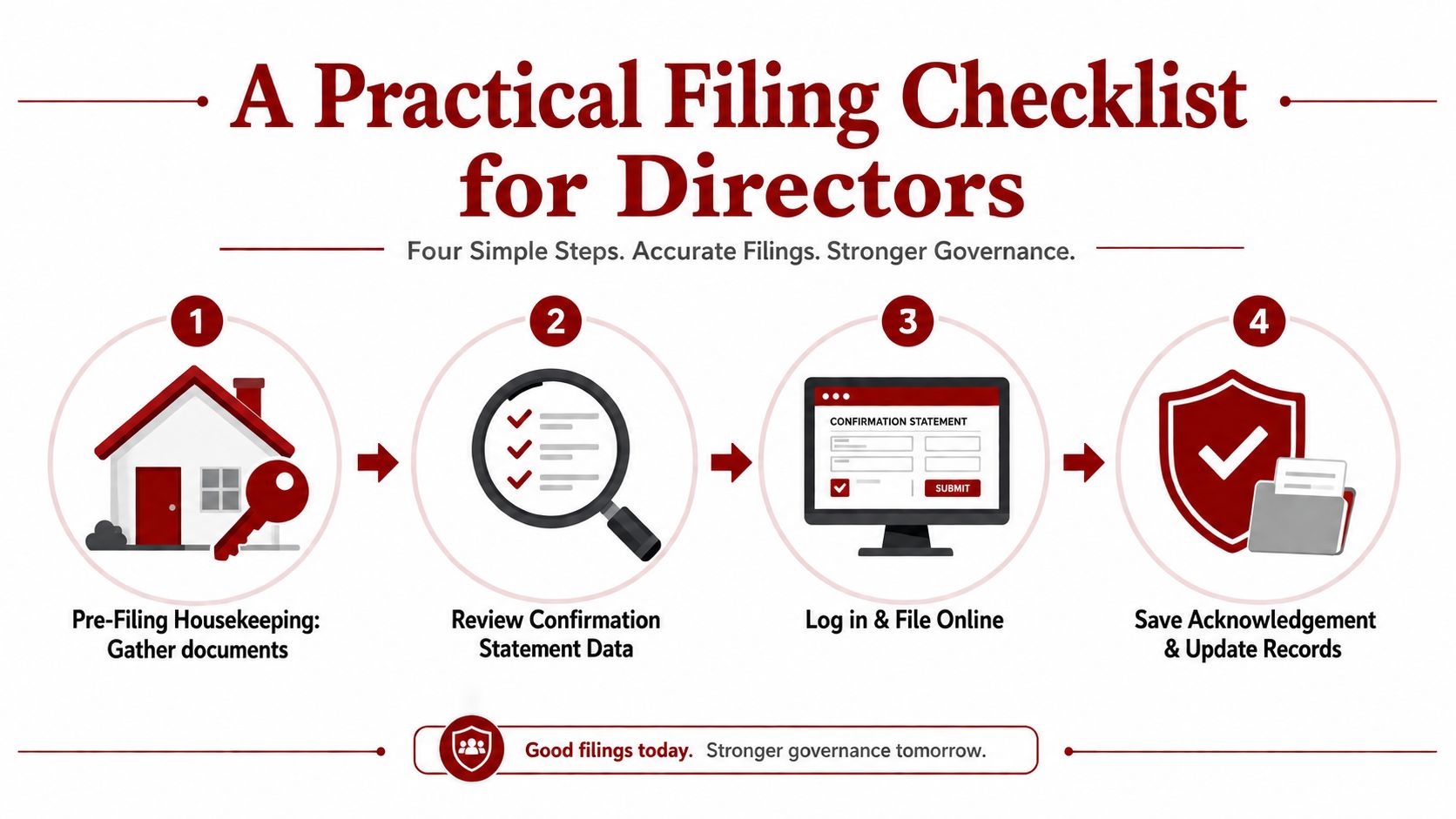
The cleanest way to file a confirmation statement is to treat it as a two-stage job. First, make sure the register is right. Then file the statement that confirms it. That order saves most of the stress.
Start with housekeeping before you open CS01
Before filing, review the company's current Companies House record and compare it with your own records. If anything has changed, file the relevant update first. That usually means separate filings for director appointments or resignations, PSC changes, shareholder changes, share capital updates, SIC code revisions, or a new registered office.
Practical rule: don't use the confirmation statement to patch missing updates. Fix the underlying record first.
Once the register is clean, log in to Companies House WebFiling or use approved third-party software. WebFiling is the straightforward route for a simple company, while software can help where the company needs reminders or a wider filing workflow. Paper filing is still possible, but it carries the higher fee and is slower to process.
What the filing day usually looks like
A sensible filing routine is short and deliberate:
- Check the current register and match it against your internal records.
- File any separate changes first, so the public record is already updated.
- Open the CS01, review the details, and confirm they're correct.
- Submit and save the acknowledgement with your company records.
The filing itself is usually quick once the underlying information is sorted. For most straightforward companies, it becomes a neat admin task rather than a project. The point is not speed for its own sake, it's accuracy.
What the fee is paying for
The filing fee is the cost of confirming the record with Companies House. It's not payment for changing the register, because changes should already have been dealt with separately. As noted in the earlier guidance, the statement must be delivered at least every 12 months with a 14-day filing window after the review period, and the fee is £50 online or £110 by paper CS01 (Inform Direct guidance).
Common Mistakes and the Consequences of Getting It Wrong
The most common confirmation statement mistake is not the filing itself, it's the order of operations. A director may submit the CS01 before the company's record has been updated, which leaves Companies House showing old information even though a filing has been made. That creates a compliance problem, because the register still does not match the company's actual details.
A simple way to avoid that error is to treat the register like a filing cabinet with labels. If the labels have changed, you update the labels first, then you confirm the file list. The CS01 does not correct the underlying record for you.
Four errors that cause avoidable trouble
- Filing too early: the statement is sent before director, shareholder, PSC, or registered office changes have been recorded.
- Missing the window: the 14-day filing period after the review period passes, which can lead to enforcement action including strike-off.
- Using the wrong form in your head: treating CS01 as if it updates capital or PSC details when those updates need their own filings first.
- Assuming dormant companies are exempt: they aren't, every UK company still needs the annual filing.
The risk goes beyond the fee. A missed confirmation statement can lead to penalties in some guidance, and if the filing is ignored for long enough it can also move the company towards strike-off. Directors should not treat it as a quick admin tick-box when the public register is still wrong.
A stronger control habit helps here, especially for teams that handle filings in a set sequence. master document quality control is a useful reference point, because the same discipline applies here, keep one current source of truth, check it before you submit, and do not rely on memory for regulated records.
The safest habit is to separate “update the register” from “confirm the register”. Those are two different actions.
A final mistake is assuming this filing is only for active companies. It is not. The filing cycle still applies to dormant and non-trading companies, so silence in the bank account does not remove the legal duty to file.
If you are deciding whether to handle recurring compliance in-house or ask for support, how to choose an accountant is a practical place to start. Some directors only need help with accounts, while others want help with accounts and repeat filings like this one. Action Accountants Limited also provides company secretarial support as part of a wider accounting and compliance service, which can be useful when you want one contact point for filings and records.
Building the Annual Rhythm and When to Bring in Support
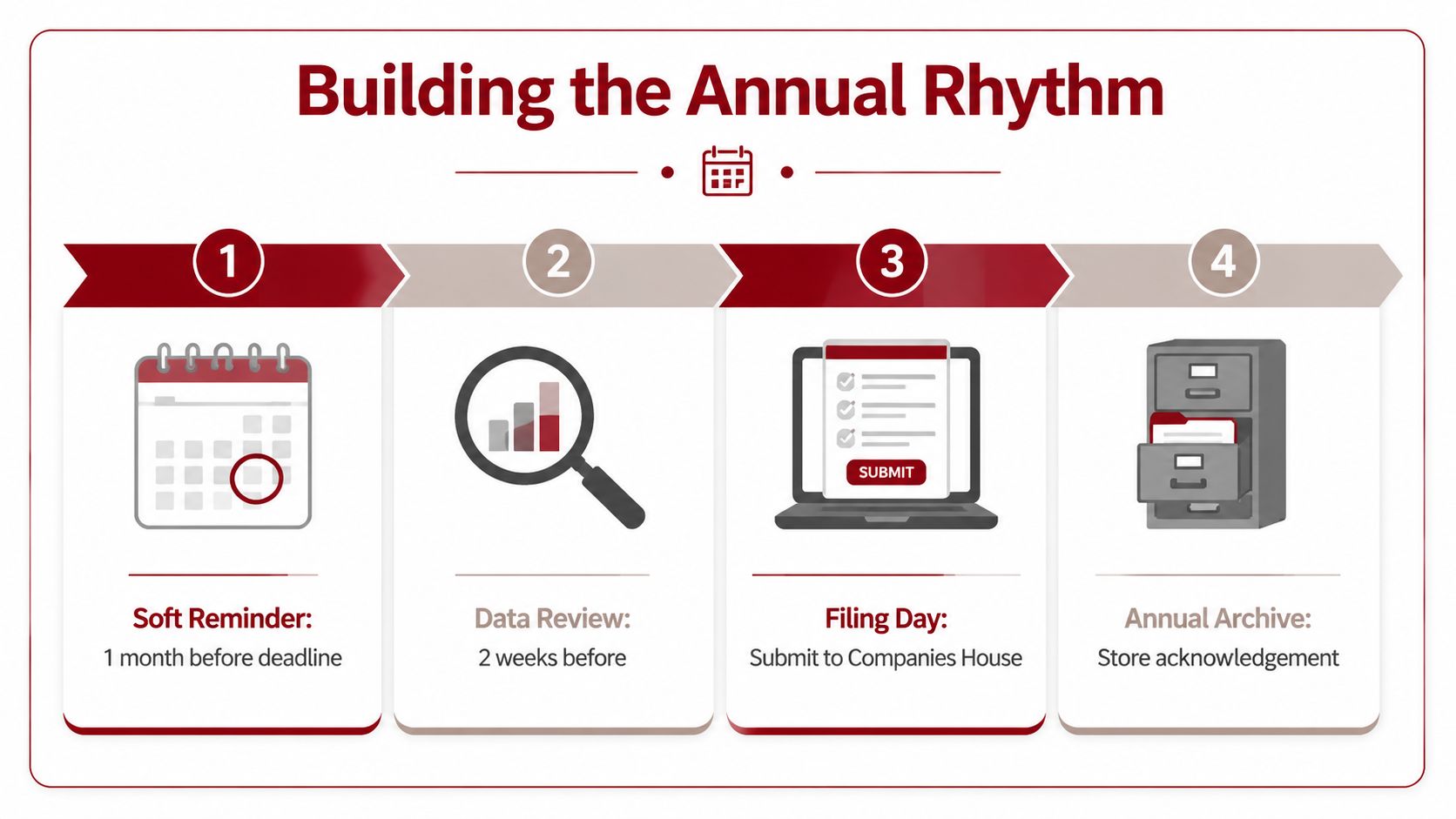
The easiest way to stay on top of the confirmation statement is to turn it into a small annual rhythm instead of a once-a-year scramble. Keep the confirmation date in the diary, check the company record before the window opens, file any separate updates first, then submit the CS01 inside the short filing period. After that, save the acknowledgement and move on.
When outside help starts to make sense
Many founders can handle a simple confirmation statement themselves. The balance changes when the company structure gets more complex, when there are multiple filings to coordinate, or when the director just doesn't want the compliance task sitting in their head for another year.
That's where company secretarial support becomes useful. How to choose an accountant is a sensible read if you're deciding whether the right support should cover only accounts, or accounts plus recurring compliance tasks like this one. Action Accountants Limited also provides company secretarial support as part of a wider accounting and compliance service, which can be useful when you want one contact point for filings, records, and year-end work.
Companies House guidance confirms that updates to directors, PSCs, shareholders or the registered office must be filed separately before the CS01, with the statement due within 14 days after the review period, so timing errors and missed changes can compound quickly if left unmanaged (1st Formations guidance).
The best next step is simple. Check your company's confirmation date today, make sure the register is up to date, and decide whether you're filing in-house or handing the compliance routine over to a professional. If you'd rather have a calm, fixed process for this and the rest of your recurring filings, visit Action Accountants Limited and ask about company secretarial support that fits your company's annual cycle.