

How to Start Construction Business: UK Guide 2026
Action Accountants •20 July 2026
A lot of construction firms start the same way. A good tradesperson picks up weekend jobs, cash starts coming in, and the next step feels obvious. Then the first real problems show up. CIS gets handled wrongly, VAT is ignored until turnover catches up, a customer pays late, or an insurer refuses a claim because the policy does not match the work being done.
That is the point where a side job becomes a business, or a mess.
Knowing the trade is only part of the job. Running a construction business in the UK means setting up the right structure, pricing work with overhead and tax in mind, keeping records that stand up to HMRC scrutiny, and making sure insurance, contracts, and subcontractor status are right before a problem lands on your desk. I have seen profitable firms lose ground in their first year because they treated admin as something to sort out later.
This guide focuses on the parts generic startup advice usually misses. It covers the financial setup, compliance points, and commercial decisions that affect cash flow from day one, especially CIS, VAT, insurance, and how you take work on. If you are still deciding between trading in your own name or setting up a company, this guide to limited company vs sole trader for UK business owners will help you choose the structure that fits your risk, tax position, and plans.
Table of Contents
- Laying the Foundations Your Business Model and Plan
- Making It Official Company Formation and Financial Setup
- Getting Covered Insurance Licences and Compliance
- Winning Work Pricing Bids and Securing Contracts
- Building Your Team Hiring and Managing Subcontractors
- Your First Year Blueprint and Key Milestones
Laying the Foundations Your Business Model and Plan
It usually starts the same way. A good tradesperson finishes a few private jobs, gets recommended, says yes to whatever comes in, and ends up running three different types of work for three different types of client. The diary looks full. The bank balance often tells a different story.
Construction is a crowded market, as noted earlier in the article, so vague positioning costs you work and margin. If you cannot explain clearly what you do, for whom, and at what price point, clients compare you on price alone. That is where early businesses get trapped.
Choose the work before the work chooses you
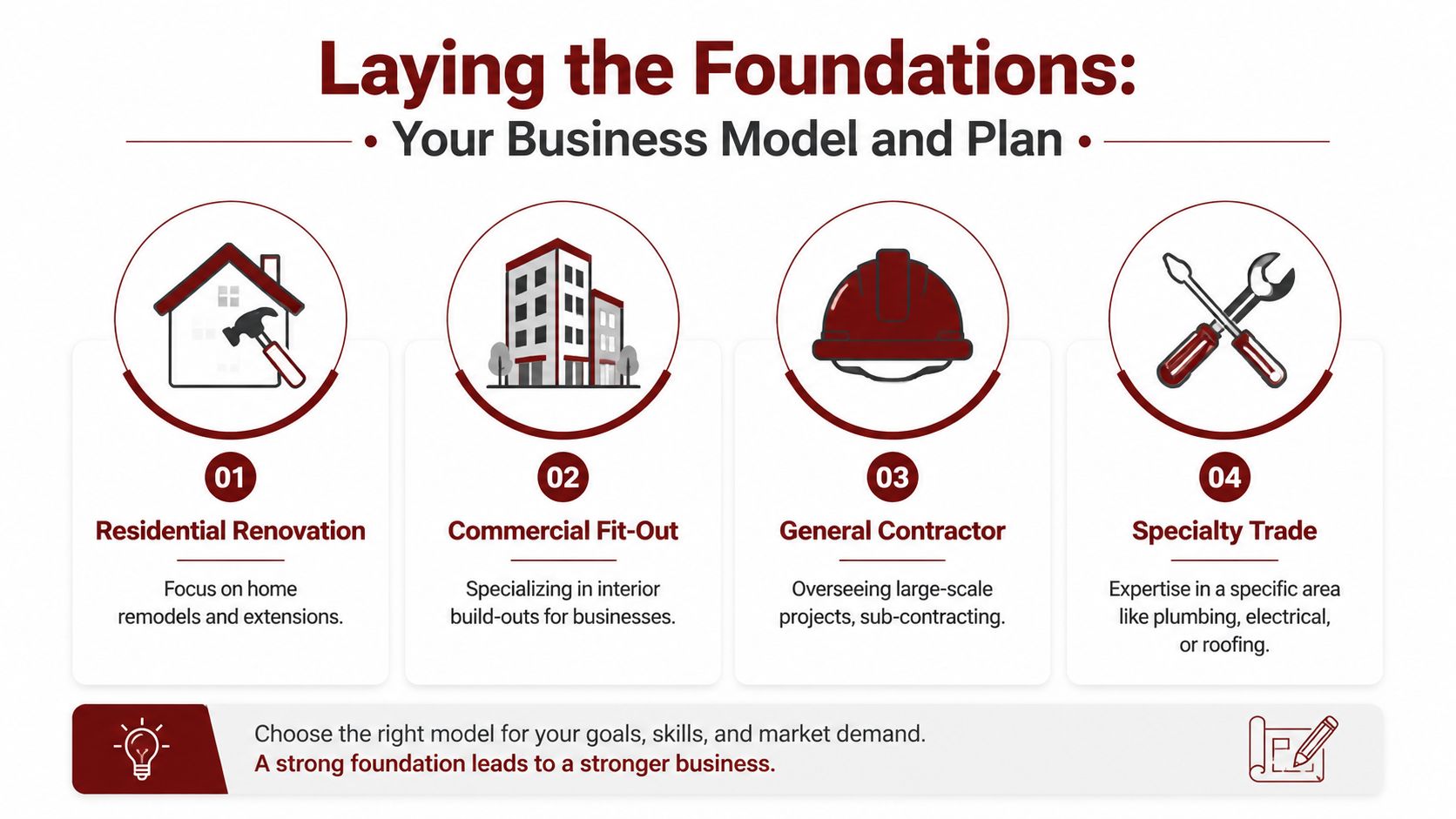
The first planning job is deciding what kind of business you are building. That means more than picking a trade. It means choosing the type of work, the type of client, and the level of operational complexity you can handle without losing control of cash flow.
| Business model | Works well when | Usually goes wrong when |
|---|---|---|
| Residential renovation | You are good with homeowners, changes to scope, and finish quality | You fail to price project management, client updates, and snagging time |
| Commercial fit-out | You can handle tight programmes, paperwork, and contractor expectations | You win larger jobs before your admin and cash reserves are ready |
| General contractor | You are strong on sequencing trades, managing subcontractors, and controlling site progress | You accept fixed-price risk without enough margin or contract discipline |
| Specialty trade | You have a clear technical skill and a service you can repeat profitably | You rely too heavily on one contractor or one source of referrals |
I have seen plenty of firms struggle because they copied a model that looked busy rather than one that suited their strengths. A plasterer moving into high-end domestic refurbishments needs strong customer handling and tight variation control. A groundworker bidding for developer packages needs capital, programme discipline, and enough back-office support to deal with applications, retentions, and disputes. Those are different businesses.
Start narrower than feels comfortable. It is easier to expand a clear offer than to rescue a business that has become a collection of random jobs.
Practical rule: Pick one core service, one main customer type, and one geographic area. Review that choice after six to twelve months, once you have real numbers.
Pick the right structure for the life you want
Your business model and legal structure need to fit together. A sole trader setup can work well for a one-person operation testing demand, especially in domestic work with low overhead and straightforward invoicing. A limited company often suits businesses taking on larger contracts, hiring staff, financing vehicles or equipment, or dealing with clients who expect a company structure.
The mistake is choosing based on image.
The right choice depends on liability, admin, tax treatment, how you plan to take money out, and whether you are building a job for yourself or a business that will employ other people. If you are still weighing that up, this guide on choosing an accountant for a construction business will help you ask the right questions before you set anything up.
If you want a side-by-side breakdown, this explanation of limited company vs sole trader is worth reading before you register anything.
Write a plan you will actually use
A useful plan for a new construction business is short, commercial, and reviewed regularly. It does not need investor language. It needs numbers you can price from and decisions you can stick to.
Set out the basics clearly:
- Your offer: The exact work you want to sell.
- Your customer: Homeowners, landlords, developers, principal contractors, or commercial occupiers.
- Your pricing method: Day rate, fixed quote, measured work, or staged pricing.
- Your target gross margin: A percentage based on real costs, not instinct.
- Your lead source: Referrals, local builders, online enquiries, tenders, or repeat commercial clients.
- Your cash cycle: How long you fund labour and materials before payment arrives.
Then answer one question many new owners avoid. What work will you refuse?
That line matters. Poor-fit jobs create most of the early damage. The drawings are incomplete, the client wants a bargain, the specification is loose, and payment terms are unclear. The job gets accepted anyway because turnover feels like progress. A month later, the labour overruns, the extras are disputed, and the profit was never there.
A business plan is useful when it stops you taking bad work, not when it sits in a folder.
If you want to build a construction business that stays profitable, define the model first. Everything else gets easier once the offer is clear.
Making It Official Company Formation and Financial Setup
Friday afternoon, the work is booked in, materials need paying for on Monday, and the contractor asks for your company number, UTR, bank details, and invoice in the right name. That is the point where a casual setup starts costing money.

Get the trading structure right before the first invoice
I see the same early mistake every year. A builder starts taking work, uses a personal account, buys materials on one card, invoices under a trading name that does not match the tax registration, then tries to tidy it up later. Cleanup costs more than doing it properly at the start.
Choose the structure that fits the risk, profit level, and type of clients you expect to work with. Sole trader can be fine for a simple start. A limited company often makes more sense once profits rise, liability exposure grows, or larger contractors expect to deal with a company. If you need help weighing that up, this guide on limited company vs sole trader for UK trades businesses sets out the practical differences.
Once you choose, make every record match that structure. The legal name on quotes, invoices, bank account, contracts, and tax registrations should be consistent. If it is not, bookkeeping gets messy and payment queries start.
Sort these basics early:
- A dedicated business bank account. Do not run business income and personal spending through the same account.
- Bookkeeping software from day one. Waiting until year end usually means missed expenses, weak records, and avoidable accountant fees.
- A filing system for quotes, invoices, receipts, supplier bills, CIS statements, and signed contracts.
- An invoice template with the correct legal name, address, payment terms, and VAT treatment.
If you're not sure what support matters at this stage, choosing the right accountant for your business early usually saves more stress than trying to untangle everything later.
Register for the taxes that affect cash flow
Construction firms get into trouble when registrations are done late or done without thinking through the knock-on effect on pricing and payment timing.
The usual registrations are straightforward on paper:
- Self Assessment or Corporation Tax, depending on your structure
- CIS, if you work under contractors, pay subcontractors, or both
- VAT, if turnover or contract type makes registration the right move
- PAYE, if you take on employees
The judgment sits in the timing.
VAT is the best example. Register too late and you can end up owing output VAT on money already spent. Register too early, price work badly, and your quotes stop competing with smaller non-registered firms. For subcontractors working for VAT-registered contractors, the domestic reverse charge adds another layer. You may issue invoices with no VAT to collect, while still paying VAT on materials and overheads. On paper, turnover looks healthy. In the bank, cash can feel tight very quickly.
CIS causes a different problem. New owners often treat it as an admin task, but it changes how money reaches the business. If deductions are taken from your labour element, your gross sales figure and your actual cash received are not the same thing. If the bookkeeping is poor, those deductions get missed or claimed late, and the tax account never ties back properly.
After you've got the legal side straight, this short video gives a useful overview of the registration side of getting started:
Contract wording can create tax problems before the work starts
One of the persistent issues in UK construction is subcontractors being treated inconsistently because the paperwork does not match the actual working arrangement. I have seen firms registered correctly for CIS and still run into avoidable tax and cash flow trouble because the contract reads more like employment than an independent business-to-business engagement.
Check the agreement before the first day on site.
Focus on the points that affect both payment and status:
- Scope of work. The contract should describe a defined service, not a vague labour-only role.
- Control. If the other party dictates hours, methods, and day-to-day supervision in a way that looks like employment, risk increases.
- Substitution. If the contract includes a substitution clause, it should reflect what could happen in practice.
- Materials and equipment. Make clear who supplies what.
- Payment terms. Confirm valuation dates, retention, deduction rules, and how variations are approved.
- Business evidence. Your own insurance, tools, branding, and client base all help show you are trading as a business.
Poor contract wording does not just create a tax argument with HMRC. It also delays payment, confuses deductions, and weakens your position if there is a dispute over extras or retention.
Read every contract. Match it to the reality of the job. If the wording is off, fix it before work starts.
Getting Covered Insurance Licences and Compliance
A common early mistake looks like this. The first decent job comes in, the client asks for insurance documents, RAMS, and proof of the right registrations, and the business owner realises the quote was built without the full cost of being compliant. Margin disappears before the work starts.
Insurance usually causes the first shock. Tools, fuel, accountancy fees, and a van deposit tend to make it into the startup budget. Proper cover often does not. Recent pricing pressure matters here. Startups' guide to starting a construction company noted that a 35% surge in UK construction insurance premiums during 2024-2025 established a higher cost base for new firms, which is one reason many startups now need far more working capital than older guides suggest.

Insurance is not an admin task
It affects whether you can tender, whether you can get on site, and whether one claim wipes out a year of profit.
Buy cover for the work you do. If you take structural work, heat works, design input, high-risk refurbishments, or use bona fide subcontractors, tell the broker plainly. I have seen firms save a few hundred pounds on premium and then find the policy wording does not match the job that created the claim. That is a bad time to discover an exclusion.
For many construction businesses, the core policies include:
- Public liability insurance: Covers third-party injury or damage claims.
- Employers' liability insurance: Usually required if you employ staff.
- Contract works cover: Protects work in progress where damage or loss would leave you paying twice.
- Tools, plant, and equipment cover: Matters if theft would stop the job or delay the next one.
- Professional indemnity cover: Relevant if you design, specify, calculate, or advise.
Check the policy schedule against your quotations and contracts. If one says you install steel, manage roofing works, or arrange demolition, and the other does not, fix it before work starts.
Licences and registrations can block payment as well as site access
Clients often ask for compliance documents before they release an order, approve a subcontractor, or permit a start on site. Domestic clients may be looser. Main contractors and commercial clients usually are not.
The exact list depends on your trade, but new firms commonly need to sort out items such as waste carrier registration, CSCS or other trade cards, qualifications for specialist work, and evidence of asbestos awareness or other site-specific training where relevant. Keep copies in one digital folder so they are easy to send.
A simple compliance file should include:
| Document | Why it matters |
|---|---|
| Insurance schedule | Shows your level of cover and policy dates |
| Trade cards and qualifications | Supports site access and pre-qualification checks |
| Risk assessments and method statements | Helps clients see how the work will be carried out safely |
| Waste and environmental paperwork | Covers disposal, transfer, and site conduct requirements |
CIS belongs in this file too. Poor setup causes avoidable payment delays, deduction errors, and HMRC problems later. If you still need to sort that out, this guide to registering for CIS correctly explains the process.
One warning here. Do not assume every worker should be treated the same way under CIS. Misclassifying labour, especially where the arrangement looks more like employment, creates tax risk quickly.
Health and safety protects cash flow
Founders often treat health and safety as paperwork for someone else. Clients do not see it that way, and neither do insurers.
Poor site controls lead to rework, delays, damaged materials, incident reporting, and arguments over who was responsible. Good systems protect people first, but they also protect margin. Even a small contractor should have workable processes for inductions, PPE rules, accident reporting, supervision, and basic risk assessment. The standard can be proportionate to the size of the jobs. It still has to exist and it still has to be followed.
A business with weak compliance may finish a few jobs. It usually struggles to win better clients, satisfy contractor checks, or keep profits once claims, delays, and payment friction start to build.
Winning Work Pricing Bids and Securing Contracts
A surprising number of new construction businesses don't lose money because they can't get work. They lose money because they win the wrong work at the wrong price.
That usually starts with labour-only thinking. You know what you need to earn per day, so you multiply that by the number of days, add materials, and send the quote. It feels quick. It also ignores supervision time, collection time, waste, call-backs, fuel, small consumables, estimating time, and the cost of jobs that slip.
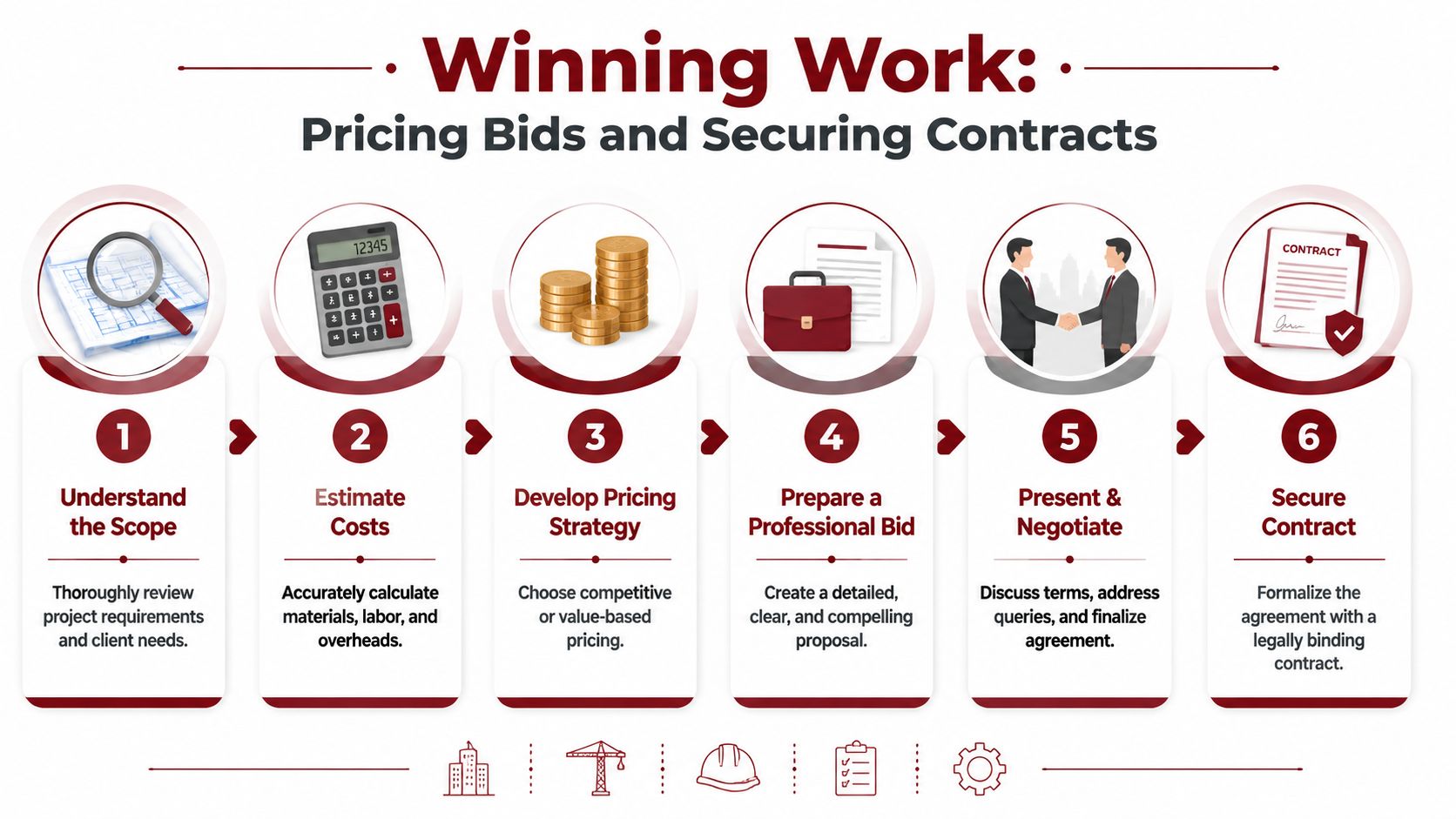
Price the whole job not just the labour
A useful quote has to recover more than wages. It must recover overhead and still leave profit after the usual site friction.
Build your pricing around these cost buckets:
- Direct labour: Your own time and anyone else physically delivering the work.
- Materials: Including wastage, collection, delivery, and price movement risk.
- Plant and tools: Hire, maintenance, replacements, and specialist equipment.
- Overheads: Insurance, software, phone, bookkeeping, vehicles, storage, admin.
- Profit: The amount left after the work is fully paid for.
If you skip overhead, you don't have a business. You have turnover.
Price for the job you're actually going to deliver, not the smooth version of it that exists in your head before site starts.
Make your quote easy to buy
Clients don't only compare price. They compare confidence.
A strong quote is easy to read and hard to misunderstand. It should define the scope, exclusions, assumptions, payment stages, start expectations, and how variations are handled. If you're tendering for commercial work, presentation matters even more because buyers may compare several submissions side by side.
A practical quote should include:
- Clear description of works
- What is excluded
- Assumptions based on drawings or site conditions
- Payment schedule
- Validity period
- Lead time and estimated duration
Many small firms experience rapid improvement. They don't need fancy branding. They need a professional document with fewer grey areas.
If you want a strong framework for paperwork that supports the job rather than complicates it, this guide on creating business contracts that protect your business is worth keeping close.
Use written contracts on every job
Even small domestic jobs need written terms. That doesn't mean every kitchen install needs a huge legal pack. It means both sides should know what's being built, what happens if the client changes the brief, when money is due, and what counts as completion.
Poor contracts usually fail in the same places:
- Vague scope: The client assumes more than you priced.
- Loose variation process: Changes get agreed on site and disputed later.
- Unclear stage payments: Cash gets delayed because nothing is tied to milestones.
- No late payment wording: You end up negotiating after the invoice is already overdue.
For anyone learning how to start a construction business, the key sales lesson is simple. Winning work is not the same as winning profitable work. Good quoting and good contracts filter out a lot of future pain.
Building Your Team Hiring and Managing Subcontractors
A common turning point comes six months in. The phone is ringing, two jobs are live, another wants to start next Monday, and the labour that got you this far is no longer enough. That is usually where margins start slipping. Work gets sold before the right people are lined up, subcontractors are brought in too quickly, and nobody checks whether the setup works under CIS.
Labour is not just a staffing issue. It affects delivery, tax, cash flow, and risk.
Decide who should be employee and who should be subcontractor
Many new firms default to subcontractors because it feels flexible and avoids the commitment of payroll. Sometimes that is the right call. Sometimes it creates a bigger problem later, especially if the person works only for you, uses your kit, follows your hours, and is managed like a member of staff.
That is where founders get caught on status.
If someone looks and behaves like an employee, calling them self-employed does not make it true. HMRC can challenge the treatment, and the cost usually lands after the money has already been spent. I have seen firms lose time and cash fixing this after a compliance check, when the original saving was small.
Use this test:
| Option | Better fit when | Main pressure point |
|---|---|---|
| Employee | You need regular availability, direct control, and continuity across jobs | Payroll, pensions, holiday pay, and wider employment duties |
| Subcontractor | Work is project-based, specialist, or genuinely independent | CIS deductions, verification, and status risk |
If you are unsure, get the status question sorted before the first payment. It is much easier to set this up correctly than to unwind a bad arrangement months later.
Good subcontractors judge your business quickly
The better tradespeople have options. They can tell within days whether a small contractor is organised, funded properly, and worth sticking with.
Late payment is the fastest way to damage your reputation. Poor scheduling comes next. If workers arrive to find missing materials, unclear instructions, or another trade in the way, you are paying for lost time whether you admit it or not.
Retention usually improves when you keep a few basics tight:
- Pay on the agreed date
- Confirm scope before work starts
- Give clear site information and access details
- Set quality expectations early
- Have materials and plant ready when promised
This is simple management, but it has a direct financial effect. Better subcontractors reduce rework, protect deadlines, and are more likely to return when the next project starts.
Run CIS properly from day one
If your business acts as a contractor under the Construction Industry Scheme, the admin cannot be treated as an afterthought. Verify subcontractors with HMRC before first payment. Use the correct deduction rate. Keep records that match the invoices, payment dates, and statements issued.
The firms that struggle with CIS usually make the same mistakes. They pay first and sort the paperwork later. They guess the deduction. They assume every worker is self-employed because that is how the trade has always done it.
A workable process looks like this:
- Verify the subcontractor before paying them
- Agree rates, scope, and payment terms in writing
- Collect the invoice and check it against the job
- Apply the correct CIS treatment
- Issue payment and the deduction statement promptly
- File and reconcile the records each month
Do not miss the status point here. CIS registration does not prove someone is correctly treated as self-employed. That misunderstanding causes a lot of trouble.
Vet properly before you hand over work
A rushed hire often becomes an expensive fix. Basic checks are usually enough, but they need to happen before the person is on site.
Ask for references. Review previous work. Check right-to-work position where relevant. Confirm public liability cover if the arrangement requires it. Make sure the name on the invoice matches the person or business you are engaging. If they are a limited company, contract with the company. If they are a sole trader, make that clear in the paperwork.
Small firms do not need a large HR function. They do need a repeatable process that stands up if there is a dispute, an accident, or an HMRC query.
Growth usually breaks first at the labour system. Firms that stay profitable are the ones that treat hiring, subcontractor control, and CIS admin as part of the job, not back-office tidying for later.
Your First Year Blueprint and Key Milestones
Six months in, a lot of new construction firms look busy and still run short of cash. The usual cause is not lack of work. It is weak control over pricing, paperwork, VAT, tax, and payment terms.
Year one needs a simple target. Stay compliant, protect cash, and learn which jobs make money.
The first ninety days
The opening quarter sets the pattern for everything that follows. If the basics are loose here, the problems usually show up later as unpaid VAT, missing CIS records, underpriced work, or insurance gaps discovered after a claim.
Get these points in place early:
- Register the business on the correct basis: Your legal structure, tax setup, and trading name should match the way you operate.
- Open a dedicated business bank account: Personal spending mixed with job money makes bookkeeping, VAT checks, and tax planning harder than they need to be.
- Set up bookkeeping from day one: Record sales, costs, mileage, materials, labour, and drawings properly from the start.
- Confirm insurance is active before work starts: A quote is not cover. Check the policy schedule, limits, exclusions, and start date.
- Standardise your paperwork: Use fixed templates for quotes, invoices, variation approvals, subcontractor details, and basic contract terms.
One more point matters in construction more than in many other trades. Keep proof for every decision that affects tax or payment. If HMRC asks why VAT was treated a certain way, or why a worker was paid under one arrangement rather than another, memory is useless. Records win.
The habits that keep you in business
Routine keeps a small contractor steady. Review your bank position every week. Check which invoices are due in, which supplier bills are due out, and what tax money needs to be ringfenced. If cash is tight, find out early. Late discovery usually means using VAT or PAYE money to plug a gap, and that gets expensive fast.
Read every contract before work starts. New firms often focus on the headline price and miss retention clauses, pay-when-paid wording, long payment terms, or scope that is too vague to defend later. A decent job can turn into a poor one if variations are not agreed in writing and billed properly.
Market conditions also matter. As noted earlier, the outlook across UK construction is mixed, with some areas holding up better than others. For a new firm, that usually points to a cautious first-year plan. Take work you can price properly, deliver well, and get paid for on time. Thin-margin residential jobs, rushed tendering, and customers who argue over every variation can keep a business busy while draining cash.
A good first year is measured in control, not noise. Clean books, correct tax treatment, paid invoices, and a clear view of job profitability put you in a far stronger position for year two.
If you're setting up a construction firm and want help with company formation, CIS, VAT, bookkeeping, payroll, or practical tax planning, Action Accountants Limited supports startups, contractors, and subcontractors across London and the wider UK. They understand the compliance traps that catch new construction businesses early and can help you build a cleaner, more profitable setup from the start.