
How to Choose an Accountant: Your 2026 Expert Guide
Action Accountants •19 July 2026
You're probably here because accounting has stopped feeling like an admin task and started feeling like a drag on the business.
Maybe you're a founder doing invoices at night, checking payroll dates in the morning, and worrying that VAT, CIS, Companies House, or your tax return is one missed email away from becoming a problem. Maybe you already have an accountant, but they only appear when a deadline is close. The numbers get filed, but nobody helps you make better decisions.
That's the primary issue. Knowing how to choose an accountant isn't about finding someone to submit forms. It's about finding someone who can keep you compliant and help you grow without creating confusion, delays, or nasty surprises.
Table of Contents
- Your First Step Isn't Finding an Accountant
- Defining Your Needs Before You Start Looking
- How to Find and Shortlist Your Top Candidates
- The Crucial Interview Questions That Reveal Everything
- Understanding Pricing Models and Spotting Red Flags
- Making Your Choice and Ensuring a Smooth Onboarding
Your First Step Isn't Finding an Accountant
The first mistake most business owners make is opening Google too early.
They search “accountant near me” because something hurts. Year-end is close. Receipts are everywhere. Payroll feels risky. A contractor has realised CIS isn't just a deduction on a statement. A landlord has bought a second property and suddenly wants clarity on records, expenses, and tax planning. The search starts in panic, so the decision often ends in compromise.
We've seen this many times. A business owner hires a firm that can “do the basics”, then six months later realises nobody is helping with cash flow, pricing decisions, dividend timing, software setup, or growth planning. Compliance gets done, but the business owner still feels blind.
Your real starting point is your desk
Before you compare accountants, define the job.
Some businesses need a reliable compliance engine. That usually means bookkeeping, VAT returns, payroll, year-end accounts, corporation tax, self assessment, and routine filing support. Other businesses need all of that plus regular commercial input. That might include cash flow forecasting, help choosing the right structure, management reporting, margin analysis, contractor cost control, or forward-looking tax planning.
Those are not the same brief.
Practical rule: If you only ask, “How much do you charge?”, you'll usually end up with a compliance provider. If you ask, “How will you help me make better decisions over the next year?”, you'll quickly see who thinks like an adviser.
A startup founder in London often needs someone who can support formation, early systems, payroll planning, and clean numbers for future funding conversations. A subcontractor may need tight bookkeeping, CIS awareness, and someone who understands how cash can look healthy on paper while still being under pressure in real life. A landlord may need help organising property-specific records and thinking ahead instead of reacting at year-end.
Write a simple role description
Open a document and answer these questions plainly:
- What is hurting right now: missed deadlines, messy books, slow invoicing, no visibility on cash, VAT stress, payroll confusion.
- What must be taken off your plate: daily bookkeeping, chasing records, tax filing, software clean-up.
- What decisions you want help with: taking money out tax-efficiently, hiring, pricing, investing, borrowing, expanding.
- What your business may look like next: more staff, more subcontractors, another property, VAT registration, better reporting.
If numbers have never felt like your first language, this guide to staying financially steady as a business owner is a useful reminder that clarity starts with understanding your own pressure points.
The right accountant becomes much easier to spot once you know whether you need a form-filer, a finance organiser, or a genuine growth partner.
Defining Your Needs Before You Start Looking
At the start of 2024, the UK private sector contained 5.5 million businesses, and 99.2% of them were small businesses. 52% traded without being registered for VAT or PAYE, which tells you something important: the market is full of very different businesses with very different accounting needs, from sole traders wanting basic returns to growing firms needing broader compliance and advisory support, according to the UK business population estimates for 2024.
That's why broad advice like “get a good accountant” doesn't help much. You need someone who fits your stage, your sector, and the way you work.
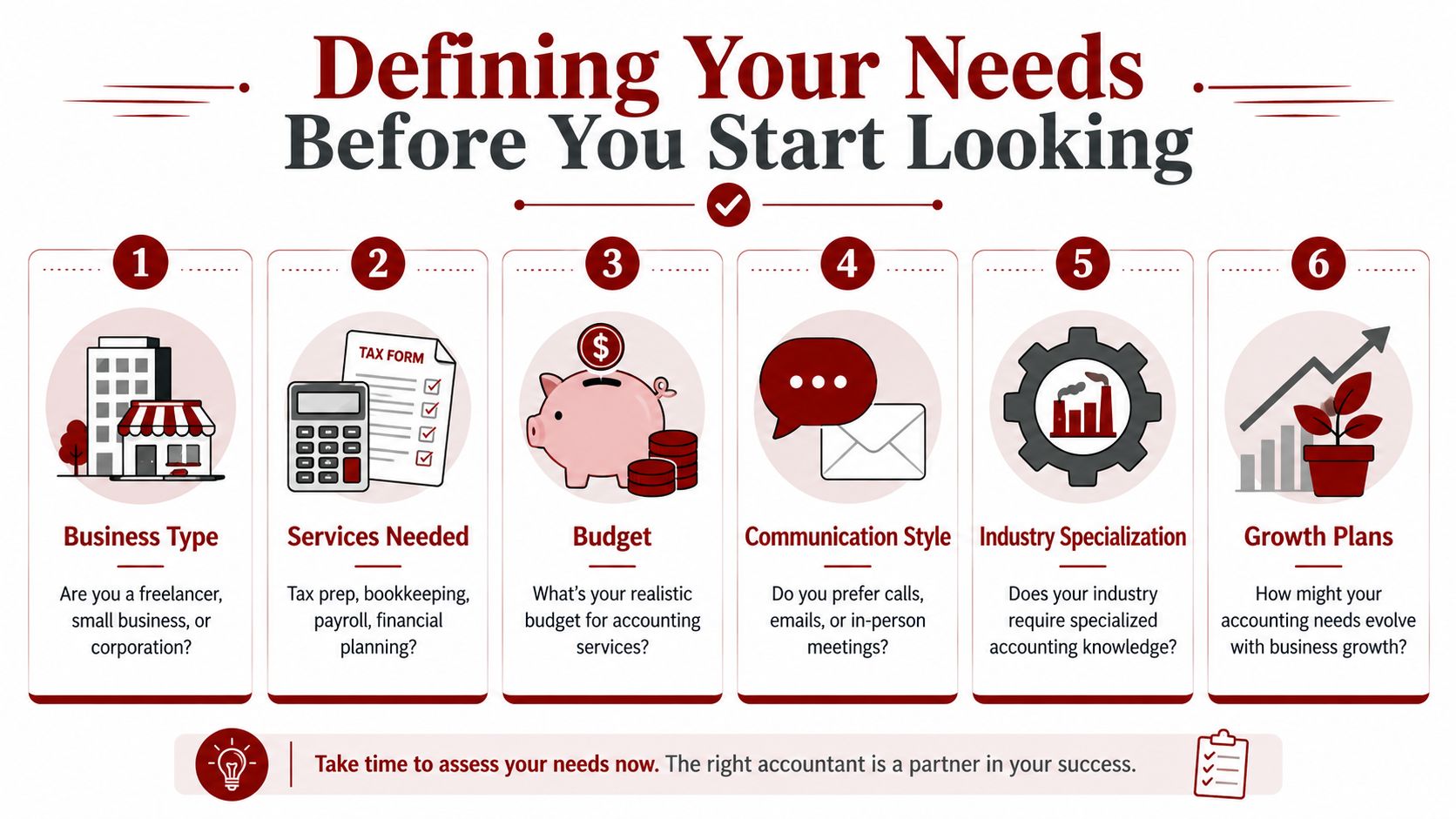
Write the brief before you compare firms
Start with your business type and current structure.
If you're self-employed, your needs may be relatively straightforward today but still benefit from good habits early. If you run a limited company, the accountant should understand the interaction between company accounts, corporation tax, payroll, dividends, and director responsibilities. If you're running multiple activities, such as consulting plus property income, complexity rises quickly.
Then define the service mix.
- Core compliance work: bookkeeping, VAT, payroll, statutory accounts, personal or company tax returns.
- Operational support: management accounts, cash flow reporting, software setup, invoice process design.
- Strategic support: tax planning, structuring advice, growth forecasting, margin analysis, funding readiness.
A lot of business owners also underestimate the value of process. If leads, proposals, and customer follow-up are inconsistent, the finance picture gets distorted too. That's why tools and workflows outside accounting matter. A practical resource like this lead management software guide can help if part of your wider challenge is turning enquiries into predictable revenue.
Separate essential work from growth support
Don't put everything into one bucket. Split your needs into two lists.
Essential now
- Stay compliant: tax returns filed correctly and on time.
- Keep records organised: bookkeeping that doesn't need rescuing every quarter.
- Run payroll properly: especially if you have staff or directors.
Valuable next
- Monthly visibility: reports that show what's happening before year-end.
- Better decisions: help with pricing, cash planning, or timing of tax liabilities.
- Sector-specific guidance: support that reflects how your industry operates.
For example, startups often need more than registration support. They may need realistic projections, cleaner systems, and advice that avoids expensive rework later. Construction businesses need someone who understands CIS in practice, not just in theory. Landlords usually benefit from an accountant who can keep property income, finance costs, and future disposal planning organised from the start.
Think about workflow as well as tax
A common mistake is focusing only on year-end outputs and not on the monthly working relationship.
Ask yourself:
| Area | What to decide before you search |
|---|---|
| Communication | Do you want email, calls, video meetings, or a mix? |
| Speed | Do you need quick answers during the month or only deadline support? |
| Software | Are you already using Xero, QuickBooks, spreadsheets, or nothing formal? |
| Documents | Who uploads records, and how often? |
| Growth | Will your needs expand over the next year? |
If your needs are still fuzzy, it helps to read practical examples of the ways an accountant supports day-to-day operations and growth. This overview of how an accountant can help your small business is a good prompt for building your own shortlist of requirements.
How to Find and Shortlist Your Top Candidates
The best shortlist usually starts offline, not online.
In the UK, 90% of smaller businesses cite a personal recommendation as the most important factor when choosing an accountant. That outranks professional qualifications at 87% and price at 84%, according to AccountingWEB's reporting on how smaller businesses choose accountants. That aligns with what we've seen in practice. Business owners trust accountants who've already proved themselves to someone they know.
Start with people who know how you operate
Ask people whose business model resembles yours, not just people you like.
A restaurant owner may love their accountant, but that doesn't mean the firm is right for a software startup, a subcontractor, or a landlord with a growing portfolio. The recommendation only matters if the accountant has handled similar reporting pressure, similar risks, and similar working rhythms.
Ask better referral questions:
- Who do they work best for: sole traders, companies, contractors, landlords, startups?
- What are they like mid-year: responsive and proactive, or silent until deadlines?
- Do they explain clearly: especially when the issue is messy or time-sensitive?
- Would you hire them again: not just “are they nice?”
Check credentials before you book meetings
A polished website doesn't tell you enough.
Before spending time on calls, verify that the accountant or firm is properly connected to a recognised professional body if they claim membership. The practical route is to look for membership with ICAEW, ACCA, CIMA, or AAT, then cross-check those details through the relevant directory. Xero's guidance on choosing an accountant also recommends interviewing at least three firms, preparing a written summary of your business needs, and checking professional membership and references through proper channels in its UK guide on how to choose an accountant.
A shortlist of three strong candidates is usually enough. Five is manageable. More than that often creates noise instead of clarity.
If cloud bookkeeping is part of your requirement, look beyond logos on a website and check whether the firm operates in a live cloud environment. This explainer on cloud accounting services gives a useful sense of what that support should involve in real life.
Local, national, or online only
There isn't one right answer here. There is only the right fit for your business.
A local North West London firm can be valuable if you want face-to-face meetings, quick understanding of local trading realities, and easier relationship-building. A larger national provider may offer broader teams and wider service lines, but sometimes you lose continuity. A purely online provider can work well if your records are clean, your needs are straightforward, and you're comfortable with a less personal model.
Ask yourself one blunt question. When something goes wrong, do you want a helpdesk, a named contact, or a partner who already understands the background?
For most growing businesses, the ideal shortlist includes firms that look competent on paper and feel commercially aware in conversation. That second part matters more than people think.
The Crucial Interview Questions That Reveal Everything
The interview matters more than the proposal.
You're not just checking whether an accountant is qualified. You're checking how they think, how they communicate, and whether they see your business as a set of filing deadlines or something worth helping to build.
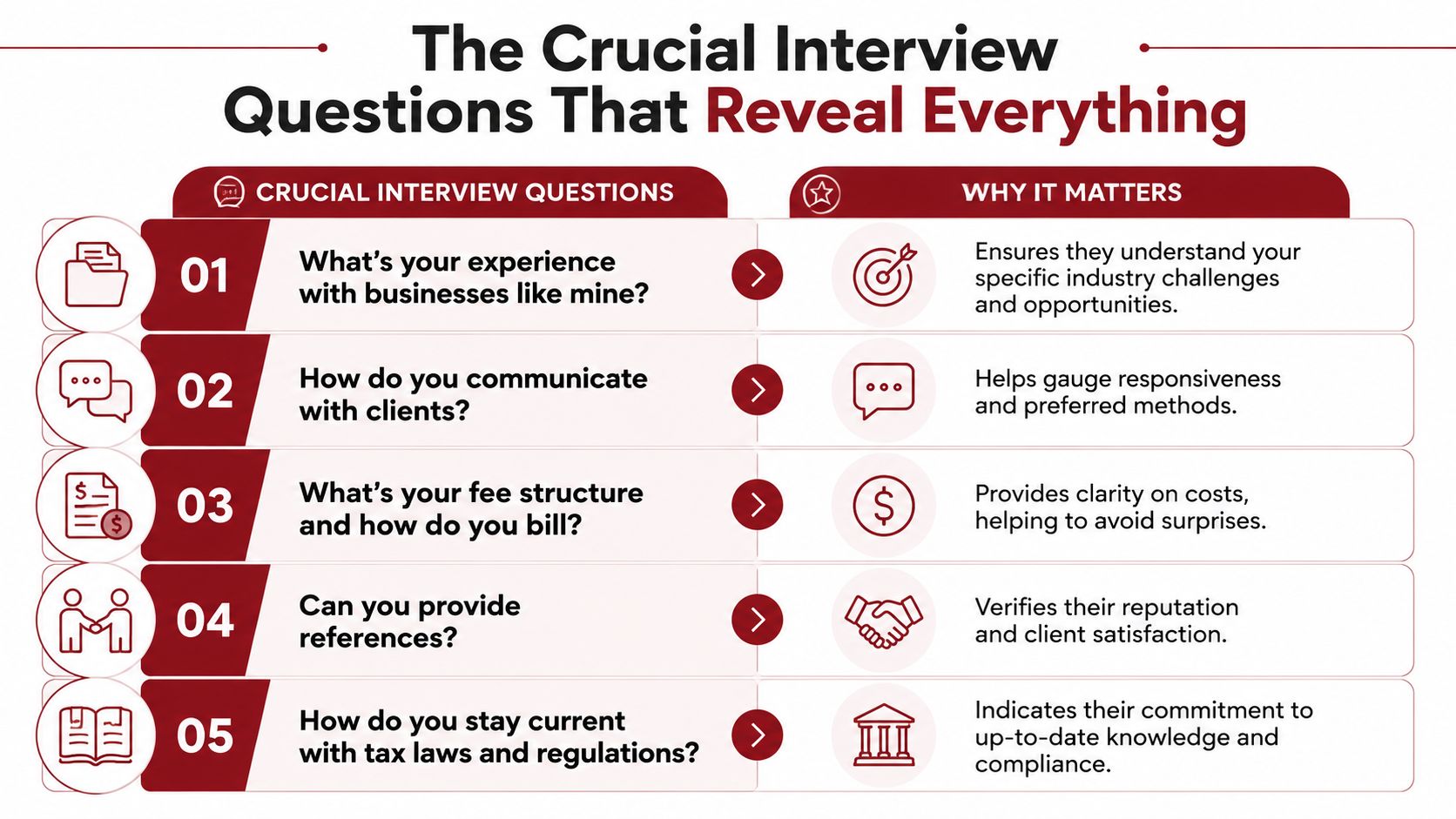
Questions about strategy
Start with the business, not the fee.
Ask questions like:
- What do you notice first about my setup?
- Where do businesses like mine usually lose money or create avoidable tax problems?
- If you took us on, what would you fix in the first few months?
- What do you need from me each month to keep things accurate and useful?
These questions reveal whether the accountant can diagnose, prioritise, and communicate. A strong answer is specific. It may mention cash collection discipline, weak coding in bookkeeping, poor separation of personal and business spending, missing visibility on margins, or software gaps that create rework.
If you're a contractor, ask how they handle CIS, subcontractor records, and the link between project timing and cash pressure. If you're a startup, ask what they'd want in place before you start talking to investors or hiring quickly. If you're a landlord, ask how they keep property records clear enough to support planning rather than year-end reconstruction.
A good accountant should be able to spot likely risks quickly. Not because they know everything about your business on day one, but because they've seen the pattern before.
Questions about who actually handles the work
Many business owners frequently stumble at this point.
A common frustration for SMEs is finding out that the person who sold the relationship isn't the person doing the work. Research cited by Britain Direct says 68% of small businesses report inconsistent communication due to junior staff handling their accounts without adequate oversight, and it recommends asking who does the work and requesting a written service level agreement in its article on how to choose a UK accountant.
Ask directly:
- Who will be my day-to-day contact?
- Who reviews the work before anything is filed?
- What gets done by juniors, and what gets checked by seniors?
- How often will we speak if nothing urgent is happening?
- Can you put team structure and review frequency in writing?
If the answers are vague, that's useful information. If the answers are defensive, that's even more useful.
A practical comparison table can help during interviews:
| Question | Strong sign | Weak sign |
|---|---|---|
| Who handles my work? | Named people and clear roles | “The team will manage it” |
| How often will we speak? | Defined cadence and channels | “Whenever needed” |
| What do you need from me? | Clear workflow and deadlines | No process |
| How do you review work? | Senior oversight explained | Unclear checking steps |
Questions about systems, security, and working style
Technology problems don't look dramatic at first. They show up later as duplicate work, version confusion, missing records, and slow answers.
Ask:
- Which platforms do you work with most often, such as Xero or QuickBooks?
- How do you collect documents and keep them organised?
- How do you handle approval, review, and storage of sensitive records?
- What does a normal month look like in your process?
If document flow is part of your concern, this guide on how to improve document security in accounting is worth reading because security and organisation are closely linked in a modern accounting workflow.
Also ask for real client references, not just testimonials on a website. Then ask those references what the relationship feels like when deadlines, errors, or urgent questions appear.
The right interview should leave you with confidence that the accountant understands your sector, runs an organised process, and won't disappear once the engagement letter is signed.
Understanding Pricing Models and Spotting Red Flags
A startup founder signs with the lowest quote in the pile. Six months later, they are paying extra for bookkeeping fixes, surprise calls, and year-end work they assumed was included. We've seen the same pattern with contractors and landlords. The problem is rarely the headline fee. It is the gap between what was promised, what was needed, and what was priced.

What different fee models really mean
Pricing tells you a lot about how a firm works.
Fixed monthly fees often suit growing businesses, startups, CIS contractors, and landlords with ongoing needs. They give you a predictable cost and make regular contact easier. But fixed fee only works if the scope is properly defined. Ask what is covered: bookkeeping, VAT, payroll, CIS returns, year-end accounts, director tax returns, management reports, and advisory time.
Hourly billing can be reasonable for one-off projects, tax investigations, clean-up work, or specialist advice. It is less comfortable for day-to-day support because small queries start to feel chargeable. That often leads clients to hold back questions they should be asking early.
Value-based pricing usually appears where the accountant is doing more than compliance. It can work well if you want forecasting, tax planning, cash flow support, or help making business decisions. The trade-off is that you need very clear deliverables, otherwise it becomes hard to judge whether you are getting value or buying good sales language.
A common mistake is comparing fees without comparing involvement. A cheaper firm may be pricing basic submissions. A better firm may be pricing regular reviews, earlier warnings, and advice that helps you avoid tax mistakes or cash flow problems. If you are choosing an accountant as a growth partner, not just a filer, that difference matters.
What must be clear in the engagement letter
A proper engagement letter protects both sides and removes assumptions before they become arguments.
It should state:
- Scope of services: exactly what the accountant will and will not do
- Fee structure: fixed, hourly, project-based, and what triggers extra charges
- Timing: filing responsibilities, deadlines, and who provides what information
- Software and records: which systems are used, who owns access, and what happens if you leave
- Meetings and advice: how often you speak and whether proactive support is included
- Points of contact: who handles day-to-day questions and who reviews the work
Unstated assumptions are a common source of hidden costs. We've seen businesses assume payroll included year-end forms, that bookkeeping included correcting old errors, or that “support” meant tax planning calls were part of the package. Those assumptions get expensive fast.
Clear service terms matter outside accounting too. The same principles apply in broader business contract planning, where scope, responsibility, and delivery terms need to be written down properly.
Here's a short video that gives extra context on fee structures and what to look for when comparing providers:
Red flags that usually show up early
Red flags usually appear before you sign.
If an accountant quotes quickly without asking about your business model, records, software, team, deadlines, or growth plans, they are probably pricing a task list. That may be enough if you only want basic filing. It is not enough if you want advice, better reporting, or support through change.
Watch for these signs:
- Vague pricing: unclear wording, missing inclusions, or lots of "from" pricing
- No sector questions: they do not ask about CIS, R&D, funding plans, property income, or how your business operates
- Extra fees buried in the small print: onboarding, payroll amendments, tax planning, and meetings charged separately without clear warning
- Slow replies early on: the sales process is often the best service you will get
- No clear relationship owner: nobody can tell you who is accountable for your work
- Software mismatch: they are uncomfortable with your systems or rely on manual workarounds
- Reactive language: they talk about filing deadlines but say little about planning, forecasting, or helping you make decisions
One warning sign matters more than the rest. If a firm never talks about your future, they are telling you how they see the relationship.
Choose with open eyes. The best value usually comes from clear scope, proactive advice, and sector fit, not the lowest monthly number.
Making Your Choice and Ensuring a Smooth Onboarding
You have narrowed the list, spoken to a few firms, and the prices are close. This is the point where many business owners choose the safest-sounding option, then realise six months later they bought year-end compliance with very little advice.
Choose the firm you want in the room when something changes. A funding round, a CIS issue, a rental purchase, a VAT query, a switch from sole trader to limited company. We've seen good decisions made easier when the accountant already understands the business and speaks up early. We've also seen the cost of picking a firm that only reacts once the deadline is near.
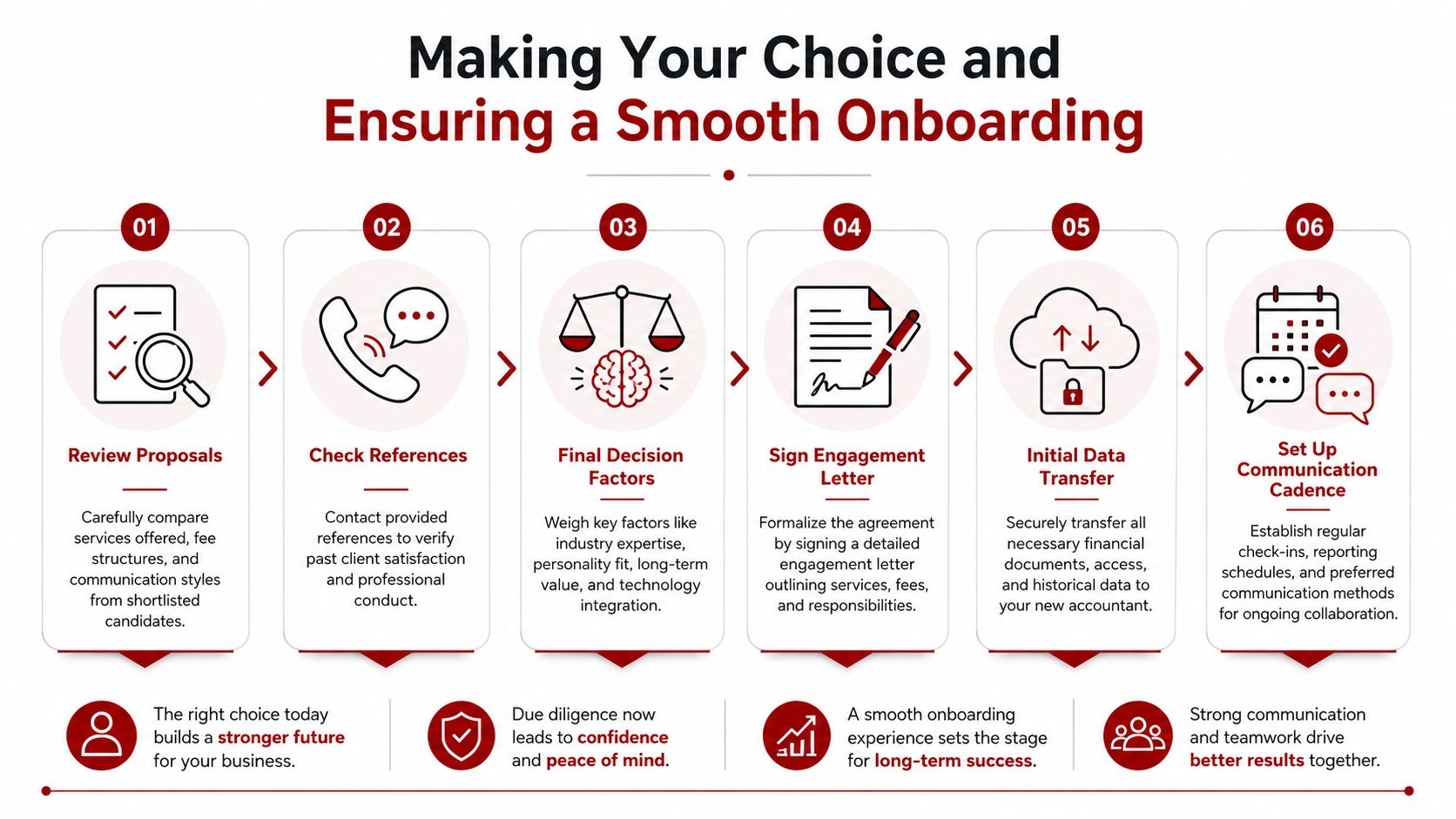
Choose for fit, not just for price
A final scorecard helps if the decision feels close, especially when one quote is lower but the support looks thinner.
| Decision factor | What good looks like |
|---|---|
| Industry fit | They understand the practical issues in your sector, such as CIS deductions, startup cash flow, contractor expenses, or landlord reporting |
| Communication | Replies are clear, timely, and useful |
| Commercial thinking | They talk about decisions, planning, and risks, not only filing dates |
| Systems | They can work properly with your bookkeeping and reporting tools |
| Clarity | Scope, fees, responsibilities, and response times are written down |
If two firms score similarly, choose the one that is more likely to help you make better decisions during the year. That usually creates more value than a small monthly saving.
What a clean onboarding should look like
Onboarding sets the tone. A common mistake is treating it as admin. It is the first test of whether the firm can take control, spot gaps, and get useful information in front of you quickly.
A good handover should cover the basics, but it should also establish how the relationship will work in practice. Who owns the work. What is due soon. Which reports matter. When you will speak. What they need from you to stay proactive rather than chasing records at the last minute.
Your onboarding checklist should include:
- Previous records: past accounts, tax returns, VAT history, payroll records, and key correspondence
- Software access: bookkeeping platform, payroll system, document storage, and banking integrations where relevant
- Authority and permissions: who can approve filings, ask questions, and access reports
- First meeting agenda: immediate deadlines, recurring responsibilities, short-term priorities, and the first business goals
- Communication rhythm: monthly, quarterly, or event-led check-ins
- Early review points: where the new accountant will check for missed reliefs, weak record-keeping, cash flow pressure, or filing risks
The first few months matter. If onboarding is rushed, the service often stays reactive.
A good accountant should leave you clearer on deadlines, numbers, and next steps within weeks. You should know who to contact, what they are handling, what you still need to do, and where they expect to add value beyond compliance.
If you want a proactive accountant who can support compliance and growth, Action Accountants Limited works with startups, SMEs, contractors, landlords, and self-employed professionals across North West London and the wider UK. If you're looking for practical advice, clear communication, and support that goes beyond box-ticking, it's worth starting a conversation.