
Payments on Account Explained: A 2026 UK Guide
Action Accountants •6 June 2026
You file your Self Assessment return, pay what HMRC says you owe, and think the worst is over. Then January lands and the bill looks wrong. It feels too high, too sudden, and badly timed.
That reaction is normal. New sole traders, landlords, and contractors get caught by this every year. The problem usually isn't the tax itself. It's the timing. You thought you were settling the past. HMRC is also asking you to prepay part of the future.
That's what payments on account do. They're not a penalty, and they're not HMRC accusing you of underpaying. They're a standard feature of the UK tax system. But standard doesn't mean painless. If your profits bounce around, or cash is tied up in materials, payroll, repairs, or late-paying clients, they can put real pressure on your business.
If numbers don't come naturally, that pressure gets worse because the paperwork feels harder than it is. This guide is built to make it simpler, in the same practical spirit as this business owner's guide to staying financially steady.
Table of Contents
- The Tax Surprise That Catches Everyone Out
- What Are Payments on Account and Who Must Pay Them
- How to Calculate Your Payments on Account With an Example
- Key Deadlines Penalties and How to Pay
- Smart Strategies to Manage Your Cash Flow
- How and When to Reduce Your Payments on Account
- Let Action Accountants Manage Your Tax with Confidence
The Tax Surprise That Catches Everyone Out
A common version goes like this. You started freelancing, took on a few clients, had a decent first year, and filed your return. You expected a tax bill. You'd braced for that part.
Then you saw a bigger amount due in January than you expected. Not just the tax for the year you'd already finished, but another amount sitting beside it. That second amount is what creates the panic.
For landlords, it often hits after a year of rental income that looked fine on paper but never sat in the bank untouched. Mortgage costs, repairs, agent fees, and general life got there first. For subcontractors, the shock usually arrives when cash is already moving out fast for tools, fuel, labour, or materials.
Payments on account feel scary because they arrive at the exact moment many people think they're done with tax for a while.
The key point is simple. HMRC isn't inventing an extra charge. It is pulling part of next year's tax bill forward. That's why your first serious January under Self Assessment can feel heavy.
What annoys people most isn't the rule. It's the lack of warning. Plenty of taxpayers understand the tax return itself. Far fewer understand why the bill suddenly includes both a catch-up element and an advance element.
That's why I'm blunt about this. If you're self-employed or have untaxed income, tax planning is not something you do after profit appears. You build it into how you run the business. Otherwise, payments on account will keep feeling like an ambush, even when they're completely predictable.
What Are Payments on Account and Who Must Pay Them
The simple version
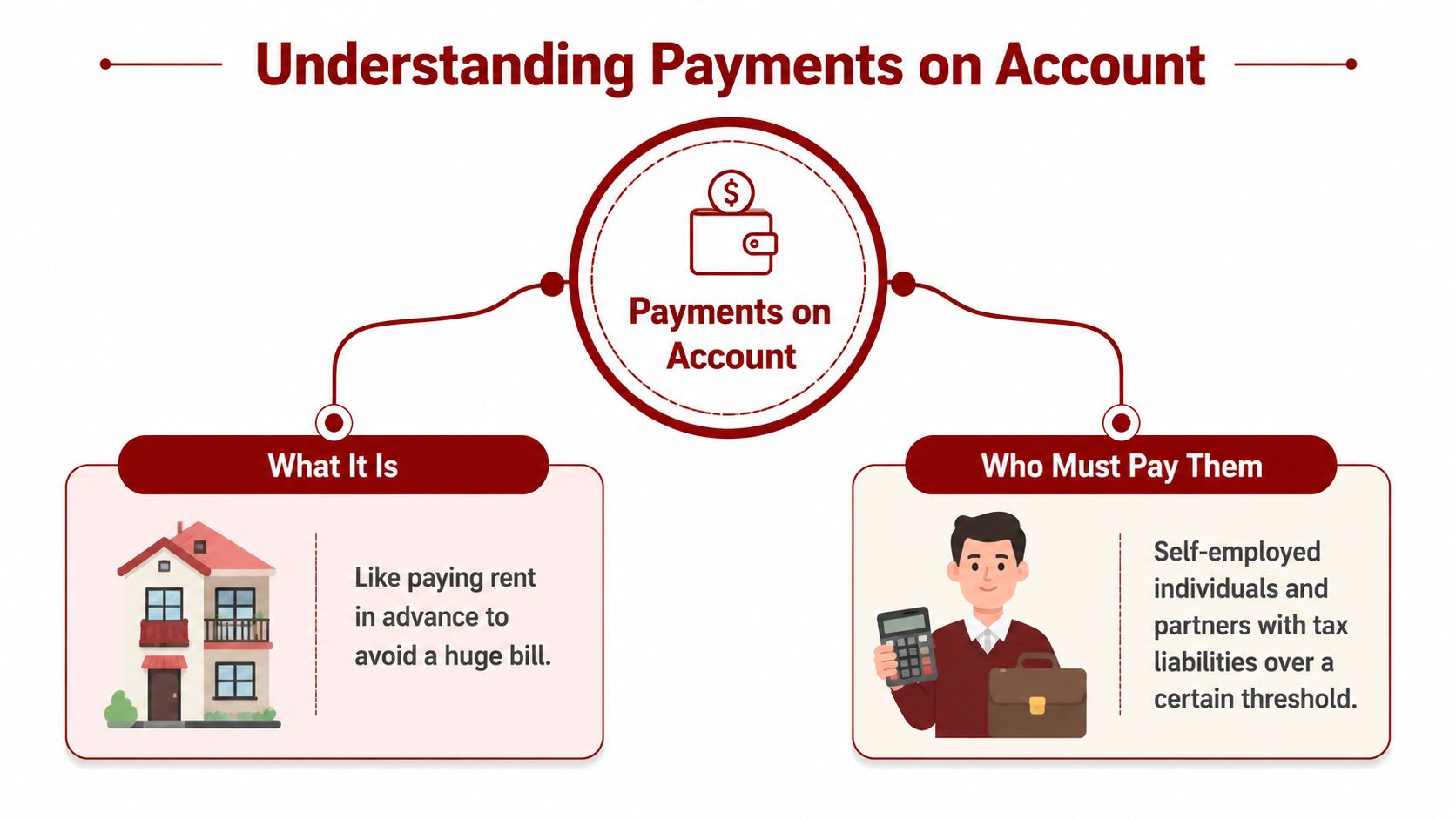
Think of payments on account like paying part of your rent in advance. You're not being charged twice. You're spreading the cost so it doesn't all land later in one lump.
In the UK, HMRC requires payments on account when the previous year's Income Tax bill is over £1,000 and less than 80% of the tax due was collected at source, such as through PAYE. They are advance instalments toward the following year's tax bill, usually split into two equal payments due on 31 January and 31 July. That rule is set out in this HMRC payments on account summary.
That's the mechanic. The practical meaning is this. If HMRC believes your income pattern will broadly continue, it doesn't want to wait until the end of the next tax cycle to collect the whole amount.
Who usually gets caught
The people most likely to deal with payments on account are:
- Sole traders who pay tax through Self Assessment rather than payroll deductions.
- Business partners whose share of profit isn't fully taxed at source.
- Landlords with rental income that creates an Income Tax bill.
- People with mixed income where PAYE doesn't cover most of what they owe.
If most of your tax already comes out through employment income, you may not be affected. If it doesn't, you probably will be once your bill reaches the trigger.
Practical rule: If your income isn't taxed as it comes in, assume HMRC will want money earlier than you'd like.
A lot of small business owners make a basic mistake. They treat tax as a once-a-year admin event. It isn't. It's a rolling cash flow obligation. That's why regular records matter. Clean books make forecasting easier, and a simple routine like the one in this bookkeeping guide for sole traders makes the whole system far less painful.
If you want a broader perspective on prepaying tax obligations, especially if you work across markets or like comparing systems, this guide to estimated tax planning for small businesses is also useful. Different rules, same lesson. Waiting until the deadline is a bad strategy.
How to Calculate Your Payments on Account With an Example
The rule that drives the maths
The starting point is straightforward. Payments on account are usually set at 50% of the previous year's Income Tax and Class 4 National Insurance liability, with instalments due by 31 January and 31 July, as HMRC explains in its payments on account guidance.
That means you don't guess from scratch. HMRC usually uses the previous year's relevant liability as the base.
A lot of confusion comes from one point. People look at their total Self Assessment output and assume every part of it feeds into the next year's advance payments. The safer way to think about it is this: start with the relevant amount HMRC is using, then split it into two equal instalments.
Worked example for a freelancer
Let's use a fictional freelance designer called Sam.
Sam completes a tax return and finds that the previous year's relevant Income Tax and Class 4 National Insurance liability is £4,000. HMRC usually sets each payment on account at 50% of that amount. So Sam's two instalments are £2,000 each.
The first one is due on 31 January. The second is due on 31 July.
Here's the simple calculation:
- Take the previous year's relevant liability: £4,000
- Divide it by two
- Result: £2,000 due in January and £2,000 due in July
What catches people out is the January stacking effect. January can include the amount still due for the completed year plus the first payment on account for the next one. That's why the cash requirement feels so sharp.
| Item | Amount | Due Date |
|---|---|---|
| Previous year relevant Income Tax and Class 4 NIC liability | £4,000 | Already calculated through Self Assessment |
| First payment on account | £2,000 | 31 January |
| Second payment on account | £2,000 | 31 July |
If Sam's income stays broadly similar, those advance payments will later be offset against the final bill. If Sam's income rises, there may be more to pay later. If it falls, Sam may have paid too much in advance and can address that through the reduction process covered below.
Don't overcomplicate the maths. The hard part usually isn't calculation. It's having the cash ready when the dates arrive.
My advice is to run this estimate as soon as your books are up to date, not when the return deadline is closing in. If you know the rough liability, you can make sensible decisions earlier about drawings, savings, stock purchases, repairs, and whether to hold back cash.
Key Deadlines Penalties and How to Pay
The dates that matter
There are two dates you need fixed in your mind. 31 January and 31 July.
January is usually the heavier one because it often carries more than one obligation. July is the follow-up instalment. If you miss either, you create a problem that's completely avoidable.
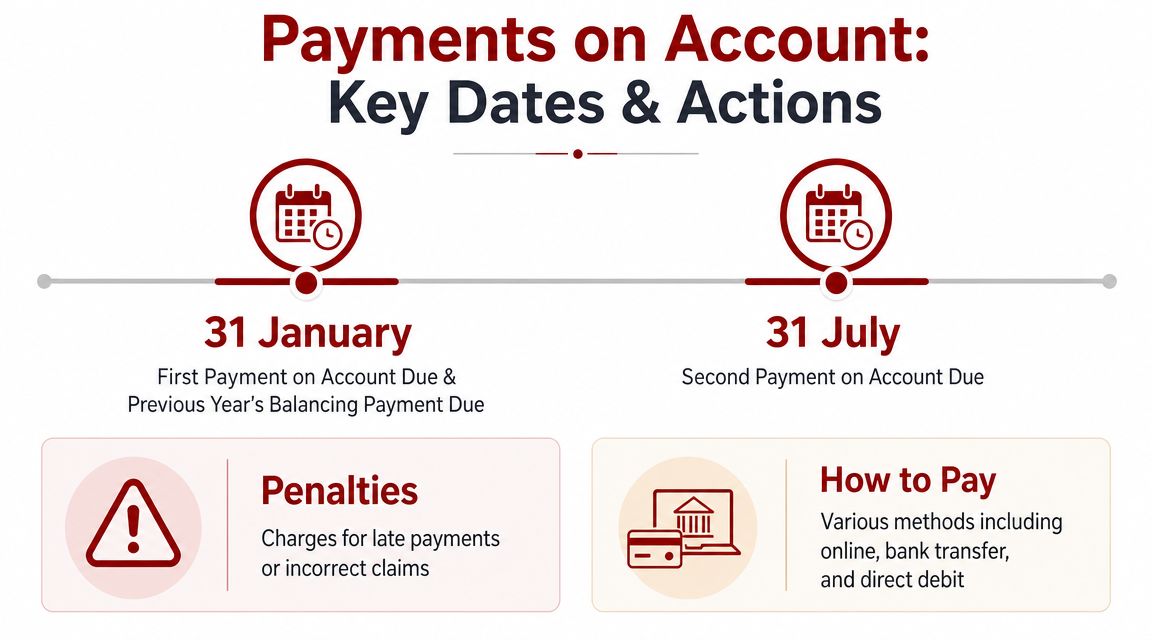
I won't dress this up. Late payment costs money and creates admin. It can also distort your wider business decisions because you start using current cash to fix old tax problems. That's how one missed deadline turns into a chain reaction.
How to keep the admin under control
Most clients don't struggle because HMRC is impossible to pay. They struggle because they leave payment decisions too late. Once that happens, even simple admin feels stressful.
A practical system looks like this:
- Diary the dates early and put reminders in your phone, calendar, and accounting workflow.
- Check your HMRC position before the deadline so you're not guessing what is due.
- Choose a payment method you'll use, such as online banking, debit card, or Direct Debit.
- Keep proof of payment in your records, especially if you're paying close to the deadline.
Late payment is rarely just a tax issue. It's usually a planning failure that shows up in your cash flow first.
If you know cash will be tight, deal with that reality before the date passes. Silence is what makes tax problems expensive. Good records, clear reminders, and money set aside in advance remove most of the drama.
Smart Strategies to Manage Your Cash Flow
The main problem with payments on account isn't understanding the definition. It's handling the cash pressure when income is uneven. Many guides explain the rule but under-explain the stress for sole traders, landlords, and contractors whose money is already tied up. FreeAgent's overview captures that point well in its discussion of cash flow stress around payments on account.

Stop treating tax as whatever is left over
This is my strongest recommendation. Open a separate bank account for tax and move money into it every time you get paid. Don't leave tax money mixed in with operating cash and hope discipline will carry you through. It usually won't.
When the tax pot is separate, you stop lying to yourself about what the business can afford. The main account shows what is available for wages, materials, software, marketing, and drawings.
A simple routine works well:
- On every invoice received, transfer a set amount into your tax account straight away.
- Review monthly, not once a year.
- Compare savings against upcoming obligations so there are no surprises.
Build a system that works when income is uneven
Volatile income needs a stronger system, not more optimism. If your work is seasonal, project-based, or dependent on a few major clients, you should forecast tax alongside cash flow.
That means looking ahead at questions like these:
- Are your profits holding up, or has work slowed down?
- Has cash been tied up in stock, subcontractor costs, repairs, or delayed customer payments?
- Will the next HMRC deadline land in a quiet trading period?
One useful habit is to ring-fence not just tax, but also VAT if you're registered. Another is to review drawings with some discipline. Too many owners take cash out during strong months and then act shocked when tax falls due.
For a wider view of how tax timing affects smaller businesses in different systems, this piece on Comfi's UAE corporate tax insights is worth a read. Different tax regime, same commercial reality. Timing can hurt even profitable businesses.
Here's a practical explainer that many business owners find helpful before they change their routine:
You don't need a complicated finance department to do this properly. A separate account, current bookkeeping, and a monthly review are enough to take a lot of the fear out of payments on account. If you want broader habits that improve control across the business, this article on spending smart for long-term business success is a sensible next read.
How and When to Reduce Your Payments on Account
When a reduction makes sense
A lot of taxpayers assume the figure HMRC sets is fixed. It isn't. If your current year income is clearly going to be lower, reducing your payments on account can be the right move.
That matters most for people with uneven earnings. Research highlighted in this discussion of affordability and overstatement risk for volatile earners highlights a key issue. A standard instalment model can overstate liability if you don't actively review your current-year position.
Reduction usually makes sense when your income has dropped for a clear reason, such as:
- Loss of a major client
- Time off due to illness
- A slowdown in your market
- Rental income disruption
- A deliberate cut in workload
If you know profits are down, overpaying and waiting for the system to catch up is bad cash management. That money may be more useful inside the business.
What evidence to keep
People get sloppy when they reduce the figure because they want breathing room, not because they have a credible estimate. That's risky.
Keep records that show why the reduction is reasonable. That might include current bookkeeping, management figures, invoices, tenancy changes, or evidence of lost work. You don't need drama. You need a supportable forecast.
Reduce payments on account when your income has genuinely fallen. Don't reduce them because the deadline is inconvenient.
You can deal with the reduction through the proper HMRC route, including the relevant form or your online account, or ask your accountant to handle it. The important part is accuracy. If you reduce too far and underpay, HMRC can charge interest on the shortfall.
So my view is simple. Reduce when the numbers justify it. Don't reduce on instinct. This is one of those areas where a quick professional review can save you from making an expensive guess.
Let Action Accountants Manage Your Tax with Confidence
Payments on account only feel simple when your income is flat, your records are current, and you always keep cash aside. For everyone else, they're a planning issue disguised as a tax issue.
That's why good advice matters. You need someone to look at the filing, the timing, the cash position, and the risk of overpaying or underpaying, then turn that into a clear action plan.

What good support actually changes
Proper support isn't just about submitting a return. It changes how you operate through the year.
That includes things like:
- Keeping books current so liabilities don't appear out of nowhere
- Forecasting tax earlier so January and July aren't a scramble
- Checking whether a reduction is justified before you make a risky claim
- Helping you organise records so HMRC queries are easier to answer
This is also where one practical service matters. Action Accountants Limited handles bookkeeping, tax compliance, payroll, and advisory work for individuals and growing businesses, including construction and property clients. If your numbers are spread across spreadsheets, receipts, bank feeds, and memory, getting them into one usable system makes tax planning far easier.
Who we help and how
We work with sole traders, landlords, subcontractors, founders, and small businesses in North West London and across the UK. The pressure points are usually the same. Cash is moving, work is busy, and tax gets pushed to the side until a deadline forces attention.
That's fixable. It starts with cleaner records and continues with better timing. If you want to understand how an accountant can take pressure off more broadly, this guide to ways an accountant can help your small business lays out the practical benefits clearly.
The best time to deal with payments on account is before they become urgent.
If your next tax date is approaching, or you're not sure whether your instalments are right, get advice before you pay the wrong amount or leave it too late.
If you want calm, practical help with payments on account, Self Assessment, bookkeeping, CIS, landlord tax, or wider business planning, speak to Action Accountants Limited. We'll help you understand what's due, when it's due, and how to manage it without wrecking your cash flow.