
UK Business Tax Planning 2026: Cut Your Company’s Tax
Action Accountants •3 July 2026
You're probably in one of two positions right now. Either the year has moved faster than expected and you're looking at your bookkeeping thinking, “I'll sort the tax later”, or you've had a decent run of invoices, rent coming in, maybe a new contract or refurbishment, and you can already feel the next bill building in the background.
That's where most tax problems start. Not with dishonesty, but with delay.
Good business tax planning isn't about gimmicks. It's about making decisions while you still have options. For a contractor in Kingsbury, that might mean buying equipment before the year end instead of after it. For a landlord in Finchley, it might mean separating property costs properly instead of leaving them mixed into a personal bank account. For a new limited company in Colindale, it often means deciding early how you'll pay yourself, when to register for VAT, and which expenses need to be documented now rather than reconstructed later.
Table of Contents
- Why Proactive Business Tax Planning Matters More Than Ever
- Choosing Your Business Structure Wisely
- Key Strategies to Legally Reduce Your Tax Bill
- Advanced Reliefs for Growth and Innovation
- Practical Tax Planning Examples
- Avoiding Costly Mistakes and Staying on Schedule
- When to Get Expert Tax Planning Help in London
Why Proactive Business Tax Planning Matters More Than Ever
A lot of owners still treat tax as a once-a-year clean-up job. That approach usually costs money. By the time the accounts are drafted, the useful decisions are often behind you.
In practice, the businesses that stay calmer around tax are rarely the ones earning the most. They're the ones that plan earlier. They separate cash for liabilities, keep records as they go, and make purchases with the tax year in mind rather than by accident.
The wider picture in the UK makes that even clearer. In the UK tax year 2024 to 2025, the provisional tax gap was 6.4% of total theoretical tax liabilities, or £59.2 billion, with HMRC collecting 93.6% of tax due according to HMRC's tax gap summary. More relevant for small owners, small businesses accounted for 62% of that tax gap in the same HMRC release.
That doesn't mean small firms are doing anything improper as a group. It often means records are weak, timing is poor, and planning happens after the fact.
Cash flow improves when tax stops being a surprise
Tax planning is really cash flow planning in work clothes. If you know a corporation tax bill is coming, or a VAT payment is likely to land in the same period as payroll and rent, you can act early.
That may mean:
- Bringing forward spending on items the business already needs
- Holding back drawings so you don't starve the company of cash
- Reviewing pricing if VAT registration is near
- Using pensions or investment allowances while the window is still open
Practical rule: If a tax decision is made after the year end, it's usually less valuable than the same decision made before it.
Reactive businesses pay more in stress
The tax itself is one part of the problem. The disruption is the other part. I've seen new business owners lose whole weekends rebuilding missing receipts, chasing bank statements, and trying to remember whether a payment was for tools, software, travel, or something personal.
That's wasted energy. Proper business tax planning gives you choices. Last-minute compliance only gives you deadlines.
Choosing Your Business Structure Wisely
The first tax planning decision isn't about expenses or allowances. It's about structure.
The vehicle matters more than most founders think
Choosing between sole trader, partnership, LLP, and limited company is a bit like choosing the right vehicle before a long journey. If you're doing occasional local trips, one option may be perfectly adequate. If you're carrying more weight, hiring people, taking on risk, or building for the long term, you need something stronger and more flexible.
A sole trader setup is simple. You trade in your own name or a business name, but legally it's still you. That works for many freelancers and smaller service businesses. The weakness is that there's no legal separation between you and the trade, so liability and tax planning flexibility are tighter.
A partnership can suit businesses with two or more people involved, especially where profit sharing is straightforward. It can work well, but only if responsibilities, drawings, and ownership are clear on paper. Verbal understandings usually age badly.
An LLP gives a partnership-style structure with limited liability features. In the right circumstances, it's useful, but it carries more administration and needs to be set up for a genuine commercial reason, not just because someone heard it was “more tax efficient”.
A limited company is a separate legal entity. That distinction matters. It affects risk, ownership, how profits are taxed, how money is extracted, and what future planning is available if the business grows, takes on investors, or expands into property or contracting work.
For founders weighing the practical difference, this guide on limited company vs sole trader gives a useful local starting point. If you're self-employed and want a second view focused on independent workers, this resource on tax advice for UK freelancers is also worth reading.
A simple comparison of the main options
| Feature | Sole Trader | Partnership | Limited Company |
|---|---|---|---|
| Legal status | You and the business are the same | Partners run the business together | Separate legal entity |
| Liability | Personal liability sits with the owner | Usually shared by partners, depending on structure | Liability generally limited to the company |
| How profits are taxed | Through personal tax | Through the partners personally | Through corporation tax, then personal tax on extraction |
| Admin burden | Lowest | Moderate | Highest |
| Planning flexibility | More limited | Depends on agreement and structure | Usually strongest for growing businesses |
| Typical fit | Freelancers, early-stage trades, side businesses | Joint ventures, family businesses, shared professional work | Growth businesses, contractors, landlords using company structures |
A structure should fit the business you're actually running, not the one you imagine in a good week.
What doesn't work is changing structure too late. Owners often incorporate after profit has already built up, contracts are already in the wrong name, and expenses have been handled inconsistently for months. That creates avoidable admin and muddled records.
What works is choosing structure with three things in mind: risk, profit pattern, and future plans. If the business is likely to hire, borrow, buy assets, or retain profit, the structure decision deserves attention early.
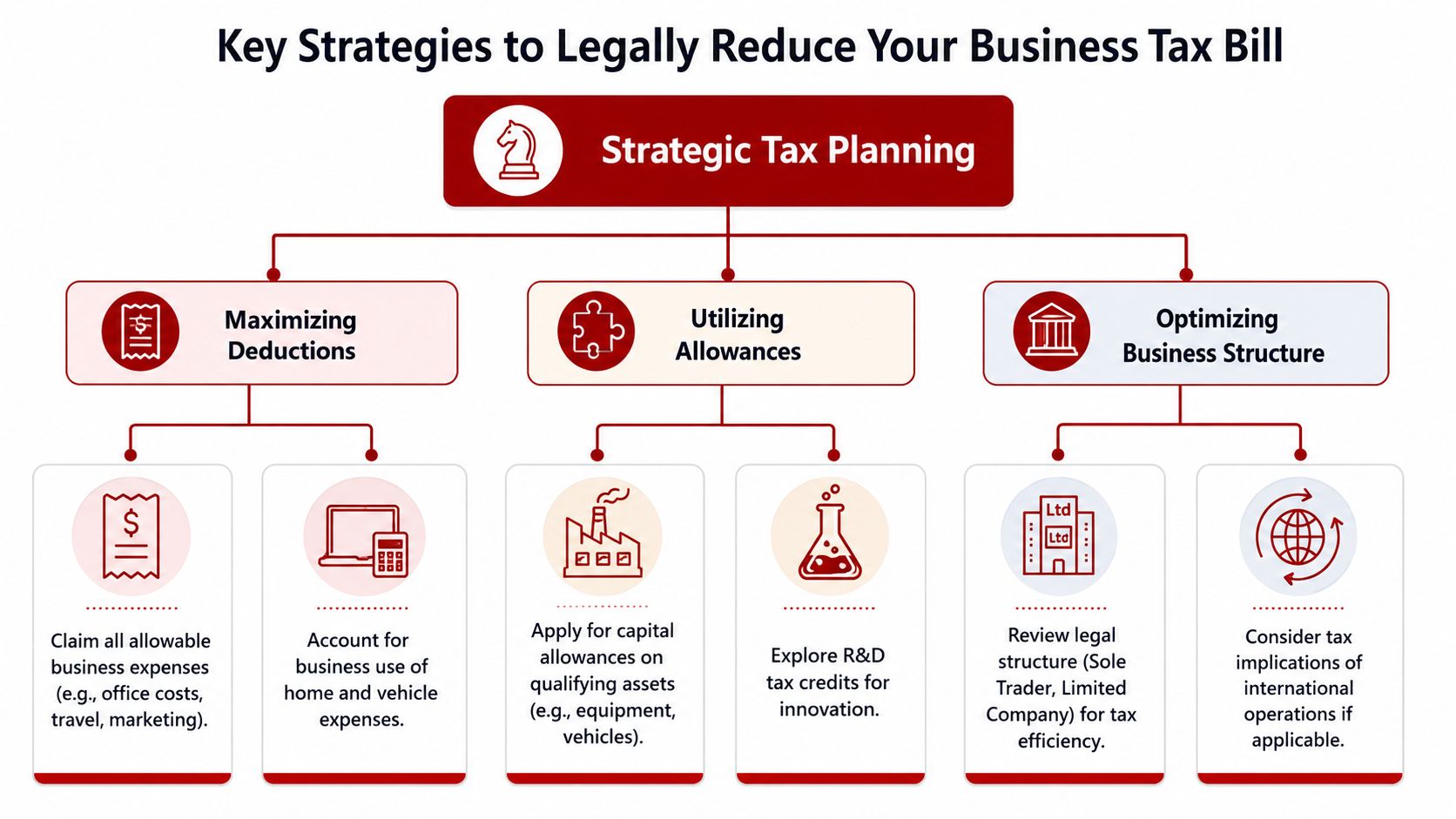
Key Strategies to Legally Reduce Your Tax Bill
A common North West London pattern goes like this. A contractor has had a strong February and March, a landlord has paid for repairs without sorting the invoices properly, and both ring in late March asking the same question. “Is there anything we can still do before year end?”
Usually, yes. The useful tax savings come from decisions made before the deadline, recorded properly, and tied to what the business was going to do anyway.
Use timing deliberately
Timing is one of the few tax tools a small business can use quickly. If profits are running higher than expected and the year end is close, bringing forward a real business cost can reduce taxable profit for the current period. In some cases, delaying an invoice by a few days also helps, provided that matches the commercial reality and the work has not been billed late just for tax reasons.
The line is simple. Record transactions in the right period. Do not backdate. Do not rename private spending as business expenditure. Do not force income or costs into the wrong year because the tax result looks better.
For limited companies, the value of that timing depends on the corporation tax band you fall into. HMRC's guidance on Corporation Tax rates sets out the current small profits rate, main rate, and marginal relief rules. In practice, that means a £5,000 decision made before year end can have a very different tax effect depending on your profit level.
Claim What the Business Uses
Many owners lose relief in boring places. Not on major planning points. On routine costs that were paid, never coded properly, and then forgotten.
Check these areas with care:
- Home working costs where part of the home is used for business
- Motor expenses where business and private use are separated clearly
- Professional fees for accounts, bookkeeping, software, and compliance
- Marketing costs such as websites, adverts, design, and content
- Tools, materials, and equipment used in the trade
- Travel and subsistence where the trip was for business and the records support it
For contractors, this often comes down to discipline. Keep mileage logs. Keep receipts. Make sure the bank statement, invoice, and bookkeeping entry match. For landlords, the trade-off is usually between repair and improvement. Replacing a broken item may be revenue. Upgrading beyond the original standard may be capital. Get that wrong and the tax treatment changes.
The rule is not “claim everything you can get away with”. The rule is “claim what is wholly and exclusively for the business, and keep evidence to support it”.
For property owners, broad commercial reading can still be useful before you buy, refurbish, or refinance. Homebase investor insights gives a useful high-level view of how investors think about tax position around real estate decisions, but UK tax treatment still needs UK-specific advice.
If your coding is already messy, fix that before year end rather than after it. This guide to VAT for small businesses is useful where the issue is not only saving tax, but getting the records and input tax treatment right from the start.
Use allowances before they are lost or delayed
Allowances reward spending that the business needs. They do not turn a poor purchase into a good one.
If the company needs equipment, machinery, or other qualifying assets, buying in the right accounting period can bring relief forward rather than leaving it until later. GOV.UK's capital allowances guidance sets out the main rules, including the Annual Investment Allowance for qualifying expenditure. The practical point is straightforward. Check the purchase date, the invoice date, and when the asset is brought into use. Those details affect the claim.
Pensions can also be effective, especially for company owners who do not need to draw every pound personally. HMRC explains the annual limits and tax treatment for tax on your private pension contributions. In owner-managed companies, an employer pension contribution can reduce company profit while moving money into long-term planning. The trade-off is access. Cash in the company is available for working capital. Cash in a pension is locked away for later.
Buy equipment because it improves the business. Use pension contributions because they fit your cash flow and long-term plans. Tax relief is the support, not the reason.
Later in the planning cycle, a short explainer can walk you through the overall mechanics.
Treat VAT as a planning decision, not just a threshold
VAT is not only an admin trigger once turnover gets high enough. It affects pricing, cash flow, margins, and how professional the business looks to certain clients.
Voluntary registration can make sense early on if you are spending heavily on software, fit-out, equipment, or subcontractors and your customers are VAT-registered themselves. In that case, recovering input VAT may outweigh the extra admin. The picture is different if you sell to private individuals or other price-sensitive customers. Then VAT can make your quote look 20% more expensive unless you absorb part of the cost yourself.
I often put it this way to new clients. VAT works like a pressure point in pricing. In some sectors it passes through cleanly. In others it bites.
So ask the commercial question first. Who bears the VAT cost, how quickly can you recover it, and will registration help or hurt your pricing position over the next 12 months?
Advanced Reliefs for Growth and Innovation
Growth often brings tax opportunities that are missed because nobody spots them during the year.
For a contractor improving a job management system, a landlord company testing a new energy setup across a block, or a software firm fixing a technical bottleneck, the question is not whether the work felt novel. The question is whether the business tried to resolve technical uncertainty, kept enough evidence, and recorded the costs in the right period.
R and D relief is wider than many owners assume
Many owners hear “R and D tax relief” and picture labs, patents, or specialist tech firms. HMRC's scope is broader than many owners realise. Work on software, production methods, internal systems, automation, or technical processes can qualify if the team was trying to overcome a genuine scientific or technological uncertainty.
That is where claims are often won or lost. The issue is usually not the work itself. It is the lack of a paper trail while the work is happening.
I see this in North West London businesses more than people expect. A builder refines a construction method to deal with site constraints. A small manufacturer changes a process to reduce failure rates. A consultancy develops a custom internal tool because off-the-shelf software will not do the job. The owner calls it “sorting out a problem”. HMRC may see qualifying activity if the facts are recorded properly.
Timing matters as well. If qualifying spend falls into a stronger profit period, the relief may be more valuable than if the same costs drift into a weaker one. That is why these claims should be reviewed before year end, not reconstructed from scraps months later.
Loss relief needs a decision, not a shrug
A bad quarter, a delayed contract, a void period on a rental property, or a project that overruns can create a loss. That loss can still be useful, but only if it is handled deliberately.
Sometimes it is better to carry a loss forward. Sometimes using it earlier gives a better result. The right answer depends on expected profits, the owner's wider income, and what is happening next in the business. A company with recovery in sight will often choose differently from a sole trader whose personal tax bill is rising now.
Cash flow is part of this decision. Using relief in the wrong order can leave a business short when the next balancing payment lands, especially if the owner has not planned for future payments on account at the same time.
Advanced reliefs reward good habits. Keep notes on what problem the business was trying to solve, when the work started, who did it, and which costs relate to it. Tax planning here works like laying pipes before the concrete goes down. Do it early and everything runs properly. Leave it too late and the fix is expensive.
Practical Tax Planning Examples
A London tech startup buying equipment early
A founder launches a small software business in North West London. Revenue is still patchy, but the company needs laptops, monitors, paid development tools, and other setup costs before sales fully settle.
The common mistake is to leave VAT alone because turnover is still below the registration trigger. That can be shortsighted. For startups investing in significant equipment, voluntarily registering for VAT below the threshold can be useful because it may allow recovery of VAT on goods purchased up to four years before registration, a planning point discussed in this video on VAT registration strategy.
The trade-off is commercial. If the startup sells to VAT-registered business clients, early registration is often easier to absorb. If it sells directly to consumers, adding VAT may affect pricing and conversion. The answer depends on the customer base, not just the rule.
A startup in this position also needs to watch cash discipline. Early founders often underestimate future balancing payments and get caught when they later face payments on account, especially if personal tax and company extraction haven't been planned together.
A CIS contractor in Kingsbury watching profit creep up
A subcontractor starts the year thinking they're still “small”. By autumn, turnover is stronger, tool purchases have mounted, mileage is up, and there may be a labourer or two helping regularly.
This is often the point where the old casual approach stops working. Expenses are half on a personal card, half in cash, and some materials are mixed with private purchases from the same builders' merchant. The contractor may still be trading as a sole trader because that's how they started, even though risk and profitability have moved on.
What works here is not a dramatic tax trick. It's tightening the basics:
- Separate banking so every business receipt and outgoing can be traced
- Capture CIS statements consistently
- Review tools, protective clothing, travel, and phone use with evidence
- Test whether incorporation now makes sense rather than assuming it always does
For contractors, structure, record-keeping, and timing tend to matter more than anything flashy. If the profit pattern has changed, the business has changed with it, whether the owner has noticed or not.
A landlord in Finchley getting organised before year end
A landlord with one or more local properties often thinks business tax planning doesn't really apply because “it's just rent coming in”. That's exactly how avoidable mistakes happen.
The weak version looks like this. Mortgage paperwork in one place, repair invoices in another, insurance on an annual direct debit that nobody codes properly, and occasional improvement work mixed up with ordinary maintenance. At year end, everything has to be reconstructed.
The stronger version is calmer. The landlord keeps a dedicated property bank account, stores invoices digitally, separates repairs from improvements as the costs arise, and reviews whether a company structure is suitable before buying the next property rather than after exchange.
Property tax planning is full of trade-offs. Holding personally may be simpler. Holding through a company may suit some long-term strategies better. Neither is automatically right. The mistake is copying another landlord's structure without looking at finance costs, extraction plans, ownership, and future purchases.
Avoiding Costly Mistakes and Staying on Schedule
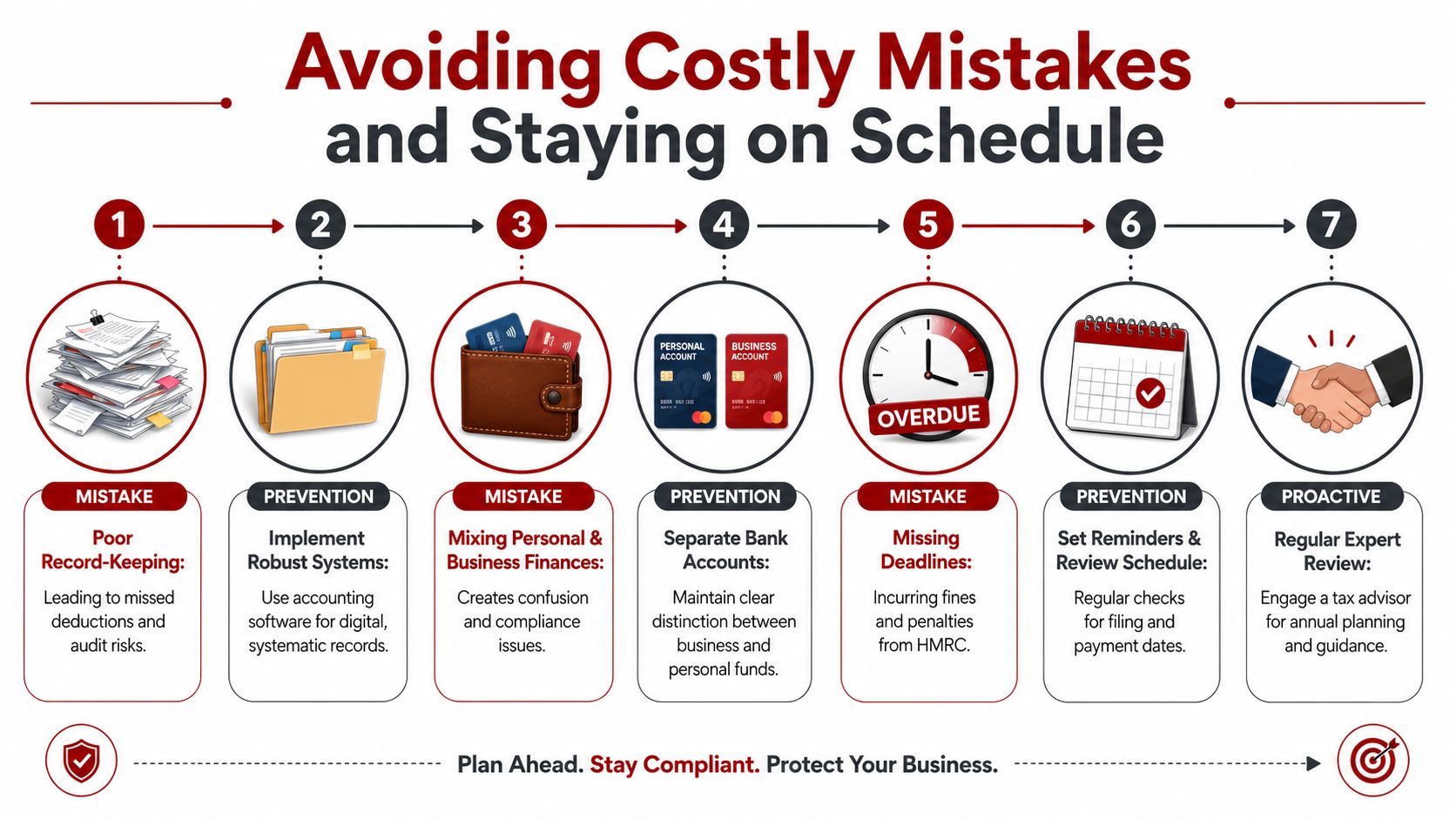
Tax planning goes wrong most often in ordinary places. Not in complex legislation. In paperwork, habits, and missed dates.
Mistakes that cost money for no good reason
I see the same patterns repeatedly with new businesses and smaller landlords.
- Mixing personal and business spending makes it harder to prove deductions and easier to miss them.
- Leaving bookkeeping until year end turns routine admin into reconstruction work.
- Not keeping VAT under review can lead to late registration problems or missed reclaim opportunities.
- Ignoring profit trends means owners don't realise their tax position has changed until the bill arrives.
- Buying assets without paperwork weakens the claim even when the purchase itself was legitimate.
A simple fix often prevents a larger problem. Use a dedicated bank account, digital receipt capture, and a monthly review. Xero, QuickBooks, and Dext are practical tools for this sort of routine discipline because they reduce the need to remember everything later.
If your records only make sense while you're explaining them out loud, they aren't organised well enough.
A working tax calendar for a small business owner
You don't need a complicated dashboard. You need a repeatable rhythm.
- Monthly review
Reconcile the bank, check expense coding, store receipts, and review whether profit is running above expectations. - Quarterly check-in
Review VAT position, look at upcoming large purchases, and test whether drawings or salary decisions still make sense. - Before the accounting year end
Decide whether planned spending, pension contributions, or invoicing timing should be brought forward or delayed. - After the year end, quickly
Finalise records while the detail is still fresh. Delay usually causes missing information. - Before filing deadlines
Don't just file. Review the result and ask what should change for the next cycle.
This is also the point where an external review can help. A local firm such as Action Accountants Limited can handle bookkeeping, VAT, payroll, accounts, and tax returns where the owner needs support across the whole cycle rather than just a year-end filing.
When to Get Expert Tax Planning Help in London
Some tax issues are perfectly manageable on your own at the beginning. Others need advice sooner than owners expect.

Get help when profit rises quickly, you hire your first employee, VAT becomes relevant, you buy significant equipment, or you're debating whether to move from sole trader to limited company. The same applies if you're a contractor dealing with CIS, or a landlord buying through a new structure.
Making Tax Digital is another area where delay creates needless friction. If you want a plain-English overview of the direction of travel, this guide to MTD compliance for freelancers is a helpful primer.
For businesses in Colindale, Kingsbury, Queensbury, Edgware, Finchley, and the wider area, it also helps to work with someone who understands the local mix of startups, contractors, and landlords. This profile of a trusted accountancy practice in London gives you a sense of what that ongoing support should look like.
If you want practical help with business tax planning, Action Accountants Limited can help you review your structure, clean up your records, plan for VAT and corporation tax, and make sensible year-end decisions before the window closes. The aim isn't clever theory. It's to help you keep more of what the business earns, stay compliant, and avoid nasty surprises later.