

Furnished Holiday Let Tax: 2026 FHL Abolition Guide
Action Accountants •14 June 2026
The special Furnished Holiday Let regime was abolished from 6 April 2025 for Income Tax and Capital Gains Tax, and from 1 April 2025 for Corporation Tax. That ended the old FHL tax advantages, including the separate treatment around finance costs, capital allowances, relief for losses on disposal, and pension-contribution treatment, and pushed former FHLs into the same basic tax framework as standard property businesses.
That catches many owners out because the problem isn't just “higher tax”. It's that a strategy built around old furnished holiday let tax rules can now become the wrong strategy entirely. If you bought, financed, or planned your exit on the basis that holiday lets sat in a privileged tax niche, that assumption has gone.
A lot of investors still talk about occupancy, nightly rates, and seasonality as if the tax wrapper is unchanged. It isn't. HMRC removed a regime that had shaped how owners structured borrowing, claimed reliefs, split income with spouses, and thought about eventual sale. TaxWatch's figures, discussed in professional commentary, show why this matters: a landlord earning £30,000 a year could pay around £4,000 less income tax under the old regime, and the CGT difference on sale could run to tens of thousands, with some examples reaching roughly £37,000 over three years (Grant Thornton commentary on the FHL tax changes).
My view is simple. Treat this as a strategic reset, not a compliance footnote. Review ownership, financing, records, and exit plans now. If you wait until your next tax return or sale, you've waited too long.
Table of Contents
- The End of an Era for FHL Tax Breaks
- What Was the FHL Tax Regime
- The New Reality Post-Abolition Tax Treatment
- Deeper Dive On Specific Tax Implications
- Practical Example A Landlord's Tax Bill Compared
- Your Action Plan Recordkeeping and Strategy Checklist
- When to Call Your Accountant
The End of an Era for FHL Tax Breaks
The FHL regime is finished. If you still assess a holiday let using the old tax advantages, your numbers are already out of date.
From April 2025, former FHL income and gains fall into the normal UK or overseas property business rules. For investors, that means a hard reset in how profit, borrowing, ownership, and exit timing should be assessed. This is not an admin tidy-up. It is a change that can reduce post-tax returns, increase pressure on cash flow, and expose weak ownership structures that previously looked acceptable.
The point many landlords miss is simple. Short-term letting still creates extra work, higher turnover, more furnishing costs, and more management friction. The old regime helped justify that effort. Once those tax advantages disappear, the business case needs to stand on commercial performance alone.
Why this is bigger than a normal tax change
Several of the tax benefits that made FHLs attractive have gone. That affects how finance costs bite, how capital spend is treated, how losses and disposal planning work, and how some owners approached pension planning. If you bought, borrowed, or structured ownership on the assumption that FHL status would continue, revisit those decisions now.
Practical rule: Rework your forecast using standard property tax treatment, then decide whether the property still earns its place in your portfolio.
The highest-risk cases are usually clear. Highly geared owners. Couples who relied on a tax-efficient split of income. Investors expecting a sale in the near term. In each case, the old tax position may have been doing more of the heavy lifting than the rental figures suggested.
A strategic reset is required
Stop asking whether the property is still an FHL for tax purposes. That question belongs to the old regime.
Ask better questions:
- Does the property still justify short-term letting on net profit, not old tax perks?
- Does the debt still work once tax relief is less favourable?
- Does the ownership split still produce the right tax outcome?
- Does your exit plan still make financial sense under the new rules?
Investors who act early can still protect cash flow and avoid expensive mistakes. Investors who delay usually discover the problem through a weaker tax return, a tighter mortgage position, or a sale that no longer delivers the expected result.
What Was the FHL Tax Regime
Before abolition, furnished holiday let tax worked because qualifying properties were treated differently from ordinary residential lettings. That separate treatment was the whole point.
A property didn't get FHL treatment just because it was on a booking platform or furnished nicely. It had to meet defined conditions under the historic rules. The property had to be furnished, commercially let, and located in the UK or EEA, and it had to satisfy the letting-condition tests explained in Saffery's overview of the furnished holiday lettings tax regime.
The old qualifying tests mattered
To qualify, the property had to be available for holiday letting for at least 210 days a year and let for at least 105 days a year. Those thresholds separated genuine short-term holiday businesses from second homes and occasional lets.
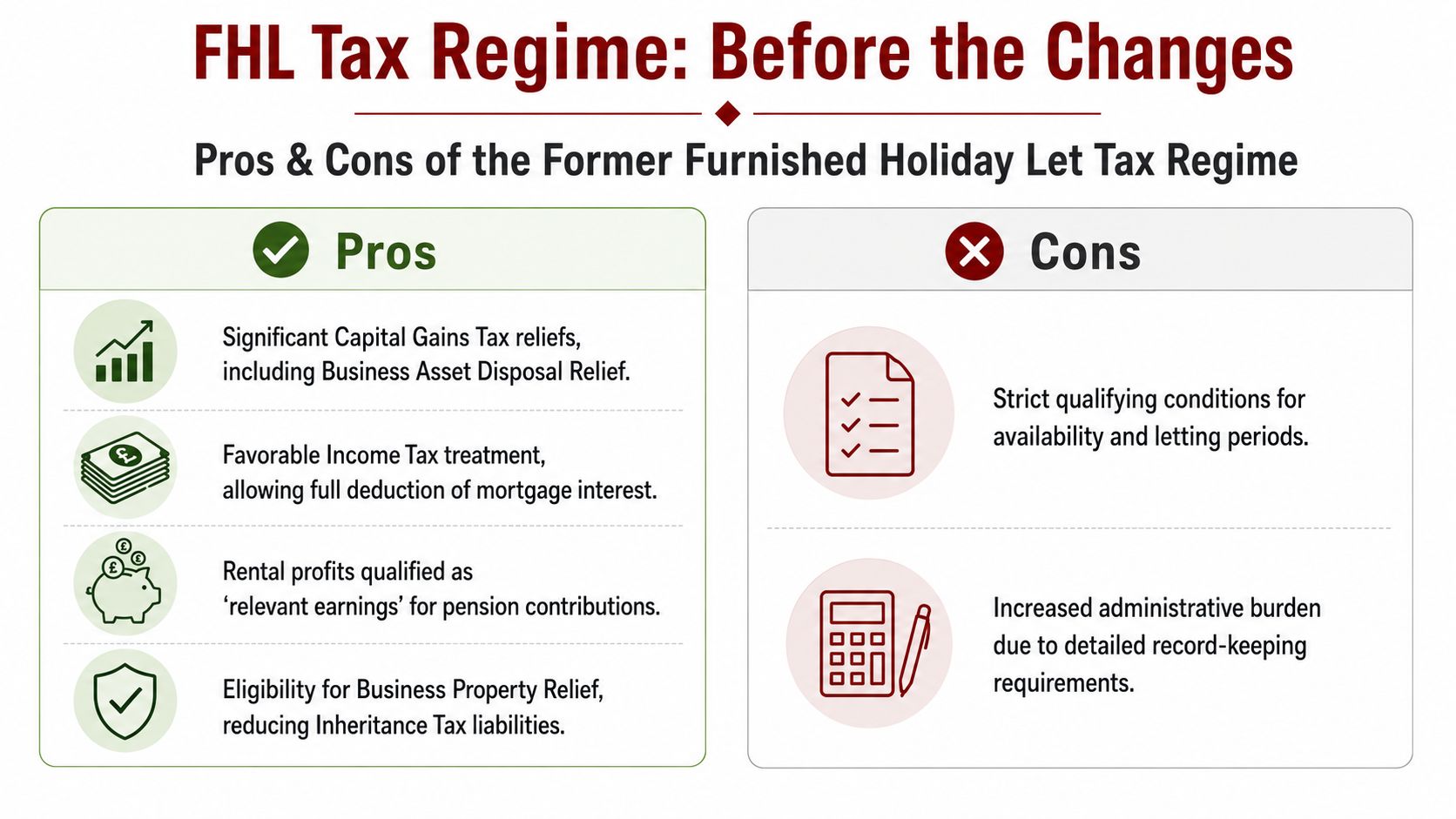
Those numbers mattered because they acted as the gateway to the old regime. If you met the tests, you were in a more favourable tax position. If you didn't, you were just another property investor with a short-term rental.
The key point for today is this: those historic tests still matter for understanding earlier years and past returns, but they no longer create a separate tax class from 6 April 2025 for Income Tax and Capital Gains Tax purposes.
Why investors cared so much
Owners cared because the old regime offered more than branding. It offered meaningful tax advantages that changed behaviour.
Under the former rules, investors often focused on these areas:
- Finance cost treatment: Borrowing could be more tax-efficient than under standard residential landlord rules.
- Capital allowances: Certain expenditure on furnishings and equipment sat in a better position than many investors now expect.
- Pension angle: Rental profits from a qualifying FHL had a different status for pension-contribution purposes.
- Inheritance and exit planning: For some owners, the appeal of an FHL wasn't the yearly income. It was the wider planning opportunities around ownership and disposal.
You didn't run an FHL under the old rules in the same way you ran a normal buy-to-let. That distinction was the commercial attraction.
There was always a trade-off. Owners had stricter record-keeping, tougher qualification conditions, and a more operational business model. But many accepted that burden because the tax upside justified it.
That's why the abolition matters so much. You haven't just lost a label. You've lost the tax logic that may have justified the structure.
The New Reality Post-Abolition Tax Treatment
From 6 April 2025, your former FHL becomes a standard property investment for tax purposes. If your numbers only worked because of the old reliefs, you need to reset the strategy now, not after the next tax return.
The old FHL label no longer gives you a tax advantage on income or gains. Your property now sits inside your normal UK or overseas property business, and that changes how profit is taxed, how costs are relieved, and how you should judge the investment.
This is a financial reset.
Your forecasts need rewriting
A lot of landlords still look at a former holiday let through a pre-abolition model. That is a mistake. You should rebuild the numbers using post-6 April 2025 treatment and test whether the property still works after tax, after finance costs, and after operational spend.
Start with the practical pressure points:
- Borrowing is less tax-efficient: Interest no longer gets the old FHL treatment.
- Capital spend needs reviewing: Do not assume the same relief outcome for fixtures, furnishings, and other expenditure.
- Sale planning needs updating: If your exit plan relied on FHL-specific reliefs, revisit it before listing the property.
- Pension planning may change: The old assumptions around pension contribution treatment no longer hold.
If you own blocks or mixed-use property and want a clearer view of how costs should now be separated and reported, our guide to service charge accounting for UK landlords will help tighten the numbers.
Before and after the change
| Tax Area | Treatment Before 6 April 2025 | Treatment From 6 April 2025 |
|---|---|---|
| Finance costs | FHLs benefited from separate treatment under the old regime | Former FHLs are taxed under the same finance-cost rules as non-FHL property businesses |
| Capital allowances | FHLs had access to FHL-specific advantages | The old capital-allowance advantage no longer applies in the same way |
| Relief on disposal | FHL status could improve the tax position on exit | Former FHLs no longer get those FHL-specific disposal advantages |
| Pension-contribution treatment | FHL profits had more favourable treatment | That advantage has been removed |
| Property classification | Separate FHL treatment and reporting requirements | Income and gains now form part of the owner's UK or overseas property business |
That table is the technical summary. The commercial point is sharper. A former FHL now needs to justify itself on real net return, not on tax benefits that have gone.
As noted earlier, commentators highlighted how wide the old gap could be for some landlords. Do not treat those old illustrations as planning assumptions anymore. Treat them as a warning about how far your expected after-tax return may now have fallen.
That is why I would be cautious about any investor who says, “the rents are still strong, so it's fine.” Gross income is not the issue. Net income after tax, finance costs, platform fees, cleaning, repairs, furnishing replacement, and void risk is the issue.
Some owners will keep the short-term model because the underlying profit is still there. Others should reconsider pricing, financing, ownership structure, or even whether a switch to longer-term letting produces a cleaner return. If you manage multiple units, this guide for vacation rental managers is a useful operational reference, but tax decisions still need to be tested against your own figures.
The right question is simple. If this property were a new investment today, under the new tax rules, would you still buy it? If the answer is no, act before weak assumptions turn into an expensive holding pattern.
Deeper Dive On Specific Tax Implications
The headline change gets most of the attention, but the messier issues sit underneath it. These underlying issues often lead investors to make expensive mistakes. They assume the abolition only affects annual profit. In practice, it can change how income is split, how retirement planning works, and how lenders and advisers look at the property.
Spousal ownership now needs proper evidence
One of the most overlooked consequences concerns jointly owned properties. After 6 April 2025, married couples who own a former FHL jointly are generally taxed on the default 50:50 basis under ITA 2007 s 836 unless they take separate legal steps to evidence a different beneficial ownership and, where relevant, file a Form 17, as explained in Tax Adviser's analysis of the end of the FHL era.
That matters if one spouse is a higher-rate taxpayer and the other isn't. It also matters if one spouse contributed more capital or carries more of the economic risk.
The practical point is simple. Documentation is no longer a side issue. If beneficial ownership is unequal, you need proper legal evidence and the correct tax position. If you don't have that, HMRC will generally default to the statutory split.
Review title deeds, declarations of trust, and any Form 17 position before your next filing cycle. Don't assume your accountant can fix weak ownership evidence after the event.
The wider commercial knock-on effects
The tax shift also changes how you should think about the business model itself.
Former FHL owners often need to revisit:
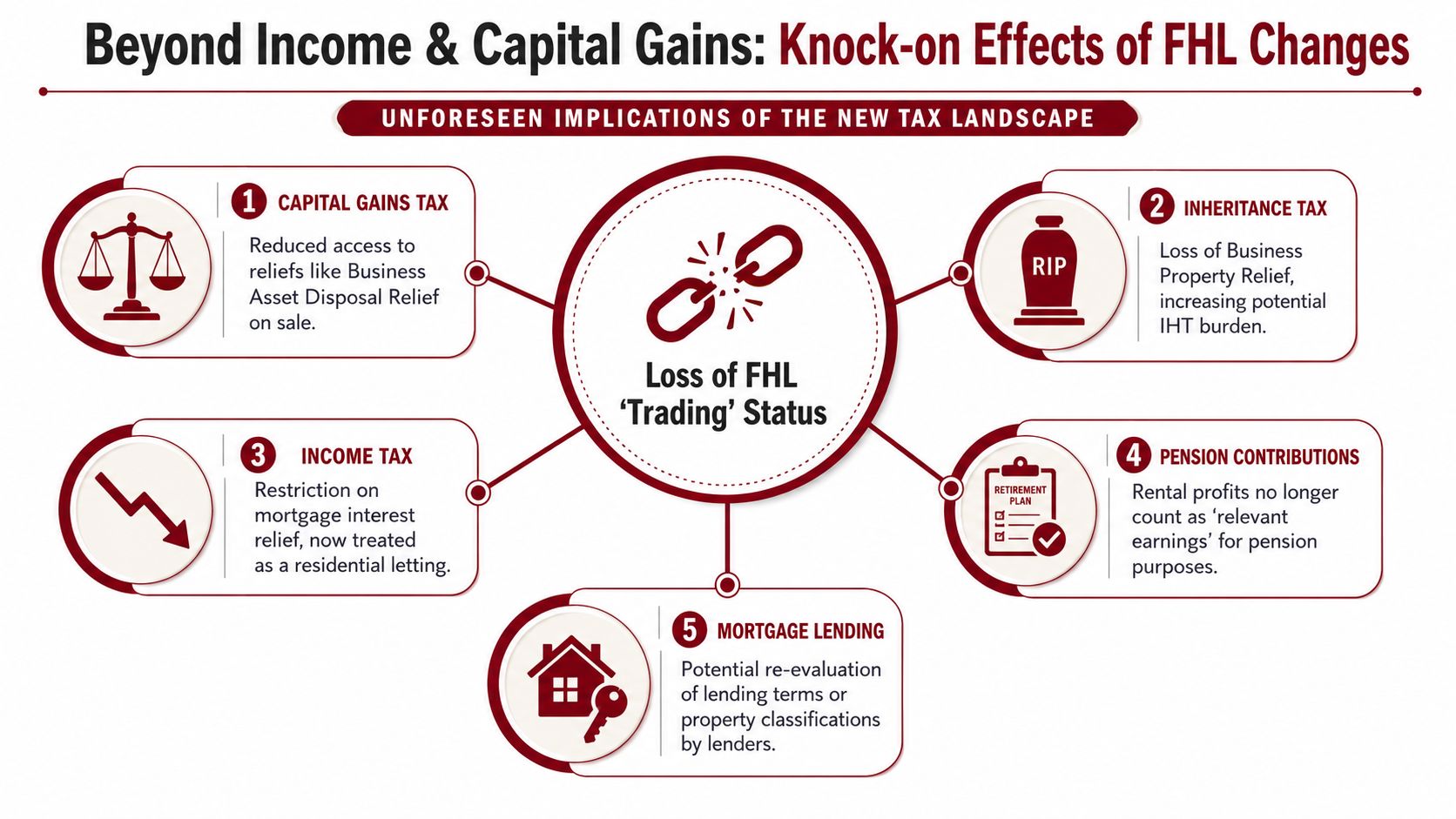
- Pension planning: The old regime had a more favourable pension-contribution treatment. That advantage has gone with abolition.
- Inheritance planning: Professional commentary has noted the loss of business property relief as part of the wider strategic reset around holiday lets.
- Lender conversations: Some owners should expect closer scrutiny of how the property is operated and financed, especially where the model relied on old FHL economics.
- Operational systems: Better records matter more now because your property sits inside the standard property framework, so expense allocation and ownership support need to be cleaner.
If you manage multiple units or hybrid short-stay properties, a practical operations resource like this guide for vacation rental managers can help you tighten categories, documentation, and expense tracking. The tax treatment has changed, but sloppy administration is still a choice.
For landlords with blocks or mixed property arrangements, it's also worth cleaning up related accounting areas that often get ignored, especially service charges and allocation methods. This UK landlord guide to service charge accounting is useful if your recordkeeping around communal costs is currently muddled.
The thread running through all of this is control. The old regime let many owners tolerate weak paperwork because the tax story was generous. The new situation rewards precision instead.
Practical Example A Landlord's Tax Bill Compared
The abolition of the FHL regime is not a technical tidy-up. It changes the economics of holding the property.
A simple investor example
Take a former holiday let bringing in £30,000 a year. As noted earlier in the article, professional commentary has highlighted that a landlord at that income level could face around £4,000 more income tax a year under the new rules than under the old FHL treatment.
That extra tax is not an accounting curiosity. It comes straight out of your cash surplus. If your mortgage, maintenance budget, and personal drawings were built around the old position, the margin can disappear quickly.
The same applies to exit planning. Earlier commentary in this guide noted that some owners could also face a much worse capital gains tax outcome on sale, with differences running into tens of thousands in certain scenarios. If your original plan relied on holding for a few years and selling efficiently, revisit that plan now. Do not assume the property still works on the same timeline.
A sensible investor should test three options with real numbers:
- Keep it as a short-term let if the post-tax profit still justifies the effort, risk, and volatility.
- Switch to a longer-term rental model if steadier occupancy gives a better net return after tax.
- Sell on a planned basis if the revised tax cost, finance cost, and workload no longer stack up.
If the strategy reset includes upgrades before reletting or sale, this guide on estimating rental property refurbishment costs is worth reading. Refurbishment spend now needs to be tested against the new tax reality, not the old FHL assumptions.
What the example should change in your decisions
This example should push you to rebuild the numbers properly.
Start with cash flow. Use the current tax treatment, current borrowing costs, and realistic occupancy. Then stress-test the result. If a modest rise in tax wipes out your buffer, the property is under more pressure than many owners admit.
Review these points straight away:
- Cash flow forecasts: Rework them using the abolished FHL position, not historic margins.
- Tax reserves: Higher liabilities can also affect your payments on account for self assessment, so budget for timing as well as total tax.
- Exit timing: Price a sale only after you understand the revised tax bill.
- Finance decisions: Recheck whether the debt still fits the property's reduced after-tax return.
Busy calendars do not prove a property is performing well. A clear post-abolition forecast does. Owners who act on that now keep control. Owners who delay usually end up making rushed decisions with less cash and fewer options.
Your Action Plan Recordkeeping and Strategy Checklist
If you own a former FHL, you need a response plan, not a vague intention to “sort it later”. The right moves are mostly unglamorous. That's exactly why they save money.
A quick visual checklist helps organise the work.
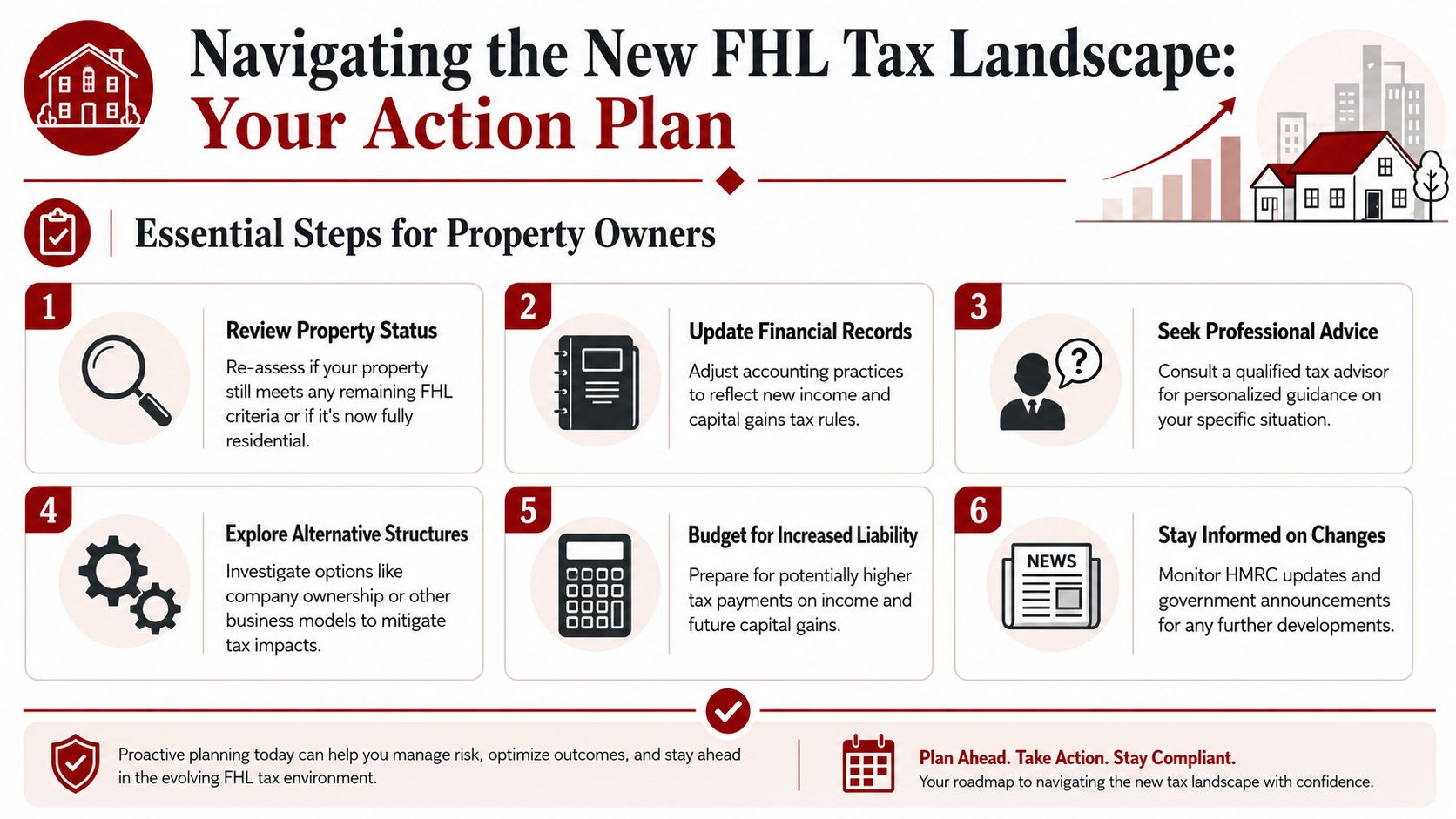
What to do now
Start with the records. If your bookkeeping still reflects the old FHL mindset, fix that first.
- Reclassify the property correctly: Treat it under the normal property business rules that now apply.
- Separate revenue from capital clearly: Old habits around fit-out and improvement spending need a stricter review.
- Check ownership evidence: Joint owners should make sure legal and beneficial ownership paperwork matches the tax position they want to support.
- Rebuild the profit forecast: Use current treatment, current borrowing costs, and realistic occupancy assumptions.
This video gives a useful overview of the practical shift owners need to understand before making planning decisions.
The bookkeeping control point that matters most is transaction coding. One construction accounting source in the brief notes that UK contractor bookkeeping needs transaction-level coding because CIS deductions must be posted at the correct rate and to the correct ledger accounts, and because HMRC treats CIS returns and monthly deadlines as compliance-critical. The same source is available in this construction bookkeeping discussion.
A weekly workflow that actually works
You don't need heroic effort. You need consistency.
Every week:
- Collect site records: Supplier invoices, subcontractor invoices, delivery notes, timesheets, and expense receipts.
- Code by job first: Don't post to general overhead if the cost belongs to a project.
- Check subcontractor entries carefully: Labour and materials should be split before payment is approved.
- Raise sales invoices promptly: Match them to applications, milestones, or certified amounts.
- Reconcile the bank: This catches missing entries quickly.
Every month:
- Review CIS postings and filing status
- Reconcile VAT control accounts
- Check unpaid retentions
- Review WIP and margin movement
- Clean up old suspense items
Choosing software without overcomplicating it
For many small and medium contractors, cloud platforms such as Xero or QuickBooks can work well if they're set up properly. Out of the box, they aren't construction systems. But with the right chart of accounts, tracking categories, invoice discipline, and reporting layout, they can support job-level reporting far better than spreadsheets scattered across phones and laptops.
Industry add-ons can help where you need estimating, project management, or document flow. The right setup depends on whether your pain point is site data capture, subcontractor payment control, or profitability reporting.
One practical option for firms that want implementation help is using an adviser with construction experience, such as Action Accountants' guide to Making Tax Digital and VAT compliance, alongside whatever software stack you choose.
A short walkthrough can help if your current process still feels manual:
Build a plan before the next filing deadline
Then deal with strategy. The abolition means many investors should reassess whether the property still belongs in personal ownership, whether financing is still efficient, and whether the long-term plan remains sensible.
Good property tax planning starts with legal facts, clean records, and a realistic holding strategy. Anything else is guesswork.
Use this checklist:
- Review your borrowing: If debt was justified by old tax treatment, recheck the numbers.
- Stress-test ownership structure: This limited company vs sole trader guide isn't property-specific, but it helps frame the wider question of whether your current structure still fits your commercial goals.
- Budget for a heavier tax burden: Don't let the next payment surprise you.
- Reassess protection alongside tax: If you own property across jurisdictions or want a plain-English primer on cover issues, this explainer on what landlord insurance is in Australia is a useful reminder that risk management and tax planning should sit together, even if the legal rules differ.
- Set a decision date: Keep, restructure, refinance, or sell. Drift is expensive.
Most mistakes happen because landlords delay obvious housekeeping. The abolition rewards the owners who move early.
When to Call Your Accountant
Some tax changes are manageable with good reading and decent records. This isn't one of them.
You should get advice quickly if you're planning to sell, refinancing a former FHL, sharing ownership with a spouse, running multiple properties, or relying on old forecasts to judge profitability. Those are the points where hidden assumptions do the damage. By the time the tax return is drafted, the best planning opportunities are often gone.
This also isn't just about tax returns. It's about legal ownership, benefit splits, borrowing decisions, and whether your property strategy still deserves the capital tied up in it.
If you're still approaching furnished holiday let tax as a niche landlord issue, you're underestimating the change. It now sits inside a broader property-planning problem that needs proper financial modelling and clean evidence.
For a wider look at the value of professional support in business and tax planning, this article on ways an accountant can help your small business is a useful starting point.
The right time to call your accountant is before you restructure ownership, before you exchange on a sale, before you rely on a tax estimate, and before HMRC sees a position you can't support properly.
If you want clear advice on how the abolition affects your property income, ownership structure, or sale plans, speak to Action Accountants Limited. They help landlords and business owners cut through technical noise, fix weak records, and make practical tax decisions before those decisions become expensive.