
VAT Reverse Charge Explained: UK SME Guide 2026
Action Accountants •11 June 2026
You've probably had this happen already. A subcontractor sends an invoice with no VAT on it, your bookkeeper asks whether to post VAT anyway, and someone on site says, “It's reverse charge, so it all cancels out.” That's how expensive mistakes start.
The UK VAT reverse charge isn't difficult once you strip out the jargon. The problem is that most explanations stop at the definition and ignore what matters to a growing business in North West London: who should invoice what, which VAT return boxes are affected, and whether your cash flow takes a hit. If you're in construction, or you run a business with mixed taxable and exempt income, you need the practical version, not the polite summary.
Table of Contents
- Demystifying the VAT Reverse Charge
- When the VAT Reverse Charge Applies
- The Reverse Charge in the Construction Industry Scheme
- Worked Example Invoicing and Journal Entries
- How the Reverse Charge Really Affects Your Cash Flow
- Common Errors and Avoiding HMRC Penalties
- Your Reverse Charge Compliance Checklist
Demystifying the VAT Reverse Charge
You finish a job, issue the invoice, and the customer questions why there is no VAT on it. Or you receive a supplier invoice with no VAT charged and assume nothing is due. That is how businesses drift into VAT errors. Under the reverse charge, VAT has not disappeared. The duty to account for it has shifted.
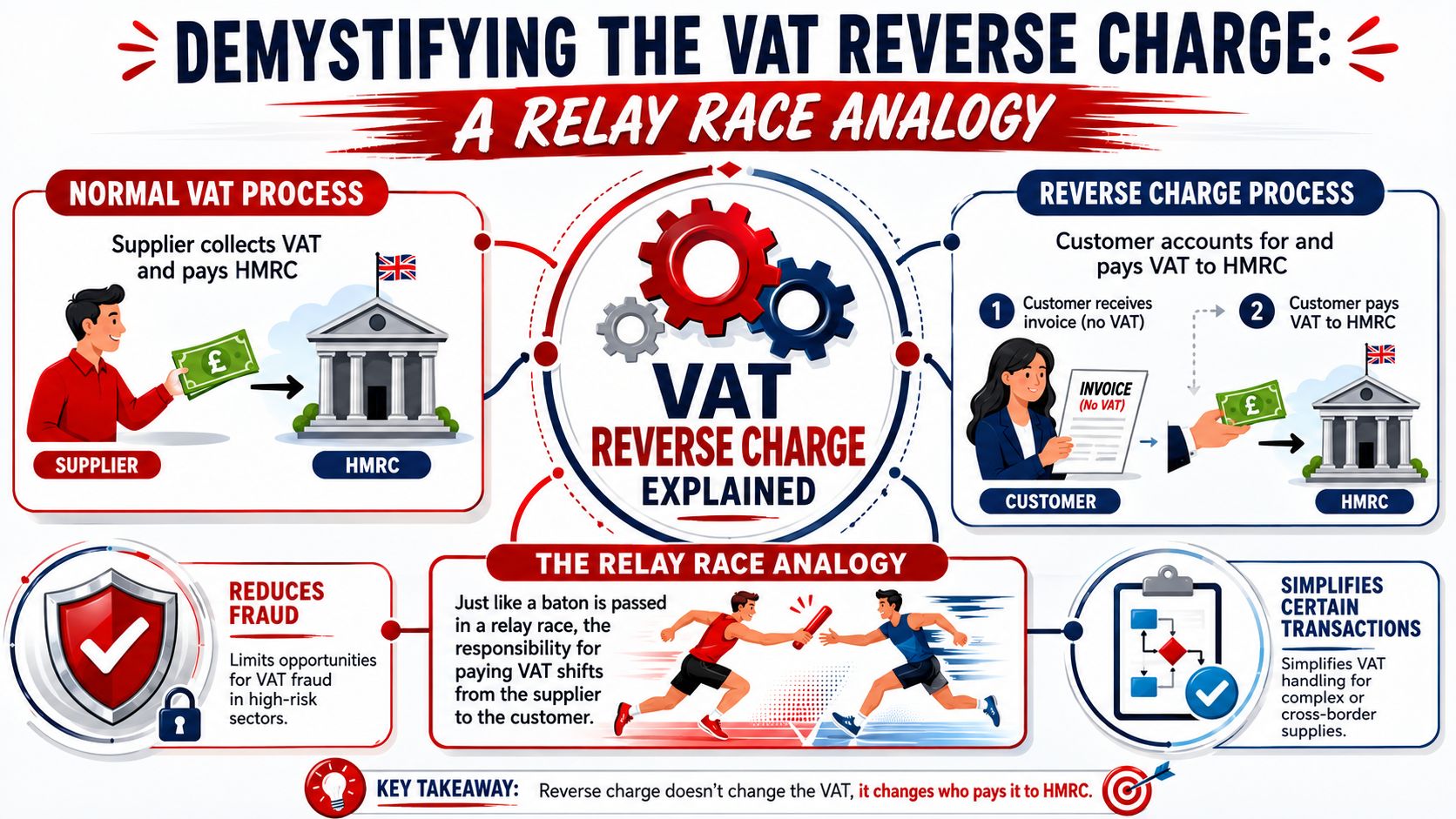
VAT reverse charge explained in plain English: the customer, not the supplier, accounts for the VAT on the transaction through their VAT return. The supplier invoices the sale without collecting the VAT amount from the customer, then the customer records the output tax and, if entitled, claims the input tax in the usual way.
What changes and what doesn't
The key change is simple. The person who declares the VAT changes.
The supply itself does not become exempt or zero-rated. It is still taxed at the rate that would normally apply. HMRC sets out the domestic reverse charge as an anti-fraud measure for specified goods and services between UK taxable persons for business use in VAT Notice 735.
That point catches clients out all the time, especially in construction. They see no VAT on the invoice and code it as exempt, outside the scope, or zero-rated. That is wrong. The tax status of the supply stays the same. Only the reporting method changes.
Practical rule: If an invoice says reverse charge, check whether you must self-account for VAT before you post it.
Why HMRC uses it
HMRC uses the reverse charge to stop suppliers collecting VAT and failing to pay it over. If the supplier never receives the VAT, that fraud risk falls.
The bigger issue for many small businesses is cash flow. A fully taxable business may post the VAT in and out on the same return with little net cost. A partially exempt business does not get that result. Neither does a construction firm that has built its working capital around receiving VAT from customers before paying HMRC later. If you miss that cash flow change, your pricing, retention planning, and VAT forecasts can all be wrong at the same time.
When the VAT Reverse Charge Applies
A wrong VAT decision here does two things fast. It puts the return at risk and distorts cash flow, especially if you rely on expected VAT receipts to fund labour, materials, or retentions.
Start with the transaction, not the invoice wording. The reverse charge applies only where the supply falls within a category covered by the UK rules, both parties are taxable businesses in the UK, and the purchase is for business use. If any part of that chain is missing, use normal VAT treatment.
Construction clients need to be stricter than this section of the rules suggests on paper. If you already deal with CIS, keep your VAT review separate from your deduction review. They overlap in practice, but they are not the same test. If you need a refresher on how CIS status affects subcontractors, see our guide to CIS for self-employed subcontractors.
What to check before you invoice or post a bill
Ask these questions in order:
- Is the supply one of the goods or services covered by reverse charge rules?
- Are both supplier and customer trading as UK taxable businesses?
- Is the purchase wholly for business use?
- Does a sector-specific rule apply, such as construction or certain high-risk goods?
Miss one answer, and you can post the transaction to the wrong VAT code.
A common non-construction example is mobile phones and computer chips. If the invoice meets the value test for those goods, the reverse charge applies to the full qualifying invoice amount, not just the value above the threshold. Businesses get this wrong when they split the treatment line by line and leave part under normal VAT. That creates avoidable corrections later.
There is another trap for growing businesses. Reverse-charge purchases can still matter when you review VAT registration exposure. Do not ignore them just because no VAT was charged on the invoice.
Quick decision table
| Question | If yes | If no |
|---|---|---|
| Is this a specified good or service under UK reverse charge rules? | Check the remaining conditions | Use normal VAT rules |
| Are both parties UK taxable businesses and is the supply for business use? | Check for any sector-specific treatment | Reverse charge usually does not apply |
| Does the transaction fall under a special rule set, such as construction or listed goods? | Apply that rule set carefully | Review the normal VAT position |
Do not trust appearances. An invoice with no VAT can be correct, or it can leave you with an HMRC error and a cash flow gap at the same time.
The Reverse Charge in the Construction Industry Scheme
A subcontractor finishes a job, sends a £20,000 invoice, and expects the VAT element to help cover wages and materials. It never arrives. Under the domestic reverse charge, that VAT is not your cash. If you price jobs or plan payments as if it is, your working capital gets squeezed fast.
For North West London construction firms, mistakes become costly. CIS and the VAT reverse charge often hit the same invoice, but they do different jobs. CIS affects tax deductions and reporting. The reverse charge decides who accounts for VAT. Treat them as separate checks every time.
When construction supplies fall into reverse charge
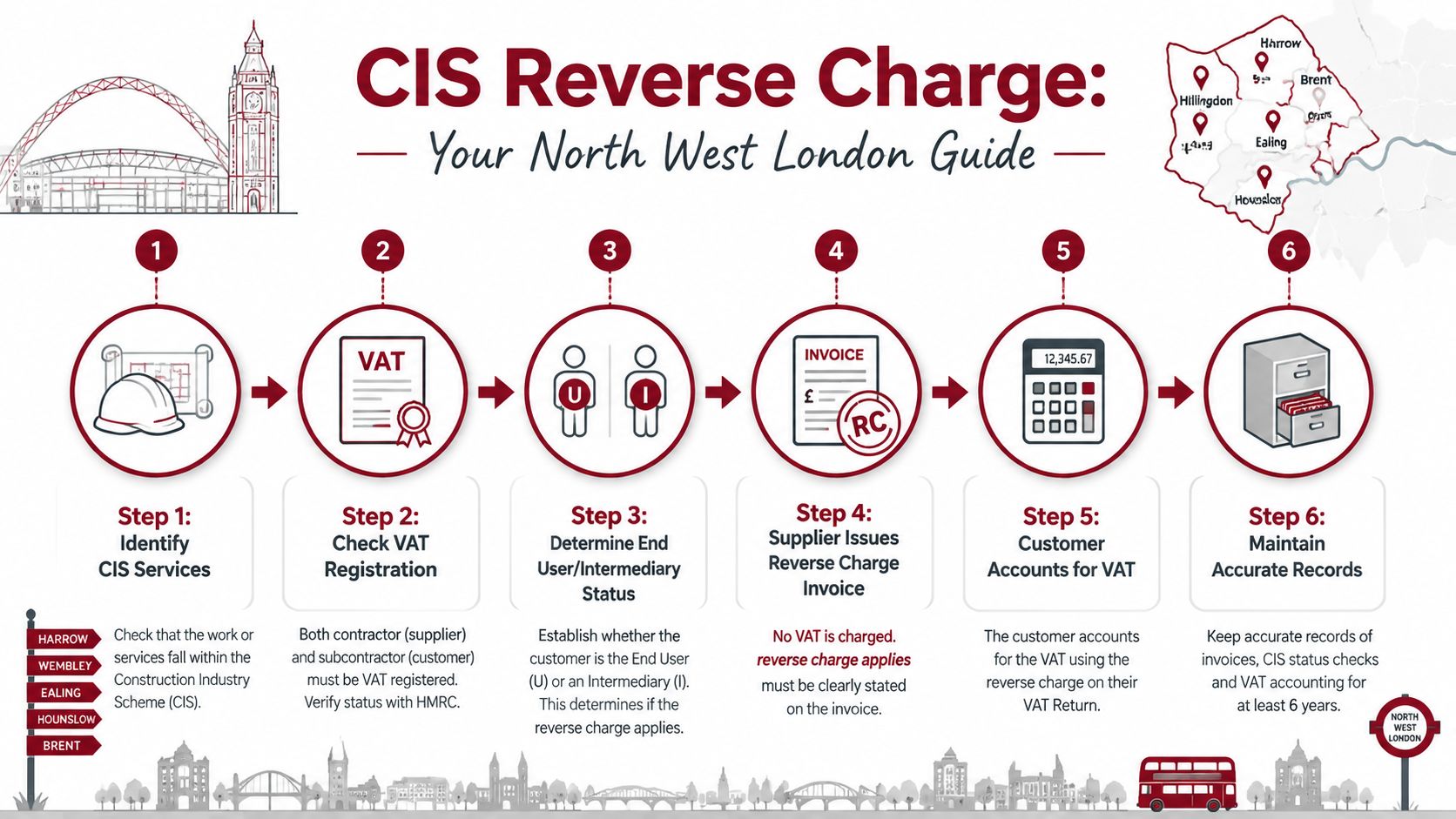
The construction reverse charge applies where the supply is standard-rated or reduced-rated, the work falls within CIS, the customer is VAT-registered, and the customer is not buying as an end user or intermediary supplier. In that case, the supplier does not charge VAT in the normal way. The customer accounts for it on their own VAT return, as set out in HMRC's VAT reverse charge technical guide.
Get this right before the invoice is raised, not after a payment query lands. The practical question is simple. Is your customer passing the work on, or consuming it themselves?
That point matters for cash flow. Many subcontractors get caught because they have built their month-end around receiving output VAT from customers. Under reverse charge, that inflow disappears, but supplier bills, payroll, and CIS deductions still need funding.
End user status decides the treatment
Written end-user status is your control point. If the customer is the end user, normal VAT rules usually apply. If they are not, and the other conditions are met, the reverse charge usually applies.
Do not guess. Do not rely on a site manager's verbal comment. Get confirmation in writing, save it with the contract, and make sure the person raising the invoice can see it.
Use this routine:
- Ask the customer to confirm whether they are an end user or intermediary supplier.
- File that confirmation with the quotation, contract, or job record.
- Apply the VAT code from that evidence, not from habit.
- Recheck the position if the contract chain changes mid-project.
That one discipline prevents a lot of reissued invoices, VAT adjustments, and payment delays.
If you also need the wider CIS position clear, keep this guide on CIS for the self-employed to hand.
If your office team is still handling invoice status by email chains and memory, fix that. A system built for automated invoicing for contractors reduces the risk of the wrong VAT treatment being used on a busy billing run.
A quick visual walkthrough helps if your team processes invoices across office and site functions.
Mixed invoices and the 5 percent rule
Mixed construction invoices cause trouble because the commercial paperwork is often messy. Labour, materials, design input, and ancillary items get rolled together, then someone in accounts applies one VAT code to the lot without checking what HMRC will accept.
HMRC allows a 5% disregard for minor reverse charge elements on mixed supplies. That can simplify treatment in the right case. It is not a shortcut for poor invoice drafting. If your team cannot explain why a mixed invoice was treated under normal VAT or reverse charge, the posting is not safe.
Partially exempt businesses need to be even more careful here. The reverse charge can change the timing and visibility of input tax recovery issues, especially where property, mixed-use, or exempt income is already limiting VAT claims. Generic explainers skip that point. You should not. If your business has any partial exemption exposure, review these invoices before the VAT return is filed.
The real operational fix
Construction businesses usually go wrong at handover. Estimating knows the contract. The contracts manager knows the chain. Accounts only sees the invoice request. That gap creates the error.
Set one rule. No construction sales invoice goes out until someone has confirmed CIS scope, VAT registration, and end-user status from the job file.
That protects compliance, but it also protects cash flow. If you know in advance which invoices will fall under reverse charge, you can price work, time supplier payments, and forecast VAT with fewer surprises.
Worked Example Invoicing and Journal Entries
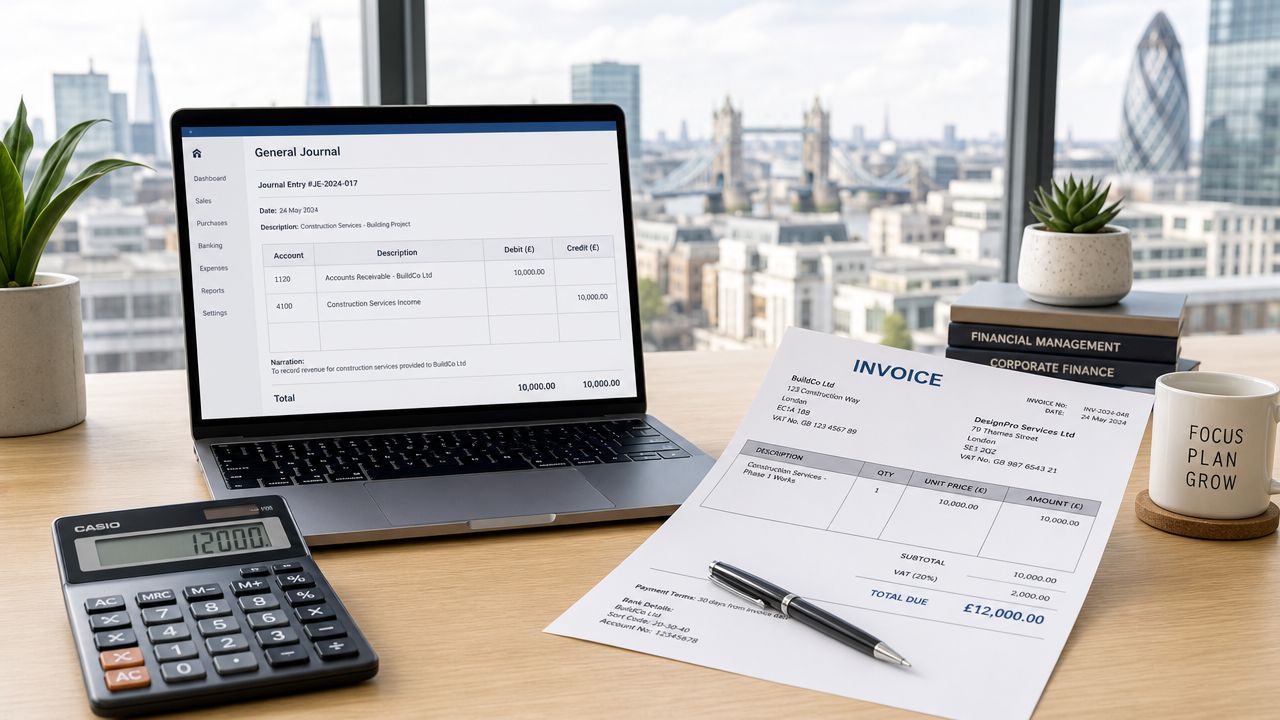
Here's the practical version. A subcontractor carries out a £10,000 construction service for a VAT-registered contractor. The supply falls within the construction reverse charge rules and the customer hasn't confirmed end-user treatment, so the subcontractor must issue a reverse charge invoice rather than charging VAT in the normal way.
From the subcontractor's side
The invoice should show the net amount payable by the customer. It should also make it clear that the domestic reverse charge applies and that the customer must account for the VAT. The supplier does not collect that VAT amount from the customer as output tax in the usual way.
A simple commercial discipline helps here. If you're issuing lots of project invoices every month, software built for automated invoicing for contractors can reduce the chances of someone using the wrong VAT template on a rushed billing run.
A straightforward bookkeeping entry for the subcontractor is usually:
- Debit trade debtors: net invoice amount
- Credit sales: net invoice amount
No normal output VAT posting is made in the same way as a standard VAT invoice because the supplier isn't charging VAT to the customer under the domestic reverse charge.
From the contractor's side
The contractor records the purchase and self-accounts for the VAT through the VAT return. Under HMRC's construction reverse charge treatment, the customer accounts for the VAT in boxes 1 and 4, and box 7 records the net purchase value, as covered earlier in the construction section.
That means the contractor's bookkeeping needs to do two jobs at once:
- capture the cost of the purchase
- generate the reverse charge VAT entries correctly for the return
A common set of journals will look like this in substance:
| Entry | Debit | Credit |
|---|---|---|
| Record purchase | Relevant cost or work in progress | Trade creditors |
| Self-account for reverse charge VAT | Input VAT control | Output VAT control |
The exact ledger names depend on your software. Xero, QuickBooks, Sage, and FreeAgent all handle this slightly differently, but the logic is the same.
If your bookkeeping setup is patchy, especially in a small owner-managed business, getting the VAT codes reviewed is far cheaper than cleaning up several VAT quarters later. This practical guide to bookkeeping for sole traders is useful even if you now trade through a company, because the record-keeping habits are the same.
Keep the contract, the customer status confirmation, and the invoice together. The journal only tells HMRC what you posted. The paperwork shows why.
How the Reverse Charge Really Affects Your Cash Flow
A lot of business owners have been told that the reverse charge is “VAT-neutral”. That statement is incomplete, and in some cases it's flatly unhelpful.
The better view is this: the reverse charge is only neutral if you can fully recover the input tax. If you can't, the effect is no longer just mechanical. It turns into a real cost.
Where the simple explanation goes wrong
Specialist commentary makes the point clearly. The common refrain that the reverse charge is “VAT-neutral” is dangerously simplistic. It's only true if the buyer can fully recover input tax. For partially exempt businesses, including property firms with mixed portfolios, the requirement to account for output VAT in box 1 can create a real, irrecoverable VAT cost if input tax recovery in box 4 is restricted, directly hurting cash flow, as discussed in Tax Adviser Magazine's reverse charge commentary.
Landlords, mixed-use property businesses, and construction firms with exempt income are often caught out. The accounts team posts the reverse charge correctly, but the business owner still feels poorer because some of that VAT can't be recovered under the normal rules.
Who should pay attention
If any of these sound familiar, don't brush this off:
- Property businesses with mixed income: Some supplies may be taxable, others exempt.
- Landlords with different types of lettings: Recovery can be restricted depending on the wider VAT position.
- Contractors with unusual group structures: One entity may bear cost while another earns the taxable supply.
- Businesses using generic bookkeeping codes: The VAT return may look tidy while cash flow worsens.
That's why this topic belongs in finance planning, not just VAT compliance.
For owners who feel they understand the work but not the finance language around it, this article on staying financially steady when numbers aren't your native language is a sensible companion read.
The recommendation I'd give most SMEs
Don't let anyone tell you “it all washes through” unless they've checked your recovery position.
Review reverse-charge purchases separately if your business has any exempt activity, partial exemption issue, or unusual property income. If you don't, you can end up pricing jobs as if VAT is harmless when it isn't. That distorts margins, contract decisions, and cash planning.
A reverse charge posting can be technically correct and still commercially painful.
Common Errors and Avoiding HMRC Penalties
Most reverse charge mistakes aren't complex. They're sloppy. Someone uses the wrong invoice template, someone else assumes every CIS job is reverse charge, and nobody checks the VAT return boxes before filing.
That's avoidable. And it's cheaper to prevent than repair.
The errors I see most often
- Wrong invoice wording: The invoice is raised without normal VAT, but it doesn't clearly show that reverse charge treatment applies.
- Bad classification: Staff assume CIS automatically means reverse charge, or they miss that customer status changes the treatment.
- Poor VAT coding: The bookkeeping software posts the purchase cost, but not the output and input VAT treatment needed for the return.
- No control over mixed businesses: Teams assume the transaction is cash-neutral when restricted recovery means it isn't.
Specialist commentary notes that the reverse charge is a cash-flow and control measure for HMRC, and while it's normally cash-neutral for the customer, that neutrality breaks for partially exempt businesses where input tax recovery is restricted, creating a real VAT cost. Misunderstanding that is a common and costly error, as explained in this reverse charge analysis.
The fix is process, not panic
Build a basic approval chain around purchase invoices and sales invoices. Good finance teams borrow controls from accounts payable disciplines, and this overview of AP internal controls best practices is useful because the same habits apply here: approval clarity, document matching, and role separation where possible.
If you're filing under Making Tax Digital, your VAT codes and digital records need to support the treatment properly. This guide to Making Tax Digital for VAT is a good checkpoint if your current setup feels improvised.
The blunt advice is simple. Treat reverse charge as a control issue, not just a tax rule. That's how you avoid disputes with customers, errors in returns, and awkward HMRC questions later.
Your Reverse Charge Compliance Checklist
You don't need a thick procedure manual. You need a short list your team uses.
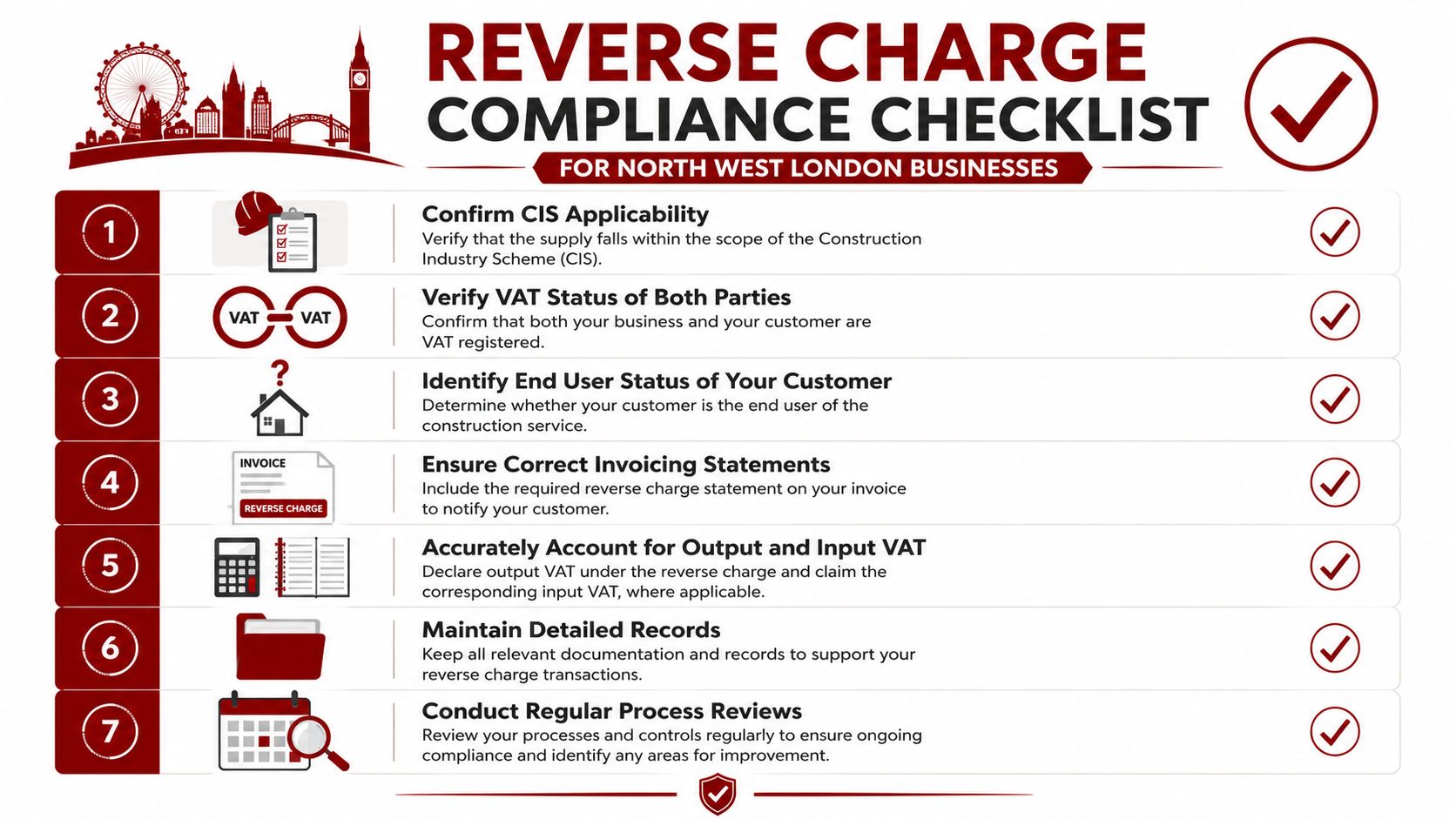
Keep this checklist in front of your invoicing team
- Check whether the supply is in scope: Don't assume. Confirm the goods or services fall within reverse charge rules.
- Verify both parties' VAT position: Especially in construction and other specified sectors.
- Confirm customer status in writing: For construction work, establish whether the customer is an end user or intermediary supplier.
- Use the right invoice template: Reverse charge invoices must be set up differently from normal VAT invoices.
- Test your accounting software codes: Make sure the transaction lands correctly in the VAT return.
- Review cash-flow impact separately: If your business has exempt or partially exempt activity, don't accept the “neutral” label without checking.
- Keep evidence together: Contract, invoice, customer confirmation, and bookkeeping trail should all match.
One final recommendation. Put one person in charge of reverse charge decisions. Shared responsibility usually means no responsibility.
If you want clear, hands-on help with VAT reverse charge issues, CIS bookkeeping, or cash-flow planning, speak to Action Accountants Limited. They work with contractors, subcontractors, landlords, and growing businesses across Colindale, Kingsbury, Edgware, Finchley, and the wider North West London area, with practical advice that keeps your records compliant and your margins protected.