
Your 2026 Guide to Registering for Self Assessment
Action Accountants •30 June 2026
You've probably got to this point because something changed. You started contracting. You let out a flat in Kingsbury. You set up a limited company and began taking dividends. Or you've had a perfectly ordinary PAYE job in Finchley or Edgware for years, then one extra income stream tipped you into Self Assessment without anyone telling you clearly.
That's where people lose time. Not because the process is impossible, but because HMRC uses language that assumes you already know which route applies to you. For new contractors, landlords, and founders in North West London, the confusion usually starts with one simple question: do I need to register, or am I overthinking this?
If you need to register, the timing matters. The setup isn't finished the day you fill in an online form. You need the right pathway, the right identifiers, and enough time for HMRC to post out the details you'll need later. Get that right early, and the rest becomes manageable. Leave it late, and a small admin task turns into a compliance problem.
Table of Contents
- Do You Really Need to Register for Self Assessment
- The Self Assessment Registration Pathways Explained
- Your Step-by-Step Guide to Online Registration
- Key Deadlines and What Happens After You Register
- Common Self Assessment Registration Mistakes
- Beyond Registration Your Next Steps in 2026
Do You Really Need to Register for Self Assessment
A lot of people assume Self Assessment is only for sole traders. It isn't. That assumption is one of the main reasons people in steady employment miss registration until a letter arrives or a deadline has already passed.

The PAYE assumption catches people out
If you're paid through PAYE, that only covers income taxed through payroll. It doesn't automatically cover rent from a property, larger dividend income, foreign income, or other untaxed amounts. HMRC's official guidance confirms you must register by 5 October if you have untaxed income from savings, investments, dividends over £10,000, foreign income, or are a company director, and 12% of new Self Assessment registrations in the last 12 months came from these non-traditional categories while 70% of UK tax guides focus on sole traders according to this review of UK Self Assessment triggers.
That gap shows up constantly in practice. A landlord with one rental property often thinks, “I'm not self-employed, so this won't apply to me.” A new director with a salary through PAYE and occasional dividends thinks the company filing has covered everything. It hasn't.
Practical rule: If income arrives outside payroll and tax hasn't been fully dealt with at source, stop assuming PAYE has solved it.
The trigger is the income type
For readers around North West London, the most common situations look like this:
- New contractor working as a sole trader: You start trading in your own name and invoice clients directly. That usually points toward Self Assessment registration.
- Landlord with a first rental property: You've moved out of a flat and now rent it out. Rental income can create a filing obligation even if your day job remains fully taxed through PAYE.
- Company director taking dividends: You've formed a company, run salary through payroll, and also taken dividends. That combination often leads people into Self Assessment.
- Foreign income or untaxed investment income: This is especially common for internationally mobile professionals and families with overseas assets.
For founders still deciding how to set themselves up, structure matters from the beginning. If you're weighing whether to trade personally or through a company, this guide on limited company vs sole trader helps frame the tax admin consequences as well as the commercial ones.
And before you even get to tax registration, it helps to think clearly about why you're setting up in the first place. A grounded piece on entrepreneurship insights can be useful if you're still in the early founder stage and trying to avoid rushed decisions.
The Self Assessment Registration Pathways Explained
Once you know you need to register, the next issue is choosing the correct route. That sounds simple, but many first-time filers make an error at this point. They start the online journey meant for one category of taxpayer when their circumstances call for another.
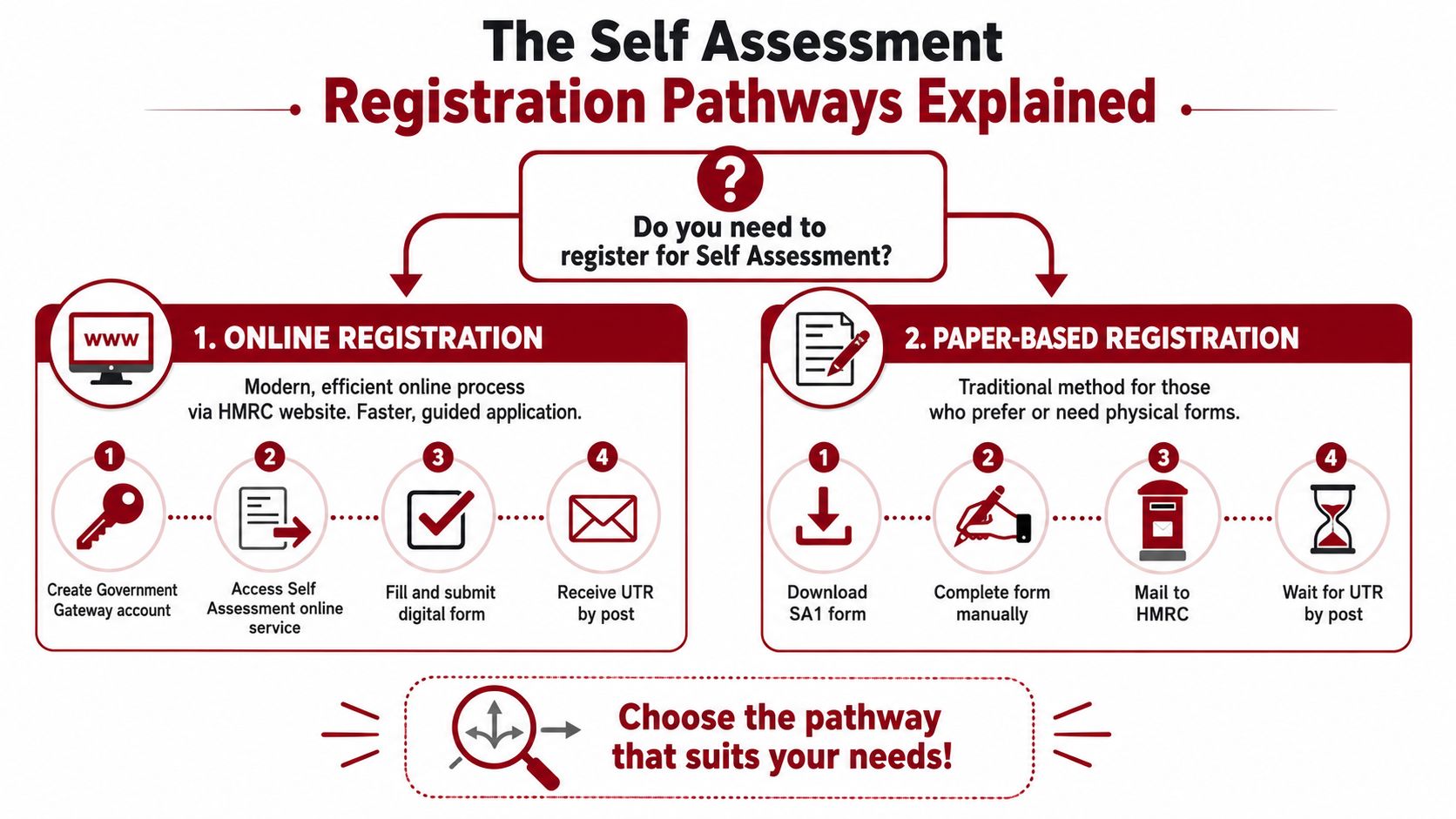
Two routes and one common misunderstanding
There are broadly two registration pathways.
| Pathway | Best suited to | What to expect |
|---|---|---|
| Online registration through HMRC | Most new self-employed individuals and sole traders | Guided process through Government Gateway |
| Form SA1 route | People who need Self Assessment but aren't registering as self-employed, such as some landlords or directors | Extra care needed to choose the correct category |
The misunderstanding is this: people think paper and online are alternatives from start to finish. They're not always. If you're in a non-self-employed category, the registration may begin differently, but you'll still need an online HMRC account to complete the process properly.
Even where Form SA1 is relevant, the online account isn't optional. Treat it as part of the registration, not something to sort out later.
Which route usually works best
For a sole trader, the online route is usually cleaner. It gives you prompts, reduces handwriting and postal errors, and aligns with HMRC's current operational expectations. If you're a contractor starting out on your own, that's often the right place to begin.
For landlords and directors, the position can be less obvious. The safer question isn't “Can I do this online?” but “What is HMRC classing me as for registration purposes?” If you answer that wrongly, the form itself can be completed neatly and still produce the wrong result.
A practical way to approach this:
- If you're trading in your own name, start by looking at the self-employed registration route.
- If you're not self-employed but still need to file, don't force yourself into the sole trader path just because it looks more familiar.
- If you already have PAYE records, remember that doesn't replace the need to register for Self Assessment where untaxed income exists.
If your next concern is the return itself rather than the registration, this overview of a sole trader tax return gives a useful picture of what follows after setup.
Your Step-by-Step Guide to Online Registration
The online process is manageable if you approach it in the right order. Problems usually come from rushing into HMRC's portal without the basic information in front of you.
Get your details ready first
Before you start, gather your core details. At minimum, that usually means your National Insurance number, proof of identity, and a clear note of when your untaxed income or business activity started. If you're doing this after work on a laptop at the kitchen table, have your passport and a recent payslip nearby. It saves time when identity checks appear.
Then create your Government Gateway account if you don't already have one. Use an email address you check regularly and keep a secure record of the login details. A surprising amount of stress later in the year comes from people not being able to get back into an account they created in a hurry months earlier.
After that, choose the correct service and category. If you're registering as self-employed, HMRC's process generally steers you toward the individual or sole trader route. If you're not self-employed, you need to make sure you aren't selecting a business type that doesn't match your actual position.
A simple pre-check helps:
- Confirm why you need Self Assessment. Is it trading income, rent, dividends, foreign income, or another untaxed source?
- Match the registration route to that reason. Don't guess based on what sounds closest.
- Note the date the income started. HMRC may ask for it, and vague answers tend to slow things down.
What happens after you submit
Many people think registration ends when they click submit. It doesn't. That's only the front half of the process.
After creating a Government Gateway account, HMRC issues a 10-digit Unique Taxpayer Reference (UTR) and a 28-day valid activation code by post within about 3 weeks, and you must use that code to activate the Self Assessment service online. If you don't activate within 28 days, the code expires and you often need to start again, as explained in this guide on how long Self Assessment registration takes.
That matters in real life because post is still part of the process. If you're moving home, using a correspondence address you don't check often, or relying on a shared household to spot HMRC letters, leave more time than you think you need.
Don't register close to the deadline and assume the post will sort itself out. The weak point is often the gap between online submission and paper delivery.
When the UTR arrives, keep it somewhere obvious and secure. You'll use it repeatedly. When the activation code arrives, deal with it the same week. Not “when things calm down”. Not “next weekend”. The code has a short life, and expired codes create avoidable delay.
Key Deadlines and What Happens After You Register
Most Self Assessment problems are not technical. They're timing problems. Someone intended to register, meant to activate their account, planned to file, then discovered that HMRC runs on fixed dates rather than good intentions.
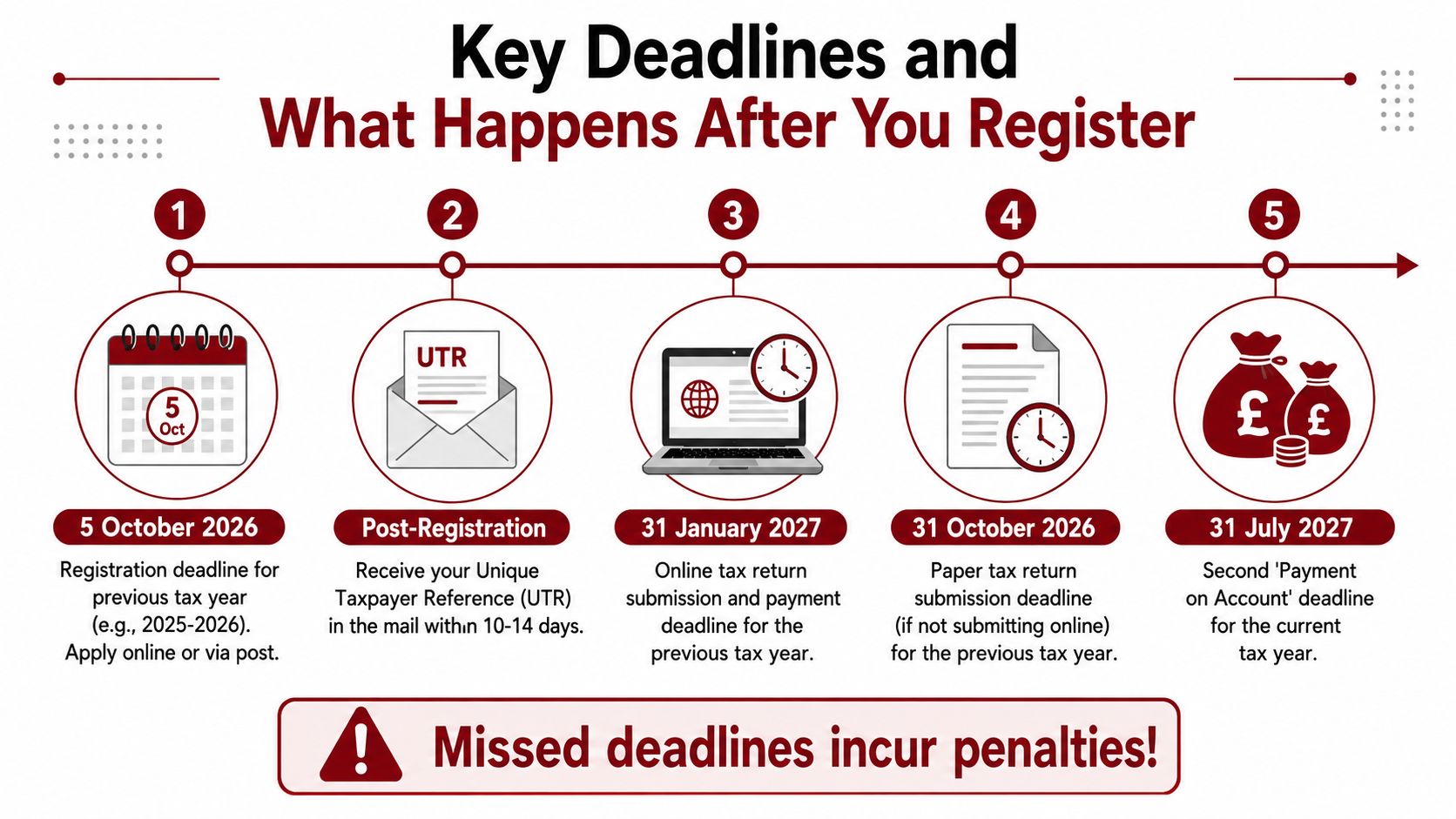
The dates that matter
For first-time filers, the anchor date is 5 October 2026. You must register for Self Assessment with HMRC by that date for the previous tax year ending 5 April 2026 if you've never sent a tax return, and missing it can lead to a fixed £100 fine even if no tax is due, according to HMRC's registration guidance for Self Assessment.
Miss the registration deadline, and you can create a penalty position before you've even filed the return.
After registration comes filing and payment. The tax year runs from 6 April to 5 April. The return and any tax due are then dealt with on the later timetable HMRC sets for filing and payment. If you want a practical overview of that full calendar, this page on the Self Assessment deadline in the UK is worth keeping bookmarked.
Why your UTR matters after registration
Your UTR is your tax identifier for Self Assessment. Once HMRC issues it, it becomes the reference point for future returns, correspondence, and payments linked to your personal filing record.
Here's the useful way to think about the sequence:
- Register first: this tells HMRC you need to file.
- Receive and secure your UTR: this is your identifier.
- Activate the service promptly: without activation, access can stall.
- Prepare to file and pay on time: registration doesn't satisfy the return itself.
For new contractors and landlords, the biggest timing mistake is treating all of this as a January task. It isn't. Registration belongs much earlier in the cycle because HMRC still relies on posted documents to complete setup.
Common Self Assessment Registration Mistakes
The expensive errors are rarely dramatic. More often, they're small assumptions that stack up. One missed letter. One wrong category. One income stream left out because it seemed too minor or too separate from the main job.
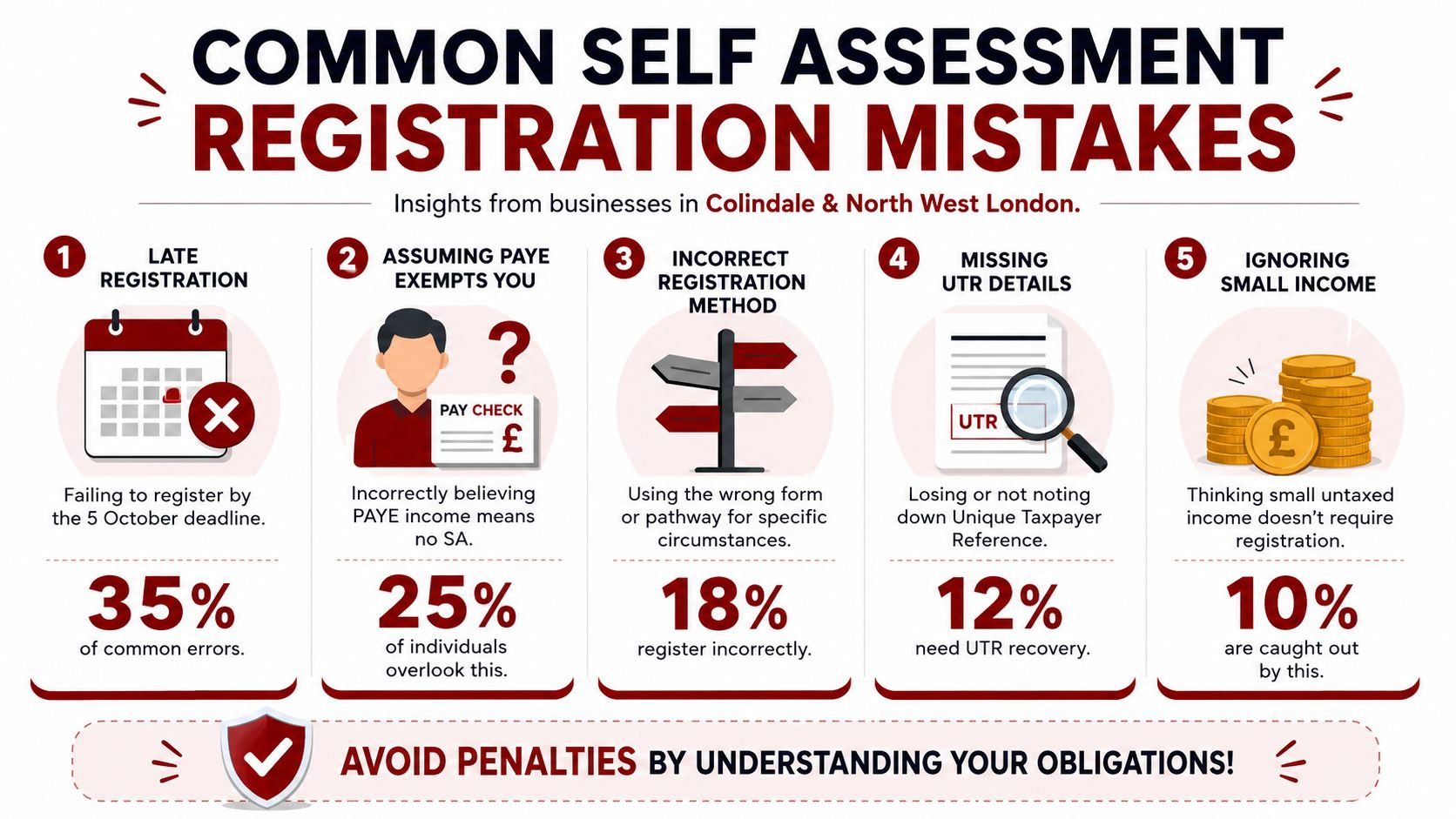
The mistakes that cause most trouble
The first is late action. People know they need to deal with Self Assessment, but they wait until filing season instead of registration season. By then, any delay with post or account activation becomes much harder to absorb.
The second is assuming PAYE closes the issue. This catches directors, landlords, and people with side income all the time. Payroll can be fully correct and you can still need Self Assessment for something else.
The third is choosing the wrong pathway. A landlord who registers as though they were self-employed, or a new founder who doesn't distinguish between company obligations and personal tax obligations, can spend weeks unpicking something that should have been straightforward.
A fourth mistake is less visible. People don't build a habit of keeping income and expense records from the start. Then, when filing comes around, they rely on memory, patchy bank entries, and old emails.
Why accuracy matters from day one
This isn't just about tidy admin. It's about reducing the risk of under-reporting. Nearly 60% of the self-employed population under-report some taxable income, and over half of taxpayers in construction, hospitality, and transport were found to be under-reporting, according to the Institute for Fiscal Studies analysis of HMRC's Self Assessment tax gap in this report on under-reported tax due.
That matters in North West London because many first-time filers work in sectors where income patterns are messy. Construction is the clearest example. A subcontractor might have invoices, CIS deductions, materials bought personally, and work spread across multiple contractors. If registration starts late and records start late, the eventual return is much more likely to be wrong.
For contractors, the best protection isn't a clever tax trick. It's accurate records from the first invoice and a registration route that matches the way you actually trade.
What works better is boring and effective:
- Open a clean record trail: Keep business income and related costs easy to identify from the start.
- Label income sources properly: Rent, dividends, sole trader income, and employment income shouldn't be merged mentally into “money I earned”.
- Act on HMRC post quickly: Most avoidable delays happen after the online form, not during it.
- Ask for help early if your setup is mixed: A contractor with rental income or a director with PAYE and dividends has more moving parts than a standard first-time filer.
Beyond Registration Your Next Steps in 2026
Registering for Self Assessment is the beginning, not the finish. Once HMRC has you in the system, your next job is making sure the first return is easy to prepare instead of painful to reconstruct.
Build a record-keeping habit early
The strongest setup is usually the simplest one you'll maintain. Keep your invoices, bank records, expense receipts, and rent records organised from the start. If you're a landlord, keep property income and property costs together. If you're a contractor, separate personal and business spending as cleanly as possible.
You don't need a complicated finance function to do this well. You need consistency. The people who cope best at tax return time are usually the ones who chose a method early and stuck to it.
A sensible checklist for the first months looks like this:
- Keep every income source distinct: Employment, self-employment, rent, and dividends should each have their own clear trail.
- Store supporting paperwork as you go: Waiting until year end means you'll miss documents.
- Review your position regularly: If your income mix changes, your filing obligations can change with it.
Prepare for Making Tax Digital
There's another reason to get organised now. From 6 April 2026, self-employed individuals and landlords earning over £50,000 must use Making Tax Digital for Income Tax, replacing the annual Self Assessment return with digital records and quarterly updates. This mandatory change extends to those earning over £30,000 from April 2027, as outlined in Sage's summary of Making Tax Digital for sole traders and landlords.
That shift changes the trade-off. A messy shoebox approach to records was never a good idea, but it becomes even less workable when digital record-keeping and regular updates are required. If your income is moving toward those thresholds, the right time to improve your systems is before the legal switch, not after it.
There's also a cash-flow angle. Once you begin filing regularly and tax becomes more visible, many people need to plan for instalments and future liabilities with more discipline. This guide to payments on account is a useful next read if you want to understand how future tax payments can affect your budgeting.
The practical message is simple. If you're a new contractor, landlord, or founder in North West London, treat registration as the first step in building a compliant routine. Done early and done correctly, it gives you breathing room. Done late, it tends to expose every weak point at once.
If you want calm, practical help with Self Assessment registration, first-time tax returns, CIS issues, landlord reporting, or getting ready for digital tax changes, Action Accountants Limited can help. Based in Colindale and working with clients across North West London and beyond, the firm supports contractors, landlords, sole traders, and growing businesses with clear advice and reliable compliance support.